
Canada and Indonesia Sign Landmark CEPA Pact: Direct Flights, Bilateral Trade Expansion, and Transpacific Tourism Investments Take Off in 2026
The historic Canada-Indonesia CEPA free trade agreement unlocks direct Vancouver-Jakarta flights, tariff cuts across 90% of lines, and bilateral eco-tourism investments.

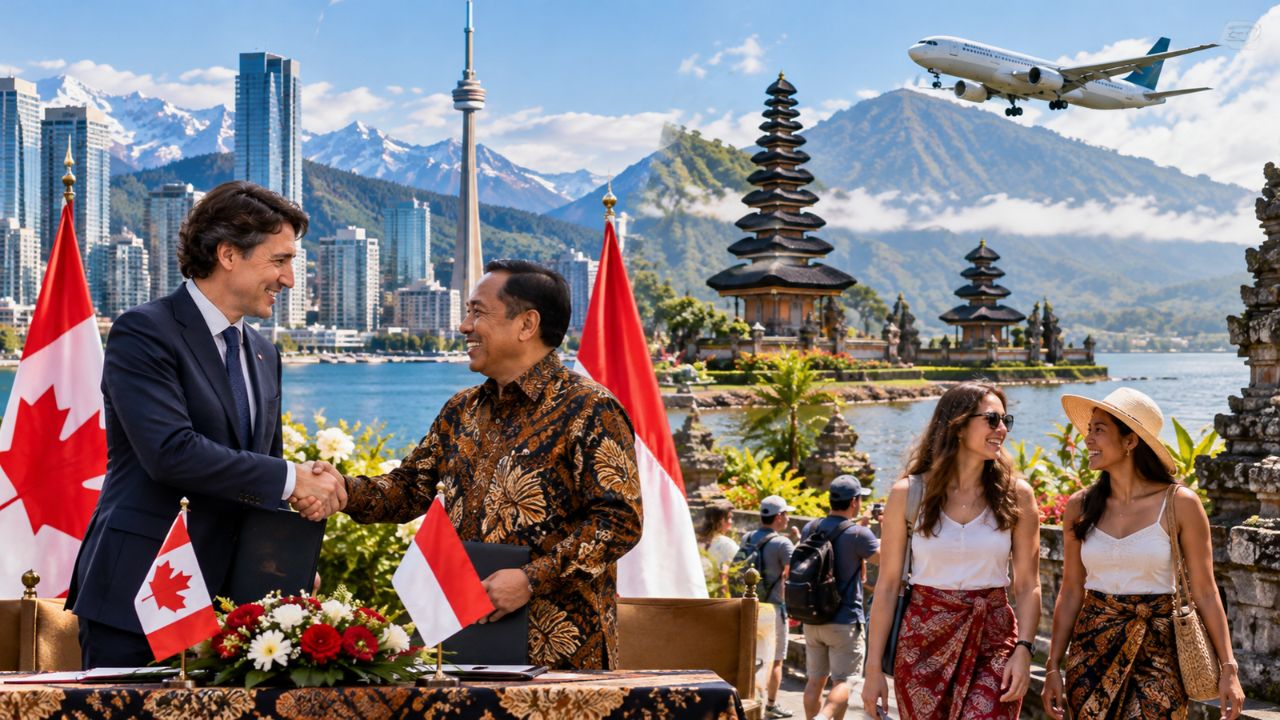
Image generated by AI
The historic implementation of the Canada-Indonesia Comprehensive Economic Partnership Agreement (CEPA) has unlocked direct transpacific air routes, major tariff eliminations, and bilateral tourism investments across Southeast Asia and North America. As Canada's first bilateral free trade agreement with an ASEAN nation, the pact paves the way for direct non-stop flights between Vancouver, Toronto, Jakarta, and Bali while opening cross-border capital for sustainable hospitality developments.
Representing a cornerstone of Canada’s broader Indo-Pacific Strategy, the agreement establishes a stable, rules-based commercial bridge with Southeast Asia’s largest economy—a nation of over 282 million people with an annual GDP exceeding $1.9 trillion. By removing unpredictable customs barriers and securing preferred market access, CEPA allows Canadian exporters to diversify away from traditional Western trading lanes. Simultaneously, it provides Indonesian manufacturers and hospitality developers with unprecedented direct access to high-yield North American consumer and investment capital.
Breaking Down Trade Barriers: Phased Tariff Elimination Schedule
At the core of CEPA is an aggressive commitment to dismantle tariff barriers and customs red tape across more than 90% of bilateral tariff lines. Economic modeling projects that the agreement will generate more than $220 million USD in additional annual GDP output, accelerating trade velocity well beyond historical levels.
Phased Tariff Reduction Framework
To allow domestic industries in both countries to scale smoothly, duty reductions are structured across three distinct operational phases:
- Phase 1 (Immediate Entry into Force): Approximately 40% of all customs duties are eliminated immediately, securing instant duty-free clearance for vital agricultural commodities, bulk resources, and industrial processing machinery.
- Phase 2 (Medium-Term Implementation): An additional 35% tariff reduction takes effect within 12 months, lowering landing costs on precision manufactured goods, consumer technologies, and value-added textiles.
- Phase 3 (Full Realization): The remaining targeted tariff lines transition to zero-duty status within two years, anchoring permanent price stability for bilateral cross-border commerce.
| Bilateral Indicator | Indonesian Commitments | Canadian Commitments |
|---|---|---|
| Tariff Line Elimination Rate | 85.9% of national tariff lines | 90.5% of national tariff lines |
| Export Value Coverage | Covers 97% of Canadian export value into Indonesia | Covers 92% of Indonesian export value into Canada |
| Primary Industry Beneficiaries | Footwear, apparel, textiles, rubber products, consumer electronics | Wheat, canola oil, pulses, potash fertilizers, clean technologies |
| Customs Environment | Streamlined clearance; removal of non-tariff import barriers | Preferential entry for Southeast Asian retail and distribution chains |
High-Growth Sectors Driving Transpacific Commerce
The economic architecture of CEPA strategically aligns complementary resource strengths and industrial capabilities across the Pacific:
1. Agri-Food and Grain Security
Canadian agricultural producers gain an essential competitive advantage in supplying Indonesia’s rapid food processing expansion. High-protein wheat, canola, and pulses now enter Indonesian ports under simplified quarantine and customs clearance protocols. Advanced Canadian agricultural equipment and soil-management software will also deploy to boost domestic Indonesian farm yields.
2. Critical Minerals and Clean Energy Transition
Indonesia's commanding global position in nickel extraction converges directly with Canadian processing technology, battery manufacturing expertise, and clean energy financing. This bilateral integration secures ethical supply chains for electric vehicles and grid-scale storage, advancing global net-zero climate goals.
3. Digital Commerce and Cross-Border Data Integrity
CEPA modernizes digital trade by prohibiting forced local data server localization, protecting proprietary source code, and establishing legally binding cross-border data transfer protocols. These provisions provide fintech platforms, cloud software providers, and remote tech workforces with legal security across both jurisdictions.
Connecting the Skies: Direct Aviation Links and Belly-Cargo Expansion
Physical air connectivity represents the vital operational engine linking trade agreements to real-world business and leisure mobility. CEPA incorporates modernized service trade chapters and dedicated air mobility frameworks that establish the regulatory groundwork for direct scheduled non-stop flights between Canada and Indonesia.
[Canada Gateways]                            [Indonesia Gateways]
Vancouver (YVR)  <--- Transpacific Direct --->  Jakarta (CGK)
Toronto (YYZ)    <--- Aviation Corridors --->  Bali - Denpasar (DPS)
Commercial Viability of Direct Flight Corridors
Historically, travelers flying between Canada and Indonesia were forced to navigate circuitous one- or two-stop itineraries through East Asian hubs such as Tokyo Narita (NRT), Seoul Incheon (ICN), or Taipei Taoyuan (TPE), resulting in total journey times of 20 to 26 hours.
Under CEPA's modernized framework:
- Passenger Corridors: Growing executive travel combined with strong outbound Canadian leisure demand provides airlines—such as Air Canada and Garuda Indonesia—with the necessary high-yield seat economics to support direct long-range widebody services (Boeing 787-9 and Airbus A350-900) between Vancouver (YVR) and Jakarta Soekarno-Hatta (CGK) or Bali Ngurah Rai (DPS).
- High-Value Belly Cargo: Non-stop passenger flights serve as vital cargo conduits, enabling rapid, direct airfreight delivery for perishable Canadian agri-foods, pharmaceuticals, and high-tech instrumentation, while returning with temperature-sensitive Indonesian horticultural exports and high-end electronics.
- Streamlined Corporate Mobility: Dedicated professional visa channels expedite short-term entry permits for commercial aircrews, aviation maintenance engineers, corporate executives, and logistics directors without standard visa delays.
Unlocking Bilateral Tourism Investment: Bali, Lake Toba, and the Canadian Rockies
Beyond physical commodity flows, CEPA introduces statutory investment protections that significantly reduce political and sovereign risk for international hospitality developers. Institutional capital from Canadian pension funds, private equity, and hotel groups can now deploy with full treaty backing into priority Indonesian tourism development zones.
| Investment Category | Indonesian Priority Destinations | Canadian Priority Destinations |
|---|---|---|
| Flagship Tourism Hubs | Bali, Lombok, Lake Toba, and Labuan Bajo | Canadian Rocky Mountains and Pacific Rim National Park |
| Sustainable Eco-Resorts | Low-impact rainforest lodges and marine sanctuary bungalows | Indigenous-led eco-retreats and backcountry wilderness lodges |
| Wellness & Cultural Stays | Traditional wellness resorts, holistic spas, and artisan villages | First Nations cultural centers, heritage lodges, and hot spring sanctuaries |
| MICE & Urban Infrastructure | Jakarta and Surabaya convention centers and business hotels | Vancouver, Toronto, and Montreal convention facilities |
1. Sustainable Destination Capital in Indonesia
Canadian hospitality brands gain legal guarantees to finance and operate luxury eco-resorts across Indonesia's "Super Priority" tourism destinations. Capital will flow into marine conservation retreats in Lombok, eco-accommodations surrounding North Sumatra's volcanic Lake Toba, and regulated eco-lodges near Komodo National Park in Labuan Bajo, pairing Canadian sustainable park architecture with Indonesia's exceptional biodiversity.
2. MICE Expansion and Business Travel
The surge in bilateral corporate partnerships drives year-round demand for Meetings, Incentives, Conferences, and Exhibitions (MICE) travel. Commercial hotels in Jakarta, Surabaya, Vancouver, and Toronto will benefit from steady mid-week corporate occupancy, insulating properties from seasonal leisure fluctuations.
3. Binding Environmental and Labor Standards
Unlike traditional trade deals, CEPA incorporates enforceable multilateral labor and environmental obligations. Signatories must comply with International Labour Organization (ILO) standards, guaranteeing fair compensation and safe working environments. Tourism investments must pass strict environmental assessments to prevent coral reef degradation, coastal erosion, and primary forest deforestation.
Traveler Logistics Guide: Navigating Canadian and Indonesian Travel
As bilateral commercial and tourism traffic expands under CEPA, business travelers and holidaymakers should prepare using these verified entry and transit guidelines:
- Aviation Routing Tactics: Until non-stop direct flights begin scheduled commercial operations, optimal one-stop connections link Vancouver (YVR) to Jakarta (CGK) via Taipei (EVA Air) or Tokyo (Japan Airlines/ANA) with transfer windows under three hours. East Coast travelers departing Toronto (YYZ) can route efficiently through Seoul Incheon (Korean Air) or Doha (Qatar Airways).
- Indonesian Entry and Visa Protocols: Canadian passport holders visiting Indonesia for tourism or short business meetings can obtain a 30-day Electronic Visa on Arrival (e-VOA) online prior to departure for 500,000 Indonesian Rupiah (~$32 USD), extendable once for an additional 30 days. Complete the official electronic customs declaration (e-CD) online within 72 hours of departure to generate a QR code for airport exit gates.
- Bali Provincial Tourist Levy: International travelers entering Bali must pay the statutory provincial tourism fee of 150,000 IDR (~$10 USD) via the official Love Bali portal (
lovebali.baliprov.go.id) before arrival. Retain the digital payment voucher on your mobile device for terminal scanning. - Canadian Entry for Indonesian Visitors: Indonesian citizens traveling to Canada require a valid Canadian Visitor Visa (Temporary Resident Visa - TRV) or, if previously holding an eligible Canadian or US visa, may qualify for expedited processing under Canada's Electronic Travel Authorization (eTA) expansion. Corporate executives traveling under CEPA intra-company transfer clauses should carry official treaty sponsorship letters.
- Local Financial and Payment Tools: While international credit cards are widely accepted at luxury hotels and major restaurants in Jakarta and Bali, local retail and inter-island transport rely heavily on QRIS (Quick Response Code Indonesian Standard). Visitors should carry modest cash reserves in Indonesian Rupiah or use digital multi-currency travel cards (such as Wise or Revolut) to withdraw funds at reputable bank ATMs (BCA, Mandiri, BNI).
Strategic Outlook: A New Transpacific Economic Corridor
The Canada-Indonesia Comprehensive Economic Partnership Agreement marks a structural turning point in transpacific commerce. By aligning aggressive tariff eliminations with direct aviation connectivity, robust environmental commitments, and institutional tourism protections, CEPA establishes an enduring framework for sustainable economic cooperation.
As airlines finalize schedules for direct Vancouver–Jakarta and Toronto–Bali routes, business leaders and leisure travelers alike stand to benefit from reduced travel times, equitable pricing, and expanded opportunities across two of the Pacific rim's most vibrant economies.
FAQ: Canada-Indonesia CEPA and Travel Expansion
What is the Canada-Indonesia CEPA?
The Comprehensive Economic Partnership Agreement (CEPA) is a bilateral free trade agreement between Canada and Indonesia that eliminates tariffs on over 90% of goods, facilitates direct aviation links, and guarantees foreign investment protections in hospitality and tourism.
Will there be direct flights between Canada and Indonesia?
Yes. The modernized services and aviation mobility framework within CEPA lays the legal and regulatory foundation for commercial carriers to launch direct non-stop flights connecting Vancouver and Toronto with Jakarta and Bali.
What are the main tourism destinations targeted for investment?
Investment provisions focus on sustainable eco-resorts and wellness infrastructure in Indonesian hubs like Bali, Lombok, Lake Toba, and Labuan Bajo, alongside nature-based and Indigenous-led tourism developments across Canada's Rocky Mountains and Pacific Rim.
Do Canadian citizens need a visa to travel to Indonesia?
Yes. Canadian travelers can apply online for an Electronic Visa on Arrival (e-VOA) for 500,000 IDR (~$32 USD), which grants a 30-day stay and can be extended once for an additional 30 days.
Related Travel Guides
Indonesia Foreign Tourist Arrivals Surge as Southeast Asia Drives Continental Travel Expansion
Canada Export Surge in Business Tourism and Travel Services Strengthens Global Trade Partnerships
Disclaimer
This article is for informational and educational purposes only. It does not constitute legal, financial, or professional advice. While we strive to provide accurate and up-to-date information, travel policies, regulations, and conditions change rapidly. Always verify information with official sources before making travel decisions. Nomad Lawyer makes no representations about the accuracy, reliability, completeness, or suitability of the information provided. Readers should consult qualified professionals for advice specific to their circumstances. The views expressed in this article are those of the author and do not necessarily reflect the views of Nomad Lawyer.
Raushan Kumar
Founder & Lead Developer
Full-stack developer with 11+ years of experience and a passionate traveller. Raushan built Nomad Lawyer from the ground up with a vision to create the best travel and law experience on the web.
Learn more about our team →