
Canadian Aviation Grid Collapses: US Storms Sever Flights in Toronto, Calgary, and Montreal
Thousands of passengers are completely isolated across Canada as a brutal shockwave from violent US storms forces the catastrophic delay of nearly 500 flights across Toronto, Calgary, and Montreal.

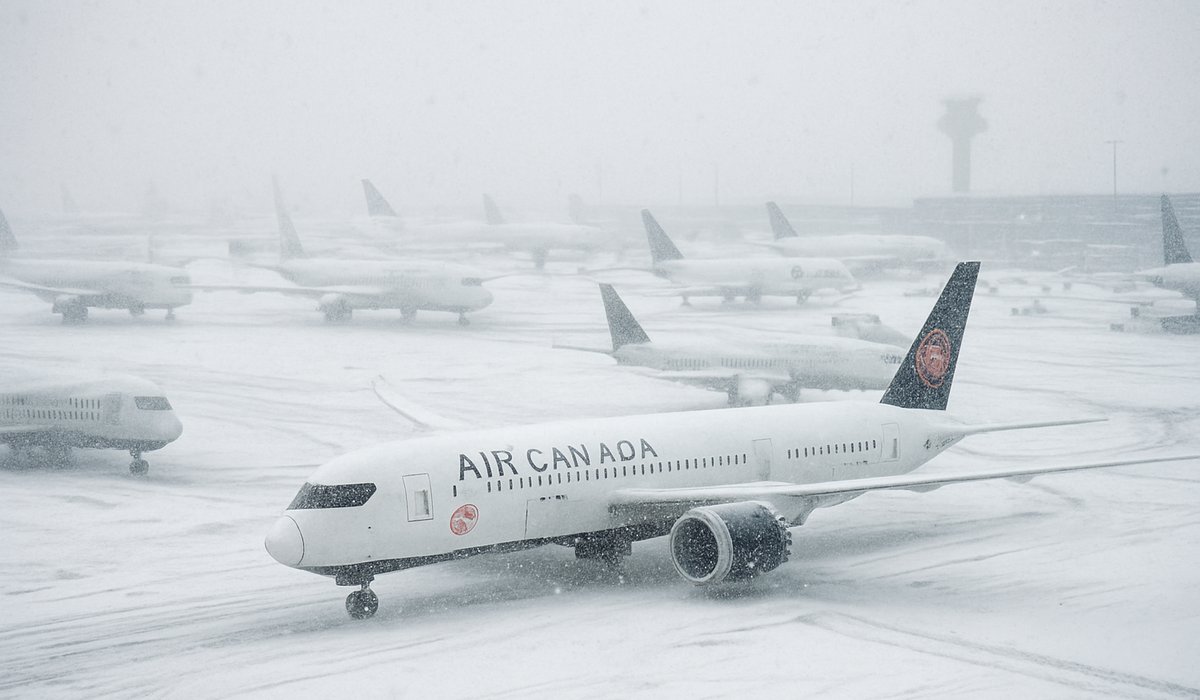
Image generated by AI
Collateral Damage Shuts Down Key Transborder Corridors
Fiercely demonstrating the incredible vulnerability of the deeply interconnected North American airspace, the massive Canadian aviation network is currently buckling under immense pressure following a catastrophic wave of violent US storms that spilled heavily across the border. Acting as a brutal operational bottleneck, severe atmospheric destabilization violently rolling across the American Midwest and Northeast essentially severed critical approach corridors, triggering 54 absolute cancellations and a massive, staggering 495 flight delays that explicitly trapped thousands of travelers spanning from Toronto to the remote northern outpost of Puvirnituq.
Because massive Canadian hubs functionally operate as highly intertwined extensions of the US grid, a thunderstorm cell hovering ominously over Chicago or New York mathematically paralyzes Canadian tarmac operations. Key legacy airlines, including Air Canada, WestJet, Porter, and highly specialized northern operators like Air Inuit and Jazz, instantly lost their operational landing slots south of the border. Unable to safely dispatch their jets into US airspace, aircraft were forced to rigidly hold position indefinitely at Canadian gates, unleashing a horrifying backlog across Toronto Pearson (YYZ), Calgary (YYC), and Montreal-Trudeau (YUL).
The Hub Effect Paralysis
When a primary Canadian hub shuts down, it acts as a massive circulatory clot for the entire nation.
Toronto Pearson, currently the absolute hardest hit by the cascading US delays, acts as the definitive spine for Air Canada’s global routing. The data proves the chaos is highly concentrated: YYZ immediately registered dozens of cancellations simply to clear up highly congested tarmac space. A plane sitting idly at a gate waiting for airspace clearance to enter the United States functionally denies that same gate to an incoming domestic flight arriving from Vancouver. The result is thousands of heavily exhausted passengers trapped physically inside aircraft parked on taxiways for hours waiting for a gate to finally open.
Assessing the Transborder Aviation Fallout
| Canadian Hub | Degree of Impact | Operational Consequence |
|---|---|---|
| Toronto Pearson (YYZ) | Absolute Epicenter | +17 cancellations; total trans-border route gridlock |
| Calgary (YYC) | Secondary Failure | Deeply compounded delays for WestJet and regional routes |
| Montreal / Ottawa | Severe Ripple Effects | Rapid displacement of connecting trans-Atlantic passengers |
What Guests Get
- Understanding transborder physics — realizing that even if the sky is perfectly sunny in Toronto, a massive blizzard in New York will legally prevent your plane from leaving the Canadian gate.
- The domino effect of aviation — grasping why a massive delay isn't just about the weather; it's about the physical unavailability of parking spots (gates) for massive jets.
- Airspace reality checks — exposing how deeply enmeshed the Canadian and American air traffic control syndicates actually are; they fundamentally operate as a single, highly sensitive breathing organism.
What This Means for Travelers
If you hold transborder tickets (Canada to the US): Prepare for heavy, aggressive delays. Specifically, ensure you completely understand US Customs and Border Protection (CBP) preclearance hours. The massive risk of a delay in Toronto or Montreal isn't just missing your flight; it is mathematically missing the operating hours of the American border agents heavily stationed inside the Canadian airport. If your flight is delayed so severely that it pushes past 8:00 PM, the US customs hall will frequently close, forcing the airline to instantly cancel your flight regardless of the aircraft's physical readiness.
Aggressively manage your rebooking strategy: Because Canadian airports are currently enduring a 495-flight backlog, the standard rebooking inventory on Air Canada or WestJet is currently sitting at absolute zero. Do not stand aimlessly in an agonizing 300-person line at the ticketing counter. Call the international customer service number using Skype or heavily utilize the airline's mobile app to intercept a re-booked seat hours before the desperate crowds physically reach the overwhelmed desk agent.
FAQ: Navigating Canada-US Flight Disruptions
If weather in the US delays my Air Canada flight, do I get compensation? No. Highly specific Canadian Air Passenger Protection Regulations (APPR) legally mandate that airlines absolutely do not owe financial cash compensation or mandatory hotel vouchers if a flight is delayed strictly due to meteorological weather events, regardless of whether the weather is in Canada or the US.
Why does a storm in the US stall domestic Canadian flights? Airplanes operate extremely tight "loops" (e.g., Toronto->Chicago->Calgary). If the aircraft gets trapped in Chicago due to a severe midwestern storm, it physically never arrives in Toronto to execute the subsequent domestic flight to Calgary, crashing the domestic schedule completely.
What happens if I cross US customs in Canada, but my flight is then canceled? This is a highly complex logistical nightmare. Because you technically entered the US conceptually (by crossing the preclearance border), you must be formally "de-processed" and physically escorted backward through secure doors back into the Canadian terminal.
Related Travel Guides
Disclaimer
This article is for informational and educational purposes only. It does not constitute legal, financial, or professional advice. While we strive to provide accurate and up-to-date information, travel policies, regulations, and conditions change rapidly. Always verify information with official sources before making travel decisions. Nomad Lawyer makes no representations about the accuracy, reliability, completeness, or suitability of the information provided. Readers should consult qualified professionals for advice specific to their circumstances. The views expressed in this article are those of the author and do not necessarily reflect the views of Nomad Lawyer.
Raushan Kumar
Founder & Lead Developer
Full-stack developer with 11+ years of experience and a passionate traveller. Raushan built Nomad Lawyer from the ground up with a vision to create the best travel and law experience on the web.
Learn more about our team →