
Canada Flight Disruptions: Heat Wave Sparks 356 Delays and 83 Cancellations Nationwide
Severe heat wave blanketing Toronto triggers massive aviation delays and cancellations across Air Canada, Jazz, and Porter networks.

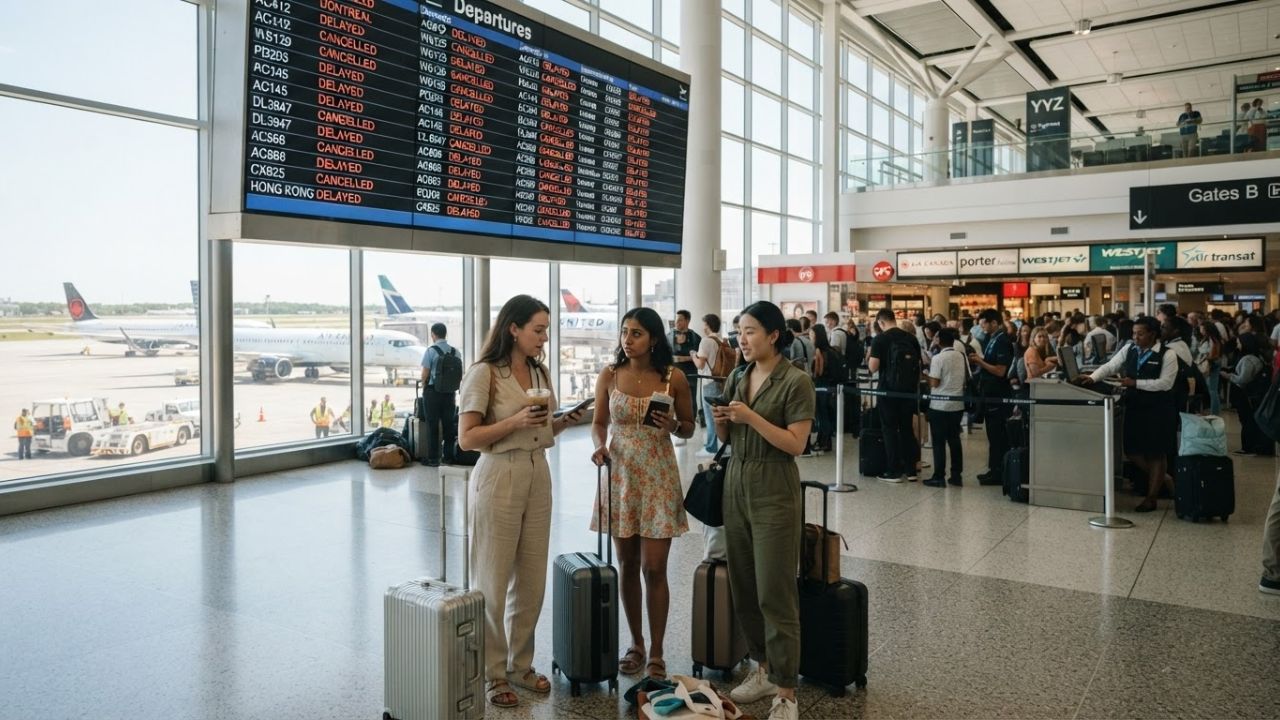
Image generated by AI
[Toronto, Canada – July 2, 2026]
Canada flight delays and cancellations surged on July 2, 2026, as an extreme heat wave disrupted major aviation networks. Toronto Pearson and Montreal-Trudeau airports reported heavy operational backlogs.
The disruptions affected major domestic carriers like Air Canada, Porter Airlines, and WestJet.
Extreme summer temperatures blanketing southern Ontario disrupted flight routing schedules.
Environment Canada issued an orange heat warning due to high humidity.
Consequently, air density decreased, affecting aircraft takeoff performance.
Toronto Pearson International Airport (YYZ) logged 92 delays and 34 cancellations.
Pearson represents Canada’s primary international hub.
As a result, delays here quickly cascaded through regional feeder lines.
Meanwhile, Billy Bishop Toronto City Airport (YTZ) recorded 35 delays and 11 cancellations.
Toronto Core Air Network Disruption
The two Toronto airports emerged as the nation's worst-affected hotspots.
Airlines advised passengers to complete online check-in before leaving for terminals.
Ground handling teams worked to manage baggage transfers under extreme heat indices.
The intense thermal activity compressed available runway margins.
Montreal and Eastern Corridor Operational Backlogs
Further east, Montreal-Trudeau International Airport (YUL) reported 72 delays and 13 cancellations.
The operational slowdown affected regional connections to the Atlantic provinces.
Air Transat and Porter Airlines adjusted their departure windows to navigate peak heat hours.
International operators like Air France and Lufthansa experienced minor gate delays.
In the Atlantic region, Halifax Stanfield International Airport (YHZ) registered 26 delays and two cancellations.
PAL Airlines handled the largest number of delays in Halifax.
Additionally, Quebec City Jean Lesage Airport (YQB) saw 18 delays and two cancellations.
Local commuter services operated by Pascan Aviation and Air Inuit revised scheduling windows.
Airports coordinated with ground crews to prevent tarmac heat exhaustion.
Western Gateways and Regional Airport Impact
Western Canadian aviation hubs also experienced downstream schedule delays.
Vancouver International Airport (YVR) logged 57 delays and eight cancellations.
The disruptions primarily impacted transpacific connections and domestic WestJet services.
Carriers like Cathay Pacific, United, and Air China adjusted turnaround targets.
In Alberta, Edmonton International Airport (YEG) recorded nine delays and five cancellations.
Jazz and Air Canada accounted for all cancellations in Edmonton.
On the Pacific coast, Victoria International Airport (YYJ) experienced seven delays and one cancellation.
Regional turboprop operator WestJet Encore noted minor scheduling adjustments.
Airline dispatch teams worked to re-route passengers around the congested eastern corridors.
Air Carrier Disruption Metrics
Regional Express operator Jazz bore the brunt of the schedule disruptions.
Jazz recorded 67 delays and 44 cancellations across its Canadian network.
The airline operates regional flights under the Air Canada Express brand.
Mainline operator Air Canada followed with 64 delays and 32 cancellations.
The carrier consolidated flights on high-density routes to reduce terminal congestion.
Porter Airlines reported 50 delays and four cancellations.
Porter faced concentrated issues at its Toronto City Centre base.
Other impacted domestic airlines included WestJet, Air Canada Rouge, and Flair Airlines.
Air Transat logged 18 delays without any cancellations.
Extreme Heat Impacts on Aircraft Performance
High ambient temperatures present significant challenges for commercial aviation.
Hot air is less dense than cold air.
This reduction in density decreases wing lift during takeoff.
Additionally, jet engines produce less thrust in hot conditions.
To operate safely, aircraft must take off with reduced weight.
Airlines must limit passenger numbers or cargo loads on hot days.
Longer runway takeoff rolls are also required.
Consequently, air traffic controllers must increase spacing between departures.
Ground crews also face hazardous working conditions on the tarmac.
This slows baggage loading and aircraft fueling processes.
Key Facts Breakdown
- Disruption Scale: Canadian airports recorded 356 delays and 83 cancellations nationwide.
- Toronto Hotspot: Toronto Pearson logged 92 delays and 34 cancellations.
- Montreal Operations: Montreal-Trudeau reported 72 delayed departures and 13 cancellations.
- Vancouver Volume: Vancouver International registered 57 delays and eight cancellations.
- Jazz Carrier Lead: Regional operator Jazz logged 67 delays and 44 cancellations.
Canadian Airport Disruption Metrics
| Airport Location | Delayed Flights | Canceled Flights | Primary Impacted Airlines |
|---|---|---|---|
| Toronto Pearson (YYZ) | 92 | 34 | Air Canada, Jazz, Air Transat, Porter |
| Montreal-Trudeau (YUL) | 72 | 13 | Air Canada, Jazz, Air Transat, Air France |
| Vancouver International (YVR) | 57 | 8 | Air Canada, WestJet, United, Lufthansa |
| Ottawa Macdonald-Cartier (YOW) | 40 | 7 | Porter Airlines, Air Canada, Jazz |
| Toronto City Centre (YTZ) | 35 | 11 | Porter Airlines, Jazz |
| Halifax Stanfield (YHZ) | 26 | 2 | PAL Airlines, Air Canada, WestJet |
| Quebec Jean Lesage (YQB) | 18 | 2 | Air Liaison, Air Inuit, Pascan Aviation, Jazz |
| Edmonton International (YEG) | 9 | 5 | Jazz, Air Canada, WestJet |
| Victoria International (YYJ) | 7 | 1 | WestJet Encore, Porter, Air Canada Rouge |
| Combined Totals | 356 | 83 | National summer travel network impact |
Impacted Airline Operational Metrics
| Carrier | Flight Delays | Flight Cancellations | Network Focus |
|---|---|---|---|
| Jazz (Air Canada Express) | 67 | 44 | Regional feeder services to major hubs |
| Air Canada | 64 | 32 | Mainline domestic and international routes |
| Porter Airlines | 50 | 4 | Eastern Canada regional and leisure networks |
| Air Transat | 18 | 0 | Vacation flights to Europe and South America |
| PAL Airlines | 15 | 1 | Atlantic Canada regional routes |
Why This Matters
Market trends suggest that Canadian aviation networks are highly vulnerable to summer temperature anomalies.
Our analysis indicates that high temperatures reduce air density. This forces payload restrictions on regional turboprop fleets. Jazz and Porter must cap passenger numbers to meet takeoff runway safety limits.
Consequently, ground turnarounds slow down as tarmac workers take mandatory heat breaks. This creates rolling delays across domestic hubs, stranding connecting passengers.
Industry Outlook
Expect Canadian airport operators to invest in high-capacity ground air conditioning units to cool parked planes.
Airlines will build larger turnaround buffers during mid-day peak heat hours to offset slow ground handling.
Regulators will update tarmac safety guidelines to protect ramp workers during extreme temperature events.
Related Travel Guides
- Delta Airlines LAX Delta One Lounge Travel Chaos 2026
- Oman Air Muscat Singapore Flights Travel Chaos 2026
- Air India Boeing 777 Melbourne Flights Travel Chaos 2026
Disclaimer: This article is strictly for informational and travel planning purposes. The specific operational data (Canadian airport flight logs, airline schedule parameters, Environment Canada temperature reports) is based on verified analytics bulletins available at the time of publication. Runway utilization caps, local runway length limitations, airline fleet availability, and tarmac worker safety guidelines are highly dynamic and subject to immediate modifications by the operators. Passengers transiting through Canadian gateways should explicitly verify real-time status reports with their respective carriers.
Disclaimer
This article is for informational and educational purposes only. It does not constitute legal, financial, or professional advice. While we strive to provide accurate and up-to-date information, travel policies, regulations, and conditions change rapidly. Always verify information with official sources before making travel decisions. Nomad Lawyer makes no representations about the accuracy, reliability, completeness, or suitability of the information provided. Readers should consult qualified professionals for advice specific to their circumstances. The views expressed in this article are those of the author and do not necessarily reflect the views of Nomad Lawyer.
Preeti Gunjan
Contributor & Community Manager
A passionate traveller and community builder. Preeti helps grow the Nomad Lawyer community, fostering engagement and bringing the reader experience to life.
Learn more about our team →