Cambodia Tourism Crisis Deepens as International Arrivals Plunge 43.7% in 2026: Siem Reap Hospitality and Angkor Guides Under Severe Financial Strain

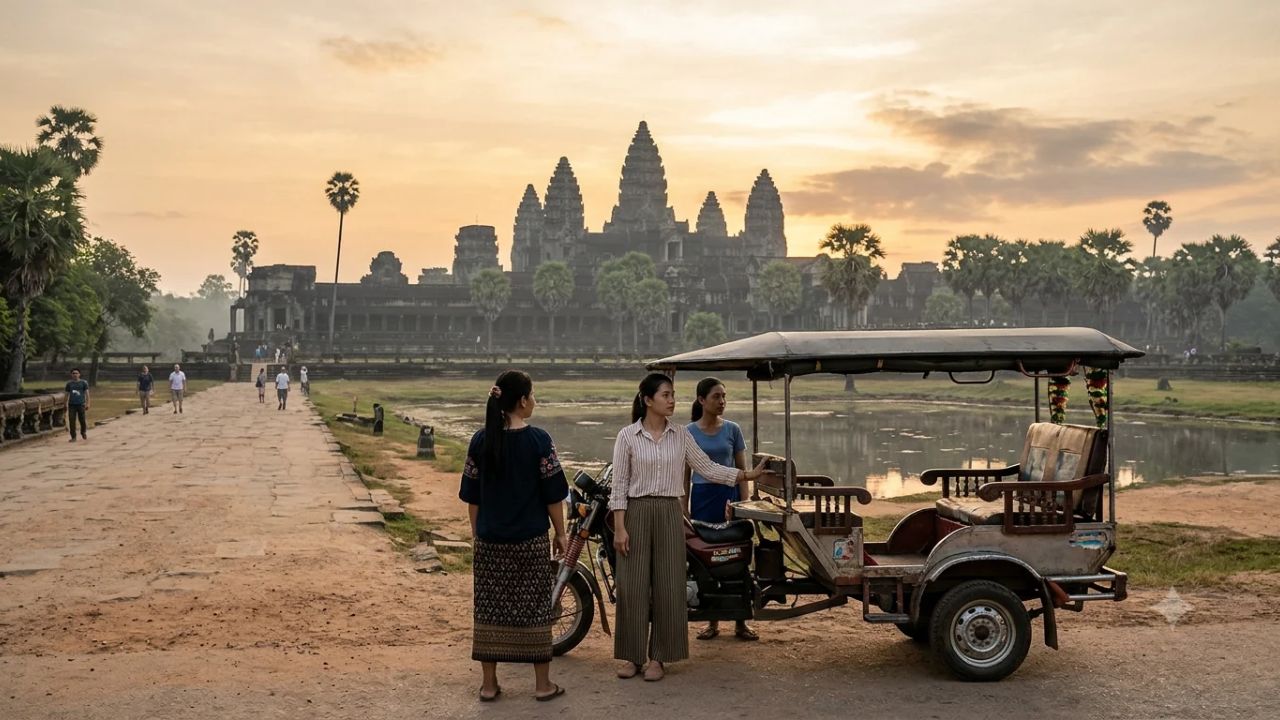
International visitor arrivals to Cambodia dropped 43.7% across the first nine months of 2026, creating severe financial headwinds for Siem Reap's tourism workforce
[PHNOM PENH, Oct 29, 2026] — Cambodia's tourism sector is grappling with a severe structural contraction as international arrivals plummeted 43.7% during the first nine months of 2026 to 2.46 million visitors—down by nearly 1.9 million travelers compared to 2025—leaving temple guides, hoteliers, and small businesses throughout Siem Reap under mounting financial strain.
[!NOTE] Crisis Overview: Official data published on October 27, 2026, by the Ministry of Tourism reveals that Cambodia welcomed 2.46 million foreign travelers between January and September 2026, a sharp drop from 4.38 million during the same period in 2025. The downturn stems from persistent Thailand overland border restrictions following 2025 skirmishes, international reputational fallout from regional cyber-scam networks, and elevated long-haul aviation costs. While domestic trips surged 46% to 27.2 million, local spending cannot offset the loss of foreign exchange receipts.
CAMBODIA INBOUND TOURISM CONTRACTION (JAN-SEP 2026)
| Column 1 |
|---|
| JAN-SEP 2025: [====================================] 4.38 Million Inbound Visitors |
| JAN-SEP 2026: [====================] 2.46 Million Inbound Visitors |
| NET DEFICIT: -1.92 Million Travelers (-43.7% Year-on-Year Contraction) |
| PRIMARY CONTRIBUTING FACTORS: |
| +-----------------------------+-----------------------------+-----------------------------+ |
| +-----------------------------+-----------------------------+-----------------------------+ |
| LOCALIZED IMPACT: Angkor Enterprise reports only 474,993 tickets sold through August 2026. |
Statistical Ledger: Recording 1.9 Million Fewer International Arrivals
The scale of the contraction represents one of the steepest year-on-year drops in Southeast Asian post-pandemic tourism history. According to statistical bulletins released on October 27, 2026, by Cambodia’s Ministry of Tourism, the country received 2,460,000 international visitors from January through September 2026. During the identical nine-month window in 2025, foreign entries reached approximately 4,380,000.
This absolute deficit of 1.92 million foreign arrivals reverberates across the national economy. Tourism has historically served as one of the four pillars of Cambodia's gross domestic product, operating alongside garment manufacturing, construction, and agriculture. The sudden loss of foreign visitors removes millions of dollars in daily consumer liquidity from circulation.
The downturn has hit independent operators, private transport drivers, family-run guesthouses, and market stallholders who depend on daily tourist footfall. With fewer international travelers patronizing restaurants, renting tuk-tuks, and hiring tour guides, revenue streams across primary tourist corridors have fallen sharply.
CAMBODIA TOURISM ARRIVALS COMPARISON (2025 VS. 2026)
| METRIC JAN-SEP 2025 JAN-SEP 2026 VARIANCE |
|---|
| ---------------------------------------------------------------------------------------------- |
| Total Foreign Arrivals 4,380,000 2,460,000 -43.7% |
| Net Tourist Deficit -- -1,920,000 -- |
| Angkor Park Tickets (Jan-Aug) ~890,000 (est.) 474,993 -46.6% |
| Domestic Tourism Trips 18,630,000 27,200,000 +46.0% |
| ECONOMIC PROFILE: International visitor daily spend averages $120-$180 vs. domestic $15-$30. |
While tourism authorities emphasize that September 2026 recorded a narrower year-on-year deficit than preceding summer months, the cumulative impact of three consecutive quarters of declining numbers has created liquidity challenges across the private hospitality sector.
Geopolitical Friction: Thailand Border Restrictions Sever Overland Corridors
A primary catalyst for the arrival slump lies along Cambodia’s western border with Thailand. For decades, the overland corridor linking Bangkok to Siem Reap via the Aranyaprathet–Poipet international border crossing functioned as the central transit route for independent backpackers, regional tour coaches, and overland Southeast Asian circuit itineraries.
However, diplomatic tensions and localized military clashes along disputed border sectors during 2025 prompted heightened security protocols, stringent immigration scrutiny, and recurring administrative restrictions on overland passenger movement.
BANGKOK-SIEM REAP OVERLAND TOURISM CORRIDOR DISRUPTION
| Column 1 |
|---|
| HISTORICAL BACKPACKER & REGIONAL CIRCUIT: |
| [ Bangkok International Gateways ] |
| v (Budget Train / Tourist Coach Route - 4 to 5 Hours) |
| [ Aranyaprathet / Poipet Border Checkpoint ] |
| v (Direct Highway 6 Transit - 2 Hours) |
| [ Siem Reap & Angkor Temple Complex ] |
| 2025-2026 BORDER DISRUPTION IMPACT: |
| - Overland tourist coach authorizations restricted by border security checkpoints. |
| - Independent transit delays and stringent visa/clearance procedures disincentivize travelers. |
| - Regional tour operators reroute "Grand Indochina" circuits through Laos or southern Vietnam. |
| - Result: Massive collapse in dual-country Thailand-Cambodia combo holidays. |
Before these restrictions, tens of thousands of international visitors combined holidays in Thailand with short three-to-four-day excursions into Siem Reap. With overland border checkpoints operating under reduced quotas, enhanced documentation requirements, and sporadic operational halts, multi-destination tour operators systematically dropped Cambodian segments from their regional package brochures.
Because short-haul regional flights between Bangkok Suvarnabhumi (BKK) or Don Mueang (DMK) and Siem Reap-Angkor International Airport (SAI) carry premium airfare pricing compared to overland bus tickets, budget-conscious travelers have opted to bypass Cambodia entirely, redirecting their itineraries to northern Thailand, Vietnam, or Laos.
Cyber-Scam Compounds: The Reputational Crisis Deterring Travelers
Beyond physical border obstacles, Cambodia faces a pervasive reputational challenge in international media. Over the past two years, global news outlets, human rights monitoring organizations, and foreign government advisories have highlighted the proliferation of illicit online scam operations housed in compound complexes across Sihanoukville, Poipet, and border areas.
Cambodia's Tourism Minister, Huot Hak, acknowledged that negative publicity surrounding illegal cyber-fraud networks and associated human trafficking syndicates has depressed foreign traveler sentiment. While legitimate tourists visiting cultural landmarks in Siem Reap, Phnom Penh, or Kampot face virtually no direct physical risk from these isolated scam enclaves, the perception of public safety has suffered.
THE TOURISM DESTINATION REPUTATION-SENTIMENT CYCLE
| Column 1 |
|---|
| [ Global Media & Advisory Reports on Border Cyber Enclaves ] |
| v |
| [ Public Perception: Safety Anxieties & Travel Hesitancy ] |
| v |
| [ Behavioral Shift: Travelers Choose Alternative Regional Destinations (Vietnam/Japan/Thailand) ] |
| v |
| [ Economic Impact: Sharp Booking Drops in Safe Cultural Gateways (Siem Reap / Angkor) ] |
| v |
| [ State Response: Minister Huot Hak Inter-Ministerial Crackdowns & International Public Outreach] |
The negative coverage has had an outsized impact on East Asian source markets. In mainland China, widespread cinematic and social media depictions of Southeast Asian telecommunication kidnapping rings have generated caution among independent travelers and family groups. Although Cambodia’s Ministry of Interior and national police authorities have executed raids on shuttered compounds and repatriated foreign nationals, industry stakeholders report that reversing negative public sentiment will require sustained public diplomacy and verified safety guarantees.
While government statistics do not specify the exact proportion of travelers who canceled bookings due to safety fears, hospitality managers across Phnom Penh and Siem Reap identify destination reputation as a persistent friction point in converting inquiries into confirmed reservations.
Source Market Deconstruction: Declines Across Key Feeder Nations
The 43.7% drop in arrivals was not confined to a single geographic area; it affected almost every major outbound feeder market across Asia, North America, and Europe.
INTERNATIONAL TOURIST ARRIVALS BY ORIGIN (JAN-SEP 2026)
| Column 1 |
|---|
| ORIGIN COUNTRY JAN-SEP 2026 ARRIVALS YEAR-ON-YEAR VARIANCE PRIMARY HEADWIND |
| ---------------------------------------------------------------------------------------------- |
| Vietnam 651,486 -28.0% Overland friction |
| China 643,314 -27.6% Safety perception |
| United States 140,276 -5.6% Airfare inflation |
| United Kingdom ~85,000 (est.) -13.8% Economic squeeze |
| France ~75,000 (est.) -15.0% Long-haul costs |
| Rest of World 864,924 -58.4% Combined pressures |
| TOTAL ARRIVALS 2,460,000 -43.7% |
Vietnam retained its position as Cambodia’s largest single source of international visitors, providing 651,486 travelers during the first nine months of 2026. However, this total represented a 28% drop compared to 2025 levels, influenced by tighter scrutiny at southern overland border checkpoints and currency exchange volatility.
China ranked second with 643,314 arrivals, down 27.6% year-on-year. Before 2020, Chinese tourists constituted the primary growth engine for Cambodian hospitality, accounting for over two million annual visitors. The current total of roughly 643,000 entries demonstrates that Chinese outbound travel to Cambodia remains far below historic baselines.
Western long-haul markets registered notable declines as well. Arrivals from the United States decreased 5.6% to 140,276 visitors. European travelers proved even more sensitive to economic headwinds: tourist arrivals from the United Kingdom dropped 13.8%, while French arrivals contracted by nearly 15%. Other vital source markets—including Indonesia, Australia, Japan, and South Korea—similarly exhibited lower demand, highlighting the global scope of the downturn.
| Country of Origin | Jan–Sep 2026 Visitor Count | Year-on-Year Growth Rate | Market Share (Jan–Sep 2026) | Primary Deterrent Factor |
|---|---|---|---|---|
| Vietnam | 651,486 | -28.0% | 26.48% | Border checks and economic shifts |
| China | 643,314 | -27.6% | 26.15% | Online scam publicity and domestic economic focus |
| United States | 140,276 | -5.6% | 5.70% | High trans-Pacific airfares |
| United Kingdom | ~85,000 (est.) | -13.8% | 3.45% | Discretionary holiday budget cutbacks |
| France | ~75,000 (est.) | -15.0% | 3.05% | Long-haul ticket prices and cost-of-living |
| Other Markets | 864,924 | -58.4% | 35.17% | Overland border closures and reduced flight routes |
| Total Inbound | 2,460,000 | -43.7% | 100.00% | Combined structural, geopolitical, and economic forces |
Siem Reap at the Epicenter: Angkor Wat Ticket Sales Slump
Siem Reap Province bears the economic brunt of this tourism decline. Unlike the capital city of Phnom Penh, which maintains a diversified economy anchored in commercial banking, manufacturing, and diplomatic services, Siem Reap relies almost entirely on cultural tourism surrounding the UNESCO-listed Angkor Archaeological Park.
ANGKOR ARCHAEOLOGICAL PARK TICKET VOLUME (JAN-AUG)
| Column 1 |
|---|
| PRE-PANDEMIC (JAN-AUG 2019): [========================================] ~1.55 Million Tickets |
| RECOVERY BASELINE (JAN-AUG 2025): [======================] ~890,000 Tickets |
| CURRENT PERIOD (JAN-AUG 2026): [============] 474,993 Tickets Sold |
| DOWNTURN IMPACT ON SIEM REAP BUSINESS ECOSYSTEM: |
| - Boutique Hotels: Occupancies falling below 30% break-even thresholds. |
| - Temple Tour Guides: Working 2-4 days per month instead of 18-22 days. |
| - Remorque (Tuk-Tuk) Drivers: Daily earnings dropping from $25-$35 to under $8-$10. |
| - Artisan Workshops: Reduced orders for stone carving, silk weaving, and lacquerware. |
Official sales data from Angkor Enterprise, the public body managing ticket revenues for the complex, confirmed the downward trend. During the first eight months of 2026, the agency registered only 474,993 foreign ticket purchases. This volume represents a steep drop compared to 2025, leaving iconic temples like Angkor Wat, the Bayon, and Ta Prohm with fraction of their usual visitor traffic.
Because revenue generated by Angkor Enterprise directly funds heritage conservation and contributes to national treasury reserves, falling ticket sales impact monument maintenance and regional public services. For local merchants, empty temple stone causeways translate directly into unsold handcrafted textiles, quiet dining rooms, and idle tour vehicles.
A modest deceleration in the rate of decline during September 2026 provided some encouragement for park authorities, but overall visitor numbers remain insufficient to support the city's extensive hospitality infrastructure.
Human Impact: The Lived Reality of Siem Reap's Tourism Workforce
The statistics represent acute personal challenges for thousands of Cambodian families whose livelihoods depend on tourism. Across Siem Reap, workers are adjusting to falling incomes, taking on private debt, or contemplating career changes.
CASE STUDY: PRIVATE TOUR GUIDE HOUSEHOLD SQUEEZE
| Column 1 |
|---|
| PROFILE: Proun Rain (Siem Reap English-Speaking Tour Guide) |
| - Professional Background: 10 years guiding international visitors through Angkor temples. |
| - Peak Operating Cadence: 18 to 22 guided booking days per month during typical seasons. |
| - 2026 Operating Cadence: Irregular bookings, often limited to 3 to 6 days per month. |
| HOUSEHOLD EXPENDITURE CUTS: |
| [ Private English Schooling for Children ] -> Transferred to lower-cost local community school. |
| [ Discretionary Family Food Budget ] -> Replaced imported proteins with basic local staples. |
| [ Long-Term Career Horizon ] -> Evaluating complete career change to survive. |
| SYSTEMIC IMPLICATION: Risk of structural "brain drain" from Cambodia's certified guide guild. |
A clear example of this strain is Proun Rain, a licensed English-speaking private tour guide who has worked around the Angkor temples for approximately a decade. Guiding foreign visitors through ancient ruins was once a stable middle-class profession in Cambodia, funding modern housing, vehicles, and private education for children.
With international bookings dropping over the past nine months, Rain saw his monthly guiding assignments shrink from regular weekly rotations to sporadic bookings. Faced with declining revenues, Rain was forced to move his children from their private English-language academy to a cheaper community school to cut household expenses. He has also begun exploring alternative careers outside the tourism sector if arrival numbers do not rebound.
Rain’s situation reflects a broader reality across Siem Reap's guide community, which numbers over 4,000 certified professionals speaking English, French, Japanese, Mandarin, Spanish, and German. When bookings disappear, these specialized professionals face an immediate loss of income. Prolonged downturns risk permanently dispersing skilled interpretive talent, weakening Cambodia's tourism capabilities when international demand eventually recovers.
Structural Pressure Across Accommodation, Dining, and Transport Sectors
The drop in tourist numbers extends beyond temple guides to the broader hospitality and services supply chain. Tourism supports an interconnected network of businesses, including hotels, laundry operators, vegetable farmers, tuk-tuk cooperatives, and souvenir carvers.
TOURISM EXPENDITURE LOSS PROPAGATION (THE VALUE CHAIN)
| FOREIGN VISITOR ARRIVES (AIRPORT / OVERLAND) |
|---|
| +---> [ LODGING ]: Boutique Hotels & Guesthouses (Room revenues, housekeeping staff) |
| +---> [ LOCAL TRANSPORT ]: Remorque (Tuk-Tuk) Drivers & Minivan Shuttles |
| +---> [ FOOD & BEVERAGE ]: Restaurants, Street Stalls & Cafes |
| +---> [ CRAFTS & CULTURE ]: Silk Weavers, Wood Carvers, Apsara Dance Troupes |
| v (Upstream cuts: Raw timber suppliers, sericulture farms, cultural wages) |
| OUTCOME: Systemic economic drag across the entire provincial informal and formal economy. |
The Cambodia Tourism Board has warned that this sustained downturn places intense financial pressure on hoteliers and small business operators. In Siem Reap, boutique hotels that expanded room capacities or refinanced operations in recent years are struggling to meet commercial debt obligations. When occupancy rates drop below 30%, properties struggle to generate sufficient revenue to cover air conditioning electricity tariffs, municipal water fees, and minimum staff payrolls.
Small family enterprises face the greatest exposure. A street-side noodle vendor or independent fruit seller outside the temple gates operates with little cash cushion. When daily international visitor counts drop by nearly half, these micro-enterprises exhaust their personal savings, often resorting to high-interest informal microloans to cover basic household needs.
Macroeconomic Headwinds: Aviation Fuel, Regional Conflicts, and Inflation
External macroeconomic challenges have compounded Cambodia’s localized difficulties. International travel patterns worldwide are adjusting to rising operational costs and geopolitical instability.
During ministerial briefings, Cambodia’s Ministry of Tourism identified conflicts in the Middle East, volatility in global crude oil markets, and elevated jet fuel prices as major factors dampening international travel demand.
EXTERNAL MACROECONOMIC PRESSURES ON CAMBODIAN TOURISM
| Column 1 |
|---|
| [ JET FUEL PRICE VOLATILITY ] |
| Reflected in airline long-haul passenger fuel surcharges -> Long-haul round-trip tickets from |
| Europe and North America to Southeast Asia remain 35% to 55% above historical averages. |
| [ AIRSPACE REROUTING ] |
| Geopolitical conflicts across the Middle East require longer flight paths -> Extends flight times |
| and raises fuel burn for Europe-to-Asia routes, pushing budget carriers out of new routes. |
| [ INFLATION & DISCRETIONARY BUDGET CUTS ] |
| Western consumer households face higher domestic mortgage, energy, and food costs -> |
| Vacationers substitute expensive long-haul trips with regional domestic or short-haul breaks. |
| [ REGIONAL INTRA-ASEAN COMPETITION ] |
| Thailand, Vietnam, and Malaysia roll out aggressive visa-free entries and direct air links -> |
| Price-conscious travelers bypass Cambodia to avoid e-visa fees and connecting transit costs. |
Aviation economics present a significant hurdle for Cambodia. Unlike regional gateways such as Bangkok Suvarnabhumi (BKK), Singapore Changi (SIN), or Kuala Lumpur (KUL), Cambodia’s airports host few long-haul direct intercontinental flights. European and North American travelers must book multi-leg itineraries that transition through secondary hubs.
When international jet fuel prices climb, airlines apply fuel surcharges to each ticket leg, making connecting itineraries to Siem Reap or Phnom Penh substantially more expensive. Faced with these costs, international vacationers increasingly select destinations with direct, affordable flight options, putting Cambodia at a competitive disadvantage.
Domestic Tourism Growth: A Partial Cushion Against Economic Drag
Amid the downturn in foreign arrivals, Cambodia’s domestic travel market has provided some relief for local hospitality providers.
Official Ministry of Tourism reports indicate that domestic travelers recorded 27.2 million trips across the kingdom between January and September 2026. This performance represents a 46% increase compared to the corresponding period in 2025.
DOMESTIC VS. INTERNATIONAL TOURISM: THE EXPENDITURE GAP
| Column 1 |
|---|
| DOMESTIC TOURISM BOOM (JAN-SEP 2026): |
| 27,200,000 Trips (+46% YoY) |
| - Characteristics: Short weekend getaways, religious holidays (Pchum Ben, Khmer New Year). |
| - Spending Profile: $15 to $30 daily spend; family-style budget dining; domestic vehicle travel. |
| - Beneficiaries: Coastal spots (Kep, Kampot, Sihanoukville) and rural ecotourism resorts. |
| LOST INTERNATIONAL MARKET (JAN-SEP 2026): |
| 1,920,000 Missing Foreign Visitors (-43.7% YoY) |
| - Characteristics: 7 to 14-day stays; luxury and boutique accommodations; guided temple tours. |
| - Spending Profile: $120 to $180 daily spend; foreign exchange injections; paid park admissions. |
| - Primary Casualties: Siem Reap luxury hotels, certified temple guides, formal tour agencies. |
| NET REALITY: 1 international visitor contributes the economic equivalent of 6 to 10 domestic |
| day-trippers in high-margin service and foreign currency revenues. |
This domestic surge helped sustain local restaurants, public resorts, and coastal destinations during national holidays such as Khmer New Year and Pchum Ben. Cambodian families traveled in large numbers to coastal towns like Kampot and Kep, as well as eco-tourism destinations in Koh Kong and Mondulkiri.
However, government economic planners recognize that domestic tourism cannot fully replace the economic impact of foreign visitors. International travelers typically stay in higher-tier hotels, hire certified foreign-language guides, dine at fine restaurants, and pay $37 for single-day Angkor passes. Domestic travelers, by contrast, are exempt from Angkor entrance fees, typically use personal transport, and spend significantly less per day. While domestic trips help keep lights on, they cannot resolve the structural liquidity challenges facing Cambodia’s international tourism businesses.
Strategic Interventions: Government Recovery Initiatives and Policy Responses
In response to the downturn, the Cambodian government and tourism authorities have initiated targeted policy responses designed to stabilize the industry and encourage international arrivals.
CAMBODIA TOURISM RECOVERY ACTION PLAN (2026-2027)
| Column 1 |
|---|
| [ AXIS 1: VISA LIBERALIZATION & FACILITATION ] |
| - Broadening electronic visa (e-Visa) fee waivers for target cultural source markets. |
| - Proposing bilateral visa exemption agreements with selected European and East Asian states. |
| [ AXIS 2: AIR CONNECTIVITY & CARRIER INCENTIVES ] |
| - Subsidizing landing and parking fees at Siem Reap-Angkor International Airport (SAI). |
| - Partnering with regional low-cost carriers to inaugurate direct routes from India and ASEAN. |
| [ AXIS 3: REPUTATION RESTORATION & PUBLIC DIPLOMACY ] |
| - Inter-ministerial crackdowns on border telecommunication fraud compounds. |
| - Sponsoring international media, travel vlogger, and travel agent familiarization tours. |
| [ AXIS 4: CROSS-BORDER CORRIDOR NORMALIZATION ] |
| - Diplomatic negotiations with Thai authorities to streamline overland border crossings. |
| - Implementing automated electronic immigration gates at the Poipet border to ease transit. |
The Ministry of Tourism, in close coordination with the Cambodia Tourism Board, has prioritized four recovery strategies:
- Rebuilding Destination Confidence: State authorities are engaging in bilateral diplomacy to counter negative perceptions surrounding regional cyber scams, highlighting the safety of cultural tourism circuits and conducting international trade missions.
- Expanding Aviation Incentives: To attract more international carriers to the newly built Siem Reap-Angkor International Airport (SAI), airport operators are offering adjusted ground handling tariffs and reduced landing fees for airlines launching direct regional routes.
- Streamlining Border Crossings: Bilateral discussions with Thai transport authorities aim to reduce transit friction at overland checkpoints like Poipet, restoring coach access for regional travelers.
- Visa Liberalization: Evaluating targeted visa waivers, streamlined e-visas, and extended stay options to keep Cambodian travel costs competitive with neighboring Southeast Asian destinations.
Rebuilding tourist confidence and returning to historic arrival baselines will require consistent policy implementation. For the hospitality workers and guides of Siem Reap, the priority remains converting these government recovery strategies into steady international bookings.
Why This Matters: Practical Traveler Guidance and Expert Perspective
The current tourism downturn carries practical implications for international travelers planning trips to Cambodia. While the drop in visitor numbers presents economic challenges for local operators, it also creates distinct opportunities for travelers seeking an authentic, uncrowded cultural experience.
STRATEGIC TRAVELER CONSIDERATIONS FOR VISITING CAMBODIA
| Column 1 |
|---|
| [ OPPORTUNITIES ] |
| - Uncrowded World Wonders: Experience Angkor Wat, Bayon, and Ta Prohm without tour group queues. |
| - Exceptional Lodging Value: Premium 5-star and boutique hotels offering discounted rates. |
| - Attentive Service: Guides, transport operators, and artisans provide personalized attention. |
| [ TRAVELER LOGISTICS & PLANNING ] |
| - Air Arrival Recommended: Fly into Phnom Penh (PNH) or Siem Reap (SAI) to bypass border delays. |
| - Direct Support: Hire licensed private guides and dine at independent locally owned bistros. |
| - Safety Context: Cultural tourism zones remain welcoming and peaceful; scam areas are isolated. |
From an on-the-ground traveler perspective, several factors stand out:
- An Uncrowded Cultural Experience: Visiting the Angkor Archaeological Park during this period offers rare, peaceful access to historical monuments. Popular temples like Ta Prohm and the Bayon can be explored without navigating dense tour groups, providing photographers and history enthusiasts with an exceptional experience.
- High Hospitality Value: With occupancy rates low, luxury boutique hotels, historic colonial properties, and private wellness resorts in Siem Reap and Phnom Penh are offering competitive seasonal rates and added-value amenities to attract guests.
- Logistical Routing Advice: Travelers visiting both Thailand and Cambodia are advised to book direct flights between Bangkok and Siem Reap rather than using overland bus transit. Flying avoids border checkpoint delays and simplifies immigration formalities.
- Ethical Tourism Contributions: International travelers can make a positive economic difference by hiring licensed private tour guides, engaging independent remorque drivers, and purchasing handicrafts directly from local artisan cooperatives.
While Cambodia's tourism sector works toward long-term recovery, travelers who visit now will discover a welcoming destination, historic monuments free from crowds, and local communities eager to share their cultural heritage.
Frequently Asked Questions (PAA)
Why did international tourist arrivals to Cambodia drop by 43.7% in 2026?
Official figures from Cambodia’s Ministry of Tourism reveal a 43.7% drop in international visitors (2.46 million down from 4.38 million in 2025) due to three main factors: overland border travel disruptions following 2025 tensions with Thailand, international safety concerns linked to media coverage of regional online scam compounds, and higher long-haul airfares driven by elevated aviation fuel costs.
Is it currently safe for international tourists to visit Siem Reap and Angkor Wat?
Yes. Cultural tourism destinations such as Siem Reap, Angkor Wat, Phnom Penh, Kampot, and Koh Rong remain peaceful and safe for foreign visitors. The illicit cyber-fraud compounds discussed in international media are concentrated in specific border enclaves and commercial zones away from tourist circuits, posing no direct physical threat to travelers visiting national heritage sites.
How has the tourism decline affected temple ticket sales at Angkor Wat?
According to official Angkor Enterprise data, ticket sales for the Angkor Archaeological Park dropped to 474,993 passes sold during the first eight months of 2026. This contraction has reduced park revenues used for monument restoration and created financial strain for local hotels, licensed guides, restaurants, and transport operators throughout Siem Reap.
What are the main border crossing requirements between Thailand and Cambodia?
While overland border checkpoints such as Poipet–Aranyaprathet are open, processing times can be extended due to heightened security protocols following 2025 border disputes. International travelers must present a valid passport, obtain a Cambodian tourist visa (available online via e-Visa or on arrival for eligible nationalities), and prepare for occasional transit delays. Many travelers choose short commercial flights between Bangkok and Siem Reap to avoid overland border delays.
How is domestic tourism performing compared to international visitor arrivals in Cambodia?
Domestic tourism in Cambodia has grown significantly, increasing 46% to reach 27.2 million trips between January and September 2026. However, while domestic travel supports regional restaurants, transport operators, and coastal resorts during national holidays, local spending averages $15 to $30 per day and cannot replace the foreign exchange revenues historically generated by international travelers.
Related Travel Guides
This article is for informational purposes. Flight routes, passenger regulations, visa rules, and transit advisories are subject to change by airlines and aviation authorities. Readers are advised to verify schedules and travel documentation with relevant carriers and border agencies before departure.
Related Stories

Taiwan Overtakes China in Japan Tourism Spending: Inbound Expenditure Reaches ¥2.21 Trillion in Q3 2026 Despite Visitor Dips
Bruges Leads Europe's Cosiest Autumn City Breaks: Belgium Outpaces Amsterdam, Prague, and Kraków in 2026 Travel Index