
Bypassing Travel Chaos: British Airways Halts Tokyo Flight After Terrifying Smartphone Fire Exposes Massive Lithium Battery Threat: Airline News
As airlines battle operational travel chaos, a terrifying smartphone fire onboard a British Airways flight at Tokyo Haneda reveals a massive, invisible threat to global aviation.

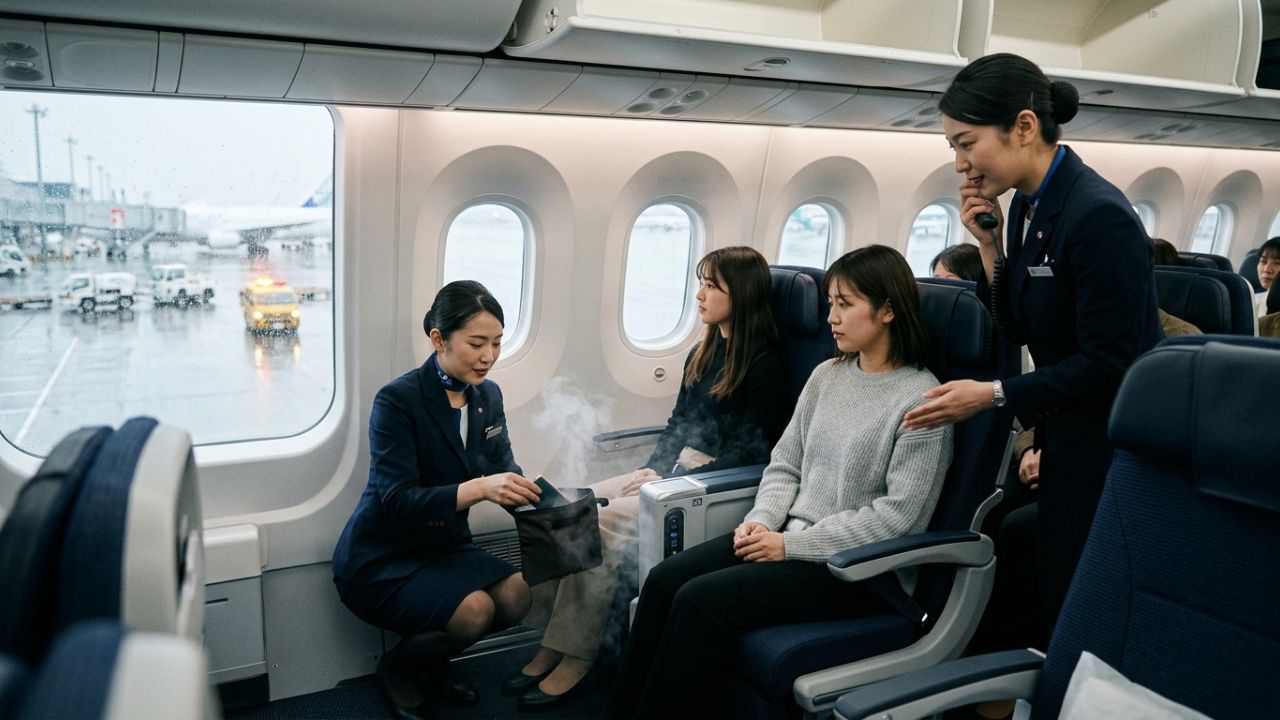
Image generated by AI
In a terrifying incident that highlights how rapidly passenger electronics can trigger massive travel chaos, a British Airways flight at Tokyo Haneda Airport was forced into a sudden emergency halt. Reported on June 20, 2026, as international travelers frantically monitor the latest airline news to avoid rolling flight cancellations, the severe disruption occurred just before departure to London. Shortly after 1 pm local time, while the aircraft was actively taxiing, a passenger's smartphone battery catastrophically overheated, filling the cabin baggage area with smoke. Directly impacting 211 passengers and crew, the immediate activation of emergency protocols forced the aircraft back to the stand, severely disrupting runway coordination. This terrifying event provides vital "survival intelligence" for travelers seeking to avoid massive, sudden airport disruptions, cementing this lithium-ion battery failure as today's most crucial headline in breaking aviation updates.
By introducing direct passenger coordination and dynamic scheduling backups, the regional aviation hubs target growing passenger demand across vital commerce sectors. The choice to coordinate flight departures in phases helps to manage gate capacity, supporting the country's broader regional transportation network.
Context: The Invisible Lithium Threat
For the highly interconnected global aviation grid, securing the cabin against uncontained fires is the absolute ultimate tactical defense against catastrophic operational failure.
Aviation safety experts consider a full-scale cabin fire to be the single most dangerous scenario in commercial aviation. While legacy safety discussions frequently focus on mechanical aircraft systems, regulators are increasingly terrified of an entirely different threat: the explosive growth of passenger-carried energy devices. Lithium-ion batteries found in smartphones, laptops, and power banks are highly susceptible to thermal runaway—a terrifying chain reaction caused by damaged cells, overcharging, or extreme cabin pressure variations. According to alarming safety data explicitly referenced by regulators, including the US Federal Aviation Administration, there were 82 reported battery-related incidents in 2025 alone. Japan’s aviation authorities have heavily tightened regulations following multiple onboard fire alerts, proving that this is not an isolated anomaly, but a massive structural risk tied directly to modern digital dependency.
To view live flight schedules, verify the active departure status of your specific British Airways itinerary, or to track potential route restorations prior to heading to the airport, travelers must consult official aviation directories. For direct updates regarding how emergency runway halts might trigger sudden flight cancellations out of Tokyo, travelers should aggressively utilize the official digital portals of their respective airlines. To explore live flight tracking and monitor the exact severity of the cascading bottlenecks paralyzing the broader Japanese airspace, passengers can consult the official FlightAware tracking service.
Section-Wise Breakdown: Containing the Threat
The Emergency Halt: 1 PM at Tokyo Haneda
The terrifying incident ignited shortly after 1 pm local time. As the British Airways aircraft began taxiing toward the runway for its long-haul departure to London, cabin crew immediately detected smoke billowing from a passenger baggage area. Realizing the extreme danger of an uncontained thermal runaway, the cockpit crew immediately halted all taxiing operations. Air Traffic Control urgently instructed an emergency return to the stand, abruptly pulling the heavy aircraft out of the departure queue and triggering localized runway disruptions.
The Cabin Response: Suppressing the Fire
The immediate, aggressive response of the British Airways cabin crew played the absolute decisive role in preventing a catastrophic escalation. Utilizing onboard fire suppression equipment, the crew successfully contained the overheating smartphone. Because the intervention was extremely rapid, the intense smoke was suppressed before it could engulf the cabin. Miraculoulsy, no emergency evacuation was required, and all 211 passengers remained entirely safe inside the aircraft while airport emergency teams boarded to conduct a rigorous inspection.
Operational Recovery: A One-Hour Delay
After the smoking device was successfully neutralized and removed from the aircraft, ground operations aggressively worked to ensure minimal disruption to broader runway traffic. Following a full, exhaustive safety clearance by airport fire services, the flight was officially permitted to continue its journey to London, suffering an operational delay of approximately one hour.
Technical Roster: Official Airline Incident Matrix
To ensure absolute factual accuracy regarding the exact flight metrics, operational response times, and the specific regulatory context defining this severe emergency, the following matrix details the strictly verified incident data:
Official British Airways Tokyo Haneda Incident Matrix
| Incident Metric / Regulation | Verified Aviation Data |
|---|---|
| Operating Carrier | British Airways |
| Location | Tokyo Haneda Airport, Japan |
| Intended Destination | London, United Kingdom |
| Time of Incident | Shortly after 1:00 PM (Local Time) |
| Total Impacted Souls | 211 Passengers and Crew |
| Triggering Event | Passenger smartphone battery fire/smoke |
| Flight Phase | Taxiing (Pre-departure) |
| Emergency Action | Immediate halt; returned to stand; fire suppression deployed |
| Evacuation Status | No evacuation required; no injuries reported |
| Total Operational Delay | Approximately one hour |
| Global Threat Context | 82 battery-related aviation incidents reported in 2025 |
Data accurately reflects the verified emergency metrics tracking the British Airways lithium battery fire incident at Tokyo Haneda as of June 2026.
Passenger Impact: The Rise of the "Invisible Risk Economy"
For the millions of passengers traversing the globe heavily reliant on electronic devices, this terrifying incident instantly highlights the massive danger of improper battery storage.
Modern aviation is now completely dependent on an "invisible risk economy." Unlike predictable mechanical failures managed by certified airline mechanics, lithium battery incidents are highly unpredictable, portable, and entirely passenger-driven. A single passenger packing a damaged, swollen power bank deep inside a tightly packed carry-on bag can instantly ground a multi-million-dollar aircraft, triggering severe delays, missed connections, and massive financial costs for all 211 people onboard. This severe reality shifts the burden of aviation safety away from the cockpit and directly into the hands of the passengers.
Industry Analysis: Redefining Digital-Age Hazards
Aviation analysts monitoring the Haneda incident note that regulatory frameworks must aggressively adapt to passenger behavior before a major catastrophe occurs.
Anup Kumar Keshan, Founder and Editor-in-Chief of Travel And Tour World, observed that this development signals a massive doctrinal shift in global safety. “This incident at Tokyo Haneda is not an isolated aviation disruption—it is a warning signal for the entire global travel ecosystem,” Keshan stated. “As passenger dependency on smart devices grows, aviation safety must evolve beyond aircraft systems and fully integrate passenger electronics risk management into standard operations.” Aviation operators emphasize that airlines are now facing immense pressure to introduce mandatory battery health certifications, stricter rules on power banks, and heavily expanded onboard fire containment technology (such as specialized lithium fire suppression kits) to combat this escalating threat.
Actionable Advice for Traveling with Electronics
To protect yourself and your fellow passengers from triggering a catastrophic in-flight fire, you must execute this strict electronic safety checklist immediately before boarding any aircraft:
- Never Check Lithium Batteries: It is a severe federal violation to pack spare lithium batteries or power banks in your checked luggage. These items must exclusively remain in your cabin baggage where crew can immediately suppress a fire if thermal runaway occurs in the cargo hold.
- Inspect for Swelling: Do not travel with damaged electronics. If your smartphone case is bulging or your power bank feels unusually hot to the touch, the battery cells are failing. Dispose of the device safely before arriving at the airport.
- Maintain Accessibility: Do not bury your charging devices deep inside heavily packed backpacks. Keep power banks easily accessible. If a device begins smoking, you must be able to instantly alert the cabin crew and retrieve it before the fire spreads to surrounding luggage.
FAQ: In-Flight Lithium Battery Fires
What caused the emergency on the British Airways flight in Tokyo?
A passenger's smartphone battery catastrophically overheated and emitted smoke while the aircraft was taxiing at Tokyo Haneda Airport, forcing an immediate halt.
How many passengers were impacted by the British Airways fire?
The incident directly impacted 211 passengers and crew members onboard the flight bound for London.
How common are lithium battery incidents in aviation?
They are becoming increasingly common; aviation safety data, including reports from the FAA, indicated 82 battery-related aviation incidents in 2025 alone.
The Reality of Modern Passenger Responsibility
The swift containment of the smartphone fire by the British Airways crew proves definitively that aggressive intervention is the ultimate weapon against thermal runaway. By effectively deploying onboard suppression equipment, the crew successfully guaranteed that 211 passengers avoided a highly dangerous emergency evacuation. Yet, as relieved travelers finally departed Tokyo following a one-hour delay, they must accept a critical new reality: aviation safety is now a shared burden. Surviving this era of extreme technological dependency demands immense personal responsibility, a complete refusal to travel with damaged batteries, and the tactical discipline to instantly notify the crew the exact second a device begins to overheat.
Key Takeaways
- Terrifying Emergency: A British Airways flight at Tokyo Haneda was halted during taxi after a smartphone caught fire.
- Rapid Suppression: Cabin crew successfully deployed fire suppression equipment, preventing an evacuation of the 211 people onboard.
- Operational Delay: The aircraft safely returned to the stand, causing a localized runway disruption and a one-hour flight delay.
- Massive Global Threat: The FAA recorded 82 severe battery-related aviation incidents in 2025 alone.
- Survival Strategy: Passengers are strongly urged to never pack power banks in checked luggage and immediately report overheating devices.
Related Travel Guides
Massive Travel Chaos Paralyzes Chicago O'Hare with 1,425 Disruptions
Disclaimer
This article is for informational and educational purposes only. It does not constitute legal, financial, or professional advice. While we strive to provide accurate and up-to-date information, travel policies, regulations, and conditions change rapidly. Always verify information with official sources before making travel decisions. Nomad Lawyer makes no representations about the accuracy, reliability, completeness, or suitability of the information provided. Readers should consult qualified professionals for advice specific to their circumstances. The views expressed in this article are those of the author and do not necessarily reflect the views of Nomad Lawyer.
Kunal K Choudhary
Co-Founder & Contributor
A passionate traveller and tech enthusiast. Kunal contributes to the vision and growth of Nomad Lawyer, bringing fresh perspectives and driving the community forward.
Learn more about our team →