
British Airways Flight BA284 San Francisco to London Heathrow Emergency Diversion Drama as Airbus A380-800 Makes Rare Forced Landing at Birmingham Airport After Mid-Air Medical Crisis Shocks Transatlantic Route
British Airways flight BA284 from San Francisco diverted an Airbus A380 to Birmingham Airport for a medical emergency be

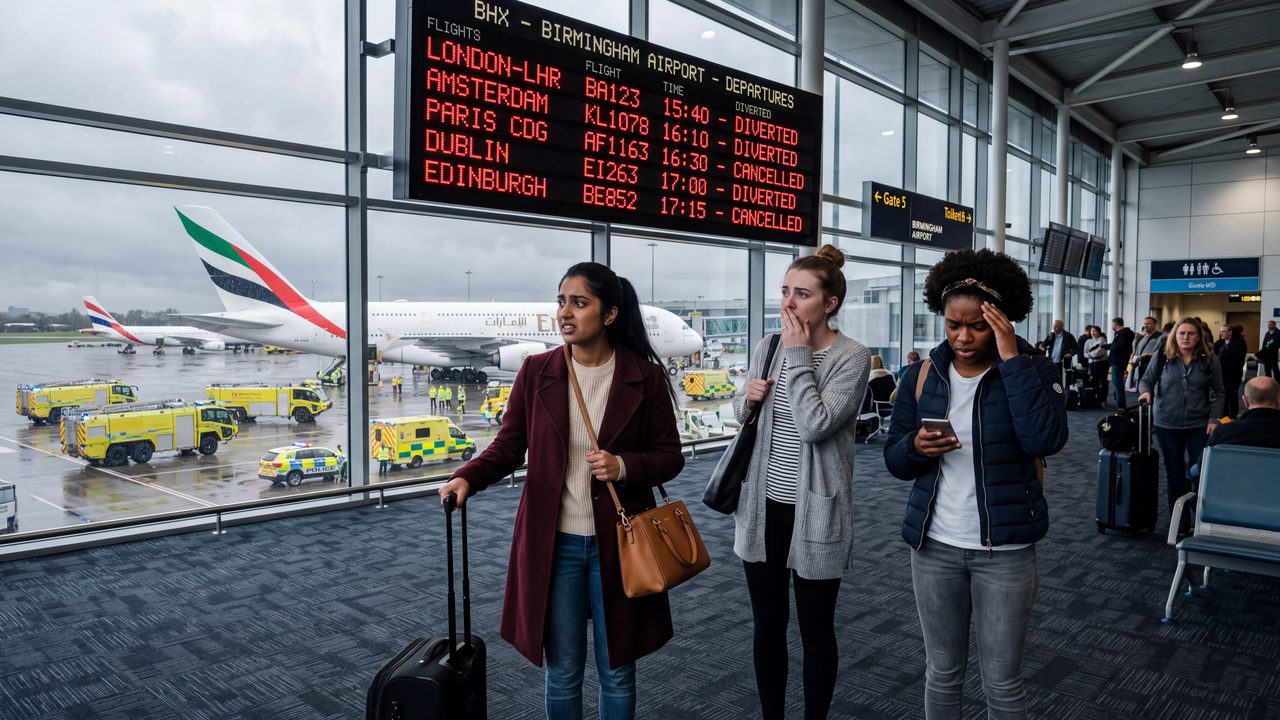
Image generated by AI
[Birmingham, June 28, 2026] — A British Airways Airbus A380-800 was forced to make a rare emergency diversion to Birmingham Airport on June 27, 2026, after a passenger suffered a medical crisis during a flight from San Francisco. The aircraft, registration G-XLEE, was diverted from its original path to London Heathrow to ensure the passenger received immediate life-saving treatment.
The incident occurred as the flight was entering the final stages of its transatlantic journey. While the aircraft was initially following standard descent procedures, the situation escalated rapidly, necessitating a shift in priority from schedule adherence to emergency medical intervention. Reports indicate that the flight crew coordinated with air traffic control to identify the fastest route to a capable medical facility, leading to the decision to land at Birmingham Airport (BHX) rather than continuing to the congested airspace of London Heathrow (LHR).
Medical Emergency Triggers Diversion Protocol in UK Airspace
The diversion of flight BA284 was prompted by a confirmed medical emergency involving a passenger located in the A380's upper-deck cabin. According to aviation protocols, flight crews must continuously evaluate the severity of health crises in real-time, balancing the needs of the patient with the operational constraints of the aircraft and available landing sites.
As the superjumbo entered UK airspace, flight tracking data showed the aircraft entering holding patterns. While such patterns are common near London Heathrow due to traffic congestion, the urgency of the onboard medical condition superseded routine arrival sequencing. The captain declared an emergency, prioritizing rapid ground-based medical access over the original flight plan.
Industry observers note that the decision to bypass Heathrow was based on a critical assessment of runway availability and the speed of emergency response. Birmingham Airport was identified as the most efficient option to minimize the time between the medical event and professional hospital care.
Birmingham Airport Infrastructure Supports A380 Emergency Landing
The selection of Birmingham Airport (BHX) was a strategic operational choice based on the specific requirements of the Airbus A380-800. As one of the largest commercial aircraft in the world, the A380 requires significant runway length and pavement strength to land safely.
Birmingham’s 10,000-foot runway provided the necessary specifications to accommodate the aircraft's weight and landing distance. At approximately 10:42 AM BST, BA284 touched down safely. Emergency medical teams were stationed on the airfield prior to arrival, allowing for the immediate transfer of the affected passenger to a local hospital.
This event was particularly notable to aviation enthusiasts and monitors, as the A380 is not a regular visitor to Birmingham Airport. The sight of the double-decker aircraft on the regional ramp is a rare occurrence, highlighting the airport's capability to handle "superjumbo" aircraft during contingencies.
Ground Operations and Refuelling Process at BHX
Following the touchdown, the aircraft remained on the tarmac for roughly two hours. This window was utilized for several critical ground operations required before the aircraft could resume its journey.
Ground crews focused on stabilizing the aircraft and conducting necessary safety checks. A primary requirement was refuelling; because the flight had diverted from its planned route and spent time in holding patterns, the aircraft needed additional fuel to meet legal and safety requirements for the short hop to London.
During this period, flight planning teams worked with air traffic controllers to secure a new routing clearance. These procedures ensured that the aircraft was fully compliant with all aviation safety regulations before departing for its final destination.
Final Leg from Birmingham to London Heathrow
After completing all necessary ground protocols, British Airways Flight BA284 departed Birmingham Airport at 1:03 PM BST. The aircraft then performed a short repositioning flight to cover the remaining distance to the capital.
The final segment of the journey lasted approximately 28 minutes. The Airbus A380 landed at London Heathrow at 1:31 PM BST, taxiing directly to Terminal 5. This allowed the remaining passengers to disembark and conclude their journey from the US West Coast. Despite the diversion, the airline managed to keep the flight within the same operational cycle, minimizing the overall delay for the majority of travelers.
Operational Analysis of the BA284 Transatlantic Route
Flight BA284 is a cornerstone of the British Airways long-haul network, providing daily connectivity between San Francisco International Airport (SFO) and London Heathrow (LHR). This route is vital for both corporate and leisure travel between the United Kingdom and the United States.
The service typically utilizes the Airbus A380-800, which is configured to transport roughly 469 passengers across four classes: First, Business, Premium Economy, and Economy. With an average flight time of 10 hours and 25 minutes, the route is subject to varying wind conditions and complex transatlantic routing.
| Flight Detail | Specification |
|---|---|
| Flight Number | BA284 |
| Departure Airport | San Francisco International (SFO) |
| Intended Destination | London Heathrow (LHR) |
| Diversion Airport | Birmingham Airport (BHX) |
| Aircraft Type | Airbus A380-800 |
| Registration | G-XLEE |
| Diversion Landing Time | 10:42 AM BST |
| Final Arrival Time | 1:31 PM BST |
| Final Arrival Terminal | Terminal 5 (LHR) |
Strategic Reasoning for the Selection of Birmingham
The choice of Birmingham as the diversion point was dictated by three primary aviation safety criteria: proximity, runway capability, and emergency response readiness.
- Proximity: The aircraft was positioned near northern UK airspace, making Birmingham a faster option than attempting to navigate the congested approach into Heathrow.
- Runway Capability: Not all regional airports can support the weight and wingspan of an A380. Birmingham's infrastructure is specifically rated to handle such wide-body aircraft.
- Response Readiness: The airport's ability to deploy medical teams immediately upon touchdown was paramount for the passenger's survival and recovery.
Why This Matters: Aviation Safety and Infrastructure Resilience
The diversion of BA284 serves as a practical case study in the resilience of modern aviation safety frameworks. The seamless transition from a scheduled transatlantic flight to an emergency regional landing demonstrates the high level of coordination between flight crews, Air Traffic Control (ATC), and ground handlers.
From an industry perspective, this incident highlights the "hidden" value of secondary airport infrastructure. While Heathrow is the primary hub, the ability of airports like Birmingham to support the world's largest aircraft during a crisis is a critical safety net for the global aviation network. It ensures that medical emergencies do not become catastrophic failures simply because a primary hub is too congested to accept an immediate landing.
Furthermore, the rapid recovery of the aircraft—refuelling and departing within two hours—showcases the efficiency of ground operational protocols. The event proves that the A380, despite its size and complexity, can be managed flexibly in non-standard environments when safety protocols are strictly followed.
Related Travel Guides
Disclaimer
This article is for informational and educational purposes only. It does not constitute legal, financial, or professional advice. While we strive to provide accurate and up-to-date information, travel policies, regulations, and conditions change rapidly. Always verify information with official sources before making travel decisions. Nomad Lawyer makes no representations about the accuracy, reliability, completeness, or suitability of the information provided. Readers should consult qualified professionals for advice specific to their circumstances. The views expressed in this article are those of the author and do not necessarily reflect the views of Nomad Lawyer.
Raushan Kumar
Founder & Lead Developer
Full-stack developer with 11+ years of experience and a passionate traveller. Raushan built Nomad Lawyer from the ground up with a vision to create the best travel and law experience on the web.
Learn more about our team →