
Widespread Flight Cancellations and Delays Disrupt Brazilian Aviation Grid
Over 460 delays and 84 cancellations hit Brazilian airports including São Paulo, Rio de Janeiro, and Brasília, affecting LATAM, GOL, Azul, and international carriers.

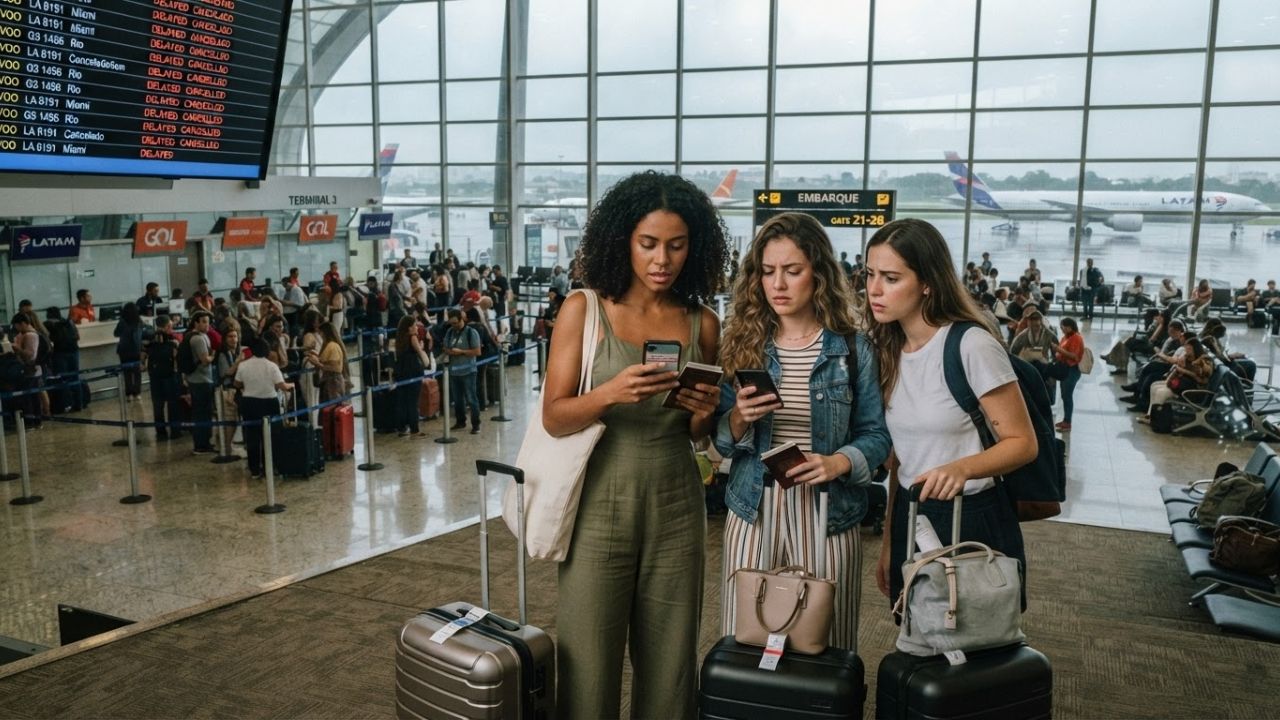
Image generated by AI
Widespread flight cancellations across Brazil have impacted domestic and international passengers. The national aviation network recorded 84 cancelled flights and 460 delayed departures, led by severe congestion at São Paulo hubs.
São Paulo Hubs Suffer Highest Congestion Rates
Flight tracking data indicates that São Paulo's primary airports experienced the most severe schedule reductions. São Paulo-Congonhas (CGH) recorded 142 delays and 30 cancellations, reflecting its high-density operations.
São Paulo-Guarulhos (GRU) reported 123 delays and 17 cancellations, affecting both domestic services and international connections. Network performance data published by LATAM Airlines indicates that the carrier had 45 cancellations and 170 delays nationwide.
GOL Linhas Aéreas reported 25 cancellations and 175 delays, the highest cumulative delay count among domestic carriers.
Regional Gateways Face Cascading Schedule Shifts
Outside São Paulo, Rio de Janeiro/Galeão (GIG) experienced 64 delays and 11 cancellations. Campinas (Viracopos) recorded 42 delays and seven cancellations, affecting Azul Brazilian Airlines' primary operations.
In the federal capital, Brasília (BSB) reported 35 delays and six cancellations. Operational safety directives managed by the National Civil Aviation Agency of Brazil (ANAC) require strict traffic separation during weather events.
Recife (REC) and Salvador (SSA) each reported six cancellations, while the island gateway of Fernando de Noronha (FEN) experienced isolated delays.
Brazil Flight Disruption Statistics
The tables below display the airport and carrier disruptions across the Brazilian network.
Flight Disruptions by Major Brazilian Airport
| Airport Hub Name | Airport Code | Cancelled Flights | Delayed Flights | Primary Affected Carriers |
|---|---|---|---|---|
| São Paulo-Congonhas | CGH | 30 | 142 | LATAM Brasil, GOL, Azul |
| São Paulo-Guarulhos | GRU | 17 | 123 | LATAM Brasil, International Carriers |
| Rio de Janeiro/Galeão | GIG | 11 | 64 | GOL, LATAM Brasil |
| Campinas (Viracopos) | VCP | 7 | 42 | Azul Brazilian Airlines |
| Brasília | BSB | 6 | 35 | LATAM Brasil, GOL |
| Recife (Guararapes) | REC | 6 | 29 | Azul, LATAM Brasil, TAP Portugal |
| Salvador | SSA | 6 | 22 | GOL, LATAM Brasil |
| Fernando de Noronha | FEN | 1 | 3 | Azul Brazilian Airlines |
Flight Cancellations and Delays by Operating Carrier
| Airline Carrier Name | Cancelled Flights | Delayed Flights | Primary Operations Hub |
|---|---|---|---|
| LATAM Brasil | 45 | 170 | São Paulo-Guarulhos (GRU) |
| GOL Linhas Aéreas | 25 | 175 | São Paulo-Congonhas (CGH) |
| Azul Brazilian Airlines | 11 | 95 | Campinas (Viracopos) (VCP) |
| Iberia | 1 | 0 | Madrid (MAD) to São Paulo (GRU) |
| Other Carriers | 2 | 20 | Multiple International Destinations |
Transit Diversions and Passenger Mitigation
Air traffic controllers are managing rerouted international flights to ensure safety. Passengers are advised to confirm their flight status online before departing for terminal gates.
Travelers with connecting itineraries should contact airline help desks to confirm standby options.
Airlines are actively adjusting aircraft rotations to minimize further cancellations across regional networks.
Why This Matters
Our analysis of the flight data indicates that Brazil's aviation system is experiencing external capacity strains. Following recent earthquakes along the northern coast of South America, airlines are avoiding Venezuelan airspace. This rerouting forces international flights into Brazil's northern air corridors, causing traffic congestion in the Brasília flight information region.
Additionally, domestic airlines operate with high fleet utilization. At airports like São Paulo-Congonhas, which has short runways and strict slot controls, there is no buffer for scheduling delays. A single weather delay in the morning cascades through subsequent flights, leading to cancellations later in the day.
Industry Outlook
Market trends suggest that regional air traffic controllers will need to establish permanent transit corridors to manage airspace diversions. Airlines are expected to increase reserve aircraft allocations to prevent cascading schedule cancellations.
Expect civil aviation authorities to review slot allocations at congested hubs like Congonhas during seasonal weather periods. The current scheduling backlog is projected to clear as traffic patterns stabilize.
Key Takeaways
- Systemic Disruption: Brazil recorded 84 flight cancellations and 460 delays across its commercial aviation network.
- São Paulo Core: São Paulo-Congonhas and Guarulhos airports accounted for over 55 percent of all disruptions.
- Carrier Impact: LATAM Brasil reported 45 cancellations, while GOL experienced the most delays with 175 flights.
- Airspace Strain: Traffic avoiding Venezuelan airspace due to earthquakes added pressure to Brazilian air corridors.
- Feeder Delays: Scheduling backlogs at main hubs triggered secondary cancellations in Recife and Salvador.
FAQ
How many flights were cancelled in Brazil?
A total of 84 flights were cancelled across major Brazilian airports, with LATAM Brasil reporting the highest share.
Which airport had the most delayed flights?
São Paulo-Congonhas (CGH) recorded the highest number of delays, with 142 flights impacted.
Why are flights avoiding Venezuelan airspace?
Recent earthquakes along the northern coast have prompted carriers to reroute flights through Brazilian airspace, increasing regional traffic density.
What should affected passengers do?
Passengers should check their real-time flight status online and contact their airlines to discuss rebooking options.
Related Travel Guides
Disclaimer
This article is for informational and educational purposes only. It does not constitute legal, financial, or professional advice. While we strive to provide accurate and up-to-date information, travel policies, regulations, and conditions change rapidly. Always verify information with official sources before making travel decisions. Nomad Lawyer makes no representations about the accuracy, reliability, completeness, or suitability of the information provided. Readers should consult qualified professionals for advice specific to their circumstances. The views expressed in this article are those of the author and do not necessarily reflect the views of Nomad Lawyer.
Kunal K Choudhary
Co-Founder & Contributor
A passionate traveller and tech enthusiast. Kunal contributes to the vision and growth of Nomad Lawyer, bringing fresh perspectives and driving the community forward.
Learn more about our team →