
Bengaluru Airport Terminal 1 vs Terminal 2: Airlines, Shuttle Transfers and BLR Guide 2026
Bengaluru Airport Terminal 1 vs Terminal 2 explained for 2026: which airlines operate from each BLR terminal, how the free 24-hour inter-terminal shuttle works, realistic transfer times, and the steps that prevent costly wrong-terminal mistakes and missed connections at Kempegowda International Airport.

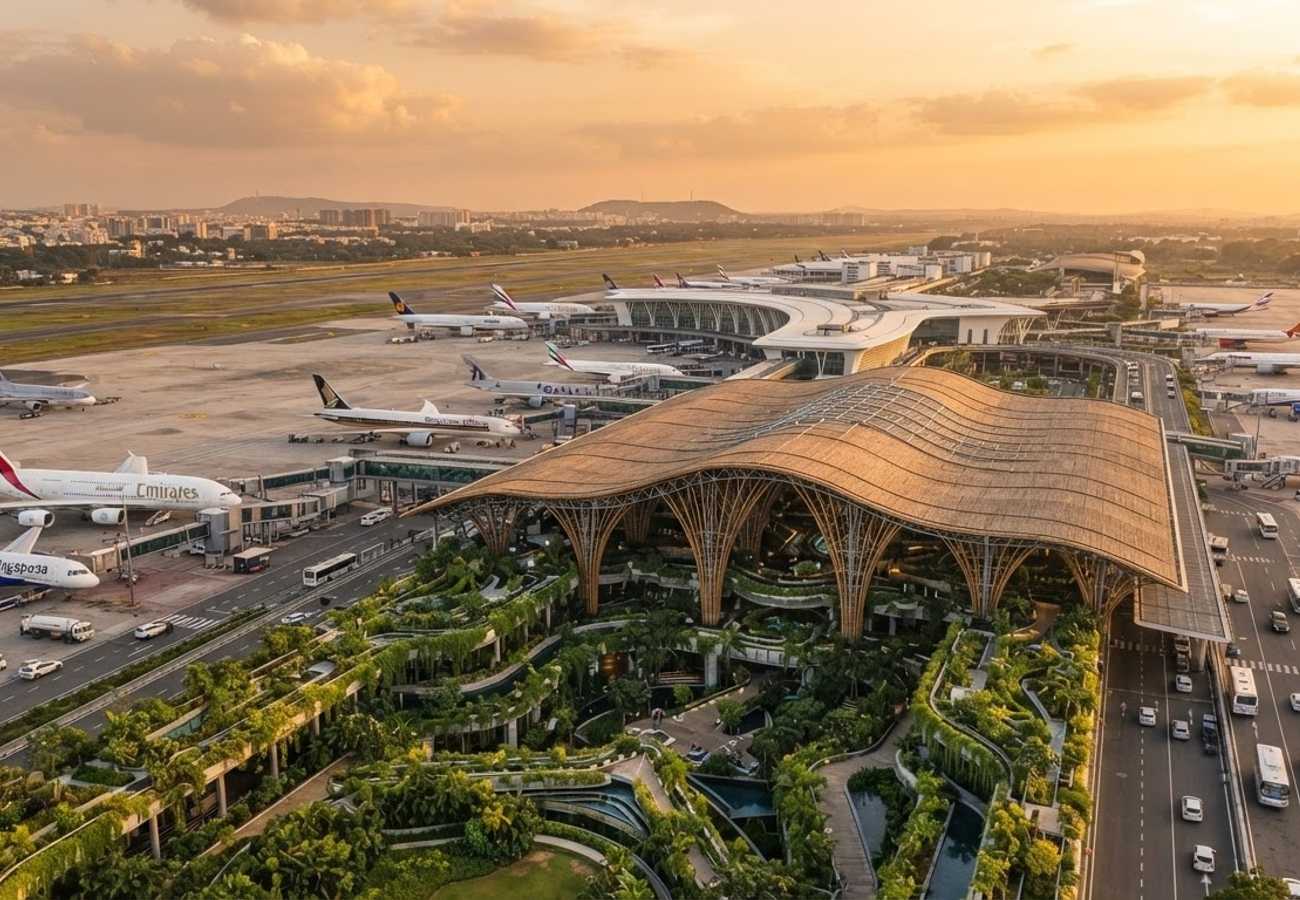
Image generated by AI
Bengaluru, August 23, 2026 — A wrong terminal at Kempegowda International Airport now costs passengers 30 to 45 minutes of unplanned terminal-hopping — and, in the worst cases, a missed flight. With nearly all international services and a growing share of domestic flights consolidated into the newer Terminal 2, the question of Bengaluru Airport Terminal 1 vs Terminal 2 has become the most common planning mistake reported by travelers passing through India's tech capital in 2026.
The two buildings stand several kilometers apart on the same airport campus, far beyond walking distance. A free inter-terminal shuttle runs 24 hours a day, yet passengers who arrive at the wrong departure hall still lose time to queues, transfers and re-checks. Reports from current operations show the confusion cuts across experience levels, catching out even frequent fliers who last passed through BLR before the terminal reshuffle.
BLR's Two-Terminal Layout: Domestic Focus at Terminal 1, International at Terminal 2
Kempegowda International Airport operates two passenger terminals. Terminal 1 is the older building; Terminal 2 is the newer facility widely known as the "garden terminal." The functional split is now clear: Terminal 1 handles predominantly domestic traffic, while Terminal 2 processes every scheduled international flight plus an expanding list of domestic services for specific airlines.
That split can produce same-day surprises. A morning IndiGo departure from Bengaluru to Hyderabad may leave from Terminal 1, while an evening Air India flight to Delhi uses Terminal 2. A passenger arriving on Emirates from Dubai always lands at Terminal 2, but an onward connection to a smaller Indian city on IndiGo or Akasa Air typically departs from Terminal 1.
The layout shapes ground transport too. App-based cabs and private taxis generally ask whether the passenger needs T1 or T2 before leaving the city. Several airport bus routes run by BMTC's Vayu Vajra service announce destinations as "Kempegowda Airport, Terminal 1" or the "Terminal 2 shuttle stop." A rider who simply says "airport" risks being dropped at the wrong building and forced onto the shuttle.
Which Airlines Operate From Bengaluru Terminal 1 vs Terminal 2
Assignments shift over time, but the mid-2026 pattern is well defined. Terminal 2 serves as Bengaluru's dedicated international terminal: every scheduled international arrival and departure, across all carriers, uses T2. That covers long-haul and regional operators including Emirates, Qatar Airways, Etihad, Lufthansa, Air France, British Airways, Singapore Airlines, Thai Airways and SriLankan Airlines, alongside the international networks of Air India, Air India Express and IndiGo. Any ticket showing Bengaluru paired with an international origin or destination points to Terminal 2 unless the airline states otherwise.
On the domestic side, Terminal 2 now anchors Air India and Air India Express at Bengaluru, covering both their domestic and international schedules. Official airline notices confirm that every Air India flight at BLR operates from T2. Star Air and other premium or full-service-style domestic operators also run from the newer terminal, and a number of IndiGo domestic flights have shifted to T2 for operational reasons, even as IndiGo maintains a large domestic bank at Terminal 1.
Terminal 1 carries the bulk of purely domestic traffic. Akasa Air, SpiceJet and Fly91 base their Bengaluru networks there, and most IndiGo domestic flights — particularly services to tier 2 and tier 3 cities such as Coimbatore, Mangaluru, Vijayawada and Ranchi — still depart from T1. One practical example: a passenger booked on Air India from Bengaluru to Mumbai checks in at T2, while a traveler on the same route with IndiGo may leave from either terminal depending on the flight number printed on the ticket.
| Terminal | Airlines | Operations at BLR |
|---|---|---|
| Terminal 2 | Emirates, Qatar Airways, Etihad, Lufthansa, Air France, British Airways, Singapore Airlines, Thai Airways, SriLankan Airlines, Japan Airlines | All scheduled international arrivals and departures |
| Terminal 2 | Air India, Air India Express | Entire Bengaluru schedule — domestic and international |
| Terminal 2 | Star Air, select IndiGo domestic flights | Domestic services |
| Terminal 1 | Akasa Air, SpiceJet, Fly91 | Domestic networks out of Bengaluru |
| Terminal 1 | Most IndiGo domestic flights | Routes to tier 2 and tier 3 cities including Coimbatore, Mangaluru, Vijayawada and Ranchi |
Exceptions exist and airline strategies evolve, so travelers should verify the terminal shown on the booking confirmation or airline app within 24 hours of departure. Airline notifications and live flight tracking data remain the reliable sources; when in doubt, a call to the carrier before leaving for the airport prevents an expensive mistake.
How BLR Splits Domestic and International Operations
International journeys at Bengaluru run through Terminal 2 from start to finish: check-in, immigration, security and boarding on departure, and immigration plus customs on arrival. The international wing is clearly signed, with dedicated immigration counters and baggage belts for overseas arrivals. A Japan Airlines passenger flying Tokyo to Bengaluru, for example, disembarks into T2's international arrivals hall, clears immigration, collects luggage and passes customs without entering Terminal 1 at any point.
Domestic operations span both terminals by airline. At Terminal 2, domestic passengers clear standard domestic security and board from domestic gates while sharing the check-in hall and landside areas with international travelers. Someone flying Air India from Bengaluru to Kolkata follows the domestic signage at T2 and never passes immigration. A passenger on Akasa or most IndiGo services to the same city is handled entirely within Terminal 1, using that building's own check-in hall and security queues.
Bengaluru Connections: Moving Between T1 and T2 on Separate Tickets
The split bites hardest during connections. A traveler flying Chennai to Bengaluru on IndiGo and continuing to Paris on Air France will typically arrive at Terminal 1 and depart from Terminal 2. That means collecting baggage at T1, exiting the building, riding the inter-terminal shuttle and checking in again for the long-haul sector. When both flights sit on a single interlined ticket, the airline may through-check bags to the final destination, but the passenger still has to move physically between buildings.
The reverse flow works the same way. An Emirates arrival from Dubai always lands at T2; a passenger connecting to an IndiGo domestic flight from Terminal 1 must clear immigration and customs at T2, reclaim luggage and shuttle across for a fresh check-in. Travelers on early-morning arrivals report that immigration and baggage delivery at T2 move quickly outside peak hours, which makes a self-connection window of three to four hours workable. Anything shorter carries real risk.
Bengaluru Airport Free Shuttle: T1–T2 Frequency, Stops and Transfer Times
The free inter-terminal shuttle bus is the only practical way to move between the two buildings. The airport-operated service runs 24 hours a day for passengers and staff. During busy periods, buses arrive roughly every 10 to 15 minutes; late at night, frequency drops as traffic thins. Travelers consistently report door-to-door transfer times of around 20 to 30 minutes once waiting, riding and walking at each end are combined.
At Terminal 2, the shuttle stop sits outside the arrivals area. After exiting customs, passengers should follow the "Inter Terminal Shuttle" signage or ask an airport marshal, then join the marked queue for buses bound for T1 and other airport facilities. At Terminal 1, the stop stands near the arrivals forecourt, close to the city bus bays and taxi lanes.
What Bengaluru's Terminal Split Means for Pickups and Airport Buses
The two-terminal system now dictates how road journeys to BLR begin and end. Cab drivers confirm the terminal before departure because the drop-off points sit kilometers apart, and a wrong selection adds an unplanned shuttle leg to the trip. The same logic applies to pickups: anyone collecting an arriving passenger needs the terminal, not just the flight number.
Bus passengers face a similar choice. Vayu Vajra services brand their runs by terminal, so boarding the wrong coach from the city can strand a traveler at the wrong forecourt with luggage in tow. Regular commuters suggest building a 20-to-30-minute buffer into any itinerary that involves switching terminals on arrival.
Why This Matters for Travelers Passing Through Bengaluru
For the traveler, the terminal question is no longer trivia — it is the first line item of any Bengaluru itinerary. A booking made months ago may not reflect a later terminal change, so the 24-hour check on the airline app functions like a pre-departure compliance step, as essential as confirming passport validity or entry documents.
From a logistical and legal standpoint, separate tickets create a self-transfer with no protected connection. If a delayed domestic arrival into T1 causes a missed international departure from T2, the onward carrier generally owes no rebooking, and any travel insurance claim will hinge on whether the passenger allowed a reasonable transfer window. The reported three-to-four-hour benchmark for T1–T2 self-connections at BLR offers a practical standard — and a defensible one if plans are ever questioned.
For remote workers and frequent flyers routing through India's tech hub, the payoff is simple: verify the terminal, budget the shuttle time, and treat the two buildings as separate airports sharing one code. Those who do turn Bengaluru into a smooth connection point. Those who don't join the daily crowd sprinting for the shuttle.
At BLR, the terminal check happens before the cab arrives — not at the curb.
Related Travel Guides
Disclaimer
This article is for informational and educational purposes only. It does not constitute legal, financial, or professional advice. While we strive to provide accurate and up-to-date information, travel policies, regulations, and conditions change rapidly. Always verify information with official sources before making travel decisions. Nomad Lawyer makes no representations about the accuracy, reliability, completeness, or suitability of the information provided. Readers should consult qualified professionals for advice specific to their circumstances. The views expressed in this article are those of the author and do not necessarily reflect the views of Nomad Lawyer.
Raushan Kumar
Founder & Lead Developer
Full-stack developer with 11+ years of experience and a passionate traveller. Raushan built Nomad Lawyer from the ground up with a vision to create the best travel and law experience on the web.
Learn more about our team →