
Beijing Capital International Airport Scraps Twenty-Five Flights and Delays Three Hundred Seventy-One Amid Super Typhoon Bavi Meteorological Disruption
Beijing Capital International Airport cancelled 25 flights and delayed 371 on July 9, 2026, due to airspace congestion from Super Typhoon Bavi.

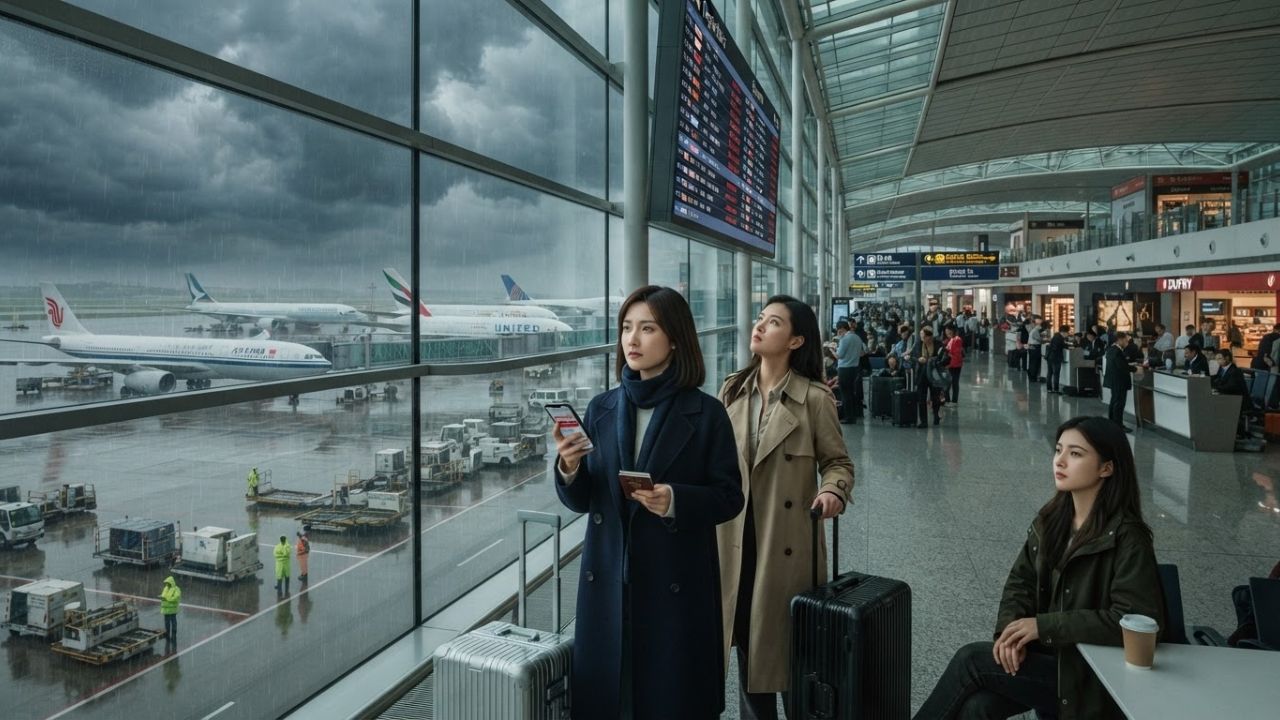
Image generated by AI
[Beijing, July 9, 2026] — Flight tracking data reveals that Beijing Capital International Airport is experiencing major operational instability. A total of twenty-five departures were cancelled and three hundred and seventy-one arrivals and departures were delayed.
Super Typhoon Bavi is generating severe wind conditions and heavy rain across the eastern seaboard of China. Although the storm did not make direct landfall near the capital, its path has closed key flight corridors.
Airlines are implementing precautionary flight cancellations and route changes to ensure aircraft safety. The knock-on effects are disrupting schedules across domestic and international networks.
Airline Performance and Cancellation Concentration
Operational metrics indicate that Air China bore the entire burden of flight cancellations at the airport today. The airline recorded twenty-five cancellations, representing two percent of its scheduled daily operations.
Hainan Airlines was the second most affected carrier, reporting forty-seven delayed flights. Shenzhen Airlines and Sichuan Airlines each registered twenty delays, while Shandong Airlines recorded seventeen delays.
Several international carriers experienced high percentage delays due to the airspace restrictions. United Airlines and EVA Air each reported sixty-six percent of their scheduled operations delayed.
Interconnected Network Pressure and Flow Restrictions
Modern aviation operations function as a single interconnected network across East Asia. When major coastal gateways like Shanghai or Hangzhou restrict operations, aircraft rotations throughout the country stall.
Air traffic controllers are enforcing flow management controls to prevent congestion in terminal areas. These safety margins reduce the number of departures permitted per hour from unaffected hubs.
Additionally, airlines are struggling with crew duty limits as rolling delays push pilots past regulated limits. Repositioning aircraft to safer airfields is also reducing fleet availability.
Cascading Terminal Impact for Transit Passengers
Passengers traveling through Beijing Capital International Airport are experiencing extended wait times at check-in desks. Delayed arrivals are causing transit passengers to miss connections to Europe, North America, and other Asian regions.
Baggage handling systems are facing backlogs as ground crews manage unscheduled gate reassignments. Overnight accommodation availability near the airport is tightening as airlines rebook stranded travelers.
Travelers are urged to check the real-time status of their flights before leaving for the airport. Downloading carrier mobile applications is recommended to track rolling schedule changes.
Refund and Rebooking Protocols for Affected Travelers
Passengers with cancelled tickets are entitled to a full fare refund or rebooking on alternative flights. Carriers are prioritizing long-haul international passengers for the first available seats.
For minor delays, airlines are advising travelers to monitor notifications before proceeding to the gate. Since the disruption is storm-related, standard flight delay compensation rules may not apply.
Passengers should keep all booking confirmations and receipts for out-of-pocket expenses. Reviewing the carrier's contract of carriage provides guidance on hotel vouchers and meal allowances.
Economic Consequences Across Related Sectors
The commercial impact of today's schedule instability reaches beyond airline operational balances. Every cancelled service represents lost passenger revenue and increased gate occupancy costs for operators.
Local hotel chains are experiencing temporary booking surges due to the influx of stranded travelers. Conversely, airport retailers are reporting lower passenger volume as travelers remain in holding zones.
Cargo operations are also facing backlogs, with belly-hold freight delayed on grounded passenger jets. Industrial logistics operators relying on express air shipping are preparing for delivery delays.
Recovery Strategy for Flight Schedules
Airlines plan to restore normal schedules using aircraft substitutions and extra recovery flights. These operations will begin as soon as air traffic control lifts the airspace restrictions.
Priority will be given to international departures to clear the backlog of transit passengers. Scheduling managers are coordinating with crew planning divisions to assign fresh flight decks.
Operational Snapshot
| Category | Total |
|---|---|
| Flights Cancelled | 25 |
| Flights Delayed | 371 |
Airline Performance Table – Beijing Capital International Airport
| Airline | Cancelled | Cancelled % | Delayed | Delayed % |
|---|---|---|---|---|
| Air China | 25 | 2% | 211 | 24% |
| Air France | 0 | 0% | 1 | 33% |
| Air Hong Kong | 0 | 0% | 1 | 50% |
| Air Macau | 0 | 0% | 2 | 50% |
| Dalian Airlines | 0 | 0% | 8 | 24% |
| Zhejiang Loong | 0 | 0% | 4 | 100% |
| Shandong Airlines | 0 | 0% | 17 | 44% |
| China Eastern | 0 | 0% | 10 | 20% |
| Hainan Airlines | 0 | 0% | 47 | 24% |
| Cathay Pacific | 0 | 0% | 2 | 12% |
| Sichuan Airlines | 0 | 0% | 20 | 48% |
| SF Airlines | 0 | 0% | 6 | 30% |
| Shenzhen Airlines | 0 | 0% | 20 | 50% |
| China Postal Airlines | 0 | 0% | 1 | 25% |
| EVA Air | 0 | 0% | 2 | 66% |
| Mahan Air | 0 | 0% | 1 | 100% |
| Korean Air | 0 | 0% | 1 | 10% |
| Air Astana | 0 | 0% | 1 | 25% |
| Mongolian | 0 | 0% | 1 | 50% |
| Air Travel | 0 | 0% | 1 | 50% |
| Tibet Airlines | 0 | 0% | 3 | 75% |
| Thai Airways | 0 | 0% | 2 | 50% |
| Emirates | 0 | 0% | 1 | 20% |
| United | 0 | 0% | 2 | 66% |
| Asiana | 0 | 0% | 4 | 57% |
| Suparna | 0 | 0% | 1 | 25% |
Why This Matters
This disruption highlights how vulnerable modern aviation systems remain to weather events occurring hundreds of kilometers away. Beijing Capital International Airport was not directly hit by the typhoon, yet it suffered hundreds of delays.
Our analysis of the flight data indicates that airline hub dominance shapes how weather disruptions are absorbed. Air China carried the entire cancellation load because it operates the majority of flights at the terminal, protecting smaller regional carriers from total cancellations.
Additionally, this event illustrates the operational limits of air traffic control flow management during major typhoons. When coastal corridors close, inland airports quickly run out of gate space to hold arriving planes.
Future Outlook
Market trends suggest that East Asian airports will face more frequent typhoon-related airspace closures in the coming years. Airlines must invest in flexible scheduling systems to minimize crew out-of-position delays.
Furthermore, airport operators must improve terminal capacity to handle stranded transit passengers during major weather events. Enhancing digital passenger rebooking platforms remains essential to reducing customer service congestion.
Related Aviation News Guides
- Widespread Flight Cancellations and Delays Impact Key Aviation Hubs Across China, India, and Japan
- Singapore Changi Airport Ranked Top Global Retail Hub Outperforming Incheon International and Tokyo Haneda in Annual Passenger Commerce Study
- United Airlines Flight UAL2027 Diverts to Salt Lake City Due to Severe Storms and Wind Shear in Denver Airspace
Disclaimer
This article is for informational and educational purposes only. It does not constitute legal, financial, or professional advice. While we strive to provide accurate and up-to-date information, travel policies, regulations, and conditions change rapidly. Always verify information with official sources before making travel decisions. Nomad Lawyer makes no representations about the accuracy, reliability, completeness, or suitability of the information provided. Readers should consult qualified professionals for advice specific to their circumstances. The views expressed in this article are those of the author and do not necessarily reflect the views of Nomad Lawyer.
Preeti Gunjan
Contributor & Community Manager
A passionate traveller and community builder. Preeti helps grow the Nomad Lawyer community, fostering engagement and bringing the reader experience to life.
Learn more about our team →