
Beechcraft BE30 Crashes Into Atlantic Ocean 50 Miles Off Florida Coast After Marsh Harbour to Grand Bahama Flight Emergency — All 11 Passengers Rescued by U.S. Coast Guard
A Beechcraft BE30 carrying 11 passengers crashed into the Atlantic Ocean 50 miles off Florida on May 12, 2026, during a Marsh Harbour to Grand Bahama flight after the pilot declared an emergency. All 11 were rescued by the U.S. Coast Guard.

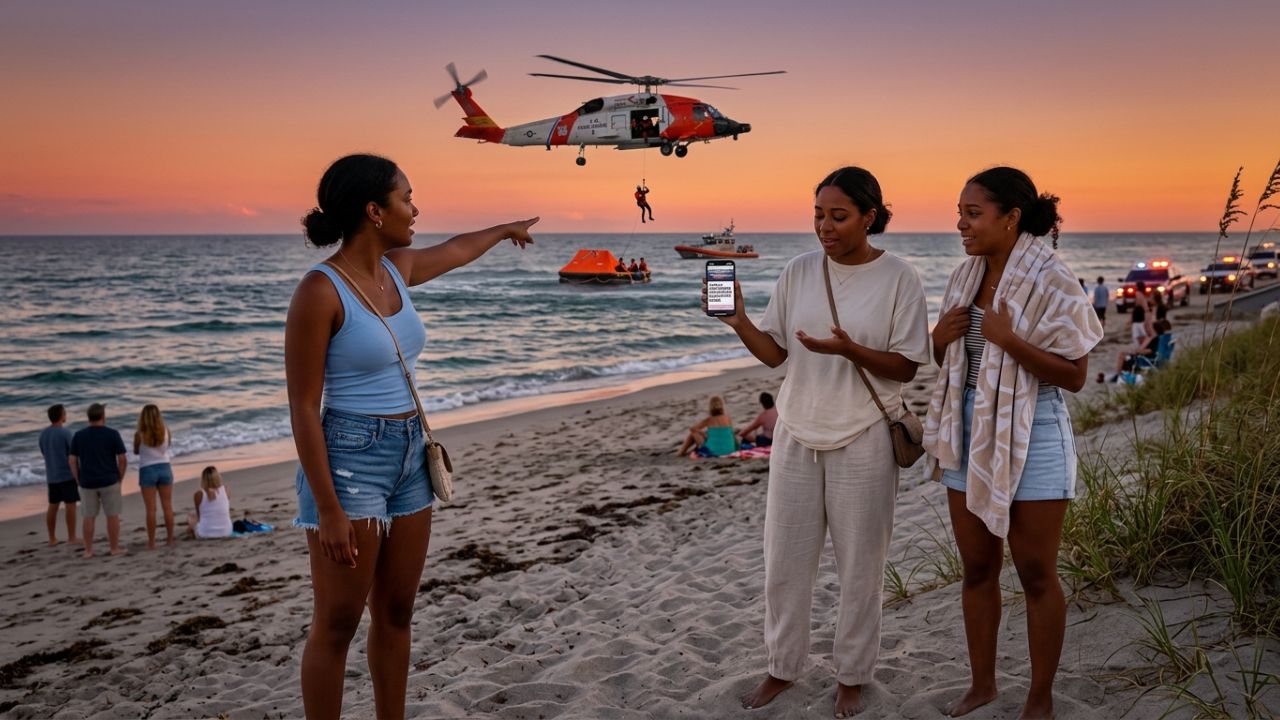
Image generated by AI
Beechcraft BE30 Crashes Into Atlantic Ocean 50 Miles Off Florida After Emergency Declaration on Marsh Harbour to Grand Bahama Flight — U.S. Coast Guard Rescues All 11 Passengers in Dramatic May 2026 Operation
Published on May 13, 2026
In one of the most dramatic aviation survival stories of 2026, a Beechcraft BE30 aircraft carrying 11 passengers and crew went down in the Atlantic Ocean approximately 50 miles off the coast of Florida on May 12, 2026, during a regional flight between Marsh Harbour Airport in the Abaco Islands and Grand Bahama International Airport — and every single person aboard survived. The U.S. Coast Guard, deploying aircraft and rescue personnel in a rapidly coordinated maritime search-and-rescue operation, located and extracted all 11 occupants from the ocean, transporting them to Florida-based trauma centers for medical evaluation. The pilot had declared an in-flight emergency before all communication was lost — triggering the Coast Guard response that saved eleven lives. The Federal Aviation Administration (FAA) and the Bahamas Aircraft Accident Investigation Authority have opened formal investigations into the cause. For the millions of travelers who use small regional aircraft to island-hop between Florida, the Bahamas, and the Caribbean, this incident is a powerful reminder of how robust — and how necessary — aviation safety infrastructure and maritime rescue systems remain in one of the world's most heavily traveled regional aviation corridors.
Quick Summary:
- A Beechcraft BE30 carrying 11 people crashed into the Atlantic Ocean approximately 50 miles off Florida's coast on May 12, 2026, during a flight from Marsh Harbour Airport (MHH), Abaco Islands, Bahamas, to Grand Bahama International Airport (FPO).
- The pilot declared an in-flight emergency before communication was lost — the specific cause of the emergency remains under active investigation.
- The U.S. Coast Guard launched an immediate coordinated rescue operation, deploying aircraft and surface rescue personnel to the crash location.
- All 11 passengers and crew were rescued from the Atlantic — transported to Florida medical facilities for treatment. No fatalities were reported.
- The Royal Bahamas Defence Force assisted in coordinating the rescue operation alongside U.S. Coast Guard assets.
- The FAA and Bahamas Aircraft Accident Investigation Authority have opened formal investigations — official findings are expected to take several months.
- The incident has raised renewed focus on small aircraft safety standards in the Florida–Bahamas regional aviation corridor, where hundreds of small aircraft operations take place daily between the islands and the U.S. mainland.
The Rescue Operation: How 11 People Survived an Atlantic Ocean Crash
The survival of all 11 occupants in an ocean crash 50 miles offshore is the outcome that every aviation safety professional trains for — and its achievement in this incident reflects the extraordinary effectiveness of the U.S. Coast Guard's maritime rescue infrastructure in one of the world's most strategically positioned rescue coverage zones.
50 nautical miles from Florida's coastline places an aircraft in the Coast Guard's Sector Key West and District 7 primary response area — one of the most heavily resourced and most frequently deployed Coast Guard zones in the United States, given the extraordinary volume of small aircraft operations across the Florida Straits, the Bahamas, Cuba, and the broader Caribbean corridor.
When the pilot's emergency declaration was received by air traffic control and subsequent loss of contact triggered the emergency response protocol, Coast Guard units — including MH-60 Jayhawk rescue helicopters and potentially HC-130 Hercules fixed-wing search aircraft — were dispatched to the last known position of the Beechcraft BE30. The aircraft's emergency locator transmitter (ELT), if properly armed and functioning, would have transmitted its GPS-derived position to the COSPAS-SARSAT satellite system, providing rescuers with a precise search starting point.
The Royal Bahamas Defence Force's coordination role reflects the binational rescue framework that governs search-and-rescue operations in the Bahamas-Florida corridor, where both countries maintain overlapping jurisdictional responsibilities and established mutual assistance protocols.
What Is a Beechcraft BE30 and Why Do These Aircraft Operate in the Bahamas?
The Beechcraft King Air C90 series — of which the BE30 designation is a specific variant — is one of the most widely operated turboprop aircraft types in regional aviation worldwide, and it is the backbone of the small aircraft operations that connect the Bahamas' 700 islands and cays to each other and to Florida's mainland airports.
The King Air series is a twin turboprop (powered by Pratt & Whitney Canada PT6 engines — among the most reliable turboprop powerplants in aviation history) capable of carrying between 6–10 passengers depending on configuration, operating at altitudes up to 30,000 feet, and providing reliable service across the short overwater routes (typically 50–300 nautical miles) that characterize Caribbean and Bahamian regional aviation.
Marsh Harbour Airport (MHH) — the departure airport for this ill-fated flight — is the primary commercial airport for Abaco Island, serving a community of approximately 17,000 residents and a substantial seasonal tourist population attracted to Abaco's extraordinary sailing waters, bonefishing flats, and the extraordinary beaches of Treasure Cay and Man-O-War Cay.
Grand Bahama International Airport (FPO) — the intended destination — serves Freeport, the Bahamas' second-largest city and a major tourism center whose residents and business community depend heavily on inter-island small aircraft operations for connectivity.
The Marsh Harbour–Grand Bahama route traverses the Bahama Banks and the Northeast Providence Channel — open Atlantic water requiring overwater operations that place twin-engine certification, life jacket availability, and emergency locator transmitter requirements at the forefront of operational compliance.
The Cause Investigation: What the FAA and Bahamas Authorities Are Looking At
The cause of the Beechcraft BE30 emergency remains officially undetermined, with both the FAA and the Bahamas Aircraft Accident Investigation Authority having opened formal investigations that will examine the aircraft's maintenance records, the pilot's training and qualification history, meteorological conditions at the time of the flight, and — once the wreckage is located and retrieved — the physical evidence from the aircraft itself.
Possible contributing factors in small aircraft overwater incidents of this type typically include:
Mechanical failure — turboprop engines, while extraordinarily reliable, can experience failures in fuel systems, oil systems, propeller control systems, or other mechanical components. The dual-engine configuration of the King Air means that a single-engine failure should not cause a ditching — the aircraft is certified to continue flight on one engine — but a failure of both engines simultaneously, or a failure in a critical system unrelated to the engines, could force an emergency landing.
Weather conditions — the Florida Straits and Bahamas region is subject to rapid weather development, particularly in the spring and summer months. Convective activity, wind shear, and reduced visibility from precipitation can create conditions that challenge small aircraft operations with limited weather avoidance technology.
Spatial disorientation — over open ocean without visual horizon reference, particularly in marginal weather or at night, spatial disorientation can occur even in experienced pilots, leading to controlled flight into terrain (or in this case, water).
The formal investigation findings — typically issued 12–18 months after an accident — will provide the definitive account of what caused the emergency declaration and subsequent ditching.
Impact on Bahamas Tourism and Florida–Caribbean Regional Air Travel
The Florida–Bahamas regional aviation corridor is one of the world's highest-density small aircraft operation zones — hundreds of flights per day connecting Florida's mainland airports (Fort Lauderdale Executive, Miami International, Palm Beach International) to Bahamian destinations including Nassau, Freeport, Eleuthera, Exuma, Marsh Harbour, and dozens of smaller island airstrips.
This volume of small aircraft operations reflects the fundamental geography of the Bahamas: 700 islands spread across 100,000 square miles of the Atlantic, many of which have no large commercial airport capable of handling mainline jet service. Small aircraft — King Airs, Cessna Caravans, Piper Cherokees — are not a supplementary travel mode in the Bahamas; they are the primary international transport infrastructure for much of the archipelago.
Carriers including Silver Airways, Flamingo Air, and Watermakers Air — along with dozens of charter operators — will face increased scrutiny in the wake of this incident, with both the FAA and Bahamian aviation authorities likely to conduct heightened operational safety reviews.
For Bahamas tourism — a sector that contributes approximately 50% of the country's GDP and welcomed over 11 million visitors in 2025 — the incident creates a momentary confidence challenge in a region where tourist perception of small aircraft safety is a genuine commercial sensitivity. Tourism authorities in Nassau and Freeport are expected to emphasize the extraordinary safety record of the corridor in aggregate and the Coast Guard's effective rescue capability as reassurance for prospective visitors.
Guide for Travelers:
- The Bahamas remains an extraordinary destination — this incident does not change the fundamental safety of commercial aviation to Nassau (NAS) via American Airlines, JetBlue Airways, or Bahamasair, all of which operate full-size commercial jet aircraft on the Florida–Nassau corridor.
- For inter-island small aircraft travel in the Bahamas: Fly with established, FAA Part 135-certified operators — Silver Airways, Flamingo Air, and similarly certified carriers comply with significantly more rigorous maintenance, crew training, and operational oversight than uncertified charter operators.
- Life jacket awareness: Every small aircraft operating over open water in the Bahamas should carry life jackets for all occupants. Before boarding any small aircraft for an over-water Bahamian inter-island flight, confirm life jacket availability with the operator.
- ELT registration: Ensure your pilot or charter operator has a registered, GPS-capable Emergency Locator Transmitter (ELT) installed and armed. GPS ELTs dramatically reduce search-and-rescue response times compared to older analog units.
- Travel insurance with emergency evacuation: Any Bahamas travel insurance policy should include emergency medical evacuation coverage — essential for the archipelago's geography, where medical facilities outside Nassau are limited and air evacuation may be required for serious injuries.
- Ferry alternatives: Several Bahamas routes have high-speed ferry options (Balearia Caribbean operates Nassau–Freeport ferry service) — a legitimate alternative to small aircraft for inter-island travel for those who prefer not to use small planes.
- Best time to visit the Bahamas: November–April represents the Bahamas' finest weather window — dry season, lower humidity, and reduced convective activity that creates the most favorable conditions for both small aircraft operations and beach and water activities.
- Marsh Harbour and Abaco: The Abaco Islands — home of Marsh Harbour Airport — offer extraordinary sailing, bonefishing, and snorkeling in protected waters. Hope Town's candy-striped lighthouse and Man-O-War Cay's extraordinary traditional boat-building culture make Abaco one of the most authentically extraordinary Bahamian destinations.
Related Travel Guides
- British Airways Flight BA1458 Declares Squawk 7700 Emergency After Co-Pilot Falls Ill at Edinburgh
- KLM Flight KL643 Boeing 787 Forced to U-Turn Over Ireland After Engine Valve Failure
- Etihad Airways Denies Fire on EY343 Chennai–Abu Dhabi After Technical Issue
Eleven people entered the Atlantic Ocean on May 12, 2026 — and eleven people came home. The U.S. Coast Guard's extraordinary capacity for rapid, precise, and effective open-ocean rescue operations is the infrastructure that made that outcome possible, and it is the infrastructure that every traveler who uses small aircraft in the Florida–Bahamas corridor should understand exists, is maintained at extraordinary readiness, and has operated with life-saving effectiveness in the most critical moments. The Bahamas remains one of the world's most extraordinary travel destinations — its turquoise waters, extraordinary marine environments, and the authentic warmth of Bahamian hospitality unchanged by any single incident. The investigation will identify what caused the Beechcraft BE30's emergency and produce recommendations that make an already safety-conscious regional aviation corridor even safer. Marsh Harbour, Grand Bahama, Nassau, Eleuthera, Exuma — the islands await. Fly informed. Choose certified operators. And trust that if the unexpected ever occurs over these extraordinary waters, the professionals who saved eleven lives on May 12 are always watching.
Disclaimer
This article is for informational and educational purposes only. It does not constitute legal, financial, or professional advice. While we strive to provide accurate and up-to-date information, travel policies, regulations, and conditions change rapidly. Always verify information with official sources before making travel decisions. Nomad Lawyer makes no representations about the accuracy, reliability, completeness, or suitability of the information provided. Readers should consult qualified professionals for advice specific to their circumstances. The views expressed in this article are those of the author and do not necessarily reflect the views of Nomad Lawyer.
Kunal K Choudhary
Co-Founder & Contributor
A passionate traveller and tech enthusiast. Kunal contributes to the vision and growth of Nomad Lawyer, bringing fresh perspectives and driving the community forward.
Learn more about our team →