
Barcelona El Prat Airport Strike: Groundforce Workers Extend Industrial Action Disrupting Summer 2026 Travel
An open-ended strike by 1,179 Groundforce employees at Barcelona El Prat Airport is causing widespread flight cancellations and baggage delays during the 2026 summer peak.

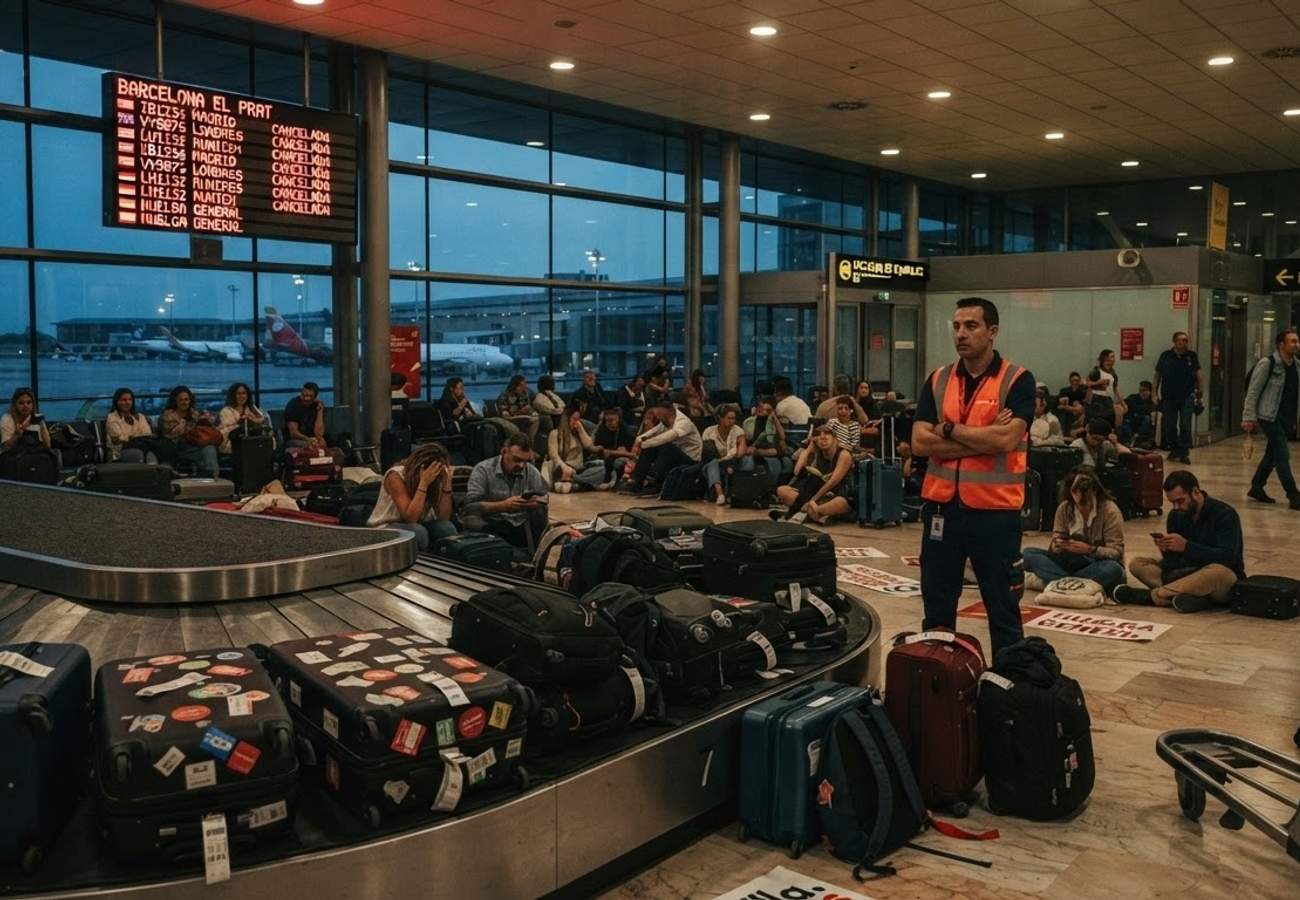
Image generated by AI
Barcelona El Prat Airport is facing a deepening operational crisis as 1,179 Groundforce employees continue an open-ended strike, resulting in hundreds of flight cancellations and thousands of delayed bags during the 2026 summer peak. The industrial action, which commenced on August 4, has severely restricted essential ground handling services, including passenger assistance and baggage coordination, forcing airlines to scramble for rebooking solutions.
The dispute has emerged at a critical juncture for Spanish aviation, coinciding with the highest passenger volumes of the year. While the Spanish government has mandated minimum service levels to prevent a total collapse of airport operations, the volatility of the situation remains high, leaving millions of holidaymakers vulnerable to sudden itinerary changes.
Labor Conflict Rooted in Workplace Safety and Staffing Shortages
The current unrest is led by the CGT, the primary union representing the Groundforce workforce in Barcelona. The union asserts that the strike is a necessary response to deteriorating working conditions and a dangerous lack of adequate staffing. According to union representatives, the physical and mental toll on ground crews has reached a breaking point due to the sheer volume of passengers processed daily.
Specific grievances cited by the CGT include:
- Excessive Workloads: Employees are reportedly managing multiple high-pressure responsibilities simultaneously.
- Staffing Deficits: High turnover rates have left remaining staff to cover gaps, leading to chronic fatigue and increased workplace stress.
- Safety Risks: The union warns that exhaustion and inadequate training for new recruits have increased the risk of operational accidents.
- Recovery Time: Workers have highlighted a lack of sufficient rest periods between demanding shifts.
Despite these claims, negotiations between Groundforce management and union leadership have failed to produce a viable agreement, leaving the strike without a scheduled end date.
Operational Fallout: Flight Cancellations and Baggage Backlogs
The impact of the industrial action has scaled significantly as the dispute entered its third week. Data provided by the strike committee indicates a substantial disruption to the airport's logistics chain, though these figures are separate from official airport administration statistics.
Reports indicate that approximately 270 flights have been cancelled as a direct result of the handling shortages. More critically for the passenger experience, the strike committee estimates that 6,000 pieces of luggage failed to travel with their owners, leading to massive backlogs in the baggage processing areas of El Prat.
For airlines, the ripple effect has been severe. The shortage of ground coordination personnel has extended aircraft turnaround times and forced carriers to implement emergency rebooking protocols to manage stranded passengers.
Impact on International Carriers and Flight Volume
Groundforce serves as a vital operational pillar at Barcelona-El Prat, providing essential turnaround and passenger processing services for a diverse portfolio of domestic, European, Middle Eastern, and Asian airlines. The scale of the dependency is evident in the projected flight volumes for the late summer window.
Industry data suggests that airlines relying on Groundforce were scheduled to execute roughly 11,600 flight movements throughout August and September. This represents a total capacity of nearly 2.4 million available seats, underscoring how a labor dispute involving a single ground handling firm can jeopardize a significant portion of the airport's total throughput.
Spanish Government Mandates Minimum Service Levels
To mitigate the chaos, Spain’s Ministry of Transport and Sustainable Mobility has intervened by imposing compulsory minimum service requirements. These mandates ensure that a baseline of operations continues, though they do not eliminate the risk of delays.
The service requirements are tiered based on the destination and available transport alternatives:
| Route Category | August Minimum Service | September Minimum Service |
|---|---|---|
| Mainland Spain to Balearic/Canary Islands, Ceuta, Melilla | 80% | 77% |
| International & Long Domestic (>5h alt transport) | 58% | 57% |
| Short Domestic (<5h alt transport) | 35% | 36% |
These regulations are designed to protect essential connectivity to Spain's outlying territories and international hubs, though they offer little relief for passengers on shorter mainland routes where service levels can drop as low as 35%.
Record Passenger Growth Intensifies Airport Pressure
The strike is occurring against a backdrop of unprecedented growth at Barcelona-El Prat. In July 2026, the airport recorded a new monthly milestone, handling 5.87 million passengers. This figure represents a 6% increase compared to July 2025, adding immense pressure to an already strained infrastructure.
Adding to the complexity, the airport also dealt with a separate technical failure in August, where an electrical outage at the control tower briefly halted all arrivals and departures. While power was restored quickly, the combination of technical glitches and labor unrest has created a high-stress environment for airport authorities and tourism stakeholders.
Why This Matters: The Traveler's Perspective
For the modern traveler, this situation highlights a critical vulnerability in aviation: the "invisible" workforce. While passengers focus on the airline, the actual movement of the plane and luggage depends on third-party ground handlers like Groundforce. When these workers strike, the airline's brand is damaged, but the passenger suffers the direct consequence of lost luggage and cancelled flights.
From a logistical standpoint, the "minimum service" mandates are a double-edged sword. While they prevent a total shutdown, they create a lottery system where some flights operate normally while others are cancelled without warning. Travelers should anticipate that "confirmed" flights may still face delays if ground crews are unavailable for the specific aircraft type or terminal.
As the dispute remains unresolved, passengers are urged to check flight status in real-time and consider carry-on luggage to avoid the current baggage processing crisis.
Related Travel Guides
Disclaimer
This article is for informational and educational purposes only. It does not constitute legal, financial, or professional advice. While we strive to provide accurate and up-to-date information, travel policies, regulations, and conditions change rapidly. Always verify information with official sources before making travel decisions. Nomad Lawyer makes no representations about the accuracy, reliability, completeness, or suitability of the information provided. Readers should consult qualified professionals for advice specific to their circumstances. The views expressed in this article are those of the author and do not necessarily reflect the views of Nomad Lawyer.
Preeti Gunjan
Contributor & Community Manager
A passionate traveller and community builder. Preeti helps grow the Nomad Lawyer community, fostering engagement and bringing the reader experience to life.
Learn more about our team →