
Austrian Airlines Secures EMAS Environmental Approval
Austrian Airlines obtains a new three-year EMAS permit, detailing resource efficiency metrics and AeroSHARK fuel-saving achievements in its 2025 report.

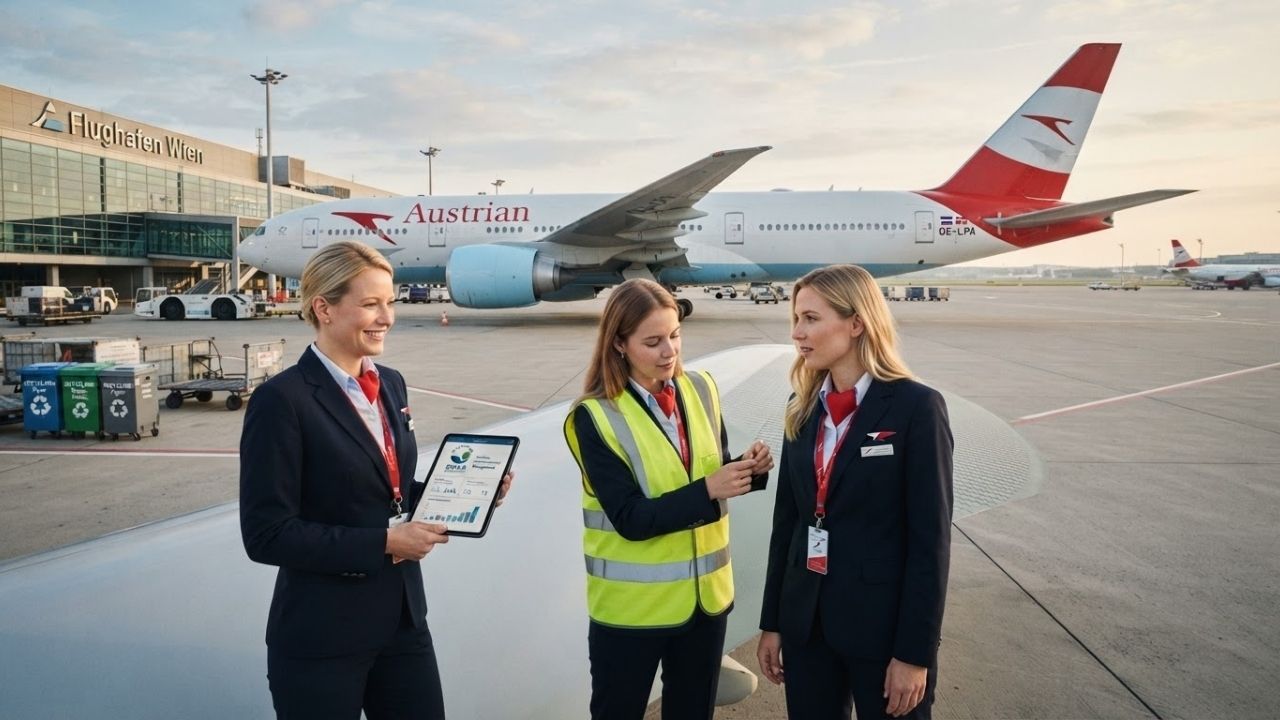
Image generated by AI
Austrian Airlines has secured a new three-year permit under the European Eco-Management and Audit Scheme (EMAS) to validate its environmental management processes. Accompanying this registration, the carrier's 2025 Environmental Report details key carbon reduction figures, including 930 tonnes of kerosene saved by utilizing sharkskin-inspired fuselage coatings.
The Local Trend Revealed
Airlines are adopting third-party ecological audit programs and aerodynamic surface technologies to verify fuel-reduction metrics. Monitored by the European Eco-Management and Audit Scheme (EMAS) and the Austrian Federal Ministry for Climate Action, Environment, Energy, Mobility, Innovation and Technology (BMK), these operational statistics define the carrier's roadmap:
- EMAS Registration: Austrian Airlines received its first full three-year EMAS permit, continuing the environmental validation framework it has maintained since 2023.
- Coordination Network: The carrier has deployed more than 40 environmental coordinators across different administrative and flight operation departments to integrate green processes.
- AeroSHARK Performance: The airline completed its first full year operating four Boeing 777-200ER aircraft fitted with AeroSHARK surface film (developed by Lufthansa Technik and BASF). The skin film reduced aerodynamic drag by approximately 0.7 percent, saving around 930 tonnes of kerosene and avoiding nearly 3,000 tonnes of carbon dioxide emissions.
- Onboard Recycling: The share of recyclable plastic and aluminum used in passenger cabins rose from 76 percent in 2024 to approximately 80 percent by the end of 2025, targeting a 100 percent recyclable share by 2027.
- Strategic Leadership: Under CEO Annette Mann, the airline's environmental report emphasizes structured audits, fleet modernization, and increased use of sustainable aviation fuel (SAF).
Local Community & Environmental Value
For the traveler, the real impact of supporting eco-responsible aviation is preserving regional heritage. Visiting family-owned vineyards (Heurigen) in Vienna's suburban districts like Grinzing to purchase wine directly from growers, and dining at independent Austrian guesthouses ensures that tourism spending stays within local neighborhood economies.
Environmental protection is advanced by choosing audited transit options. Using EMAS-validated airlines reduces overall travel impact by supporting carrier commitment to transparent resource tracking. Passengers arriving at Vienna Airport can choose the S-Bahn Line S7 rail link to reach central Vienna in 25 minutes, avoiding highway emissions and satisfying guidelines monitored by the Austrian National Tourist Office (ANTO).
Visitor Insider Tips for Vienna Travel
Travel and transit specialists recommend the following practices when flying with Austrian Airlines:
- Use City Baggage Check-In: Avoid carrying heavy bags. If flying with Austrian Airlines, check in your baggage at the city terminal inside Wien Mitte station up to 24 hours before your flight and receive your boarding pass directly.
- Choose the S7 S-Bahn over CAT: Save money on airport transfers. The local S-Bahn Line S7 train takes 25 minutes and costs under €5, compared to the faster but more expensive City Airport Train (CAT).
- Observe the Off-Peak Window: Visit Vienna in April and May or September and October. Temperatures are mild (12°C to 20°C), tourists are fewer, and you will avoid the high summer crowds and peak hotel rates.
- Sample Regional Culinary Specialties:
- Order a Wiener Melange coffee with a slice of Sachertorte at traditional coffee houses.
- Try a crispy Wiener Schnitzel served with local potato salad.
- Observe Local Customs: Clink glasses with direct eye contact when saying "Prost" (cheers). Tipping is standard practice: round up restaurant bills by about 5 to 10 percent (or to the nearest €5 or €10) when paying the waiter, rather than leaving cash on the table.
- Explore Under-the-Radar Escapes: Skip the crowded imperial apartments at Schonbrunn and visit the Hermesvilla hunting lodge. It is located inside the quiet Lainzer Tiergarten nature reserve, where wild deer roam freely along peaceful woodland paths.
Environmental Outlook
The long-term impact of Austrian Airlines' EMAS registration is the validation of airline decarbonization metrics. By combining AeroSHARK drag reduction technologies on widebody fleets with audited recycling targets, the carrier aims to establish standard operational audits for the wider Lufthansa Group network, demonstrating how fleet-wide carbon tracking supports the transition to sustainable aviation.
FAQ: Austrian Airlines EMAS & AeroSHARK Tech
What is the EMAS registration for Austrian Airlines? EMAS is the European Eco-Management and Audit Scheme, validating the airline's environmental management system under a new three-year permit.
What is the AeroSHARK technology used on JAL aircraft? AeroSHARK is a drag-reducing surface film modeled after sharkskin, deployed across Austrian Airlines' fleet of four Boeing 777-200ER aircraft.
How much fuel did the AeroSHARK coating save? The coating reduced aerodynamic drag by approximately 0.7 percent, saving around 930 tonnes of kerosene and avoiding nearly 3,000 tonnes of carbon dioxide emissions in its first year.
What is the airline's target for recyclable cabin materials? Austrian Airlines increased its recyclable cabin plastic and aluminum share to approximately 80 percent in 2025, targeting a 100 percent recyclable share by 2027.
Related Travel Guides
Disclaimer
This article is for informational and educational purposes only. It does not constitute legal, financial, or professional advice. While we strive to provide accurate and up-to-date information, travel policies, regulations, and conditions change rapidly. Always verify information with official sources before making travel decisions. Nomad Lawyer makes no representations about the accuracy, reliability, completeness, or suitability of the information provided. Readers should consult qualified professionals for advice specific to their circumstances. The views expressed in this article are those of the author and do not necessarily reflect the views of Nomad Lawyer.
Raushan Kumar
Founder & Lead Developer
Full-stack developer with 11+ years of experience and a passionate traveller. Raushan built Nomad Lawyer from the ground up with a vision to create the best travel and law experience on the web.
Learn more about our team →