
Massive Travel Chaos Paralyzes Australia and New Zealand as 716 Flight Cancellations and Delays Strand Qantas and Jetstar Passengers in Sydney and Auckland: Airline News
A devastating wave of travel chaos cripples the trans-Tasman aviation network, as Sydney, Melbourne, and Auckland suffer 16 cancellations and 700 massive flight delays.

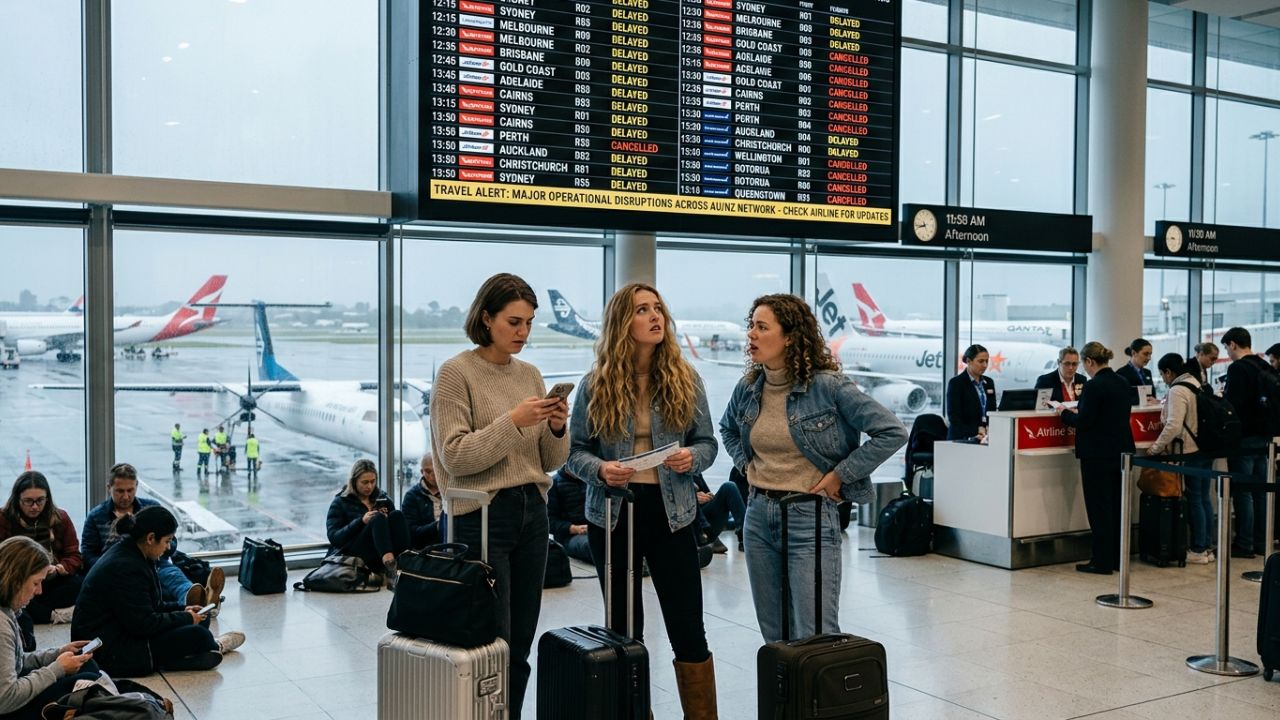
Image generated by AI
In a devastating breakdown of trans-Tasman aviation logistics, severe travel chaos has violently paralyzed operations across the primary networks of Australia and New Zealand, stranding thousands of passengers. Reported on June 20, 2026, as exhausted trans-Pacific travelers frantically monitor the latest airline news for any sign of recovery following the June 19 gridlock, the entire region absorbed an overwhelming wave of operational bottlenecks. Recording exactly 16 outright flight cancellations and an astonishing 700 compounding delays, this massive wave of airport disruptions ruthlessly strangled both domestic and international travel flows. Major regional carriers—including Qantas, Virgin Australia, Jetstar, and Air New Zealand—suffered severe schedule destruction, instantly impacting passengers at critical entry points from Sydney and Melbourne to the scenic corridors of Queenstown and Rotorua. As thousands of desperate travelers flood terminals seeking immediate rebooking, this massive dual-nation operational collapse represents today's most crucial headline in breaking aviation updates and passenger survival strategy.
By introducing direct passenger coordination and dynamic scheduling backups, the regional aviation hubs target growing passenger demand across vital commerce sectors. The choice to coordinate flight departures in phases helps to manage gate capacity, supporting the country's broader regional transportation network.
Context: The Vulnerability of the Trans-Tasman Grid
For the highly interconnected Australia-New Zealand aviation grid, the massive disruption exposes the terrifying fragility of high-density Southern Hemisphere hubs.
When 700 flights are delayed and 16 flights are canceled across core gateways, the structural resilience of the travel sector is pushed past its absolute breaking point. Major regional carriers operate heavily within these specific geographic sectors, meaning substantial scheduling pressures are instantly felt across the board. The scope of this backlog spanned massive international trans-Tasman routes and vital domestic networks. For international and domestic visitors planning itineraries through high-traffic gateways like Sydney and Melbourne, the logging of hundreds of delayed movements proves how easily interconnected schedules fail. When delays cascade across these critical chokepoints, they violently disrupt the flow of independent and group tourism, leaving travelers highly vulnerable to missed connections and destroyed vacation itineraries across the Tasman Sea.
To view live flight schedules, verify the active departure status of your specific trans-Tasman itinerary, or to track potential route restorations prior to heading to the airport, travelers must consult official aviation directories. For direct updates regarding how these massive operational failures might impact your current flight cancellations out of Sydney or Auckland, travelers should aggressively utilize the official digital portals of their respective airlines. To explore live flight tracking and monitor the exact severity of the cascading bottlenecks paralyzing the broader trans-Tasman airspace, passengers can consult the official FlightAware tracking service.
Section-Wise Breakdown: Dissecting the Network Collapse
Australia: The Melbourne and Sydney Bottlenecks
Within Australia, the absolute heaviest volume of overall flight disruptions was observed at Melbourne Tullamarine. While recording a lower total of 3 cancellations, Melbourne Airport operations were completely crushed by an exceptional 236 delayed flights. Sydney, however, suffered the most severe direct schedule destruction, enforcing exactly 6 cancellations while managing 206 compounding delays. Further north, Brisbane recorded 1 cancellation alongside a substantial tally of 130 delays, while the popular Gold Coast network registered 1 cancellation and 43 passenger delays, paralyzing the eastern seaboard.
New Zealand: The Auckland and Regional Gridlock
In New Zealand, the largest international gateway in Auckland faced intense operational pressure, executing 2 cancellations and recording 71 massive flight delays. However, the most unique operational pattern emerged in Rotorua; carriers enforced exactly 2 cancellations, yet remarkably recorded zero delays, indicating total immediate grounding of specific routes rather than rolling congestion. In the south, the critical tourist hub of Queenstown documented a single cancellation alongside 14 delays, severely threatening inbound tourism access to the deep south.
Technical Roster: Official Trans-Tasman Disruption Matrix
To ensure absolute factual accuracy regarding the exact volume of grounded flights and the specific operational damage inflicted across the primary hubs of both nations, the following matrix details the strictly verified flight data:
Official Airport Disruption Matrix (June 19, 2026)
| Airport / Hub | Verified Cancellations | Verified Delays | Operational Impact Profile |
|---|---|---|---|
| Sydney (SYD) | 6 Flights | 206 Flights | Highest cancellation rate; massive core hub congestion |
| Melbourne Tullamarine (MEL) | 3 Flights | 236 Flights | Highest total delay volume; severe turnaround failures |
| Brisbane (BNE) | 1 Flight | 130 Flights | Northern gateway scheduling constraint |
| Auckland (AKL) | 2 Flights | 71 Flights | Primary NZ international gateway disruption |
| Gold Coast (OOL) | 1 Flight | 43 Flights | Coastal tourism route instability |
| Queenstown (ZQN) | 1 Flight | 14 Flights | Southern tourist hub arrival disruptions |
| Rotorua (ROT) | 2 Flights | 0 Flights | Unique immediate grounding pattern; zero cascading delays |
Data accurately reflects the verified disruption metrics tracking the total 700 flight delays and 16 cancellations paralyzing operations across Qantas, Virgin Australia, Jetstar, and Air New Zealand.
Passenger Impact: Stranded Across the Tasman
For the thousands of tourists physically trapped inside terminals from Sydney to Queenstown, the immediate impact of this 716-flight disruption wave is severe logistical exhaustion and destroyed itineraries.
Because tighter regional schedules connecting the Gold Coast, Rotorua, and Queenstown rely entirely on the punctual arrival of incoming aircraft from mega-hubs like Melbourne, a cascading delay instantly strands passengers overnight. Travelers faced extended waiting times, agonizing missed connections, and completely revised departure schedules. The 16 outright cancellations forced passengers into a brutal competition for rebooking onto alternate Qantas or Air New Zealand flights, drastically increasing pressure on standby capacity during a heavily congested travel window.
Industry Analysis: The Statistical Probability of Failure
Aviation analysts monitoring the operational collapse across Australia and New Zealand note that cumulative data of this nature provides critical benchmarks for evaluating network reliability.
Analysts emphasize that managing 700 concurrent delays across only a handful of major hubs requires massive ground infrastructure. The sheer volume of disruptions experienced by carriers like Jetstar and Virgin Australia suggests that aircraft rotation—the ability to turn an arriving plane around for departure quickly—broke down entirely. Tourism operators utilize these specific daily operational figures to map out long-term infrastructure requirements, warning that as passenger volume increases, the statistical probability of these massive transit disruptions within the trans-Tasman corridor will only continue to rise unless significant scheduling buffers are introduced.
Actionable Advice for Surviving the Trans-Tasman Gridlock
If you are currently trapped inside Sydney, Melbourne, or Auckland airports during this operational breakdown, you must execute this strategic survival checklist immediately:
- Exploit Digital Rebooking in Major Hubs: If your flight out of Sydney or Melbourne Tullamarine is disrupted, do not wait for the physical service desk. Immediately monitor official digital display boards and use your airline's mobile app to rebook. Ground staff are overwhelmed; your app is the fastest route to securing a seat on the next Qantas or Virgin service.
- Update Contact Details for Secondary Hubs: If you are flying through Brisbane or the Gold Coast, ensure your contact details are fully updated in your booking profile. Airlines operating in these hubs primarily push sudden schedule amendments via SMS alerts or email notifications; missing these alerts means missing your rebooked flight.
- Demand Entitlements in Regional Terminals: If you are stranded in Rotorua or Queenstown, locate the dedicated carrier service desks inside the main terminal. Because fewer daily flights operate here, alternative arrangements are managed strictly by available ticketing agents. Be prepared to formally request a statement of your entitlements regarding meals and overnight accommodation as dictated by local consumer protection frameworks.
FAQ: Australia and New Zealand Flight Disruptions
How many flights were delayed or canceled across Australia and New Zealand?
Global tracking systems officially recorded exactly 700 flight delays and 16 flight cancellations across the trans-Tasman network on June 19, 2026.
Which airlines were affected by this travel chaos?
The massive scheduling backlogs severely disrupted major regional carriers, including Qantas, Virgin Australia, Jetstar, and Air New Zealand.
Which airports suffered the most severe disruptions?
Melbourne Tullamarine recorded the highest delay volume (236 delays, 3 cancellations), while Sydney suffered the highest cancellation rate (6 cancellations, 206 delays).
The Reality of Trans-Tasman Hub Gridlock
The catastrophic breakdown across the Australian and New Zealand aviation networks proves definitively that highly interconnected, trans-oceanic hubs possess a terrifying operational fragility. By effectively recording 700 delayed flights and 16 cancellations, the cascading failure quickly stranded travelers attempting to cross the Tasman Sea or connect to vital regional tourism centers. Yet, as exhausted tourists frantically attempt to secure rebookings via SMS alerts or demand accommodation vouchers in Auckland and Melbourne, they must accept a critical new reality: systemic congestion cannot be fixed quickly. Surviving this level of interconnected travel chaos now demands extreme psychological adaptability, a complete refusal to panic in long customer service lines, and the tactical discipline to instantly utilize digital rebooking tools the exact second an operational delay is announced.
Key Takeaways
- Massive Network Collapse: The trans-Tasman network suffered severe travel chaos, recording exactly 700 delays and 16 flight cancellations.
- Melbourne Delay Anchor: Melbourne Tullamarine absorbed the highest volume of delays, suffering a massive 236 delayed flights.
- Sydney Cancellations: Sydney Airport suffered the worst direct schedule destruction with 6 outright cancellations and 206 delays.
- Major Airlines Crippled: Qantas, Virgin Australia, Jetstar, and Air New Zealand all suffered severe scheduling pressures across domestic and international routes.
- Survival Strategy: Passengers are strongly urged to instantly rebook via airline apps in major hubs, and directly engage terminal staff in regional centers like Queenstown to secure required accommodations.
Related Travel Guides
Massive Travel Chaos Paralyzes Chicago O'Hare with 1,425 Disruptions
Delta Air Lines Triggers US Domestic Flight Cancellations
Australia NZ Disruption Live Updates on Reddit
Zealand) are manually sourced directly from official FlightAware tracking reports issued regarding the June 19, 2026 incident. Travelers are legally advised to constantly verify their exact departure status, explicitly audit their specific passenger rights regarding carrier-controlled cancellations versus systemic regional congestion, and maintain extreme adaptability directly via official airline applications prior to navigating the highly interconnected trans-Tasman transit network.
Disclaimer
This article is for informational and educational purposes only. It does not constitute legal, financial, or professional advice. While we strive to provide accurate and up-to-date information, travel policies, regulations, and conditions change rapidly. Always verify information with official sources before making travel decisions. Nomad Lawyer makes no representations about the accuracy, reliability, completeness, or suitability of the information provided. Readers should consult qualified professionals for advice specific to their circumstances. The views expressed in this article are those of the author and do not necessarily reflect the views of Nomad Lawyer.
Kunal K Choudhary
Co-Founder & Contributor
A passionate traveller and tech enthusiast. Kunal contributes to the vision and growth of Nomad Lawyer, bringing fresh perspectives and driving the community forward.
Learn more about our team →