
Australia's Deni Ute Muster 2026: Deniliquin Camping Sells Out as Riverina Travel Rush Intensifies
As reserved camping sells out and Cobb Highway roadworks pause, up to 20,000 travelers prepare to descend on Deniliquin for the 27th annual Deni Ute Muster across the Riverina flatlands.

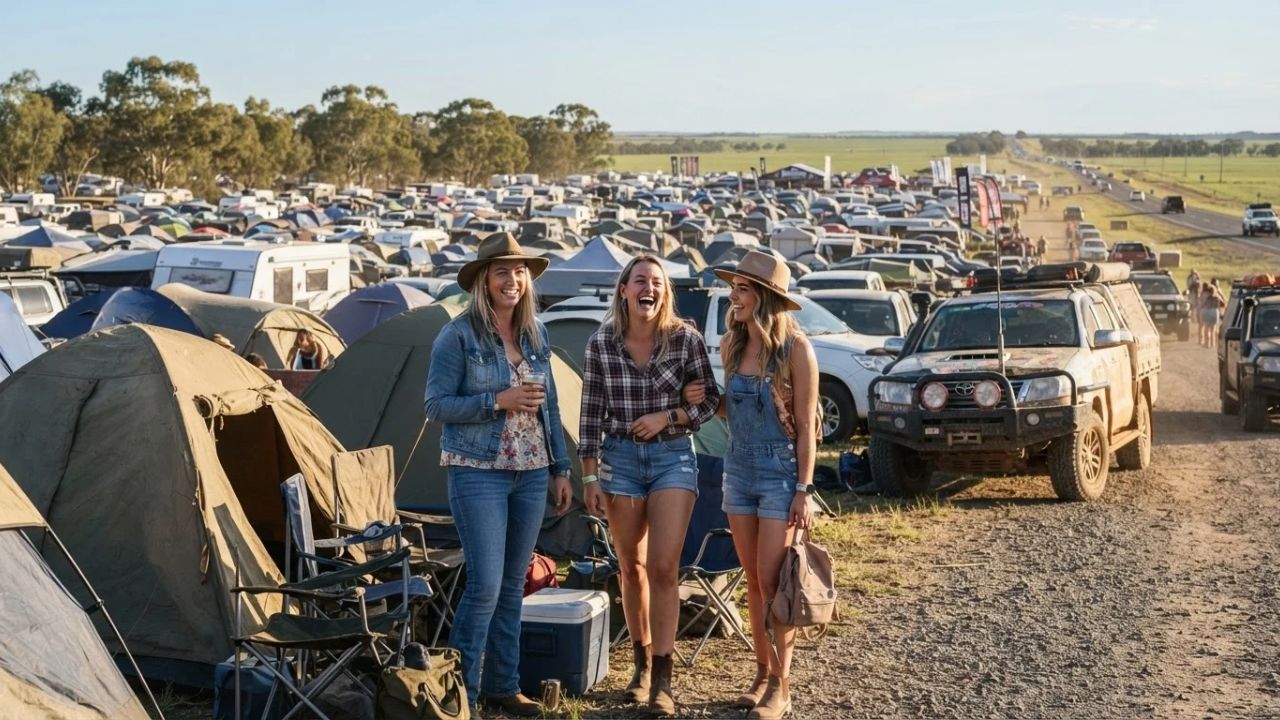
Image generated by AI
In the quiet Riverina flatlands of southwestern New South Wales, the agricultural town of Deniliquin is home to exactly 6,431 urban residents according to the Australian Bureau of Statistics 2021 Census—yet each October, its population swells by more than 310% as up to 20,000 festival-goers descend for the legendary Deni Ute Muster. Entering its 27th year on 2 and 3 October 2026, with official community festivities spanning Muster Week from 29 September through 3 October, this gathering has triggered an immense rural logistics operation. With all pre-bookable reserved campsites officially sold out, general admission camping operating strictly on a first-come basis, and state transport authorities halting regional highway resurfacing to handle the traffic, the quiet pastoral hub is preparing for one of the Southern Hemisphere's ultimate tests of outback travel infrastructure.
The 2026 Capacity Squeeze: Camping Sellouts and Highway Logistics
Absorbing an influx equal to roughly 3.1 times the resident urban population poses complex operational challenges for a regional service town. The most pressing travel consideration for the 2026 event centers on sleeping arrangements. While all reserved camping inventory is exhausted, general admission tickets still provide access to unreserved camping areas, including family zones and the renowned Ute Paddock. However, these spaces operate on a first-in, first-served system without assigned plots. Campers traveling in convoys who want to pitch tents together are officially required to arrive together through the main gates when they open at 8:00 AM on 1 October 2026. All attendees must pack down and depart the grounds by 2:00 PM on Sunday, 4 October 2026.
To alleviate accommodation shortages across local motels and caravan parks, organizers have introduced an off-site reserved family camping area at Bluey’s Paddock, operating from 28 September until 4 October. Equipped with showers, toilets, wash water, and a dedicated dump point, this satellite site enforces a strict vehicle lockdown: all vehicle movements are banned after 6:00 PM on Wednesday, 30 September. In addition, event management has established a contingency plan to activate an unreserved overflow camping zone at Bluey’s Paddock from Thursday afternoon if arrival volumes outpace main paddock capacity. A trial early-entry window was also created for 500 reserved campsite holders between noon and 6:00 PM on Wednesday, 30 September, demonstrating how organizers are actively staggering peak arrival waves.
Road access demands equal foresight from self-drive visitors. According to Transport for NSW, major resurfacing works along Hardinge Street on the Cobb Highway within Deniliquin are being paused in mid-September specifically to clear the corridor for Muster traffic, with roadworks scheduled to resume in mid-October. Despite the construction pause, temporary traffic management remains in force: motorists must observe a 40 km/h speed limit, navigate street parking restrictions, and follow local detours through Wood Street to access essential shopping at Coles and Deni Plaza.
What Makes Deniliquin and the Riverina Different: An Outback Rite of Passage
Deniliquin sits at the strategic crossroads of the Cobb and Riverina highways, roughly three and a half hours north of Melbourne, approximately eight hours southwest of Sydney, and a little over two hours from the nearest regional airport in Albury. Surrounded by expansive pastoral plains and the tranquil waterways of the Edward River (Kolety), the region offers a striking contrast to the coastal tourism hubs of eastern Australia.
The Deni Ute Muster is far more than an outdoor country music concert; it stands as an authentic celebration of Australian bush culture and rural resilience. Spanning roughly 160 hectares of open red plains, the festival grounds host adrenaline-charged ute circle work competitions, barrel racing, whip-cracking demonstrations, and record-setting gatherings of Australian-made utility vehicles fitted with oversized bull bars and towering aerials.
Crucially, the economic momentum of the festival now spreads far beyond the ticketed boundary fence. Backed by a $333,333 grant from the NSW Government’s Open Streets Program Foundation Events 2026–27, Deni Play On The Plains Festival Ltd and Edward River Council have created the "Spirit of the Muster" CBD program. On Wednesday, 30 September, Cressy Street closes entirely to vehicle traffic from 10:00 AM to 2:00 PM, drawing thousands of early-arriving travelers into the heart of town around the lush Waring Gardens precinct. This street activation ensures that visitor spending directly supports independent country bakers, butchers, saddleries, and family-owned hardware stores before headline musical acts take the main stage.
Visitor Insider Tips: Navigating the Deni Muster Like a Seasoned Bush Camper
Traveling to a remote outback event of this scale requires practical self-reliance and strict adherence to festival ground rules:
- Bring Your Own Drinking Water: A vital rule that catches unprepared visitors off guard: potable drinking water is not supplied in the general camping paddocks. While basic utility water is available for amenities, all campers must carry adequate drinking water—a minimum of four to five liters per person per day—in portable jerry cans or self-contained caravan tanks.
- Observe Vehicle Lockdown Rules: Once your vehicle enters the camping paddocks, it cannot leave and re-enter until the event officially concludes. If you plan to drive into Deniliquin for supplies during the weekend, park your vehicle in the external day-parking lot and enter the campground on foot, or make use of designated community shuttle buses. For the Thursday night entertainment, non-camping ticket holders are strictly barred from driving private cars onto the site and must use official event transport.
- Explore Regional Fallback Bases: With Deniliquin lodging under immense pressure, base your stay in the twin river towns of Echuca Moama, located approximately one hour south along the Cobb Highway. Recommended by Visit NSW, Echuca Moama provides diverse accommodation options, including Murray River houseboats, historic motels, holiday parks, and cabin resorts. Alternatively, check inventory in the quiet intermediate township of Mathoura, nestled directly between Deniliquin and Moama, which features uncrowded caravan parks and peaceful bush camping grounds.
- Coach Travel Alternatives: Travelers without private four-wheel drives can utilize booked regional coach services operated by NSW TrainLink. Scheduled coach routes connect Deniliquin, Mathoura, Moama, and Echuca directly to rail hubs in Albury and Wagga Wagga. Advance seat reservations are mandatory, so secure your booking weeks before departure.
- Pack for Desert Temperature Swings and Red Dust: The 160-hectare festival terrain consists primarily of hard-packed clay and loose gravel that transforms into slick mud during spring showers. Pack sturdy, water-resistant work boots, wide-brimmed felt hats, and heavy-duty ground sheets. While October days across the Riverina often bring warm sunshine, desert nighttime temperatures frequently plummet below 5°C, requiring heavy wool bedding and thermal layers for comfortable tent camping.
Cultural and Environmental Context: Red Gum Forests, River Health, and Community Resilience
The massive temporary population influx shines a spotlight on the environmental stewardship of the Murray-Darling basin. Deniliquin’s lifeblood is the Edward River (Kolety), an anabranch of the Murray River that weaves through immense stands of ancient river red gums (Eucalyptus camaldulensis). Nearby sanctuaries protected by the NSW National Parks and Wildlife Service, including Murray Valley National Park, safeguard critical wetlands that provide breeding habitats for threatened woodland birds and native fish like the Murray cod.
Operating a 20,000-person gathering in a fragile semi-arid farming environment requires rigorous environmental management. Festival organizers implement extensive waste separation, aluminum can collection drives, and blackwater disposal points to prevent contaminants from entering local river catchments.
For the resident farming community of the Riverina, the Deni Ute Muster represents a lifeline of cultural pride and economic renewal. Having navigated prolonged agricultural drought cycles and shifting commodity markets, local sporting clubs, volunteer fire brigades, and charity groups manage festival gates and catering stalls to raise vital community funds. By respecting total fire bans, taking every scrap of rubbish out of the paddocks, and patronizing small town retailers, visitors forge a genuine connection with the pastoral custodians whose hard work keeps regional Australia thriving.
FAQ: Visiting the Deni Ute Muster 2026
When do campgrounds officially open for general ticket holders?
Campgrounds officially open at 8:00 AM on Thursday, 1 October 2026. All attendees must pack up their campsites and exit the festival grounds by 2:00 PM on Sunday, 4 October 2026.
Is drinking water provided inside the festival camping grounds?
No. Potable drinking water is not provided within the camping paddocks. Campers must carry their own fresh drinking water supply, with authorities recommending at least four to five liters per person each day.
Can I drive my car in and out of the campground during the weekend?
No. Vehicles driven into the camping areas are locked down and cannot leave until the festival finishes. If you require vehicle mobility during the event, use the external day-parking area.
Where should I stay if all Deniliquin accommodations are booked out?
Check accommodation in Echuca Moama, situated one hour south along the Cobb Highway, or search for caravan parks and campgrounds in Mathoura, halfway between Deniliquin and Moama.
Under the vast starry skies of the Riverina, the rumble of engines and the warmth of bush hospitality turn a quiet farming plain into an unforgettable celebration of outback soul.
Related Travel Guides
Disclaimer
This article is for informational and educational purposes only. It does not constitute legal, financial, or professional advice. While we strive to provide accurate and up-to-date information, travel policies, regulations, and conditions change rapidly. Always verify information with official sources before making travel decisions. Nomad Lawyer makes no representations about the accuracy, reliability, completeness, or suitability of the information provided. Readers should consult qualified professionals for advice specific to their circumstances. The views expressed in this article are those of the author and do not necessarily reflect the views of Nomad Lawyer.
Raushan Kumar
Founder & Lead Developer
Full-stack developer with 11+ years of experience and a passionate traveller. Raushan built Nomad Lawyer from the ground up with a vision to create the best travel and law experience on the web.
Learn more about our team →