
Safe Streets and Solo Autonomy: How Women Are Redefining Independent Travel Across South Korea
As women command 84% of global solo travel bookings, South Korea welcomes 10.7 million visitors in six months, with safe streets, high-speed rail, and solo-dining culture fueling independent journeys.

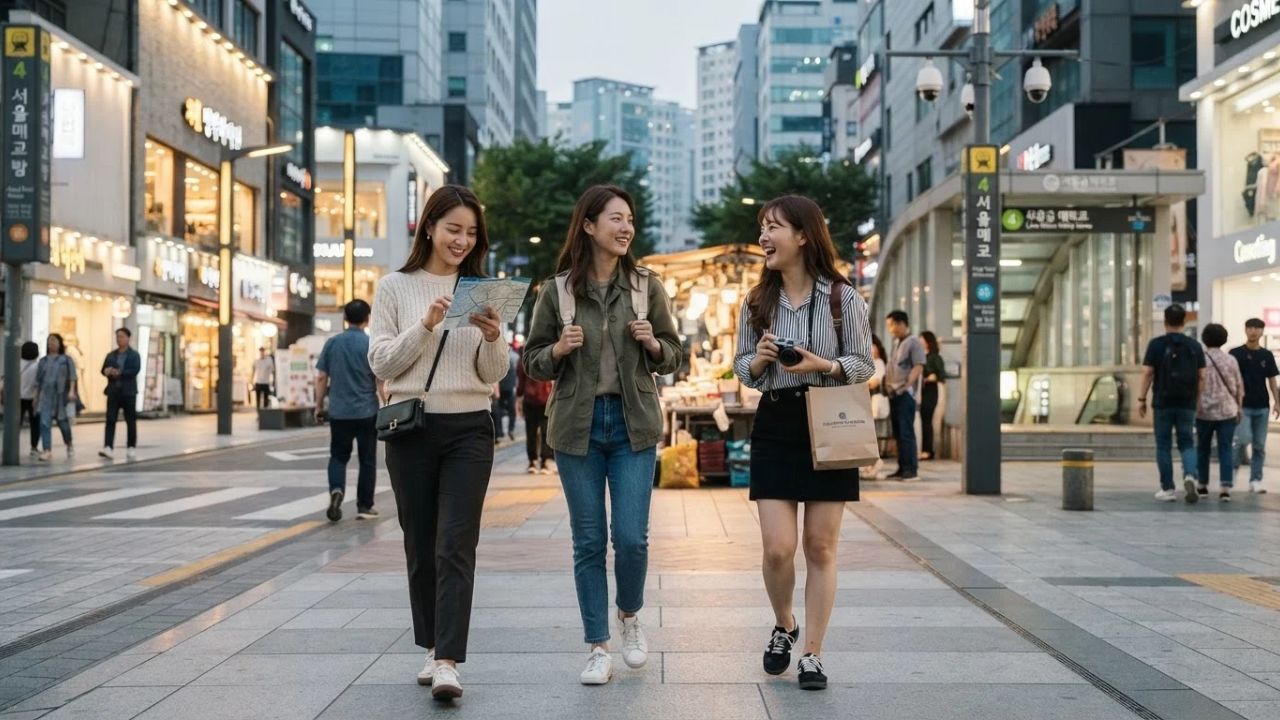
Image generated by AI
While solo exploration was historically portrayed as a nerve-racking endeavor weighed down by safety warnings, independent women now command an astonishing 84 percent of all individual travel bookings worldwide across a $549 billion market—and nowhere is this autonomy more visible than in South Korea. In the first half of 2026 alone, the country welcomed 10.7 million international arrivals, representing a 21.3% year-on-year surge, with unaccompanied female travelers comprising 42% of all non-group foreign arrivals moving through Incheon International Airport. Supported by ubiquitous 5G connectivity, exceptionally low crime rates, and an urban fabric engineered for personal security, these travelers are logging average stays of 9.4 days—more than double the 4.2 days typical of organized tour groups—and fundamentally reshaping how independent adventurers navigate East Asia.
The Solo Travel Revolution: How Safety and Cultural Autonomy Power East Asia
The explosive growth of solo female tourism reflects a profound shift in consumer psychology. Behavioral studies show that 85% of women choose to travel alone primarily to gain personal autonomy and scheduling freedom, while 81% seek to break away from routine domestic and workplace pressures. Furthermore, 76% dedicate their solo itineraries entirely to wellness, mental restoration, and self-care. Rather than waiting for companions, 63% of first-time solo female travelers plan multiple independent journeys per year, with 45% embracing short, highly targeted micro-trips that blend remote professional work with cultural discovery.
This demographic wields formidable economic clout. Unlike low-budget backpacker models of the past, independent women prioritize premium lifestyle experiences, allocating approximately 45.5% of their total travel budgets to shopping and 39.5% to high-end local gastronomy. In South Korea, where nearly 45% of all independent foreign visitors are young adults between the ages of 18 and 34, destination choices are heavily influenced by the global soft power of Korean television, contemporary music, advanced skincare innovations, and modern fashion.
Aviation and transit hubs across the region reflect this momentum. In neighboring Southeast Asia, Malaysia recorded 21.2 million foreign arrivals during the first six months of 2026—a 2.5% increase over 2025—with solo female travelers similarly accounting for 42% of non-group arrivals at Kuala Lumpur International Airport. Across major Asian hubs, 58% of solo female visitors originate from nearby East and Southeast Asian markets, while long-haul travelers from Western nations make up 32%.
Seasonal booking dynamics demonstrate remarkable flexibility: 61% of solo female journeys occur during shoulder seasons (March to May and September to November), allowing travelers to secure a 28% reduction on average airfares and hotel rates while generating a 34% higher occupancy rate for regional boutique accommodations during off-peak periods. Crucially, 59% of first-time solo visitors return to the same country within 24 months, with 47% exploring at least two distinct provinces per journey. High-speed rail lines and domestic flights facilitate this dispersal, with 68% of solo women relying on internal mass transit and spending an average of $210 per trip exclusively on domestic travel. As promoted by the Korea Tourism Organization, destination authorities are responding by tailoring municipal services to support independent explorers.
What Makes South Korea Different: The Architecture of Safe Autonomy
What elevates South Korea above almost any other global destination for solo female travelers is its comprehensive municipal safety infrastructure. With 48% of independent women identifying personal security as their primary criterion when selecting a country, South Korea delivers an environment where walking alone through city streets at midnight feels completely routine. Metropolitan centers feature high-density public lighting, visible emergency call pillars, and round-the-clock convenience stores on virtually every block that double as designated emergency safe havens.
Equally transformative is the rapid evolution of Korean dining culture. Traditionally, communal eating formed the cornerstone of Korean social life, making solitary dining an awkward pursuit. Today, the nationwide honbap (solo eating) movement has revolutionized the culinary sector. Restaurants across Seoul, Busan, and Daegu now cater explicitly to individual patrons, offering single-diner counter seating, automated self-ordering touchscreen kiosks, and individual portion sizes for traditional stews, noodles, and even tabletop barbecue.
The country's compact geography allows solo travelers to shift seamlessly between contrasting regional environments. Within two and a half hours, high-speed KTX trains operated by KORAIL transport travelers from the neon corridors of Seoul to the coastal fish markets and cliff walks of Busan. In the capital, the historic Joseon-dynasty palace architecture of Changdeokgung, recognized on the UNESCO World Heritage Centre register, offers peaceful secret gardens tucked directly behind contemporary government avenues. Further south, the volcanic coastline of Jeju Island provides walking trails and ocean sanctuaries where independent travelers can immerse themselves in nature without vehicular congestion.
Visitor Insider Tips: Navigating South Korea as an Independent Female Traveler
To maximize your journey while navigating the local culture with ease, follow these practical insider recommendations:
- Essential Navigation Apps: Google Maps does not provide accurate walking or transit directions in South Korea due to national spatial data regulations. Prior to landing, download Naver Map or KakaoMap (both available in English) for real-time metro exits, bus arrival tracking, and walking directions. Install Kakao T for safe, verified taxi hailing without language barriers, and pick up a rechargeable T-money card at Incheon Airport to tap through subways, city buses, and convenience stores nationwide.
- Solo Dining Mastery (Honbap): Look for storefront signs displaying "1인분 가능" (single portion available) or self-service ordering kiosks. Neighborhoods like Hongdae, Sinchon, and Ikseon-dong in Seoul feature dedicated solo-diner restaurants serving individual hotpots (shabu-shabu), stone-pot bibimbap, and steaming bowls of seolleongtang (ox-bone soup). If you crave Korean pork belly barbecue (samgyeopsal), many neighborhood venues will welcome a solo guest provided you order two portions—an easy feat given the exceptional flavor.
- Strategic Neighborhood Bases: In Seoul, base yourself in Insadong or Anguk to walk among peaceful traditional hanok tearooms, artisan galleries, and royal palaces, or choose Yeonnam-dong near Hongdae for boutique cafes, creative studios, and easy airport rail access. In Busan, stay near Gwangalli Beach or Haeundae for scenic oceanfront running tracks and illuminated bridge views. On Jeju, base yourself in Aewol for dramatic coastal sunsets or near Seongsan to climb volcanic tuff cones at sunrise.
- Etiquette and Social Nuances: When handing over payment cards, passports, or transit passes, always offer them with both hands, or with your right hand supported lightly at the wrist or elbow by your left hand. Avoid speaking loudly on subway trains, and never occupy designated priority seats reserved for pregnant women, elderly citizens, or disabled passengers, even on empty train cars.
- Rejuvenation at Traditional Bathhouses: Experience authentic restorative self-care by visiting a traditional Korean bathhouse (jjimjilbang). Facilities across Seoul and Busan provide female-only mineral baths, heated clay therapy rooms, and traditional exfoliating scrubs (seshin) performed by experienced female practitioners, offering an affordable, tranquil retreat after intensive walking days.
Cultural and Environmental Context: Community Roots, Female Cooperatives, and Mindful Travel
The rise of independent female tourism has fostered a deep alignment with sustainability and community empowerment. Survey data shows that 36% of solo female travelers actively verify a provider’s environmental credentials before booking, while 34% prioritize patronizing female-owned and locally run enterprises.
On the semi-tropical shores of Jeju Island, this mindset connects directly with the living cultural heritage of the Haenyeo—traditional female free-divers who harvest abalone, sea urchins, and conch without oxygen gear. Operating through centuries-old village cooperatives, the Haenyeo enforce strict seasonal harvesting bans and ecological limits to protect marine biodiversity. Solo travelers walking the coastal Jeju Olle Trail directly sustain these coastal communities by purchasing fresh seafood meals prepared at modest oceanfront huts run by retired diving grandmothers.
Moreover, the high rate of inter-regional route dispersion—with 47% of independent women traveling beyond the capital—distributes economic revenue into secondary agricultural and artisan towns. Visitors staying in restored wooden guesthouses in Jeonju or exploring organic green tea fields in Boseong help preserve traditional architectural methods and regional crafts. By engaging respectfully with local customs, traveling during quiet shoulder seasons, and championing independent regional producers, solo female travelers are leading a transition toward low-impact, highly rewarding cultural tourism across South Korea.
FAQ: Solo Travel in South Korea 2026
Is South Korea safe for first-time solo female travelers?
Yes. South Korea consistently ranks among the safest countries globally, with well-lit streets, reliable 24-hour public surveillance, low crime rates, and safe public transportation options available throughout the day and night.
Do international travelers need a visa to enter South Korea?
Travelers from visa-exempt countries, including the United States, Canada, the European Union, and the United Kingdom, can enter visa-free for tourism, but must obtain an approved K-ETA (Korea Electronic Travel Authorization) online before departure.
Can solo travelers easily dine alone in restaurants across South Korea?
Yes. The widespread honbap (solo dining) movement means many restaurants feature single-seat counter dining, touchscreen ordering kiosks, and single-serving menus, particularly in major cities like Seoul and Busan.
Which navigation app should international visitors use in South Korea?
Google Maps has restricted functionality in South Korea. Visitors should install Naver Map or KakaoMap, which provide English-language walking directions, live transit tracking, and accurate metro navigation nationwide.
Stepping alone through the quiet palace courtyards of Seoul or along the breezy coastlines of Jeju proves that the true joy of solo travel is discovering the boundless strength of your own footsteps.
Related Travel Guides
Disclaimer
This article is for informational and educational purposes only. It does not constitute legal, financial, or professional advice. While we strive to provide accurate and up-to-date information, travel policies, regulations, and conditions change rapidly. Always verify information with official sources before making travel decisions. Nomad Lawyer makes no representations about the accuracy, reliability, completeness, or suitability of the information provided. Readers should consult qualified professionals for advice specific to their circumstances. The views expressed in this article are those of the author and do not necessarily reflect the views of Nomad Lawyer.
Raushan Kumar
Founder & Lead Developer
Full-stack developer with 11+ years of experience and a passionate traveller. Raushan built Nomad Lawyer from the ground up with a vision to create the best travel and law experience on the web.
Learn more about our team →