
The Airfare Squeeze: Inside Asia's October 2026 Jet Fuel Shock and How IndiGo's Surcharges Impact Travelers

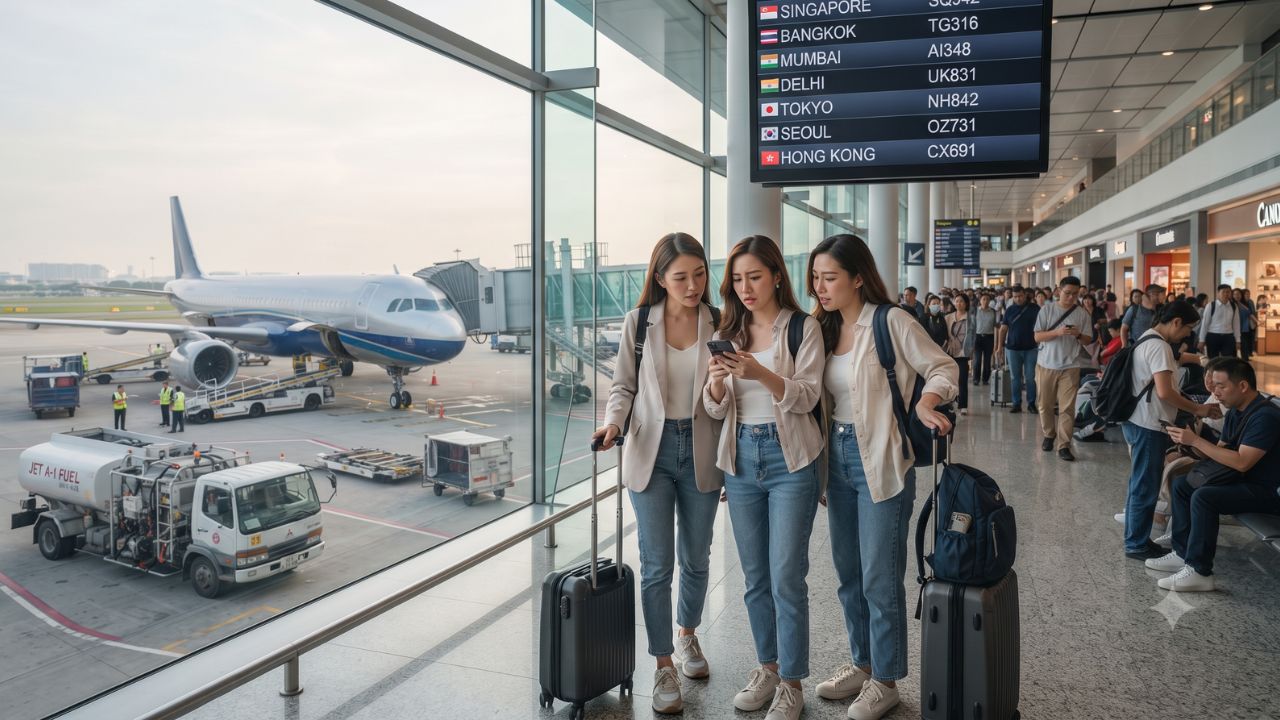
Fuel expenditures have abruptly spiked to consume up to 42% of total airline operating expenses across Asia this October 2026, triggering immediate distance-tiered fare increases on millions of passenger tickets. Driven by regional refining bottlenecks and middle distillate supply deficits, benchmark aviation turbine fuel (ATF) prices in Singapore reached US$188.60 per barrel—a staggering year-on-year surge exceeding 120%. In response, major carriers across South, East, and Southeast Asia have reintroduced aggressive fuel surcharge matrices, pushing spot ticket prices on select domestic and regional routes up by as much as 68%.
From India's market leader IndiGo to full-service flag carriers like Cathay Pacific, Japan Airlines (JAL), and Singapore Airlines, commercial airlines are passing elevated procurement costs directly to consumers. Understanding this sudden tariff restructuring is vital for holidaymakers, corporate travelers, and travel planners mapping autumn and winter itineraries across the Asia-Pacific region.
The Refining Crunch: What Is Driving Asia's Aviation Turbine Fuel Surge
Unlike raw crude oil, aviation kerosene (Jet A-1) is heavily dictated by regional refining crack spreads—the profit margin refiners earn when processing crude oil into middle distillates. According to global energy benchmark data from the International Air Transport Association (IATA), the worldwide average jet fuel index stood at US$185.43 per barrel (US$1.17 per liter) entering the final quarter of 2026.
However, the Asia-Pacific region bears a localized premium. Elevated freight insurance and regional supply constraints pushed Singapore spot prices to US$188.60 per barrel, outpacing European (US$187.30/bbl) and North American (US$184.90/bbl) averages.
In standard operational environments, fuel accounts for 25% to 30% of an airline's cost structure. Under current conditions, aviation fuel represents between 35% and 42% of total operational outlays. Because low-cost carriers operate on slim profit margins, unhedged airlines have been forced to immediately revise passenger tariff sheets to avoid unsustainable operational cash burn.
Sub-Regional Fare Adjustments: A Pan-Asian Breakdown
The impact of rising jet fuel costs has reverberated across every major aviation corridor in Asia, reshaping ticket pricing from domestic commuter routes to long-haul transpacific journeys.
South Asia: IndiGo's Multi-Tier Surcharge Framework
In India, state-owned energy retailers—including IOCL, BPCL, and HPCL—raised Delhi ATF prices from INR 121,000 per kiloliter to INR 137,000 per kiloliter on October 1, marking a month-on-month jump of over 14%.
IndiGo, which commands nearly two-thirds of India's domestic passenger traffic, enacted a comprehensive fuel surcharge restructuring effective at 00:01 hours on October 6, 2026. The distance-based fee applies across its entire network:
- Domestic Flights (Up to 500 km): INR 375
- Domestic Flights (501 to 1,000 km): INR 600
- Domestic Flights (1,001 to 1,500 km): INR 900
- Domestic Flights (1,501 to 2,000 km): INR 1,150
- Domestic Flights (Above 2,000 km): INR 1,300
- SAARC Regional Routes (>500 km): INR 1,000 to INR 3,000
- Southeast Asia, GCC & East Asia: INR 5,500
- African Routes: INR 6,000
- European Long-Haul Routes: INR 10,000
The Directorate General of Civil Aviation (DGCA) noted immediate fare surges across high-density domestic routes. Spot airfares on the Delhi–Hyderabad corridor climbed 68%, while Mumbai–Kolkata jumped 51%, Bengaluru–Delhi rose 44%, and Chennai–Mumbai increased 39%. Competitors including Air India, Vistara, SpiceJet, and Akasa Air have similarly recalibrated baseline tariffs.
East Asia: Japan, South Korea, and Hong Kong Tariff Adjustments
In East Asia, civil aviation authorities and legacy carriers adjusted distance bands in line with Singapore kerosene benchmarks:
- Hong Kong: Cathay Pacific implemented a 34% increase in medium- and long-haul fuel surcharges following approval from the Civil Aviation Department.
- Japan: Japan Airlines (JAL) and All Nippon Airways (ANA), operating under tariff guidelines from the Ministry of Land, Infrastructure, Transport and Tourism (MLIT), increased long-haul fuel surcharges by up to ¥33,000 (US$220) per intercontinental segment.
- South Korea: Korean Air and Asiana Airlines escalated international fuel surcharges by two complete distance tiers.
Southeast Asia: ASEAN Regional Pressures
Across Southeast Asia's dense aviation network, Singapore Airlines enacted a 12% dynamic surcharge revision, while Malaysia Airlines raised international fixed leg fees by 15% and Thai Airways implemented an 18% surcharge adjustment. In the Philippines, the Civil Aeronautics Board (CAB) enforced its Level 6 fuel surcharge matrix for October, permitting carriers like Cebu Pacific and Philippine Airlines to raise passenger fees.
Regional Jet Fuel Benchmarks & Airline Operational Metrics (October 2026)
| Region / Economic Metric | Benchmark Level | Operational Impact | Consumer Fare Effect |
|---|---|---|---|
| Global Average Jet Fuel Index | US$185.43 / barrel | +120% YoY increase across international markets | Upward pressure on global long-haul tariffs |
| Asia-Pacific Spot Price (Singapore) | US$188.60 / barrel | Highest regional benchmark worldwide | Triggers mandatory airline surcharge reviews |
| European Benchmark (CIF NWE) | US$187.30 / barrel | High regional refining premiums | Increases transatlantic and Asia–Europe fares |
| North American Index | US$184.90 / barrel | Balanced refining capacity buffers | Surcharges concentrated on long-haul routes |
| Airlines Fuel Share of OpEx | 35% – 42% (Normal: 25%–30%) | Compresses operating margins for unhedged LCCs | Forces rapid distance-tiered fee structures |
| Average Passenger Load Factor | 82.4% Across Asia-Pacific | Airlines prioritize route yield over seat dumping | Reduced promotional flash sales |
| Surcharge Share of Total Ticket | 10%–14% (Short) / 24%–28% (Long) | Surcharges now form a major percentage of base fare | Higher overall total booking checkout totals |
Visitor Insider Tips
- Shift to High-Speed Rail on Short Corridors: On high-demand domestic routes under 500 kilometers—such as Delhi–Jaipur or Tokyo–Osaka—opt for high-speed rail (Vande Bharat Express in India or Shinkansen in Japan). Train fares remain immune to aviation fuel surcharges, offering predictable pricing and downtown-to-downtown convenience.
- Book Flights with Extended Lead Times: Spot fares booked within 14 days of departure now carry steep fuel surcharge penalties. Booking four to six weeks in advance secures lower baseline fare buckets, partially mitigating added surcharge tiers.
- Maximize Frequent Flyer Miles: Frequent flyer reward redemptions often calculate mileage based on distance rather than fluctuating fuel surcharges. Check award seat availability on partner alliances (Star Alliance, oneworld) to bypass elevated cash airfares.
- Unbundle Low-Cost Carrier Extras: When flying low-cost carriers like IndiGo or Cebu Pacific, decline bundled packages (checked bags, seat selection, onboard meals) if traveling light to balance out compulsory fuel fees.
Cultural and Environmental Context
The current fuel crunch intersects with Asia's evolving aviation sustainability mandates. Several governments are introducing Sustainable Aviation Fuel (SAF) blending mandates, including Singapore's 1% SAF requirement starting in 2026, South Korea's 1% international flight mandate, and Japan's 10% blending target by 2030.
While SAF delivers dramatic lifecycle greenhouse gas reductions, it currently commands a price two to four times higher than conventional Jet A-1 kerosene. In response, regional carriers are accelerating fleet modernization programs, retiring older Boeing 737 NGs and Airbus A320ceos in favor of Airbus A320neo, A350, and Boeing 787 Dreamliner aircraft that reduce per-seat fuel burn and carbon emissions by 15% to 25%.
FAQ: Asian Airline Fuel Surcharges & Fares 2026
Why did IndiGo and Asian airlines raise fuel surcharges in October 2026?
Surging jet fuel benchmark prices in Singapore (US$188.60/bbl) and a 14% month-on-month ATF price hike in India pushed fuel costs to over 40% of airline operating expenses.
How much extra will domestic flights in India cost due to surcharges?
IndiGo's distance-tiered surcharge adds between INR 375 for short flights under 500 km up to INR 1,300 for domestic routes exceeding 2,000 km.
Are long-haul international flights from Asia affected?
Yes. Long-haul surcharges have risen significantly, adding up to INR 10,000 on IndiGo European routes, ¥33,000 (US$220) on JAL/ANA long-haul sectors, and a 34% hike on Cathay Pacific.
Will ticket prices decrease if global oil prices drop?
Airline fuel surcharges historically lag spot market price reductions by one to two months due to monthly fuel procurement contract cycles and regulatory approval schedules.
As energy markets reshape the economics of the sky, savvy travelers will navigate Asia's skies by planning ahead, embracing regional rail, and timing their bookings with care.
Related Travel Guides
Disclaimer
This article is for informational and educational purposes only. It does not constitute legal, financial, or professional advice. While we strive to provide accurate and up-to-date information, travel policies, regulations, and conditions change rapidly. Always verify information with official sources before making travel decisions. Nomad Lawyer makes no representations about the accuracy, reliability, completeness, or suitability of the information provided. Readers should consult qualified professionals for advice specific to their circumstances. The views expressed in this article are those of the author and do not necessarily reflect the views of Nomad Lawyer.
Raushan Kumar
Founder & Lead Developer
Full-stack developer with 11+ years of experience and a passionate traveller. Raushan built Nomad Lawyer from the ground up with a vision to create the best travel and law experience on the web.
Learn more about our team →