
Aviation Updates: Typhoon Mekkhala and Tropical Storm Higos Trigger Catastrophic Asia Travel Chaos as Air China, Japan Transocean Air, China Eastern, ANA Wings, Hainan Airlines, IndiGo, Singapore Airlines and Batik Air Record 290 Flight Cancellations and 3,781 Delays Across Japan, China, Singapore, Indonesia, India, Hong Kong, Malaysia and More on June 25, 2026
Typhoon Mekkhala and Tropical Storm Higos have triggered catastrophic flight disruptions across Asia on June 25, 2026, with 290 cancellations and 3,781 delays recorded across Japan, China, Singapore, Hong Kong, Indonesia, India, Malaysia and the UAE — led by Air China (42 cancellations, 184 delays), Japan Transocean Air (39 cancellations), China Eastern (33 cancellations, 382 delays), ANA Wings (23 cancellations), IndiGo (168 delays), and Singapore Airlines (105 delays), with Naha Airport recording the highest single-airport cancellation count of 30 and Kuala Lumpur recording 334 delays.

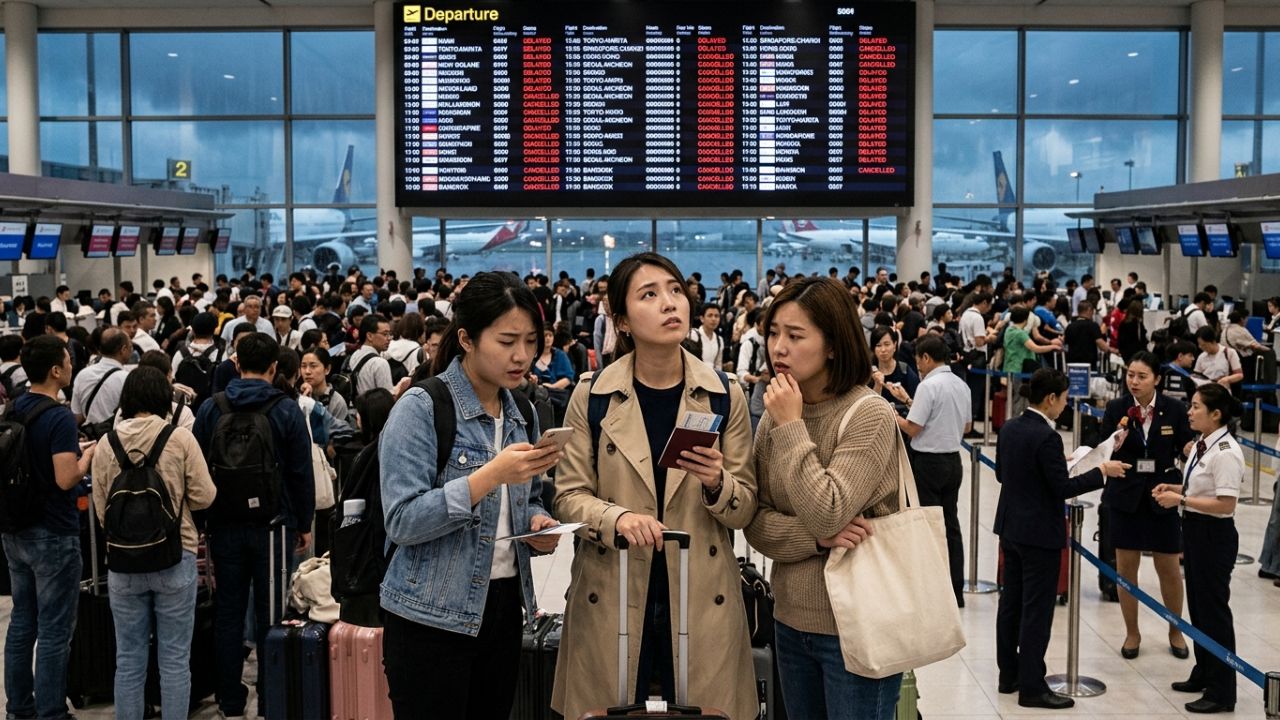
Image generated by AI
Aviation Updates: Typhoon Mekkhala and Tropical Storm Higos Trigger Catastrophic Asia Travel Chaos as Air China, Japan Transocean Air, China Eastern, ANA Wings, Hainan Airlines, IndiGo, Singapore Airlines and Batik Air Record 290 Flight Cancellations and 3,781 Delays Across Japan, China, Singapore, Indonesia, India, Hong Kong, Malaysia and More on June 25, 2026
When a typhoon moves northward toward the Nansei Islands and a tropical storm tracks simultaneously toward eastern Japan, the aviation network across the most densely connected airspace on earth does not simply slow down — it fractures. On June 25, 2026, that fracture became one of the most disruptive single-day aviation events Asia has seen this year.
Breaking airline news from airport operational monitoring systems and FlightAware tracking data confirms that Asia's aviation network has been struck by a catastrophic travel chaos event on June 25, 2026, with a total of 290 flight cancellations and 3,781 flight delays recorded across nine countries — Japan, China, Singapore, Hong Kong, the UAE, the Philippines, Malaysia, Indonesia, and India — as the combined atmospheric force of Typhoon Mekkhala (taifū No. 7), positioned south of Okinawa and moving northward toward the Nansei Islands, and Tropical Storm Higos (taifū No. 8), forecast to approach eastern Japan later in the week, simultaneously compressed aviation operations across the region's most critical hubs. The disruption touched passengers at airports spanning Tokyo Haneda, Naha, Miyako, Ishigaki, Singapore Changi, Hong Kong International, Kuala Lumpur, Jakarta, Delhi, Mumbai, Beijing Daxing, Shanghai, Guangzhou, Shenzhen, Chengdu, Chongqing, Dubai, and Manila — producing an airport disruption event of truly continental scale.
Among the airlines absorbing the heaviest operational punishment were Air China — which recorded the highest cancellation count of any single carrier with 42 cancellations and 184 delays — Japan Transocean Air (39 cancellations, 28 delays), China Eastern (33 cancellations and a staggering 382 delays — the highest delay count of any airline in the region), ANA Wings (23 cancellations, 34 delays), Hainan Airlines (22 cancellations, 132 delays), IndiGo (168 delays), Singapore Airlines (105 delays), Batik Air (19 cancellations, 26 delays), SpiceJet (13 cancellations, 54 delays), Air Do (12 cancellations, 17 delays), Garuda Indonesia (8 cancellations, 23 delays), and Cathay Pacific (49 delays). The scale and geographic breadth of the disruption confirm June 25 as one of the most consequential single-day aviation disruption events of the 2026 northern hemisphere summer season.
Expanded Overview: Two Tropical Systems, One Continental Aviation Crisis
The meteorological trigger for the June 25 Asia aviation crisis is a consecutive wave of severe tropical cyclone activity over the western Pacific — a pattern that has historically been among the most operationally destructive forces that Japan's regional aviation network can face. Typhoon Mekkhala, designated taifū No. 7 by the Japan Meteorological Agency, was located south of Okinawa on June 25 and tracking northward toward the Nansei Islands chain, which stretches from Kyushu to Taiwan and hosts several of Japan's most cyclone-vulnerable regional airports, including Naha, Miyako, and Ishigaki. Mekkhala was expected to remain strong as it approached the Nansei Islands from approximately Thursday through Saturday, bringing sustained strong winds, heavy rainfall, and the low-visibility conditions that ground regional aviation operations at exposed island airports.
Simultaneously, Tropical Storm Higos, designated taifū No. 8, was forecast to approach eastern Japan later in the week — creating a dual-cyclone pressure scenario that placed aviation planners and airline operations centers across Japan in the position of managing active weather impacts at southern island airports while planning preemptively for potential disruptions at mainland airports in the approaching Higos track.
In China, the disruption drivers are distinct but no less operationally significant. Beyond any weather contribution, Chinese aviation is facing a combination of internal logistical bottlenecks, rising global jet fuel prices, and broader geopolitical tensions that have collectively produced operational challenges across the major aviation hubs of Beijing, Shanghai, Guangzhou, Shenzhen, Chengdu, and Chongqing — compressing schedules, increasing turnaround times, and generating the cascade of delays that China Eastern's 382-delay count most visibly reflects.
Section-Wise Breakdown: The Worst-Hit Airports Across Asia
Naha Airport, Japan — Highest Single-Airport Cancellation Count
Naha Airport on Japan's Okinawa island recorded the most severe cancellation impact of any airport in Asia on June 25, with 30 cancellations and 75 delays — a disruption level that effectively removed a significant portion of Okinawa's daily air connectivity from the operational schedule. Naha is the primary aviation gateway for the Okinawa island chain and handles a substantial volume of domestic Japanese tourist traffic as well as regional Asian leisure travel. The typhoon's approach toward the Nansei Islands placed Naha directly within the impact corridor, making the airport's elevated cancellation count the most foreseeable consequence of Mekkhala's northward track.
Miyako Airport, Japan — Regional Service Paralyzed
Miyako Airport recorded 28 cancellations and 4 delays — a disruption profile that reflects near-complete suspension of scheduled services rather than the delay-heavy pattern that larger hub airports typically exhibit. Japan Transocean Air and ANA Wings — the two carriers most exposed to Miyako's regional Japanese routes — accounted for the majority of the cancelled flights, with the typhoon's approach making continued operations at this exposed island airport operationally untenable.
Kuala Lumpur International Airport, Malaysia — Delay Capital of the Crisis
Kuala Lumpur International Airport recorded 334 delays and 4 cancellations — the highest single-airport delay count of any facility in Asia on June 25. The operational picture at KLIA suggests a different disruption mechanism from Japan's typhoon-driven cancellations: at Kuala Lumpur, the primary impact manifested as schedule compression and extended turnaround times rather than outright grounding of services. AirAsia, Malindo Air, and Malaysia Airlines were among the carriers most affected at the airport. The 334 delays at KLIA represent a volume of schedule disruption that cascades through the entire airport's gate sequencing and ground handling infrastructure for the full day, affecting passengers whose own flights may not have been directly delayed but who experience secondary effects through congested terminals and extended queue times.
Singapore Changi Airport — 260 Delays, Zero Cancellations
Singapore Changi Airport recorded 260 delays with no cancellations — a disruption profile that reflects the operational resilience of one of the world's most efficiently managed aviation hubs. Singapore's geographic position, away from the direct typhoon impact corridor, meant that cancellations were unnecessary — but the volume of inbound delayed traffic from affected regional airports, combined with operational ripple effects from Chinese and Japanese network disruptions, generated 260 delays across Singapore's schedule. Singapore Airlines absorbed 105 delays at Changi and other regional airports, making it one of the most delay-affected major carriers of the day despite recording no cancellations.
Jakarta Soekarno-Hatta, Indonesia
Jakarta Soekarno-Hatta International Airport recorded 28 cancellations and 213 delays — one of the highest combined disruption totals of any airport outside Japan and China. Batik Air (19 cancellations, 26 delays) and Garuda Indonesia (8 cancellations, 23 delays) were the primary carriers contributing to Jakarta's elevated cancellation count.
Delhi Indira Gandhi International Airport, India
Delhi Indira Gandhi International Airport logged 12 cancellations and 210 delays, with SpiceJet and IndiGo accounting for a substantial share of the disruption. IndiGo's 168 delays — accumulated across Delhi, Mumbai, and other Indian network points — represent one of the highest single-airline delay totals of the day.
Tokyo Haneda Airport, Japan
Tokyo Haneda Airport recorded 15 cancellations and 209 delays as weather-related disruptions cascaded across the Japanese domestic and international schedule. Japan Transocean Air — whose regional network focuses on Okinawa and southern island operations — contributed heavily to Haneda's cancellation count, with Air Do (12 cancellations, 17 delays) also significantly impacted at Haneda and New Chitose.
Beijing Daxing Airport, China
Beijing Daxing International Airport recorded 8 cancellations and 151 delays, reflecting the domestic Chinese operational pressure that is compounding the June 25 disruption beyond the typhoon-specific impact in Japan. The Daxing delay count affects a predominantly domestic Chinese passenger profile whose connectivity across China's tier-one city network was materially compressed throughout the day.
Hong Kong International Airport
Hong Kong International Airport recorded 117 delays, with Cathay Pacific absorbing 49 delays across Hong Kong and Tokyo Haneda operations — the majority concentrated at HKIA. Hong Kong recorded no cancellations, reflecting the airport's structural distance from the direct typhoon impact zone, but the volume of inbound and outbound delayed services from Chinese and Japanese network disruptions generated a substantial operational compression at the transit hub.
Verified Disruption Data Matrices
Worst-Hit Airport Summary — Asia, June 25, 2026
| Airport | Country | Cancellations | Delays |
|---|---|---|---|
| Kuala Lumpur International | Malaysia | 4 | 334 |
| Singapore Changi | Singapore | 0 | 260 |
| Jakarta Soekarno-Hatta | Indonesia | 28 | 213 |
| Delhi Indira Gandhi | India | 12 | 210 |
| Tokyo Haneda | Japan | 15 | 209 |
| Beijing Daxing | China | 8 | 151 |
| Hong Kong International | Hong Kong | 0 | 117 |
| Naha Airport | Japan | 30 | 75 |
| Miyako Airport | Japan | 28 | 4 |
Airlines Most Disrupted — Asia, June 25, 2026
| Airline | Cancellations | Delays | Primary Hubs Affected |
|---|---|---|---|
| Air China | 42 | 184 | Beijing, Shanghai, Guangzhou |
| Japan Transocean Air | 39 | 28 | Haneda, Miyako, Naha, Ishigaki |
| China Eastern | 33 | 382 | Shanghai, Guangzhou, Chengdu |
| ANA Wings | 23 | 34 | Miyako, Naha, Japanese regional |
| Hainan Airlines | 22 | 132 | Beijing, Shanghai, Hainan |
| IndiGo | 0 | 168 | Delhi, Mumbai |
| Singapore Airlines | 0 | 105 | Changi, Kuala Lumpur, Hong Kong |
| Batik Air | 19 | 26 | Jakarta |
| SpiceJet | 13 | 54 | Delhi, Mumbai |
| Air Do | 12 | 17 | Haneda, New Chitose |
| Cathay Pacific | 0 | 49 | Hong Kong, Tokyo Haneda |
| Garuda Indonesia | 8 | 23 | Jakarta |
Regional Network Summary — June 25, 2026
| Region | Total Cancellations | Total Delays | Primary Trigger |
|---|---|---|---|
| Japan (Okinawa region) | High | Moderate | Typhoon Mekkhala (taifū No. 7) |
| China (major hubs) | Moderate | Very High | Logistical pressure, fuel costs |
| Southeast Asia | Low-Moderate | High | Network cascade from Japan/China |
| South Asia (India) | Low | High | Operational ripple effects |
| Hong Kong | None | Moderate | Network cascade |
Network Total: 290 cancellations and 3,781 delays across Asia on June 25, 2026.
All data sourced from FlightAware and individual airport operational reports.
Passenger Impact: Thousands Stranded Across Nine Countries
The human scale of the June 25 Asia disruption is captured most starkly in a single framing: 3,781 delayed flights represent a minimum of several hundred thousand passenger-hours of additional waiting, connection uncertainty, and itinerary disruption across nine countries simultaneously. For passengers in Naha and Miyako — where 30 and 28 cancellations respectively eliminated a substantial portion of all daily scheduled services — the immediate practical consequence was not a delayed flight but no flight at all, with the next available service dependent on when typhoon conditions permitted the resumption of operations.
For passengers connecting through Singapore Changi, Kuala Lumpur, or Hong Kong on multi-leg Asia itineraries, the 260, 334, and 117 delays at these respective hubs created the classic cascading connection risk: an inbound delay from Japan or China that pushes the arrival past the connection window to an onward service, triggering a missed connection that may not have an available alternative until the following morning.
IndiGo's 168 delays across Indian network points — combined with SpiceJet's 13 cancellations and 54 delays — produced a severe disruption to India's domestic aviation market on the same day that international inbound traffic from Southeast and East Asia was also being compressed by the regional disruption. For Indian passengers returning from Japan, China, or Singapore, the combination of an international delay and a disrupted domestic connection created a compounded travel experience with no straightforward resolution.
Passengers affected by cancellations are advised to contact their carrier immediately for rebooking on the next available service, to retain all disruption documentation for insurance and compensation claims, and to monitor real-time flight status via carrier apps before leaving for the airport. Passengers whose international connections have been disrupted should approach the ticketing desk of the operating carrier at their transit hub for onward rebooking coordination.
Industry Analysis: Consecutive Typhoons and the Cascading Network Effect
The June 25 Asia aviation disruption is a textbook example of how a regional meteorological event — even one whose direct physical impact is limited to a relatively small geographic area — can generate cascading disruption effects across an entire continental aviation network through the mechanism of delayed and cancelled aircraft rotations.
Japan Transocean Air's 39 cancellations at Haneda, Miyako, Naha, and Ishigaki — all airports within or adjacent to the Nansei Islands typhoon impact corridor — remove from the operational schedule a set of aircraft that were planned to operate subsequent services throughout the day. The grounded aircraft cannot be repositioned to serve their planned onward rotations, creating gaps in Japan's domestic regional network that affect passengers whose own flights have not been directly cancelled by weather conditions.
China Eastern's extraordinary 382-delay count reflects a different but equally important dynamic: schedule compression at Chinese hub airports, where the combination of domestic operational pressures and inbound traffic disruptions from Japanese and Southeast Asian network points creates a day-long delay cascade that grows throughout the operational cycle as each delayed aircraft extends its gate time into the next rotation.
The interaction between Japan's weather-driven cancellation event and China's operationally-driven delay event is what produces the truly continental scale of the June 25 disruption — two distinct mechanisms combining to generate a total network impact that neither would produce in isolation.
Conclusion: Recovery Timeline and the Path Forward
The restoration of normal aviation operations across the June 25 Asia disruption will follow two distinct recovery timelines determined by the two distinct disruption mechanisms. Japan's typhoon-driven cancellations will recover as Typhoon Mekkhala clears the Nansei Islands — a process that may extend across multiple days if the storm's track brings it into closer proximity with additional Japanese airports. China's operationally-driven delays will begin recovering within 24 hours as airlines work through the accumulated schedule backlog and restore normal rotation sequences.
For the hundreds of thousands of passengers stranded or delayed across Asia on June 25, the immediate priority is confirmed communication with their carrier — not passive waiting. Rebooking options, alternative routing through unaffected hubs, and compensation entitlements all require proactive engagement with airline customer service teams, and the passengers who act earliest in a disruption of this scale typically secure the best recovery outcomes.
The June 25 Asia aviation crisis is a powerful reminder that the world's most densely connected regional aviation market remains deeply exposed to the meteorological forces of the western Pacific typhoon season — forces that will continue to define the operational landscape of Asian aviation for the remainder of the 2026 typhoon season.
Key Takeaways
- Total Disruption: Asia recorded 290 flight cancellations and 3,781 flight delays on June 25, 2026 — one of the largest single-day disruption events of the year.
- Primary Cause — Japan: Typhoon Mekkhala (taifū No. 7) south of Okinawa moving northward toward the Nansei Islands, with Tropical Storm Higos (taifū No. 8) forecast to approach eastern Japan later in the week.
- Primary Cause — China: Logistical bottlenecks, rising jet fuel prices, and geopolitical tensions compressing operations at Beijing, Shanghai, Guangzhou, Shenzhen, Chengdu, and Chongqing.
- Highest Cancellations — Airport: Naha Airport recorded 30 cancellations — the highest single-airport cancellation total in Asia.
- Highest Delays — Airport: Kuala Lumpur recorded 334 delays.
- Most Cancellations — Airline: Air China led with 42 cancellations and 184 delays.
- Most Delays — Airline: China Eastern recorded 382 delays — the highest delay count of any single carrier.
- Japan-Specific Impact: Japan Transocean Air (39 cancellations), ANA Wings (23 cancellations) — most exposed Japanese carriers on Okinawa/Nansei Islands routes.
- Countries Affected: Japan, China, Singapore, Hong Kong, Indonesia, India, Malaysia, UAE, Philippines.
Related Travel Guides
Seattle Tacoma Airport 80 Delays 3 Cancellations Travel Chaos 2026
Finnair Helsinki Vantaa 6 Cancellations 83 Delays Travel Chaos 2026
Global Flight Cancellation and Compensation Guide 2026
Disclaimer: This article is strictly for informational purposes only. All flight cancellation and delay data is sourced from FlightAware and individual airport operational reports for June 25, 2026. Typhoon tracking data reflects Japan Meteorological Agency designations as of the publication date. All operations are subject to real-time change as meteorological conditions evolve. Passengers are urgently advised to verify their flight status directly via their carrier's official platform and contact their airline immediately to confirm rebooking arrangements and applicable passenger rights.
Disclaimer
This article is for informational and educational purposes only. It does not constitute legal, financial, or professional advice. While we strive to provide accurate and up-to-date information, travel policies, regulations, and conditions change rapidly. Always verify information with official sources before making travel decisions. Nomad Lawyer makes no representations about the accuracy, reliability, completeness, or suitability of the information provided. Readers should consult qualified professionals for advice specific to their circumstances. The views expressed in this article are those of the author and do not necessarily reflect the views of Nomad Lawyer.
Preeti Gunjan
Contributor & Community Manager
A passionate traveller and community builder. Preeti helps grow the Nomad Lawyer community, fostering engagement and bringing the reader experience to life.
Learn more about our team →