
Aviation Updates: Finnair Suffers 6 Flight Cancellations and 83 Delays at Helsinki-Vantaa Airport, Triggering Widespread Travel Chaos Across Finland, Germany, UK, Spain, Portugal, the Mediterranean and Beyond as Kuressaare, Joensuu, Málaga, Chania, Stockholm and Dozens of European Routes Face Severe Airport Disruptions
Finnair has suffered 6 flight cancellations and 83 delays at Helsinki-Vantaa Airport on June 25, 2026, creating cascading travel chaos across an extensive European network spanning Finland, Germany, the UK, Portugal, Spain, the Nordics, the Balkans, the Mediterranean, and beyond.

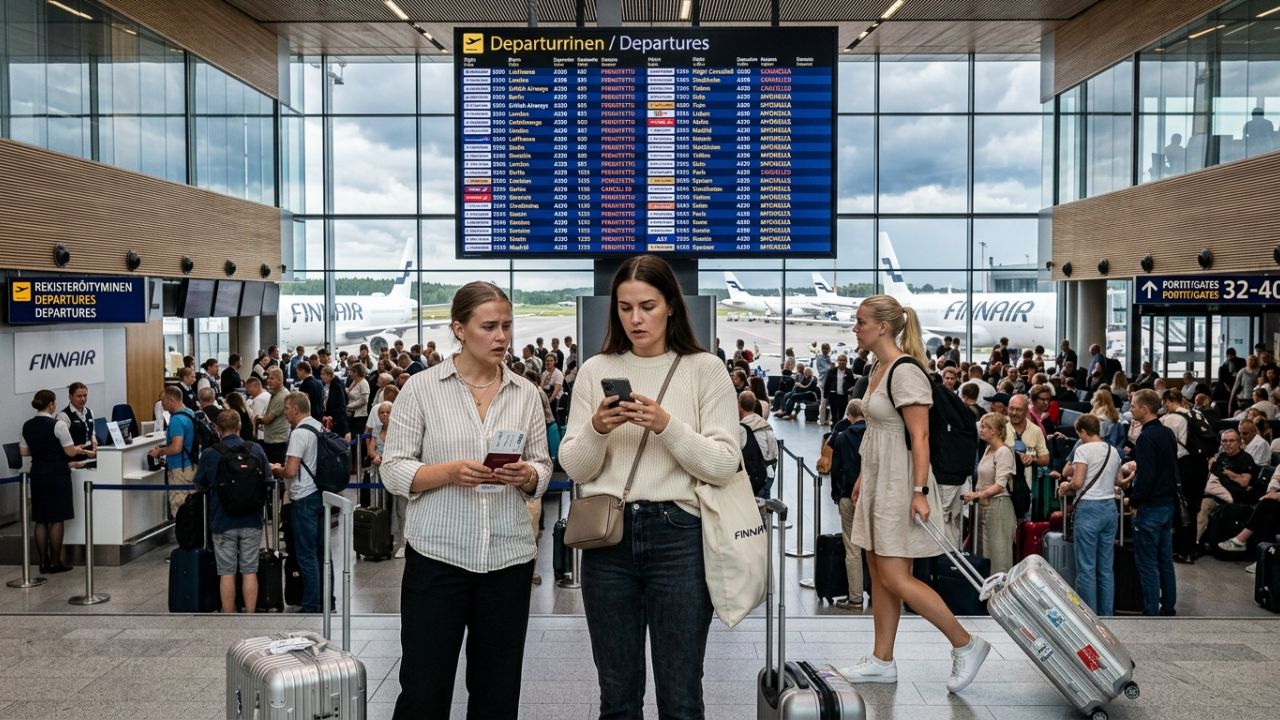
Image generated by AI
Aviation Updates: Finnair Suffers 6 Flight Cancellations and 83 Delays at Helsinki-Vantaa Airport, Triggering Widespread Travel Chaos Across Finland, Germany, UK, Spain, Portugal, the Mediterranean and Beyond as Kuressaare, Joensuu, Málaga, Chania, Stockholm and Dozens of European Routes Face Severe Airport Disruptions
As Finnair's European schedule buckles under the compounding pressures of peak summer demand and the unforgiving realities of hub-airport operations, thousands of passengers are being forced to absorb the full weight of a sweeping operational breakdown — one that stretches from Finland's remote domestic airstrips all the way to the sun-baked runways of the Mediterranean.
Breaking airline news sourced directly from real-time tracking data via FlightAware confirms that Helsinki-Vantaa Airport — Finland's primary international aviation hub and the operational backbone of Finnair's expansive European network — recorded a deeply damaging day of travel chaos on June 25, 2026. A total of 6 flight cancellations and an exhausting 83 flight delays were officially logged against Finnair's scheduled operations, collectively paralyzing passenger flows across one of the most geographically extensive single-carrier European networks currently in active service.
The scale of this airport disruption is particularly striking when measured against the breadth of the route network affected. This was not a localized terminal crisis confined to a handful of nearby destinations — it was a continent-wide unraveling of Finnair's carefully constructed schedule, pushing passengers bound for Kuressaare, Joensuu, Málaga, Chania, Stockholm, London, Manchester, Frankfurt, Hamburg, Lisbon, Rome, Milan, Paris, Dubrovnik, Larnaca, Oslo, Copenhagen, Riga, Prague, Malta, Keflavík, and more than two dozen additional destinations into a desperate scramble for rebooking options, revised connections, and answers from overwhelmed customer service teams.
Expanded Overview: The True Scope of Finland's Aviation Crisis
What makes the June 25 disruption at Helsinki-Vantaa particularly severe is the arithmetic of how even a modest number of cancellations can produce an outsized passenger impact when a hub carrier of Finnair's network density is the carrier in question. Six cancellations sound manageable in isolation. But Finnair is not a point-to-point operator with contained route pairs — it is a Star Alliance hub carrier whose entire schedule is built around wave operations, synchronized connections, and rotational aircraft utilization. When any leg in that finely tuned sequence falls away, the consequences propagate outward through the network with speed and severity that far exceeds what the cancellation number alone would suggest.
The 83 delays recorded alongside those cancellations are the visible symptom of that propagation effect. Each delay represents an aircraft that missed its inbound rotation, a crew that approached duty-hour limits before its outbound departure, or a gate sequence that backed up as ground handling teams absorbed the cumulative pressure of a disrupted schedule. For passengers at Helsinki-Vantaa, this translated directly into revised departure times displayed on departure boards, announcements of last-minute gate changes, and the dawning realization that carefully planned connections at downstream European airports were no longer achievable within the original itinerary.
The disruption also registered beyond Finland's borders. Isolated cancellations were recorded at Vilnius (VNO), Vienna (VIE), and Warsaw (WAW), each logging one cancelled Finnair-operated service. While the absolute numbers at these airports remained low, the fact that their cancellation percentages appeared proportionally higher reflects how these smaller stations operate with fewer scheduled Finnair frequencies — meaning a single cancellation can represent a significant fraction of the day's planned services.
Section-Wise Breakdown: Helsinki-Vantaa at the Centre of the Storm
Helsinki-Vantaa Airport: Finland's Paralysed Aviation Core
Helsinki-Vantaa Airport bore the overwhelming concentration of the June 25 disruption, recording 6 cancellations — equivalent to 1% of its total scheduled operations — alongside the staggering figure of 83 delayed flights across Finnair's departing and arriving services. As Finland's sole Category 1 international gateway and the operational nerve center of Finnair's entire network, any structural disruption at this airport does not merely affect passengers flying in and out of Helsinki. It affects every connection that those passengers were due to make at secondary European hubs, every inbound tourist whose arrival pushed back by hours, and every rotational aircraft whose delayed arrival guaranteed that its next outbound departure would also miss its scheduled window.
The geographic footprint of the Helsinki-Vantaa disruption stretched across both the domestic Finnish network and the airline's extensive international schedule simultaneously — a dual-front operational crisis that placed maximum pressure on Finnair's ground operations, crew scheduling teams, and customer service infrastructure throughout the day.
Affected Routes: From Finland's Arctic North to the Mediterranean South
The list of destinations impacted by the June 25 disruptions reads like a comprehensive survey of Finnair's entire European network. Domestic Finnish services connecting Helsinki to Kuressaare, Joensuu, Kajaani, Kronoby, Kuopio, Mariehamn, Oulu, Rovaniemi, Vaasa, Tallinn, and Tartu experienced operational challenges — many of these routes serving communities in northern Finland for whom Finnair represents the only practical air connection to the capital.
Beyond Finland's borders, the disruption cascaded across the Nordic and Baltic corridors, with services to Stockholm, Gothenburg, Bergen, Oslo, Trondheim, Copenhagen, Riga, Vilnius, Warsaw, and Vienna all impacted. Western European connectivity was similarly affected, with passengers traveling to London, Manchester, Amsterdam, Frankfurt, Hamburg, Paris, Nice, Lisbon, Milan, Turin, Rome, Prague, Malta, and Keflavík all encountering revised schedules and extended waiting periods. The Mediterranean and Southeastern European sectors were not spared either, with services to Málaga, Alicante, Chania, Catania, Dubrovnik, Larnaca, Tivat, and Gazipaşa all registering operational disruptions.
Flight Details and Verified Disruption Impact Matrix
The following data matrix reflects the precise operational snapshot at Helsinki-Vantaa Airport on June 25, 2026, sourced directly from FlightAware's real-time tracking records.
Confirmed Disruption Data — Helsinki-Vantaa Airport, June 25, 2026
| Airport | Cancelled Flights | Delayed Flights | Airline |
|---|---|---|---|
| Helsinki-Vantaa (HEL) | 6 | 83 | Finnair |
Data sourced from FlightAware. The 6 cancellations represent approximately 1% of Helsinki-Vantaa's total scheduled operations for the day. Additional isolated single-flight cancellations were recorded at Vilnius (VNO), Vienna (VIE), and Warsaw (WAW) on Finnair-operated services.
The ratio of 83 delays against 6 cancellations is analytically significant. It suggests that Finnair chose to absorb disruption through schedule compression and delay absorption rather than executing outright cancellations — a deliberate operational strategy that prioritizes keeping passengers moving at the cost of significant punctuality deterioration. For time-sensitive travelers, a five-hour delay can be functionally equivalent to a cancellation in terms of its impact on downstream connections. But for the carrier, preserving a technically operated flight protects commercial revenue, maintains crew utilization, and reduces the compensation liability that formal cancellations trigger under EU Regulation 261/2004.
Passenger Impact: The Human Cost Across 40+ Destinations
For the passengers caught in the June 25 disruption, the practical consequences varied sharply depending on their specific itinerary — but the common denominator was disruption at scale. Leisure travelers on summer charter-style services to Málaga, Chania, Catania, and Alicante — routes carrying families with carefully booked hotel stays, rental car reservations, and pre-paid excursions — faced the most immediate financial exposure. A five-hour delay into a Mediterranean resort destination effectively eliminates an entire day of a week-long holiday. A cancelled service to Kuressaare or Joensuu — domestic routes with limited frequency — could mean a full day's wait before the next available seat.
Passengers connecting through Helsinki from long-haul Finnair services — inbound from Asia, North America, or the Middle East — and then traveling onward to secondary European destinations faced particularly complex itinerary collapses. Missing a connecting service to Dubrovnik or Tivat during peak summer season, when Mediterranean seats are effectively sold out, is not a problem that resolves itself with a rebooking onto the next day's flight. It requires re-routing through alternative hubs, often on different carriers, with considerable cost and logistical complexity.
Under EU Regulation 261/2004, passengers whose Finnair flights were cancelled or delayed by more than three hours and whose journey originates from an EU-territory airport — as Helsinki-Vantaa is — may be entitled to compensation of between €250 and €600 per passenger, depending on route distance, alongside mandatory provision of meals, refreshments, and hotel accommodation where overnight stays are required. Passengers are strongly advised to retain all boarding passes, cancellation notifications, and receipts for incidental expenses, and to submit formal compensation claims directly to Finnair's customer relations team.
Industry Analysis: Why Finnair's Hub Is Under Maximum Pressure
The June 25 disruption is best understood not as an isolated operational failure but as the latest expression of structural pressures that have been building across European aviation throughout the 2026 summer season. Several forces are converging simultaneously to produce exactly this type of large-scale hub disruption.
Peak demand saturation is the overarching context. European leisure travel demand in summer 2026 is running at historically elevated levels, with airlines scheduling at or near maximum capacity to capture post-pandemic revenue recovery. At hub airports like Helsinki-Vantaa, this means that every gate is occupied, every ground handling slot is committed, and there is effectively zero buffer capacity to absorb even minor inbound delays without triggering cascading downstream disruptions.
Aircraft turnaround compression is the mechanical consequence of that saturation. When carriers schedule at maximum utilization, aircraft rotations are planned with turnaround windows that leave no margin for the ordinary friction of heavy passenger volumes, late-clearing customs queues, or minor technical snags. Any inbound aircraft arriving even 20 minutes late at a hub like Helsinki can generate a 90-minute or longer delay on its next outbound service once crew rest obligations, fueling, and passenger boarding are factored in.
ATC capacity constraints across the European Functional Airspace Blocks — particularly in the high-density corridors connecting Scandinavia to Central and Southern Europe — continue to impose ground delay programs that further compress carrier schedule buffers. Finnair's route network, which spans a uniquely wide geographic arc from Finland's Arctic north to the Mediterranean coast, is particularly exposed to cumulative ATC slot restrictions affecting multiple airspace sectors simultaneously.
Conclusion: Recovery Outlook and What Travelers Must Know
The operational disruption at Helsinki-Vantaa Airport on June 25, 2026 — encompassing 6 cancellations and 83 delays across Finnair's European network — will require a 24–48 hour recovery window before the airline's schedule fully stabilizes and stranded passengers are fully reabsorbed into normal operations. The breadth of the affected route list, spanning more than 40 destinations across nine countries and four European sub-regions, confirms that this was a genuinely systemic disruption rather than a localized event.
For travelers currently in transit or planning imminent departures on Finnair services through Helsinki-Vantaa, the immediate priorities are clear: monitor the airline's digital platform and app for real-time flight status updates, arrive at the airport with significant time buffer ahead of scheduled departure, and carry documentation of any cancellation or delay notification received. Those seeking compensation under EU261 should act promptly — Finnair's customer relations infrastructure will be managing a high claim volume following a disruption of this scale.
For Austria, the Nordic countries, the Baltics, and the Mediterranean destinations that depend on Finnair's Helsinki hub for connectivity, this disruption serves as a timely reminder of how deeply a single carrier's operational health is woven into the travel plans of millions of passengers across an entire continent.
Key Takeaways
- 6 Cancellations, 83 Delays: Helsinki-Vantaa Airport recorded a devastating 6 Finnair flight cancellations and 83 delays on June 25, 2026 — one of the most disruptive single-day events for the Finnish national carrier this summer season.
- Helsinki at the Core: The 6 cancellations at HEL represented approximately 1% of scheduled operations for the day. Secondary isolated cancellations were also recorded at Vilnius, Vienna, and Warsaw.
- 40+ Destinations Impacted: The disruption affected routes spanning domestic Finnish services and international connectivity to Germany, the UK, Spain, Portugal, Scandinavia, the Balkans, the Mediterranean, the Baltics, and Iceland.
- EU261 Rights Apply: Passengers on cancelled or severely delayed Finnair departures from Helsinki-Vantaa may claim between €250–€600 compensation per person under EU Regulation 261/2004, alongside mandatory meal and accommodation provisions.
- Delay Strategy Over Cancellations: The 83:6 ratio of delays to cancellations indicates Finnair deliberately absorbed disruption through schedule slippage rather than outright groundings — protecting revenue but significantly extending journey times for thousands of passengers.
- Passenger Action Required: Affected travelers are urgently advised to actively monitor aviation updates via Finnair's official app, retain all disruption documentation, and contact Finnair customer service immediately to confirm rebooking arrangements.
Related Travel Guides
Finnair Helsinki Flight Cancellations Travel Chaos 2026
Travel Chaos Cripples Spain as Iberia and Ryanair Suffer 1,079 Delays
Global Flight Cancellation and Compensation Guide 2026
Disclaimer: This article is strictly for informational purposes only. All disruption data is sourced directly from FlightAware's real-time tracking platform and reflects the operational situation at Helsinki-Vantaa Airport on June 25, 2026. Airline schedules, rebooking availability, and route recovery timelines are highly volatile and subject to continuous, real-time revision. Passengers are urgently advised to verify their specific flight status directly via Finnair's official platform prior to airport departure.
Disclaimer
This article is for informational and educational purposes only. It does not constitute legal, financial, or professional advice. While we strive to provide accurate and up-to-date information, travel policies, regulations, and conditions change rapidly. Always verify information with official sources before making travel decisions. Nomad Lawyer makes no representations about the accuracy, reliability, completeness, or suitability of the information provided. Readers should consult qualified professionals for advice specific to their circumstances. The views expressed in this article are those of the author and do not necessarily reflect the views of Nomad Lawyer.
Preeti Gunjan
Contributor & Community Manager
A passionate traveller and community builder. Preeti helps grow the Nomad Lawyer community, fostering engagement and bringing the reader experience to life.
Learn more about our team →