
Asia-Pacific Airlines Record Surging Passenger Boom: Up 9.1% in February 2026

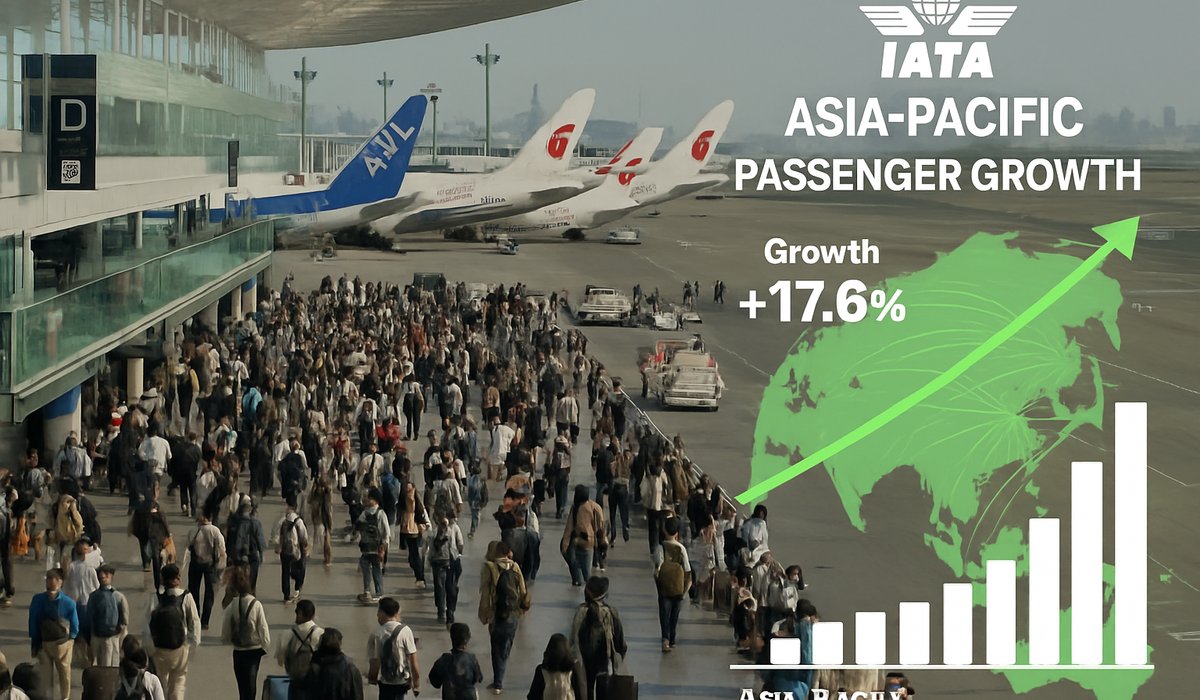
Image generated with AI
**> Quick Summary
- The Asia-Pacific region recorded a 9.1% increase in revenue passenger kilometres (RPKs) year-over-year in February 2026
- The region accounted for a massive 34.5% of total global air traffic, maintaining its status as the world's largest market
- China led domestic growth with an enormous 12.5% increase in demand
- Australia was the lone major regional market to falter, recording a 1.1% decline in domestic traffic
- International demand across the region spiked 8.6%, supported by aggressive network expansions**
The centre of gravity for global aviation has planted itself firmly over the Eastern Hemisphere. In February 2026, the Asia-Pacific region rode a powerful wave of travel demand, setting new highs that outpaced global averages and cemented the region as the dominant engine of international and domestic air travel.
According to fresh data released by the International Air Transport Association (IATA), countries spanning from India to Japan—including China, South Korea, Singapore, Malaysia, Indonesia, Thailand, Vietnam, the Philippines, and Australia—collectively drove a stunning 9.1% increase in revenue passenger kilometres (RPKs) compared to February 2025.
With regional capacity rising to match, the Asia-Pacific aviation sector now commands a commanding 34.5% of total global air traffic. Airplanes are fuller, routes are expanding, and traveler confidence has crested.
The International Surge: 8.6% Growth Year-on-Year
The true strength of the February figures stems from the aggressive return of international routing across the region. Airlines spanning major hubs like Tokyo, Seoul, Kuala Lumpur, Jakarta, Bangkok, Manila, and Singapore reported an 8.6% year-on-year growth in international passenger demand.
This boom is actively supported by carriers deploying expanded route networks and higher flight frequencies. Regional capacity ticked upward by 7.3%, trailing slightly behind the ferocious demand. As a result, the regional load factor climbed a full percentage point to 86.6%, meaning Asia-Pacific carriers are flying highly efficient, tightly packed aircraft.
A Mixed Bag for Domestic Markets
While global domestic aviation traffic saw a healthy 6.3% rise, the breakdown within the Asia-Pacific bloc revealed highly nuanced national trends:
🇨🇳 China (Mainland) – The Unstoppable Engine
Mainland China continues to operate as an absolute behemoth in global domestic aviation. Domestic RPKs surged by a massive 12.5%. This explosive growth was powered by relentless travel activity across indispensable Tier 1 and Tier 2 corridors, including Beijing–Shanghai, Guangzhou–Chengdu, and Shenzhen–Xi’an. Despite airlines pumping 13.4% more capacity into the sky, load factors remained highly profitable at 85.9%.
🇮🇳 India – Slowing But Stable Growth
India posted a modest 0.6% rise in domestic demand, a significantly cooler figure than the explosive growth seen in early post-pandemic years. Vital routes connecting major technology and commercial hubs like Delhi, Mumbai, Bengaluru, Hyderabad, Kolkata, and Chennai proved resilient. With capacity creeping up 1.9%, India's load factor eased slightly to 89.1%—which still ranks as the highest aircraft utilization rate among all major domestic markets globally.
🇯🇵 Japan – Steady and Highly Efficient
Japan registered a cautious but positive 0.8% increase in domestic RPKs. This slow-burn recovery across routes bridging Tokyo, Osaka, Fukuoka, Sapporo, and Okinawa was met with disciplined capacity management. Japanese carriers actively reduced capacity by 0.8%, a strategic move that pushed the load factor up to a highly respectable 84.9%.
🇦🇺 Australia – The Anomaly in the Region
In stark contrast to its Asian neighbors, Australia emerged as the sole major Asia-Pacific domestic aviation market to fall backward. Domestic traffic fell 1.1% across the continent. Oddly, carriers continued to inject capacity—up 3.8%—into routes like Sydney, Melbourne, Brisbane, and Perth. This severe mismatch resulted in a grim load factor plunge down to 69.2%, signaling deep structural friction in the Australian domestic market.
2026 and Beyond: Asia-Pacific Rules the Skies
The February 2026 IATA data eliminates any lingering doubt regarding where the future of commercial aviation lies. Driven by rebounding mega-economies, accelerating business corridors, and a thriving middle-class tourism sector, the Asia-Pacific region's dominance is mathematically undeniable.
Hubs like Singapore Changi, Tokyo Haneda, Seoul Incheon, and Bangkok Suvarnabhumi are operating as intense velocity centers for international movement. With capacity practically mirroring aggressive demand curves—and aircraft flying fuller than global averages—the region's carriers are entering the thick of 2026 not in a mode of recovery, but in a mode of supreme operational expansion.
If current velocity holds, Asia-Pacific airlines are structurally positioned to set the pace for global commercial aviation well into the 2030s.
Source: Travel And Tour World / IATA
Related Travel Guides
- Frontier Airlines Flight F94807 Diverts to Jacksonville International Airport Due to Severe Weather on 10 July 2026
- Unprecedented European Travel Chaos: Ryanair, Lufthansa, and easyJet Paralyzed as 1,668 Flights Delayed and 42 Canceled Across Spain, Germany, and the Netherlands: Latest Airline News
- Air India and IndiGo Unleash Massive Wave of Domestic Flight Cancellations, Sparking Fears of Severe Summer Travel Chaos Across India: Latest Airline News
Disclaimer
This article is for informational and educational purposes only. It does not constitute legal, financial, or professional advice. While we strive to provide accurate and up-to-date information, travel policies, regulations, and conditions change rapidly. Always verify information with official sources before making travel decisions. Nomad Lawyer makes no representations about the accuracy, reliability, completeness, or suitability of the information provided. Readers should consult qualified professionals for advice specific to their circumstances. The views expressed in this article are those of the author and do not necessarily reflect the views of Nomad Lawyer.
Kunal K Choudhary
Co-Founder & Contributor
A passionate traveller and tech enthusiast. Kunal contributes to the vision and growth of Nomad Lawyer, bringing fresh perspectives and driving the community forward.
Learn more about our team →