
Unprecedented Asian Aviation Meltdown: 6,424 Flights Delayed and 349 Canceled as Travel Chaos Paralyzes Cathay Pacific, Japan Airlines, and ANA Across Tokyo, Bangkok, and Kuala Lumpur: Latest Airline News
A catastrophic operational collapse has triggered massive airport disruptions across China, India, Japan, and the Middle East, leaving tens of thousands of international passengers entirely stranded.

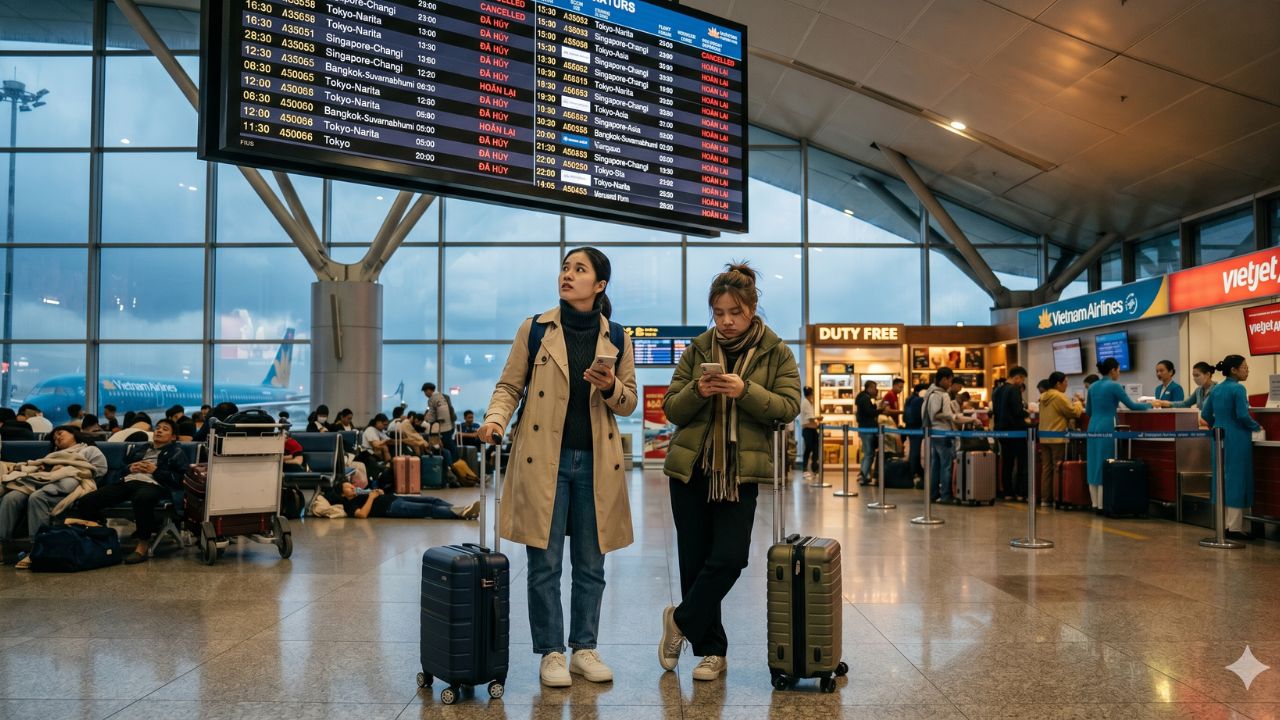
Image generated by AI
The entire Asian aviation network has violently fractured under the immense pressure of an absolutely unprecedented operational collapse, plunging tens of thousands of international and domestic passengers into severe travel chaos. Delivering terrifying airline news for the global travel sector, massive, multi-nation airport disruptions have actively paralyzed critical transit hubs across Japan, Thailand, Saudi Arabia, Malaysia, Hong Kong, China, India, and Indonesia. According to the absolute latest aviation updates, an astronomical 6,424 flight delays and 349 devastating flight cancellations have completely destroyed flight schedules today, May 30, 2026. Legacy titans including Cathay Pacific, Japan Airlines, All Nippon Airways (ANA), and Saudia are aggressively battling catastrophic gridlock across mega-hubs in Tokyo, Bangkok, Kuala Lumpur, Jeddah, and beyond. This catastrophic domino effect has effectively trapped passengers inside heavily overcrowded terminals, sparking a desperate scramble for incredibly scarce rebooking options across 36 major Asian airports.
The Epicenter of the Crisis: A Multi-Nation Meltdown
This massive, system-wide failure is not isolated to a single country; it is a highly volatile, synchronized collapse of the entire regional airspace. Aviation analysts tracking the massive volume of flight cancellations report that China and India are currently absorbing the most catastrophic damage, while highly efficient hubs in Japan and Southeast Asia are violently buckling under the sheer volume of diverted and severely delayed aircraft.
Major carriers are heavily reporting unprecedented operational failure. China Eastern recorded the absolute highest delay total with a staggering 478 delays and 36 cancellations, while Shenzhen Airlines suffered the highest cancellation volume with 51 dead flights. IndiGo aggressively accumulated 365 delays across its massive Indian network. In Japan, the combined forces of Japan Airlines and ANA suffered a terrifying 548 delays. When legacy giants like Air India, Cathay Pacific, AirAsia, and SpiceJet simultaneously report massive operational breakdowns, the entire continent's travel infrastructure effectively ceases to function.
Section-Wise Breakdown: The Continent Paralyzed
To explicitly comprehend the staggering, multi-nation scale of these horrific airport disruptions, we must execute a highly detailed, section-wise breakdown of the primary geographic zones currently buckling under this immense operational pressure.
The Chinese Mega-Hubs: Shenzhen, Guangzhou, and Shanghai
Mainland China is the undisputed epicenter of today’s terrifying gridlock. Guangzhou Baiyun International Airport experienced the absolute highest number of delays in all of Asia, recording a catastrophic 705 delays and 37 cancellations. Just to the south, Shenzhen Bao’an International Airport reported 519 delays and a massive 48 cancellations, the highest cancellation total recorded globally today. The devastation rapidly spread north, with Shanghai Pudong reporting 304 delays and 17 cancellations, and Shanghai Hongqiao suffering 198 delays and 14 cancellations. The Chinese capital, Beijing Capital, recorded 146 delays and 14 cancellations. Other critical regional hubs completely paralyzed include Hangzhou Xiaoshan (288 delays, 9 cancellations), Xiamen Gaoqi (181 delays, 3 cancellations), Nanjing Lukou (170 delays, 9 cancellations), Chongqing Jiangbei (162 delays, 6 cancellations), Kunming Changshui (156 delays, 13 cancellations), Xi’an Xianyang (157 delays, 9 cancellations), and Zhengzhou Xinzheng (130 delays, 12 cancellations).
The Indian Subcontinent: Delhi and Mumbai Gridlock
India’s critical aviation infrastructure has been violently pushed to its absolute limits. Delhi’s Indira Gandhi International Airport, the busiest in the nation, suffered a massive 585 delays and 13 cancellations, heavily impacting carriers like IndiGo, Air India, SpiceJet, Akasa Air, and Air India Express. Further south, Mumbai Chhatrapati Shivaji International Airport recorded 214 agonizing delays and 5 outright cancellations, completely trapping thousands of domestic business travelers and international tourists.
The Japanese Archipelago: Tokyo, Fukuoka, and Sapporo
Japan’s famously efficient aviation sector has been completely overwhelmed. Tokyo Haneda Airport registered a terrifying 546 delays and 6 cancellations, creating massive bottlenecks for Japan Airlines, ANA, ANA Wings, Air Do, and Solaseed. Across the city, Narita International Airport reported 159 delays and 7 cancellations, heavily disrupting Jetstar Japan and Peach Aviation. The chaos spread rapidly to regional hubs, with Fukuoka Airport suffering 129 delays and 4 cancellations (disrupting Skymark), and New Chitose in Sapporo recording 107 delays and 3 cancellations.
Southeast Asia and Hong Kong: Bangkok, Jakarta, and Kuala Lumpur
The critical transit arteries connecting Southeast Asia are actively bleeding capacity. Hong Kong International Airport registered 141 delays, severely impacting Cathay Pacific, Hong Kong Airlines, and EVA Air. In Thailand, Suvarnabhumi Airport in Bangkok experienced 167 delays, hitting Thai Airways, Thai Vietjet Air, and Bangkok Airways. Malaysia's Kuala Lumpur International Airport saw 192 delays and 2 cancellations, severely disrupting AirAsia, Malaysia Airlines, and Malindo Air. Indonesia’s massive Jakarta Soekarno-Hatta Airport recorded 99 delays and 27 cancellations (the highest cancellation count outside China), heavily impacting Garuda Indonesia, Batik Air, Citilink, and Lion Air.
The Middle East: Saudi Arabian Disruptions
The massive ripple effects aggressively reached the Middle East, violently striking Saudi Arabia. King Khalid International Airport in Riyadh recorded 68 delays, heavily disrupting operations for Saudia, Flynas, Oman Air, and Etihad Airways. Simultaneously, King Abdulaziz International Airport in Jeddah suffered 59 delays and 2 cancellations, further exacerbating the regional gridlock.
Flight Details: The Airline Disruption Matrix
To explicitly quantify the massive operational damage absorbed by specific carriers, the following mandatory table clearly outlines the exact performance metrics for the most severely disrupted airlines today:
| Airline | Delayed Flights | Cancelled Flights | Key Hubs Affected |
|---|---|---|---|
| China Eastern | 478 | 36 | Shanghai, Guangzhou, Shenzhen |
| IndiGo | 365 | 0 | Delhi, Mumbai, Saudi Arabia |
| Japan Airlines | 303 | 0 | Haneda, Narita, Fukuoka, Sapporo |
| All Nippon Airways | 245 | 3 | Tokyo Haneda, Regional Japan |
| Shenzhen Airlines | 236 | 51 | Shenzhen Bao’an, Guangzhou |
| Air India | 201 | 0 | Delhi, Mumbai |
| Hainan Airlines | 145 | 29 | Major Chinese Hubs |
| Air India Express | 89 | 0 | Delhi, Mumbai |
| Saudia | 81 | 2 | Riyadh, Jeddah |
| AirAsia | 76 | 0 | Kuala Lumpur, Bangkok |
| Cathay Pacific | 70 | 0 | Hong Kong |
| ANA Wings | 65 | 0 | Regional Japan |
Passenger Impact: Stranded Without Solutions
For the everyday global traveler, the passenger impact of this staggering 6,424-delay event is absolutely devastating. When an international tourist flying Cathay Pacific or Japan Airlines experiences an unannounced multi-hour delay in Hong Kong or Tokyo, they mathematically miss crucial long-haul connections to Europe or North America. The terrifying reality of these massive airport disruptions is that airline customer service desks are instantly overrun, leaving furious passengers to heavily absorb hundreds of dollars in unexpected, out-of-pocket costs for emergency hotel accommodations and alternative ground transport. Families are currently suffering through extreme, chaotic terminal conditions without adequate seating or reliable rebooking information, rapidly destroying consumer trust across the entire Asian aviation sector.
What This Means for Travelers: Actionable Advice
As this unprecedented operational meltdown aggressively rips through the Asian continent, domestic and international passengers must instantly adopt highly defensive travel tactics to physically survive the airports:
- Pad Everything: Aggressively arrive at the airport a minimum of 4 hours prior to departure; the standard 2-hour window mathematically guarantees you will miss your flight due to extreme security bottlenecks.
- Track Aircraft Individually: Do not rely on terminal display boards. Actively utilize tools like FlightAware to track your specific incoming aircraft to mathematically predict your exact delay time.
- Keep Documents Ready: Ensure all essential travel documents are easily accessible, as terminal congestion will severely complicate the check-in and rebooking processes.
- Assert Your Rights: Review the specific rebooking and refund policies offered by your airline, and maintain meticulous records and receipts of all emergency expenses for future compensation claims.
FAQ: Massive Asian Aviation Meltdown
How many total flights have been disrupted across Asia today? According to the absolute latest data, the continent is currently suffering through a catastrophic 6,424 delayed flights and 349 outright flight cancellations.
Which Asian airports are experiencing the absolute worst delays? The worst operational gridlock is heavily concentrated in China and India, with Guangzhou Baiyun (705 delays) and Delhi’s Indira Gandhi International (585 delays) leading the massive collapse.
Which airlines are canceling the most flights right now? Shenzhen Airlines recorded the highest airline cancellation total with 51 dead flights, followed closely by China Eastern, which suffered 36 cancellations alongside a staggering 478 delays.
Industry Analysis: The Fragility of Asian Airspace
From a highly critical macroeconomic perspective, this massive surge in flight cancellations exposes a terrifying, systemic vulnerability completely rotting the core of Asian aviation. While specific weather patterns or isolated air traffic control strikes often trigger localized delays, a synchronized collapse across 36 major airports—spanning from Tokyo to Jeddah—indicates severe, widespread airspace congestion and severe operational fragility. Airlines operating ultra-tight turnaround schedules, like IndiGo and AirAsia, are mathematically the absolute first to suffer when regional ATC limits airspace entry. If global aviation authorities refuse to heavily invest in unified airspace management and aggressive infrastructure expansion, these catastrophic, multi-nation operational meltdowns will permanently destroy the long-term reliability of the massive Asian transit economy.
Conclusion: A Continent on the Brink
The devastating wave of 6,424 delayed flights and 349 cancellations that violently ripped through Japan, China, India, and Southeast Asia is a terrifying warning for the global travel sector. The immediate, massive operational collapse at mega-hubs like Tokyo Haneda, Delhi, and Guangzhou perfectly illustrates how incredibly fragile the Asian aviation network truly is. As massive carriers like Cathay Pacific, Japan Airlines, and ANA furiously struggle to stabilize heavily delayed schedules, passengers are left completely abandoned to bear the brutal emotional and financial costs of systemic travel chaos. Navigating the Asian skies today strictly requires immense tactical preparation, extreme flexibility, and a highly realistic understanding that the modern regional aviation system perpetually operates on the absolute brink of total collapse.
Key Takeaways
- Catastrophic Disruptions: Asia was violently slammed by a massive operational meltdown, resulting in an astonishing 6,424 delayed flights and 349 outright cancellations.
- Worst Hit Airports: Guangzhou (705 delays), Delhi (585 delays), Tokyo Haneda (546 delays), and Shenzhen (519 delays, 48 cancellations) suffered the absolute highest volume of agonizing delays.
- Airlines Heavily Impacted: China Eastern (478 delays), IndiGo (365 delays), Japan Airlines (303 delays), and Shenzhen Airlines (51 cancellations) bore the absolute brunt of the operational failure.
- Systemic Fragility: The massive disruptions highlight the severe fragility and overwhelming congestion of the massive, highly interconnected Asian airspace.
- Passenger Warning: Travelers are heavily advised to monitor real-time aviation updates using official third-party apps like FlightAware and prepare for extended, multi-hour terminal waits.
Related Travel Guides
All Nippon Airways Deploys Massive Pokémon Fleet From Tokyo Haneda
Africa-Asia Flight Corridor Absolutely Explodes Defying Global Aviation Slump
India Fuels Massive Vietjet Travel Surge to Vietnam Bypassing Global Chaos
Disclaimer
This article is for informational and educational purposes only. It does not constitute legal, financial, or professional advice. While we strive to provide accurate and up-to-date information, travel policies, regulations, and conditions change rapidly. Always verify information with official sources before making travel decisions. Nomad Lawyer makes no representations about the accuracy, reliability, completeness, or suitability of the information provided. Readers should consult qualified professionals for advice specific to their circumstances. The views expressed in this article are those of the author and do not necessarily reflect the views of Nomad Lawyer.
Kunal K Choudhary
Co-Founder & Contributor
A passionate traveller and tech enthusiast. Kunal contributes to the vision and growth of Nomad Lawyer, bringing fresh perspectives and driving the community forward.
Learn more about our team →