
Aviation Updates: Massive Typhoons Unleash Travel Chaos Across Asia, Triggering 136 Flight Cancellations and 5,846 Delays
Extreme weather severely paralyzes the Asian aviation network, grounding Japan Airlines and China Southern as massive airport disruptions sweep from Tokyo to Dubai.

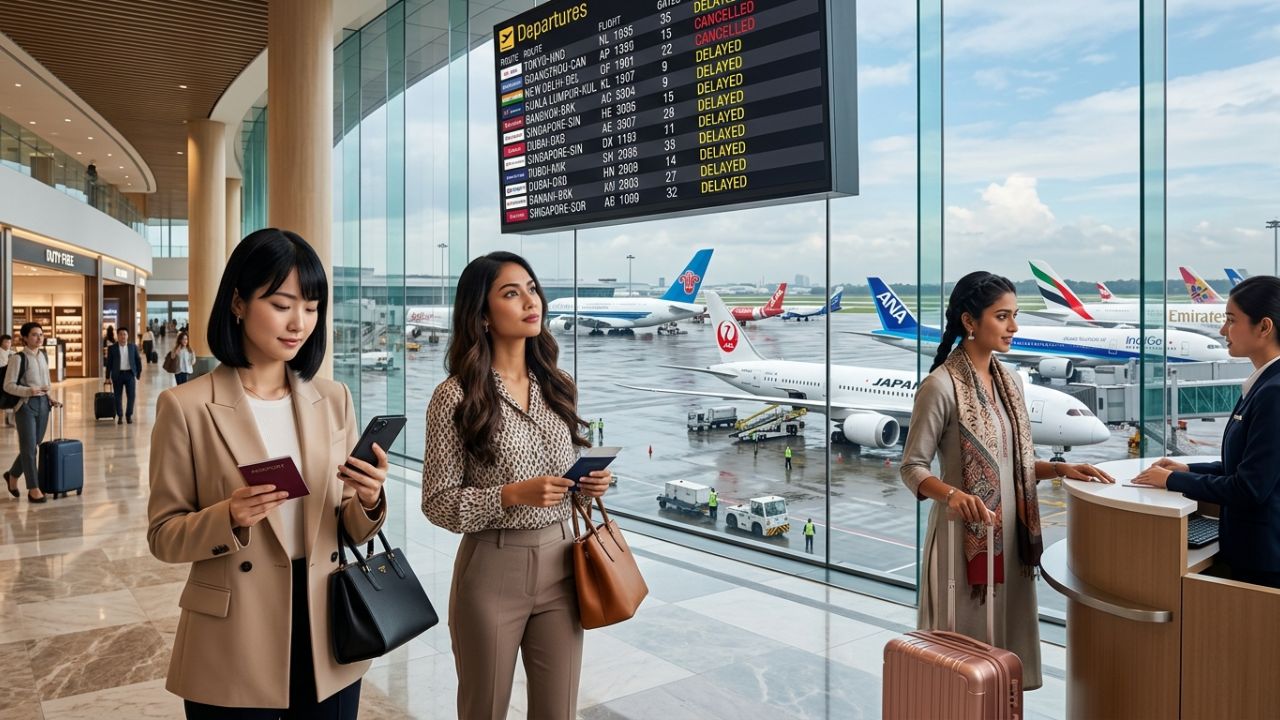
Image generated by AI
Aviation Updates: Massive Typhoons Unleash Travel Chaos Across Asia, Triggering 136 Flight Cancellations and 5,846 Delays
A brutal combination of intense tropical cyclones and localized monsoon flooding has completely fractured the highly integrated Asian aviation network, creating a sprawling crisis spanning multiple continents.
Image generated by AI
Air travel across the Eastern Hemisphere is currently facing absolute devastation as severe, extreme weather conditions generate crippling airport disruptions across dozens of international mega-hubs. According to the most recent airline news and verified operational data, an aggressive combination of intense typhoon activity and heavy monsoon rainfall has plunged the Asian network into total travel chaos. Airlines spanning Japan, China, India, Malaysia, Thailand, and the UAE have been violently forced to abandon their schedules as reduced visibility and extreme winds close critical air corridors. Consequently, major operators including Japan Airlines, China Southern, ANA Wings, IndiGo, Batik Air, Lao Airlines, and Emirates are battling catastrophic congestion. Across more than 30 major airports, from Tokyo to Dubai, the massive weather system has officially triggered 136 absolute flight cancellations and an agonizing 5,846 total flight delays, stranding hundreds of thousands of passengers in terminal gridlock.
Expanded Overview: The East Asian Weather Collapse
When evaluating critical aviation updates, weather systems of this magnitude completely overwhelm even the most advanced air traffic control infrastructure. The current disruption is acting as a massive operational bottleneck, heavily concentrated over East Asia but rippling outward across the globe.
Japan and China are actively absorbing the most severe operational pressure, acting as the epicenter of the crisis. From there, secondary impacts are rapidly degrading schedules across South and Southeast Asia—including India, Indonesia, Malaysia, and Thailand. Airlines operating within these zones are confronting violent, cascading schedule instability driven primarily by weather-related airspace restrictions, ground handling freezes due to lightning protocols, and sprawling runway capacity limitations. The 5,846 recorded delays indicate that rather than executing full operational shutdowns, airports are attempting to force traffic through severely constrained weather windows, resulting in horrific delays.
Section-Wise Breakdown: The Japanese and Chinese Congestion Crisis
East Asia remains ground zero for this specific disruption cycle, with Tokyo and the Pearl River Delta completely overwhelmed by air traffic congestion.
In Japan, Tokyo Haneda Airport recorded the highest single-hub delay volume, staggering under 759 total delays as it battled severe flow restrictions. The instability violently infected the broader Japanese network, with Narita registering 103 delays and New Chitose recording 115 delays.
In China, the disruption was equally catastrophic. Guangzhou Baiyun International Airport suffered a massive blow, logging 717 delays and 13 absolute cancellations. Just to the south, Shenzhen Bao’an Airport reported 660 delays and 7 cancellations. The weather front also heavily crippled the broader Chinese mainland, generating massive friction at Shanghai Hongqiao (329 delays), Beijing Capital (291 delays), Xiamen Gaoqi (281 delays), Kunming Changshui (221 delays), and Shanghai Pudong (183 delays).
Section-Wise Breakdown: Southeast Asian and Middle East Ripple Effect
Because modern airline networks are so tightly integrated, the East Asian weather disaster rapidly infected connecting hubs deep into South Asia and the Middle East.
In Southeast Asia, heavy delay volumes indicated growing operational stress. Kuala Lumpur International (265 delays, 1 cancellation), Jakarta Soekarno-Hatta (258 delays, 3 cancellations), and Bangkok Suvarnabhumi (231 delays, 1 cancellation) all struggled to process the inbound backlog. India's Indira Gandhi International Airport (New Delhi) absorbed 161 delays and 5 cancellations. Further west, the critical Middle Eastern transit corridors also buckled; Dubai International Airport logged 105 delays and 4 cancellations, while Istanbul Airport reported 83 delays and 2 cancellations. Islamabad International Airport in Pakistan managed to remain comparatively stable, recording only 6 delays and 2 cancellations.
Flight Details: Asia Weather Disruption Airline Impact Matrix
The exact operational telemetry regarding the hardest-hit airlines caught in this massive typhoon and monsoon cycle has been consolidated into the mandatory matrix below.
Asia Weather Disruption: Airline Impact Matrix
| Airline | Delayed Flights | Cancelled Flights |
|---|---|---|
| China Eastern | 757 | 19 |
| China Southern | 750 | 5 |
| Japan Airlines | 391 | 3 |
| Air China | 334 | 8 |
| Hainan Airlines | 252 | 12 |
| XiamenAir | 251 | 2 |
| ANA Wings | 151 | 9 |
(Note: Regional and low-cost carriers including IndiGo, Batik Air, and AirAsia also reported moderate, sustained disruption levels throughout the event).
Passenger Impact: Navigating the Storm Protocols
For the passengers trapped in hubs like Guangzhou, Tokyo, and Kuala Lumpur, the 5,846 flight delays generated intense, highly localized misery. Travelers faced incredibly long waiting times, dangerously missed connections, and widespread operational uncertainty as departure boards continuously updated with rolling delays.
Aviation authorities strongly advise that passengers trapped in this specific Asian weather gridlock must take immediate, proactive steps. Travelers should relentlessly monitor airline notifications through official apps, rebook onto flexible or refundable tickets immediately if their direct route is heavily exposed to the typhoon's path, and utilize alternative hub connections outside the immediate storm zone. Showing up early is critical, as terminal congestion at check-in and security checkpoints is completely paralyzing standard operations.
Industry Analysis: Systemic Vulnerability to Extreme Weather
Aviation strategists analyzing this specific event note that the disruption perfectly highlights the extreme vulnerability of Asia’s highly interconnected aviation system during extreme weather cycles.
The heavy exposure of specific carriers—such as China Eastern (757 delays, 19 cancellations) and China Southern Airlines (750 delays, 5 cancellations)—proves that localized weather events in East Asia can instantly destroy the schedule integrity of massive global operators. The primary drivers—airspace congestion, rerouting, low visibility, and runway capacity restrictions—cannot be mitigated by airline operations teams. When a typhoon sits over a critical node like Tokyo or the Pearl River Delta, the entire Asian network is forced to slow down, absorbing the shockwave through massive rolling delays rather than systemic cancellations.
Conclusion: A Network Under Intense Strain
Ultimately, this massive weather event proves that even the most robust airport infrastructure will buckle under the sheer force of extreme typhoon and monsoon activity. By generating 136 total flight cancellations and 5,846 flight delays, the storm system completely disrupted travel from Japan to Dubai, severely heavily impacting carriers like Japan Airlines, Air China, and Emirates. As the typhoon activity continues to violently influence Japan and the surrounding Pacific regions, airlines and passengers must remain highly vigilant. The situation remains incredibly dynamic, and until the weather systems actively clear the primary air corridors, extreme schedule volatility and sprawling delays will remain the absolute baseline for Asian air travel.
Key Takeaways
- Massive Disruption: A major weather system generated 136 flight cancellations and 5,846 flight delays across the Asian aviation network.
- Epicenter of Chaos: East Asia absorbed the heaviest damage, with Tokyo Haneda (759 delays) and Guangzhou (717 delays) heavily paralyzed.
- Airlines Battered: China Eastern (757 delays, 19 cancellations) and China Southern (750 delays, 5 cancellations) recorded the highest individual airline impacts.
- Widespread Contagion: The delays cascaded outward, infecting major regional hubs in Kuala Lumpur, Jakarta, Bangkok, New Delhi, and Dubai.
- Primary Causes: The travel chaos was driven entirely by severe typhoon activity, intense monsoon rainfall, and subsequent airspace restrictions.
FAQ: Asian Aviation Network Weather Disruption 2026
Which airlines experienced the most delays during the Asian weather disruption? China Eastern and China Southern were the most heavily impacted, recording 757 and 750 delays respectively. Major carriers like Japan Airlines (391 delays) and Air China (334 delays) were also severely affected.
Which airports were at the center of the travel chaos? East Asian hubs suffered the most extreme congestion, specifically Tokyo Haneda Airport in Japan and Guangzhou Baiyun International Airport in China, both of which recorded over 700 delays.
Why were so many flights delayed across Asia? The massive wave of 5,846 delays was caused directly by severe, extreme weather conditions, primarily intense typhoon activity and heavy monsoon rainfall, which forced airports to implement strict airspace and runway flow restrictions.
Related Travel Guides
British Airways WestJet Codeshare Agreements Aviation Updates 2026
Toronto Pearson Airport Delays Air Canada WestJet Travel Chaos 2026
Asia Pacific Typhoon Flight Disruption Survival Guide 2026
Disclaimer: This article is strictly for informational purposes. The delay statistics (5,846 total delays), cancellation figures (136 total cancellations), and specific airport/airline operational metrics (e.g., Tokyo Haneda, China Eastern) are based on data sourced directly from FlightAware and affected airport authorities at the time of publication. Severe weather disruptions caused by typhoons and monsoons are highly dynamic and actively dangerous. Passengers must monitor real-time flight status directly with their airline and adhere to all local safety advisories before attempting to travel to the airport.
Disclaimer
This article is for informational and educational purposes only. It does not constitute legal, financial, or professional advice. While we strive to provide accurate and up-to-date information, travel policies, regulations, and conditions change rapidly. Always verify information with official sources before making travel decisions. Nomad Lawyer makes no representations about the accuracy, reliability, completeness, or suitability of the information provided. Readers should consult qualified professionals for advice specific to their circumstances. The views expressed in this article are those of the author and do not necessarily reflect the views of Nomad Lawyer.
Preeti Gunjan
Contributor & Community Manager
A passionate traveller and community builder. Preeti helps grow the Nomad Lawyer community, fostering engagement and bringing the reader experience to life.
Learn more about our team →