
Aviation Updates: Massive Travel Chaos Paralyzes Toronto Pearson Airport as Air Canada and Air France Log 16 Flight Cancellations
Toronto Pearson International Airport experiences severe airport disruptions with 127 delays and 16 cancellations, severely crippling Canadian and US travel routes.

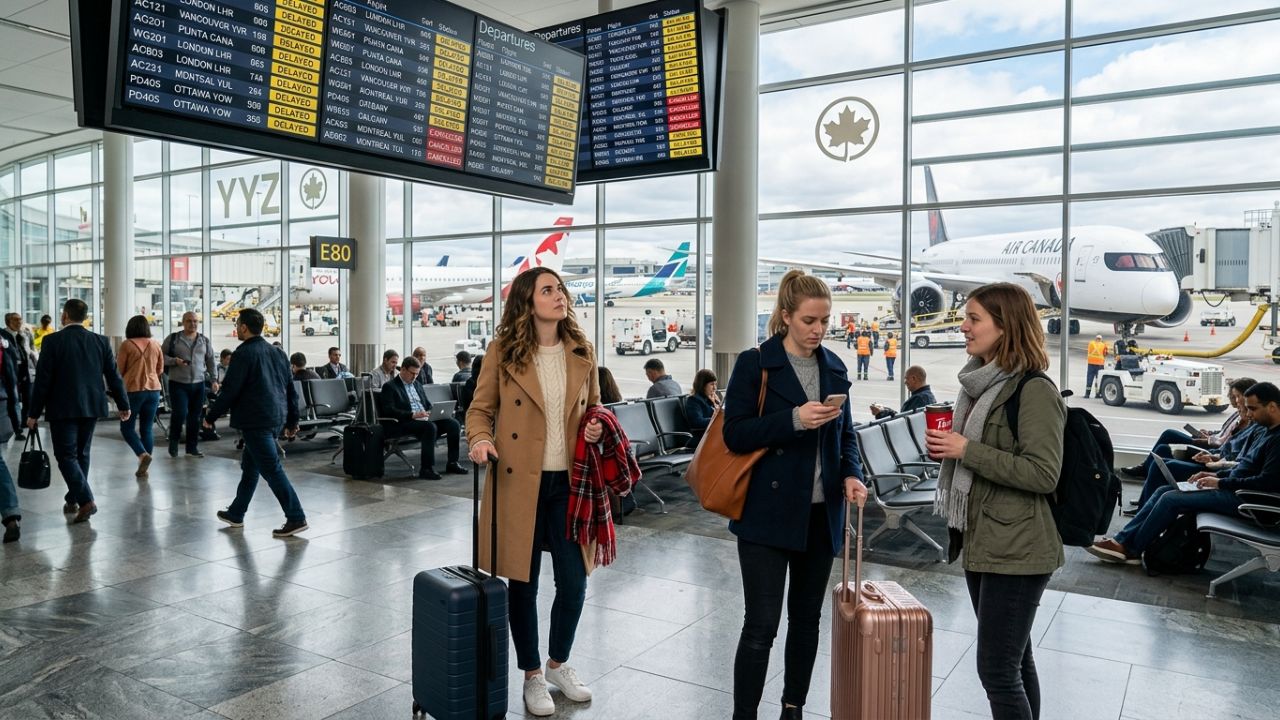
Image generated by AI
Aviation Updates: Massive Travel Chaos Paralyzes Toronto Pearson Airport as Air Canada and Air France Log 16 Flight Cancellations
Canada’s primary international gateway suffers a sprawling operational meltdown, generating severe network friction across both domestic corridors and high-volume transborder routes into the United States.
Image generated by AI
Severe airport disruptions have violently rippled across the North American aviation network as Toronto Pearson International Airport suffered a concentrated operational breakdown on June 26, 2026. According to the absolute latest airline news and verified airport telemetry, Canada’s busiest aviation gateway buckled under extreme travel instability, officially registering 16 outright flight cancellations alongside an agonizing 127 total flight delays in a single day. This catastrophic loss of schedule integrity generated sprawling travel chaos across the entire Canadian aviation system. The operational meltdown severely crippled critical domestic routes directly linking Toronto to Vancouver, Winnipeg, Ottawa, Montreal, and Calgary. Furthermore, the friction rapidly corrupted high-volume international hubs, devastating passenger itineraries bound for Indianapolis, Los Angeles, and Orlando. Major legacy operators including Air Canada, Jazz Aviation, Air France, and WestJet all suffered critical network damage as the hub failed to maintain operational flow.
Expanded Overview: The Toronto Infrastructure Bottleneck
When reviewing standard aviation updates, an operational collapse at a mega-hub like Toronto Pearson carries massive implications for global travel connectivity.
Because Pearson functions as Canada's absolute primary international gateway, the daily operations failure generated massive, cascading knock-on effects that rapidly spread across connecting flights and onward international travel routes. The 16 total flight cancellations and 127 rolling delays indicate a profound structural strain on the airport's scheduling efficiency. The operational flow through the massive facility was aggressively uneven throughout the day, completely destroying both short-haul domestic turnaround times and deeply complex long-haul international connections. When Toronto Pearson loses capacity, the entire Canadian network slows down in response.
Section-Wise Breakdown: The Domestic Capacity Loss
The absolute brunt of the cancellation wave fell aggressively on the Canadian domestic network, led almost entirely by Air Canada and its regional affiliates.
Direct routes linking Toronto to Vancouver and Winnipeg suffered outright cancellations. The rolling delays further saturated the Canadian domestic map, completely corrupting flight schedules bound for Ottawa, Montreal, Saskatoon, Calgary, Charlottetown, Victoria (North Saanich), Yellowknife, Deer Lake, Edmonton, and Kelowna. Air Canada absorbed the highest recorded disruption volume, logging 7 cancellations and 43 delays. Its leisure branch, Air Canada Rouge, recorded 4 cancellations and 18 delays, while its express partner, Jazz Aviation, registered 4 cancellations and 15 delays. Independent operators also struggled; Porter Airlines logged 11 delays, while WestJet and Flair Airlines experienced localized friction.
Section-Wise Breakdown: International Feeder Disruption
The disruption quickly bled into the US transborder and international transatlantic corridors, affecting dozens of foreign carriers attempting to execute turnaround operations at Pearson.
US-bound corridors were severely impacted, with cancellations dropping flights to Raleigh / Durham, Miami, and Phoenix. Rolling delays absolutely devastated routes to Austin, Nashville, Boston, Denver, Dallas–Fort Worth, Newark, Indianapolis, Los Angeles, Orlando, Chicago, San Diego, San Francisco, and St. Louis. The transatlantic and global network also faltered. Cancellations hit services to Vienna, London, and Paris. Delays choked operations bound for Frankfurt, Amsterdam, Warsaw, Cairo, Kingston, Incheon, and Bridgetown (Christ Church). Air France was particularly hard-hit proportionally, logging 1 cancellation and 3 delays on highly limited capacity, while major foreign carriers like Lufthansa, KLM, Emirates, Cathay Pacific, and Delta Air Lines all absorbed localized damage.
Flight Details: Toronto Pearson Airline Disruption Matrix
The precise operational telemetry detailing this sprawling failure has been consolidated into the mandatory matrix below, outlining the specific delay and cancellation metrics for every carrier impacted during the June 26 disruption cycle.
Toronto Pearson Airline Disruption Matrix
| Airline | Cancelled | Cancelled (%) | Delayed | Delayed (%) |
|---|---|---|---|---|
| Air Canada | 7 | 2% | 43 | 13% |
| Air Canada Rouge (ACA) | 4 | 3% | 18 | 17% |
| Jazz (ACA) | 4 | 3% | 15 | 11% |
| Air France | 1 | 25% | 3 | 75% |
| Air North Charter | 0 | 0% | 1 | 100% |
| Cathay Pacific | 0 | 0% | 2 | 33% |
| Delta Air Lines | 0 | 0% | 1 | 8% |
| Lufthansa | 0 | 0% | 2 | 50% |
| Endeavor Air (DAL) | 0 | 0% | 1 | 3% |
| Flair Airlines | 0 | 0% | 3 | 6% |
| ITA Airways | 0 | 0% | 1 | 50% |
| PSA Airlines (AAL) | 0 | 0% | 1 | 9% |
| KLM | 0 | 0% | 2 | 50% |
| LOT Polish Airlines | 0 | 0% | 2 | 50% |
| Euroatlantic Airways | 0 | 0% | 1 | 50% |
| Egypt Air | 0 | 0% | 1 | 50% |
| Philippine Airlines | 0 | 0% | 1 | 50% |
| Porter Airlines | 0 | 0% | 11 | 10% |
| Republic | 0 | 0% | 1 | 2% |
| SkyWest | 0 | 0% | 2 | 14% |
| Air Transat | 0 | 0% | 9 | 27% |
| Emirates | 0 | 0% | 1 | 25% |
| Virgin Atlantic | 0 | 0% | 2 | 100% |
| American Airlines | 0 | 0% | 1 | 7% |
| WestJet | 0 | 0% | 2 | 1% |
Passenger Impact: Navigating the Rebooking Process
For the thousands of passengers attempting to navigate through Toronto Pearson on June 26, the scheduling collapse resulted in massive terminal congestion and wildly fractured travel itineraries. While the disruption remains operational in nature, the short-term effects heavily compromised inbound tourism arrivals into Canada and outbound leisure travel.
Aviation authorities emphasize that passengers caught in this gridlock must monitor their airline applications aggressively. In most cases, major operators like Air Canada and Air France will rebook passengers automatically utilizing internal system capacity, completely bypassing the need to wait in physical terminal queues. Eligibility for direct financial compensation depends heavily on the specific airline's policy and overarching Canadian regulatory conditions regarding the root cause of the cancellation.
Industry Analysis: Systemic Causes of Hub Instability
Aviation strategists point out that the massive disruption footprint at Toronto Pearson highlights the extreme vulnerability of primary international hubs. When local air traffic congestion, adverse weather, or localized ground crewing issues throttle a major facility, airlines are forced into reactionary postures.
Air Canada, holding the absolute largest market share at the airport, naturally absorbed the vast majority of the statistical damage. However, the sheer breadth of foreign carriers impacted—ranging from Euroatlantic Airways to Philippine Airlines—proves that the airport environment itself struggled to process inbound and outbound movements efficiently. Fortunately, no long-term structural impact has been confirmed, indicating that this specific disruption was a severe, yet contained, single-day operational failure.
Conclusion: A Network Reliant on Precision
Ultimately, the June 26 travel chaos at Toronto Pearson International Airport proves exactly how quickly a localized operational bottleneck can paralyze travel across North America. The combination of 16 flight cancellations and 127 delays devastated the schedules of Air Canada, Air France, and WestJet, heavily impacting vital routes to Vancouver, Montreal, Los Angeles, and London. As the airport authority and airline operations teams work frantically to restore capacity and clear the backlog of displaced passengers, travelers utilizing Canada's busiest hub must continuously monitor official airline communications and build high levels of flexibility into their summer itineraries.
Key Takeaways
- Massive Gridlock: Toronto Pearson registered 16 total flight cancellations and 127 total delays on June 26, 2026.
- Air Canada Severely Hit: Air Canada (7 cancellations, 43 delays) and Air Canada Rouge (4 cancellations, 18 delays) absorbed massive disruption volumes.
- Widespread Impact: The chaos impacted over 20 unique airlines, including Air France, WestJet, Porter, KLM, and Delta.
- Domestic Routes Corrupted: Cancellations and delays devastated flights to Vancouver, Montreal, Calgary, Ottawa, and Winnipeg.
- International Network Stalled: High-volume US transborder routes (Los Angeles, Orlando) and European transatlantic routes (London, Paris) suffered heavy delays.
FAQ: Toronto Pearson Airport Flight Disruptions 2026
Which airline cancelled the most flights at Toronto Pearson Airport? Air Canada recorded the highest disruption volume with 7 absolute cancellations and 43 delays, followed closely by its regional partner Jazz Aviation and leisure brand Air Canada Rouge.
How many total flights were delayed or cancelled at Toronto Pearson? During this specific June 26 operational cycle, Toronto Pearson Airport officially registered 16 flight cancellations and 127 total flight delays.
What should passengers do if their flight from Toronto is delayed? Passengers must aggressively monitor airline notifications through official apps. While carriers like Air Canada may rebook automatically, travelers should always verify their updated travel status and maintain a highly flexible itinerary.
Related Travel Guides
Australia New Zealand Flights Cancelled Qantas Jetstar Travel Chaos 2026
Emirates Airbus A380 Fleet Restoration Dubai Airport 2026
Canada Domestic Flight Disruption Passenger Survival Guide 2026
Disclaimer: This article is strictly for informational purposes. The flight information, delay statistics (127 delays), cancellation figures (16 cancellations), and airline metrics (Air Canada, Air France, WestJet) are based on data sourced directly from FlightAware for operations on June 26, 2026. Airlines frequently adjust schedules and routes to prioritize operational safety. In the event of a change, passengers should remain calm, explore alternative flight options, and understand their carrier’s specific rebooking policies.
Disclaimer
This article is for informational and educational purposes only. It does not constitute legal, financial, or professional advice. While we strive to provide accurate and up-to-date information, travel policies, regulations, and conditions change rapidly. Always verify information with official sources before making travel decisions. Nomad Lawyer makes no representations about the accuracy, reliability, completeness, or suitability of the information provided. Readers should consult qualified professionals for advice specific to their circumstances. The views expressed in this article are those of the author and do not necessarily reflect the views of Nomad Lawyer.
Kunal K Choudhary
Co-Founder & Contributor
A passionate traveller and tech enthusiast. Kunal contributes to the vision and growth of Nomad Lawyer, bringing fresh perspectives and driving the community forward.
Learn more about our team →