
Gridlock Above the Clouds: Navigating Asia’s 3,900-Flight Delay Surge Across Jakarta, Tokyo, and Delhi

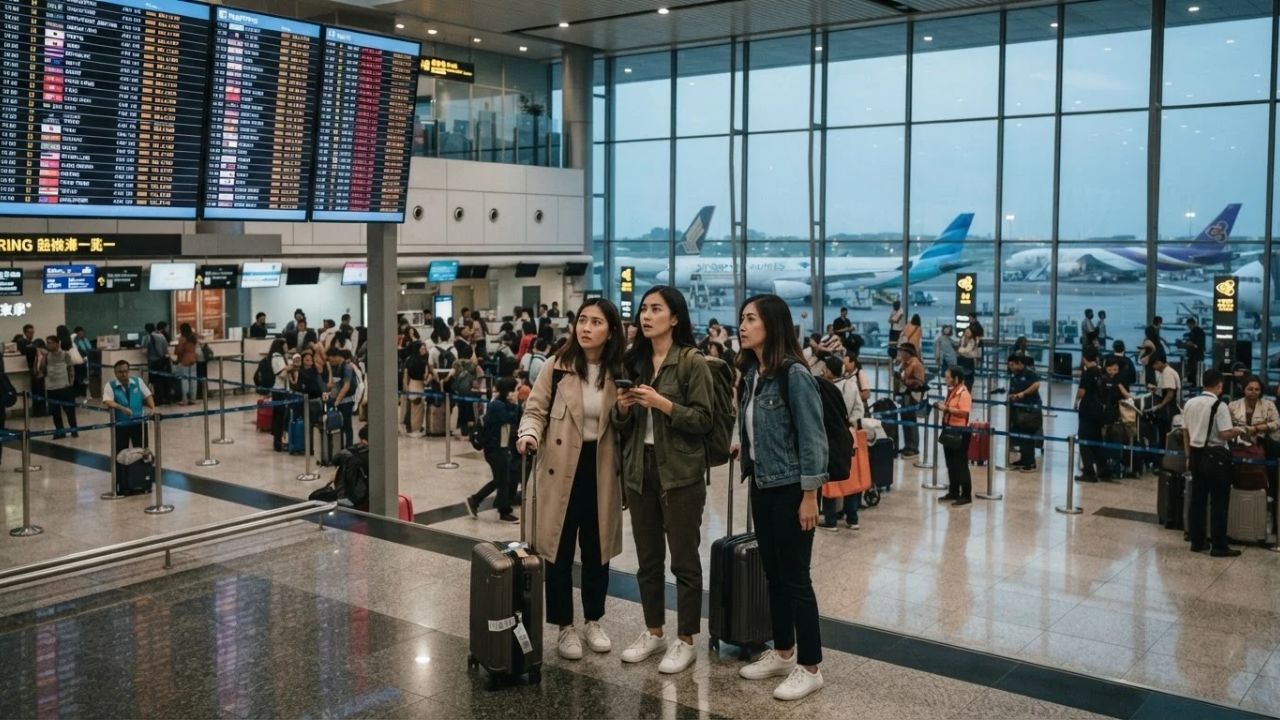
While air travelers usually prepare for regional storms or isolated mechanical snags, the profound fragility of Asia's interconnected air corridors was exposed on 15–16 September 2026, when a cascading operational bottleneck triggered 3,913 flight delays and 361 cancellations across the continent’s most vital gateways. What few travelers realize is that Jakarta's Soekarno-Hatta International Airport emerged as the single hardest-hit facility for grounded departures with 33 cancellations, while Tokyo International Airport (Haneda) logged an astonishing 387 delays, sending shockwaves across connecting corridors from New Delhi to Guangzhou.
For long-haul travelers navigating Asia, these systemic disruptions reveal a modern transit reality: when high-volume hubs suffer aircraft scheduling bottlenecks, tarmac congestion, and operational capacity limits, the ripple effects ignore national boundaries. An aircraft delayed in the congested airspace of southern China can derail a midnight connection in Bangkok, leave business passengers stranded in Mumbai, and trigger missed island ferry transfers in Bali. Navigating this dynamic requires looking past generic airline notifications to master real-time rerouting, passenger compensation frameworks, and high-speed ground transit alternatives.
The Operational Domino: Mapping 3,900 Delays Across Asia’s Busiest Gateways
According to global tracking figures compiled by FlightAware on 15 September 2026 at 3:03 pm ET (16 September at 2:04 am Jakarta Time), operational strain struck simultaneously across East Asia, South Asia, Southeast Asia, and the Middle East.
Tokyo Haneda led all Asian airports in total delayed movements, recording 387 delayed flights against a single cancellation as heavy domestic and international volumes overwhelmed terminal runways. Across China, operational pressure rippled through major industrial centers:
- Guangzhou Baiyun International Airport: Recorded 199 delays and 12 cancellations.
- Shenzhen Bao’an International Airport: Logged 192 delays and 6 cancellations.
- Shanghai Pudong International Airport: Noted 127 delays and 7 cancellations, alongside Shanghai Hongqiao with 70 delays and 11 cancellations.
- Beijing Gateways: Capital International logged 84 delays and 5 cancellations, while Daxing recorded 53 delays and 10 cancellations.
- Regional Chinese Hubs: Chengdu Tianfu logged 56 delays and 13 cancellations, Chengdu Shuangliu had 52 delays and 4 cancellations, Kunming Changshui saw 59 delays and 10 cancellations, Chongqing Jiangbei recorded 53 delays and 9 cancellations, Nanjing Lukou logged 30 delays and 7 cancellations, Wuhan Tianhe noted 29 delays and 13 cancellations, and Ningbo Lishe recorded 26 delays and 4 cancellations.
In Southeast Asia, Jakarta's Soekarno-Hatta International Airport suffered the heaviest wave of outright grounded flights, registering 33 cancellations and 177 delays. Other Indonesian transit points felt the squeeze, with Bali's Ngurah Rai International logging 74 delays and 5 cancellations, and Surabaya's Juanda International reporting 54 delays and 9 cancellations. Vietnam's premier entry points faced severe slowdowns, with Hanoi's Noi Bai recording 192 delays and 3 cancellations, while Ho Chi Minh City's Tan Son Nhat logged 118 delays and 4 cancellations. Elsewhere, Bangkok Suvarnabhumi recorded 163 delays and 8 cancellations, Kuala Lumpur International logged 129 delays and 6 cancellations, and Manila International reported 121 delays and 5 cancellations.
South Asian transit hubs absorbed similar shocks. Indira Gandhi International Airport in Delhi stood as South Asia’s most impacted hub, with 162 delays and 12 cancellations. Chhatrapati Shivaji International in Mumbai recorded 54 delays and 3 cancellations, Hyderabad’s Rajiv Gandhi logged 50 delays and 4 cancellations, Srinagar had 13 delays and 3 cancellations, and Pune reported 11 delays and 6 cancellations.
The Middle East's primary intercontinental transit bridges were heavily affected:
- Jeddah King Abdulaziz: Logged 235 delays and 9 cancellations.
- Tel Aviv Ben Gurion: Recorded 183 delays and 3 cancellations.
- Riyadh King Khalid: Registered 145 delays and 11 cancellations, alongside Abha Regional with 43 delays and 10 cancellations.
- Dubai International Airport: Experienced 117 delays and 11 cancellations, disrupting crucial east-west passenger transfers.
Airlines absorbed the brunt of the breakdown. China Eastern recorded the highest cancellation count of any carrier, canceling 49 flights while delaying 189 (an 8% delay rate). Indonesia's low-cost carrier Citilink experienced 24 cancellations and 26 delays, with cancellation and delay rates both at 9%. Air China canceled 21 flights with 84 delays, and Batik Air reported 19 cancellations and 63 delays (a 20% delay rate). In India, SpiceJet canceled 18 flights—representing 23% of its entire scheduled operation—with 20 delays (a 26% delay rate), while market leader IndiGo recorded 165 delays (an 8% delay rate) and 6 cancellations. Middle Eastern flag carrier Saudia logged 18 cancellations and 160 delays, posting a 29% delay rate.
Other impacted carriers included Shenzhen Airlines (4 cancellations, 96 delays), Vietnam Airlines (4 cancellations, 65 delays), Malindo Air (4 cancellations, 40 delays), Thai Vietjet Air (4 cancellations, 40 delays), China Express (3 cancellations, 70 delays), XiamenAir (3 cancellations, 46 delays), All Nippon Airways (2 cancellations, 113 delays), Flynas (2 cancellations, 83 delays), Air Arabia (2 cancellations, 50 delays), AirAsia (2 cancellations, 39 delays), FlyDubai (2 cancellations, 39 delays), Garuda Indonesia (2 cancellations, 28 delays), Royal Jordanian (2 cancellations, 22 delays), and Pakistan International Airlines (2 cancellations, 16 delays).
What Makes Asian Air Travel Geographically Unique
The geography of Asia makes aviation an indispensable lifeline rather than a casual travel luxury. In Indonesia, an archipelagic nation spanning over 17,000 islands across three time zones, air routes between Jakarta, Surabaya, and Bali replace highway arteries that simply cannot exist across deep oceanic trenches. When flights stall at Soekarno-Hatta, vital cargo, fresh produce, and family travelers are cut off across thousands of miles of ocean.
Similarly, India's subcontinent demands high-frequency air connectivity to bridge northern Himalayan valleys like Srinagar with southern coastal tech hubs like Hyderabad and Pune. In Japan, Tokyo Haneda functions not merely as an international terminal, but as the pulsating heart of domestic connectivity, feeding remote northern prefectures in Hokkaido and southern subtropical outposts in Okinawa.
Because these hubs operate at near-maximum runway capacity, they lack the operational slack seen in less congested regions. A 30-minute departure ground stop in Guangzhou or a weather diversion into Delhi sets off an unavoidable chain reaction, stranding crews outside their legal duty hours and leaving aircraft out of position for downstream morning departures across six countries.
Visitor Insider Tips: Surviving Regional Flight Delays Like an Aviation Expert
When an entire continent’s flight grid stumbles, relying on generic customer service lines guarantees frustration. Through practical resources curated by Japan National Tourism Organization and Wonderful Indonesia, seasoned travelers protect their itineraries through active planning.
- Build Generous Four-Hour Layover Buffers: If booking self-transfers or itineraries involving separate tickets across different airlines, never schedule layovers under four hours at mega-hubs like Tokyo Haneda, Delhi Indira Gandhi, or Jakarta Soekarno-Hatta. A minor 45-minute delay on an inbound regional hop will cause you to forfeit a long-haul intercontinental flight with zero airline rebooking liability.
- Pivoting to High-Speed Rail Networks: When domestic aviation in Japan or China falters, take the train. If your domestic flight out of Tokyo Haneda is delayed by hours, walk to the terminal monorail, head to Tokyo Station, and book a seat aboard the Shinkansen bullet train to Kyoto, Osaka, or Hiroshima. In China, travelers stranded by airspace delays in Guangzhou or Shanghai can utilize China Railway’s high-speed rail lines to reach regional cities in comfort, bypassing tarmac delays entirely.
- Master Airport Sleep Pods and Transit Lounges: Avoid sleeping on terminal floor tiles during multi-hour irregular operations. At Jakarta Soekarno-Hatta Terminal 3, book a micro-room at the Digital Airport Hotel capsule facility. At Delhi Indira Gandhi Terminal 3, head to the Encalm Lounge or transit sleeping pods located before security clearance to rest and recharge devices in quiet conditions.
- Know Your Passenger Compensation Rights: Understand regional regulatory compensation mandates. In Indonesia, Minister of Transportation Regulation PM 89/2015 requires carriers to provide refreshments after 90 minutes of delay, heavy meals after three hours, and direct cash compensation of IDR 300,000 for carrier-caused delays exceeding four hours. In India, Directorate General of Civil Aviation (DGCA) rules require airlines to provide free hotel accommodation and meals for major overnight cancellations, alongside refunds or alternative flight arrangements.
- Keep Essential Gear in Your Cabin Bag: Never check medications, power banks, international travel adapters, or a fresh change of clothes into your checked baggage. When delays cause missed baggage transfers between airlines, your checked luggage may take 48 hours to catch up with you at your final destination.
Cultural and Environmental Context: Sustainable Alternatives to Overburdened Airspace
The recurring frequency of massive airspace bottlenecks underscores an urgent ecological truth: Asia’s booming travel economy cannot rely solely on aviation expansion to sustain regional mobility. Aviation fuel emissions, airport noise pollution, and the environmental footprint of continuous terminal expansions put severe pressure on local ecosystems, from Jakarta’s sinking coastal plain to Tokyo Bay’s fragile marine basins.
Across China and Japan, massive public investments in zero-emission electrified high-speed rail have proven that domestic travelers prefer swift, center-to-center ground transit over the anxiety of airport security queues and tarmac ground stops. Expanding high-speed rail corridors—such as Indonesia’s Whoosh train linking Jakarta to Bandung—presents an inspiring model for shifting passenger volume away from short-haul domestic flights to low-carbon ground arteries.
As international visitors explore the breathtaking cultural wonders of Asia, choosing sustainable transit alternatives like overnight sleeper trains, electric intercity coaches, and modern rail networks helps relieve pressure on crowded skies. By traveling with patience, cultural humility, and eco-conscious foresight, travelers directly contribute to a more balanced and resilient regional transport future.
FAQ: Navigating Asian Airport Delays 2026
What should I do if my connecting flight in Asia is canceled? Immediately visit your operating airline’s transfer service desk inside the transit zone, request rebooking on the earliest available departure or partner carrier, and secure vouchers for meals or hotel accommodation where delays exceed several hours.
How does Indonesian law protect passengers during severe flight delays? Under Indonesian regulation PM 89/2015, airlines must provide snacks after 90 minutes, meals after three hours, and IDR 300,000 in direct compensation for airline-caused delays exceeding four hours.
Can high-speed trains replace domestic flights during flight disruptions in Tokyo? Yes. From Tokyo Haneda, travelers can easily reach Tokyo Station via the Tokyo Monorail and board high-frequency Shinkansen bullet trains to major cities like Nagoya, Kyoto, and Osaka, bypassing air delays completely.
What is the minimum connection time recommended at major Asian hubs? For itineraries booked on separate tickets or requiring international-to-domestic transfers, allow at least 3.5 to 4 hours to clear immigration, re-check baggage, and navigate extensive terminal complexes.
When the flight boards flicker with red delay warnings, the seasoned wanderer knows that the journey is not halted—only redirected toward unexpected adventures on the ground.
Related Travel Guides
- Mountains, Mangroves, and Terracotta Dunes: How Ras Al Khaimah and Emirates Are Opening the UAE’s Northern Frontier
- Single-Ticket Asian Journeys: How Japan and South Korea Are Linking Rails, Ferries, and Border Crossings in 2026
- Stranded in Narita: Navigating Nepal Airlines’ A330 Breakdown, Passenger Rights, and Tokyo-Kathmandu Aviation Realities
Disclaimer
This article is for informational and educational purposes only. It does not constitute legal, financial, or professional advice. While we strive to provide accurate and up-to-date information, travel policies, regulations, and conditions change rapidly. Always verify information with official sources before making travel decisions. Nomad Lawyer makes no representations about the accuracy, reliability, completeness, or suitability of the information provided. Readers should consult qualified professionals for advice specific to their circumstances. The views expressed in this article are those of the author and do not necessarily reflect the views of Nomad Lawyer.
Raushan Kumar
Founder & Lead Developer
Full-stack developer with 11+ years of experience and a passionate traveller. Raushan built Nomad Lawyer from the ground up with a vision to create the best travel and law experience on the web.
Learn more about our team →