
Thousands Stranded: Asia's Worst Aviation Crisis—388 Flights Cancelled, 5,245 Delayed Across China, Japan, Thailand, UAE, Qatar Airports
A massive aviation crisis has paralyzed Asia's major airports with 388 flight cancellations and over 5,245 flight delays affecting IndiGo, ANA Wings, China Southern, Emirates, Malindo Air, and dozens of other carriers across Beijing, Shanghai, Tokyo, Dubai, Bangkok, Jakarta, and Doha.

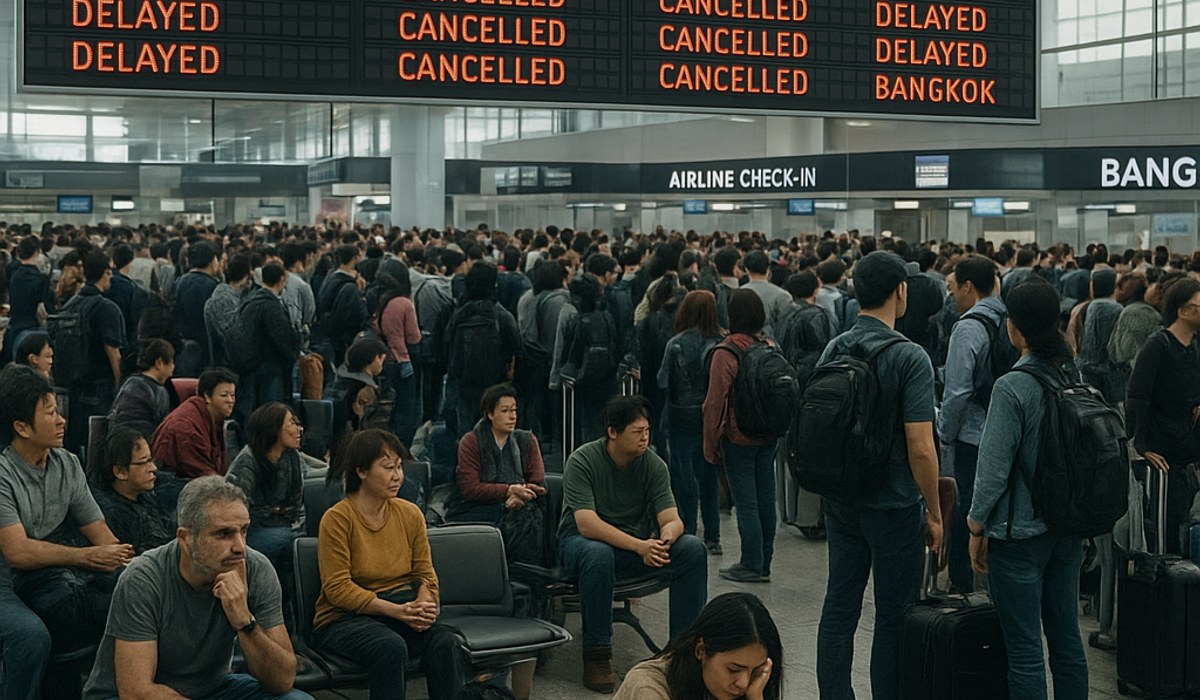
Image generated by AI
QUICK SUMMARY
- 388 flights cancelled and 5,245 flights delayed across major Asian airports in massive operational crisis
- Affected countries: China, Japan, Thailand, Qatar, UAE, Indonesia, India, Malaysia, Saudi Arabia, Philippines
- Most impacted airline: China Southern Airlines (63 cancellations, 1,130 delays)
- Major airports hit: Guangzhou Baiyun (55 cancellations, 516 delays), Shenzhen (49 cancellations, 400 delays), Shanghai airports severely disrupted
- Root causes: Weather disruptions, operational failures, air traffic control bottlenecks creating cascading network collapse
Asia's Aviation System Faces Unprecedented Crisis as Thousands of Travelers Languish in Airports
A perfect storm of operational failures has crippled air travel across Asia, leaving thousands of passengers stranded and uncertain about when their journeys might resume. Yesterday's collapse saw 388 flights outright cancelled and another 5,245 delayed—a scale of disruption that exposed vulnerabilities in the continent's busy aviation network. The chaos spread across major hubs from Beijing and Shanghai to Tokyo, Dubai, Bangkok, Jakarta, and beyond, with carriers including China Southern Airlines, China Eastern, IndiGo, Emirates, ANA Wings, and Malindo Air unable to maintain schedules.
For travelers caught in the crisis, the experience represents far more than mere inconvenience. Missed connections, cancelled business meetings, delayed family reunions, and extended airport waits have become the norm across Asia's most critical travel hubs.
Which Airlines Faced the Worst Disruptions?
The breakdown of operations affected a wide spectrum of carriers, with some experiencing exponentially worse performance than others.
China Southern Airlines dominated the disruption list, accounting for 63 cancellations (2% of its Asian operations) but facing an astounding 1,130 delays (47% of scheduled flights). China Eastern followed with 57 cancellations and 619 delays, while Shenzhen Airlines recorded 45 cancellations with delays affecting 53% of its schedule—the highest percentage disruption among major carriers.
Regional carriers bore disproportionate impact:
- Japan Air Commuter: 40 cancellations (36% of flights), 24 delays (22%)
- Air China: 39 cancellations, 378 delays (20% of schedule)
- Hainan Airlines: 39 cancellations, 272 delays (36%)
- Sichuan Airlines: 19 cancellations, 198 delays
- Shanghai Airlines: 14 cancellations, 95 delays
International carriers also suffered significantly:
- IndiGo: 9 cancellations, 401 delays (18% of operations)
- ANA Wings: 10 cancellations, 30 delays
- Emirates: 1 cancellation, 141 delays (36% of Dubai-originating flights)
- FlyDubai: 9 cancellations, 24 delays
- SpiceJet: 11 cancellations, 85 delays (44%)
- Malindo Air: 3 cancellations, 78 delays (41%)
One telling metric reveals the crisis's severity: Qatar Airways and Japan Airlines managed near-perfect operational records with zero to minimal cancellations, yet even these carriers reported 51 and 169 delays respectively—suggesting network-wide gridlock rather than individual airline failure.
Airport-by-Airport Breakdown: Where the Chaos Centered
China's aviation infrastructure absorbed the hardest blow, with major airports descending into operational collapse.
Most Severely Disrupted Airports
Guangzhou Baiyun International Airport (CAN) emerged as the crisis epicenter with 55 cancellations (6% of daily flights) and 516 delays (64% of operations)—meaning two-thirds of scheduled flights faced delays exceeding 15 minutes.
Shenzhen Bao'an International Airport (SZX) followed with 49 cancellations (7% of total flights) and 400 delays (58%)—similarly catastrophic operational failure indicating systematic airport-wide challenges rather than scattered incidents.
Hangzhou Xiaoshan International Airport (HGH) recorded 10 cancellations plus 223 delays affecting 45% of daily operations, suggesting capacity and traffic control constraints.
Chongqing Jiangbei International Airport (CKG) registered 8 cancellations and 137 delays (30% of schedule), demonstrating that even secondary hubs couldn't escape the continental crisis.
Shanghai airports (Combined SHA and PVG terminals) collectively experienced 28 cancellations and 343 delays—affecting multiple terminals and creating confusion for transferring passengers.
Other significantly impacted facilities included:
- Beijing Capital International Airport (PEK): 8 cancellations, 117 delays
- Chengdu Shuangliu (CTU): 10 cancellations, 101 delays
- Hefei Xinqiao (HFE): 8 cancellations, 44 delays
- Taiyuan Wusu (TYN): 8 cancellations, 43 delays
Geographic Scope: A Continental Crisis Spanning Six Time Zones
The disruptions weren't isolated to one country or region—they cascaded across Asia's entire eastern and southern corridors.
China experienced the densest concentration of disruptions, reflecting its status as the world's second-largest aviation market. Multiple Chinese carriers and 20+ airports faced simultaneous operational challenges, suggesting weather patterns, air traffic control gridlock, or fuel supply constraints affecting the entire system.
Japan reported significant impacts at Tokyo facilities, with Japan Air Commuter and All Nippon Airways facing considerable delays despite normally reliable operations.
Southeast Asia faced substantial disruptions with Thailand (Bangkok Suvarnabhumi), Indonesia (Jakarta and Bali airports), and Malaysia reporting widespread delays—affecting both regional and long-haul international routes.
Middle Eastern hubs including Qatar (Hamad International, Doha) and UAE (Dubai International) processed thousands of delayed passengers, with Emirates reporting 141 delays affecting its premium international network.
India documented significant delays at Delhi, Mumbai, and Chennai airports, while Saudi Arabia reported delays at Riyadh facilities.
Root Causes: What Triggered the Continental Collapse?
Multiple compounding failures rather than single-point failure appear responsible for the crisis's unprecedented scale.
Weather disruptions in key regions likely triggered the cascade—severe thunderstorms, wind shear, or visibility constraints at major hub airports can force ground stops affecting not just departing and arriving flights but also aircraft positioning and crew scheduling across networks.
Operational bottlenecks suggest staff shortages, particularly in air traffic control towers. During high-traffic periods, single-tower overload can create ripple effects: delayed departures, held aircraft, crew duty violations, and subsequent schedule collapses.
Air traffic management constraints may have required flow controls—intentional flight delays implemented to manage airspace capacity—that compounded as the day progressed.
Fuel supply chain disruptions at major hubs could explain simultaneous cancellations across multiple carriers at specific airports.
Maintenance emergencies affecting multiple aircraft simultaneously in regions without spare aircraft availability would necessitate flight cancellations.
What This Means for Travelers: The Immediate and Cascading Impact
The scale of disruption—388 cancellations and 5,245 delays—translates into stranded passengers across multiple time zones facing exponentially worsening rebooking challenges.
Immediate impacts:
- Approximately 90,000-150,000 passengers directly affected across cancelled and delayed flights
- Connecting passengers face missed onward flights, effectively increasing affected passenger count to 200,000+
- Hotel availability exhausted as thousands require overnight accommodations
- Ground transportation queues extending hours as rental car companies and shuttle services overwhelm
Cascading effects:
- Business conferences and meetings cancelled or postponed across Asia-Pacific region
- Tourism revenue losses as travelers abandon plans or rebook to different destinations
- Crew scheduling collapse affecting subsequent days' operations
- Aircraft positioned wrongly across the network, reducing available capacity for 48+ hours
Financial implications for airlines include compensation obligations, fuel costs from extended operations, crew overtime expenses, and potential fuel surcharges for alternative routing—totaling potentially $100+ million in industry losses.
Practical Guidance: What Travelers Should Do Now
If your flight was affected, immediate action maximizes your options:
Check airline communications immediately—most carriers issued alerts via app, email, and SMS before terminal announcements. Check your airline's website or call their disruption hotline for current rebooking information.
Visit airline customer service in person if online resources prove slow or unhelpful. High-traffic periods see extended waits, but ground staff can access real-time rebooking options not available through automated systems.
Document everything—capture flight confirmation numbers, delay notifications, receipts for meals/hotels, and gate agent names for potential compensation claims later.
Explore alternative routing—consider how you might reach your final destination through alternative airports, carriers, or route combinations. Middle-seat premium cabin seats sometimes available when economy is full.
Know your rights—international travel carries specific regulations. EU261 compensation ($250-600+ per passenger) applies to EU-registered carriers for delays exceeding 3 hours; similar protections exist in other jurisdictions.
Monitor broader recovery—subsequent days may show continued delays as aircraft positioning normalizes. Consider whether flexible travel dates might offer better outcomes than combating the immediate backlog.
FAQ: Your Questions About Asia's Aviation Crisis
Q: Will my airline compensate me for cancellation or delay? A: Compensation eligibility depends on your airline's country of origin and delay length. International carriers from EU nations face €250-600 obligations for 3+ hour delays. Document everything and file claims through your airline's website or regulatory bodies like the CAA or DGCA.
Q: How long will delays continue across Asian airports? A: Complete recovery typically requires 48-72 hours as aircraft reposition and crews reset to legal duty schedules. Expect minor delays cascading through week's end even after primary disruption resolves.
Q: Should I rebook with a different airline or wait for my original booking? A: If your airline offers flexibility, consider rebooking on competitors if they show available capacity for your final destination. Original airline obligations limit their rebooking to same-day alternatives when possible, but direct competitors may offer faster recovery.
Q: Can I claim travel insurance for this disruption? A: Check your policy's specific wording. "Force majeure" (weather, air traffic control) often excludes coverage, while "airline operational issues" may be covered. File claims with your insurer with documentation including delay notifications.
Q: What's the best way to avoid future disruption impacts? A: Build routing flexibility into important travel—avoid same-day connections through disruption-prone airports when possible, maintain trip insurance covering cancellation, and consider direct flights bypassing major hubs during peak seasons.
Looking Ahead: Asia's Aviation Network Faces Long Recovery
The scale of yesterday's disruptions signals systemic vulnerabilities in Asia's aviation infrastructure at a time of record passenger growth.
As the continent recovers, questions linger: Will this incident trigger infrastructure investments in air traffic control? Can staffing constraints be addressed through pilot training expansion? Will carriers implement network redundancy to prevent single-hub failures from cascading globally?
For the thousands of travelers currently stranded across Asia, the immediate reality involves extended airport stays, cancelled meetings, and uncertain reconnection timelines. This crisis reminds passengers why flexible travel arrangements, comprehensive insurance, and realistic schedule planning remain essential for navigating modern aviation.
Disclaimer
This article is for informational and educational purposes only. It does not constitute legal, financial, or professional advice. While we strive to provide accurate and up-to-date information, travel policies, regulations, and conditions change rapidly. Always verify information with official sources before making travel decisions. Nomad Lawyer makes no representations about the accuracy, reliability, completeness, or suitability of the information provided. Readers should consult qualified professionals for advice specific to their circumstances. The views expressed in this article are those of the author and do not necessarily reflect the views of Nomad Lawyer.
Raushan Kumar
Founder & Lead Developer
Full-stack developer with 11+ years of experience and a passionate traveller. Raushan built Nomad Lawyer from the ground up with a vision to create the best travel and law experience on the web.
Learn more about our team →