
Massive Travel Chaos Strikes Anchorage International: Alaska Airlines and Sterling Airways Trigger Flight Cancellations Amid Severe Airport Disruptions: Latest Airline News
Ted Stevens Anchorage International Airport is currently battling severe travel chaos, reporting 49 delays and 5 flight cancellations as massive airport disruptions cripple the Alaskan aviation grid.

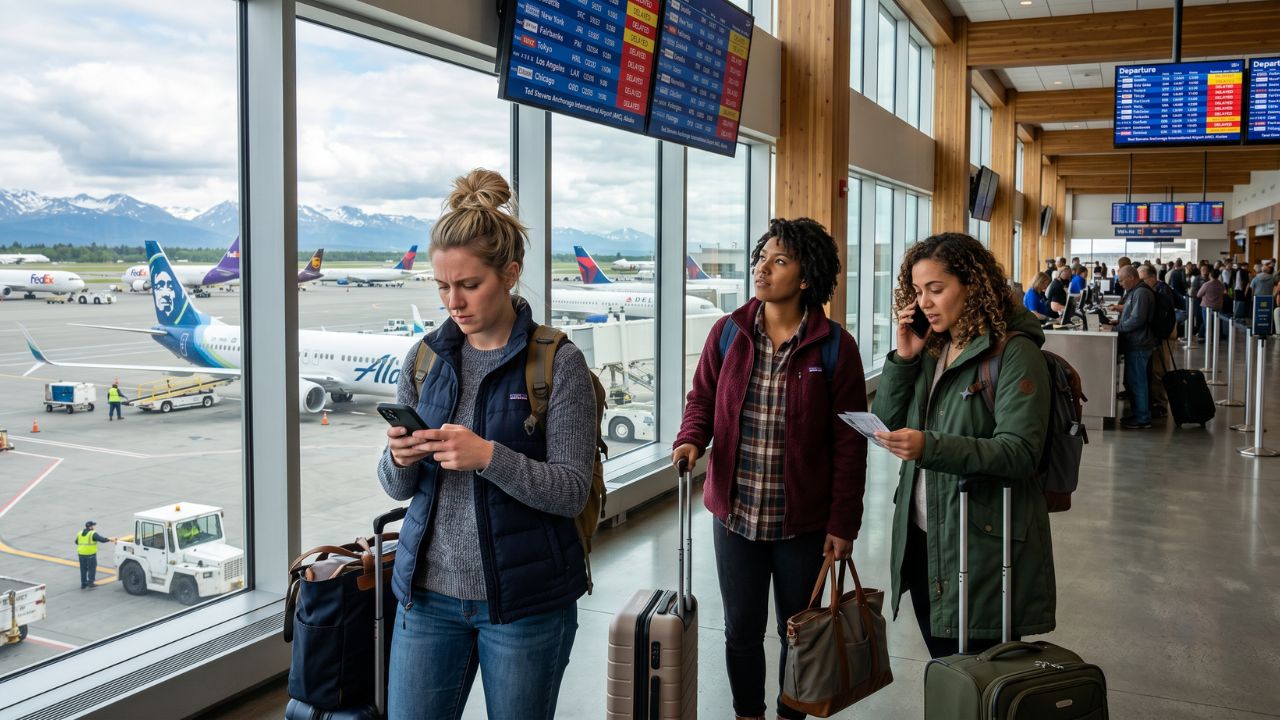
Image generated by AI
A sudden wave of intense travel chaos has violently disrupted operations at Ted Stevens Anchorage International Airport, severely crippling one of the most vital strategic aviation hubs in the United States network. Reported on June 19, 2026, terminal departure boards reflect the massive operational damage inflicted on June 18, displaying a devastating 49 delays and 5 outright flight cancellations. This severe wave of airport disruptions has hit both domestic and international carriers, paralyzing passenger movement across critical North American and trans-Pacific routes. With major legacy and cargo carriers—including Alaska Airlines, American Airlines, Cathay Pacific, and Sterling Airways—caught in the gridlock, the disruption has temporarily severed Anchorage’s vital travel connectivity. As airlines desperately attempt to shuffle displaced flight crews and resolve this deeply frustrating logistical crisis affecting major destinations like Seattle, Utqiaġvik, and Taoyuan City, the resulting ripple effect across the Alaskan aviation grid is driving today's most crucial headline in breaking airline news and essential global aviation updates.
By introducing direct passenger coordination and dynamic scheduling backups, the regional aviation hubs target growing passenger demand across vital commerce sectors. The choice to coordinate flight departures in phases helps to manage gate capacity, supporting the country's broader regional transportation network.
Context: The Collapse of the Pacific Bridge
For the North American aviation industry, the sudden, severe travel chaos ripping through Anchorage perfectly illustrates how quickly operational challenges at massive logistical hubs can completely paralyze the broader network.
Historically, Ted Stevens Anchorage International Airport serves as a critical, dual-purpose gateway. It is the primary lifeline connecting remote Alaskan communities to the lower 48 states, whilst simultaneously acting as one of the busiest long-haul Pacific cargo and passenger transit nodes in the world. Today, however, that efficiency has collapsed. While 5 canceled flights may seem relatively limited compared to mega-hubs like Atlanta, the true devastation lies in the massive volume of 49 delays. Because flights in and out of Alaska operate on incredibly strict weather and operational margins, a single delayed turnaround instantly snowballs into massive downstream travel chaos. Passengers are currently facing agonizingly long waiting times, mathematically guaranteed missed connections, and hastily revised itineraries. This specific disruption pattern suggests that both regional and international carriers were simultaneously impacted, indicating a wider, systemic effect on Anchorage travel schedules rather than a single airline-specific technical failure.
To view live flight schedules, verify the active delay status of your specific Alaskan or trans-Pacific itinerary, or to track active regional airspace restrictions, travelers must consult official aviation directories. For direct updates regarding how this massive travel chaos affects specific route abandonments and current flight cancellations out of Anchorage, travelers should aggressively utilize the official portals of Alaska Airlines and Sterling Airways. To explore live flight tracking and monitor the exact severity of the cascading bottlenecks at competitor Pacific mega-hubs, passengers can consult the official FlightAware tracking service.
Section-Wise Breakdown: The Epicenters of Gridlock
The Domestic and Regional Blockade
The absolute epicenter of the flight cancellations is heavily concentrated on critical domestic routes. The 5 outright cancellations specifically destroyed connectivity to Utqiaġvik and Seattle, severing the primary arterial route connecting Alaska to the mainland United States. The domestic delay footprint is massive, trapping passengers heading to New York City, Phoenix, and a vast network of crucial regional Alaskan destinations including Dillingham, Kodiak, Unalaska, Fairbanks, Juneau, King Salmon, Aniak, Nome, and Sand Point.
The Trans-Pacific Cargo and Passenger Delay
Simultaneously, massive operational challenges have struck the international trans-Pacific routes. Flights linking Anchorage to Taoyuan City (Taiwan) were significantly influenced by the rolling delays. Major international carriers, including Cathay Pacific, China Airlines, EVA Air, and Singapore Airlines, all registered severe operational friction. Because Anchorage serves as a mandatory technical stop or vital cargo hub for these trans-Pacific heavyweights, the 49 delays instantly generated massive continent-wide network friction, delaying crucial international commerce and long-haul passenger arrivals.
Technical Roster: Anchorage Aviation Disruption Data
To ensure absolute factual accuracy regarding the exact parameters of this massive systemic collapse and the specific airlines driving the regional flight cancellations, the following matrix details the verified operational data impacting Anchorage:
Anchorage Flight Disruption Matrix
| Airline | Cancelled | Cancelled (%) | Delayed | Delayed (%) |
|---|---|---|---|---|
| Alaska Airlines | 5 | 3% | 8 | 6% |
| Sterling Airways | 0 | 0% | 11 | 55% |
| Alaska Central Express | 0 | 0% | 8 | 22% |
| Cathay Pacific | 0 | 0% | 5 | 17% |
| China Airlines | 0 | 0% | 3 | 33% |
| American Airlines | 0 | 0% | 2 | 25% |
| EVA Air | 0 | 0% | 2 | 18% |
| Northern Air Cargo | 0 | 0% | 2 | 13% |
| Horizon (ASA) | 0 | 0% | 2 | 11% |
| Ryan Air Service | 0 | 0% | 2 | 20% |
| Condor | 0 | 0% | 1 | 50% |
| Mas Air | 0 | 0% | 1 | 33% |
| Delta Air Lines | 0 | 0% | 1 | 4% |
| United | 0 | 0% | 1 | 6% |
| Singapore Airlines | 0 | 0% | 1 | 100% |
Data recorded on June 18, 2026. Routes affected by cancellations: Utqiaġvik, Seattle. Routes affected by delays: New York City, Phoenix, Dillingham, Kodiak, Unalaska, Fairbanks, Juneau, King Salmon, Aniak, Nome, Sand Point, Taoyuan City.
Passenger Impact: The Connecting Nightmare
For the thousands of travelers attempting to utilize Anchorage as a transit hub or final destination, the massive volume of delays guarantees a highly stressful, heavily compromised journey.
The immediate passenger impact of this structural travel chaos is the complete eradication of connecting itineraries. When Alaska Airlines records the highest number of cancellations (5 flights) and 8 delays, the intricate web of connections linking remote Alaskan communities to the lower 48 states is destroyed. Passengers flying out of remote outposts like Kodiak or Nome who intended to connect through Anchorage to reach Seattle are now mathematically stranded. Because 49 aircraft are simultaneously off-schedule, the terminal is overflowing with passengers competing for a highly limited number of customer service agents. Tourism-related movements, particularly seasonal summer journeys through Anchorage to explore the Alaskan wilderness, are experiencing severe short-term adjustments. Travelers are forced to absorb extended layover times, while the financial toll of emergency accommodations and lost excursion days mounts rapidly.
Industry Analysis: The Fragility of the Pacific Hub
Aviation industry analysts view the systemic breakdown at Anchorage as definitive proof that the Alaskan aviation grid is highly vulnerable to rapid, unmanageable operational congestion.
Analysts note that while 5 cancellations (all from Alaska Airlines) represent a targeted failure, the staggering presence of 49 delays spread across 15 different airlines indicates a fundamental failure in airport capacity management or systemic localized weather constraints. The disruption is actively punishing both the regional feeder network (Sterling Airways with 11 delays; Alaska Central Express with 8) and the international long-haul network (Cathay Pacific with 5 delays). Industry experts emphasize that because Anchorage is a massive linchpin for global cargo and Pacific routing, these localized airport disruptions will instantly ripple across the Pacific, delaying inbound aircraft returning to Asia and the continental US. Analysts predict that airlines will struggle to reset their operational boards; the massive volume of displaced aircraft will inevitably bleed residual delays into subsequent flight schedules.
Actionable Advice for Navigating the Anchorage Gridlock
While standard passengers cannot control regional ATC flow constraints or airline operational bottlenecks, you can execute this strategic survival checklist to actively bypass the travel chaos currently suffocating Anchorage:
- Stay Updated via the App, Not the Board: Do not rely on physical terminal screens during massive airport disruptions. Monitor your airline’s mobile app obsessively. When a flight officially cancels, the app will offer digital rebooking options minutes before the terminal screens update, allowing you to secure a seat before the physical crowd panics.
- Audit Your Regional Connecting Flights: Do not assume your entire itinerary is insulated. If your ticket involves a connection on a regional operator like Sterling Airways (suffering a massive 55% delay rate) or Alaska Central Express, recognize that these routes are highly vulnerable. Book the earliest possible morning flight to ensure you have multiple backup options.
- Understand Refund and Rebooking Rights: When cancellations to Utqiaġvik or Seattle are recorded, passengers are generally rebooked on alternative services. However, refund eligibility is strictly determined by airline policy. If the disruption is within the carrier's control, immediately demand meal vouchers and overnight hotel accommodations while you wait for the next available departure.
- Bypass the Customer Service Queue: If you are stranded at Anchorage and need to rebook a canceled Alaska Airlines flight, do not join the massive physical line at the service desk. Immediately call the airline’s customer service number or use their online chat system. Phone agents have identical rebooking power and answer significantly faster than physical agents dealing with hostile crowds.
FAQ: Anchorage Airport Disruptions
Why is Anchorage International Airport experiencing massive travel chaos?
The massive Alaskan hub is suffering from severe operational disruptions resulting in 5 flight cancellations and a staggering backlog of 49 delayed flights, crippling domestic, regional, and international routes.
Which airlines are responsible for the highest number of delays and cancellations?
Alaska Airlines recorded the highest number of flight cancellations (5 flights), while regional operator Sterling Airways registered the highest volume of delays, severely impacting 11 flights (a 55% delay rate).
Which destinations were most impacted by the Anchorage gridlock?
The localized travel chaos resulted in outright flight cancellations to Utqiaġvik and Seattle, while massive delays severed connections to New York City, Phoenix, Taoyuan City, and numerous remote Alaskan communities.
The Reality of Combating Hub Saturation
The severe operational gridlock currently paralyzing Ted Stevens Anchorage International Airport proves definitively that massive logistical transit hubs remain entirely susceptible to catastrophic, rolling travel chaos. By absorbing 49 delays and 5 flight cancellations across a diverse coalition of legacy, regional, and international carriers, Anchorage demonstrates the extreme volatility of the modern aviation network. As Alaska Airlines and Sterling Airways desperately attempt to shuffle crews to recover their destroyed itineraries—frequently stranding passengers in heavily congested terminals—travelers must accept a critical new reality: surviving the Alaskan skies requires aggressive digital rebooking tactics, a thorough understanding of airline compensation policies, and a ruthless willingness to adapt to sudden, systemic airport disruptions.
Key Takeaways
- Massive Alaskan Gridlock: Anchorage International Airport is currently suffocating under severe travel chaos, reporting 49 delays and 5 flight cancellations.
- Alaska Airlines Cancellations: The primary legacy carrier suffered the heaviest cancellation burden, grounding 5 flights (severing the Utqiaġvik and Seattle routes) alongside 8 delays.
- Sterling Airways Paralyzed: Regional operator Sterling Airways recorded the highest delay volume, suffering 11 delayed departures (a massive 55% disruption rate).
- Trans-Pacific Disruption: International carriers including Cathay Pacific, China Airlines, and EVA Air were caught in the gridlock, delaying vital Pacific routes to Taoyuan City.
- Connecting Routes Destroyed: The massive volume of delayed aircraft guarantees missed domestic connections, stranding passengers attempting to reach remote Alaskan communities or the lower 48 states.
Related Travel Guides
Massive Travel Chaos Paralyzes Chicago O'Hare with 1,425 Disruptions
Disclaimer
This article is for informational and educational purposes only. It does not constitute legal, financial, or professional advice. While we strive to provide accurate and up-to-date information, travel policies, regulations, and conditions change rapidly. Always verify information with official sources before making travel decisions. Nomad Lawyer makes no representations about the accuracy, reliability, completeness, or suitability of the information provided. Readers should consult qualified professionals for advice specific to their circumstances. The views expressed in this article are those of the author and do not necessarily reflect the views of Nomad Lawyer.
Kunal K Choudhary
Co-Founder & Contributor
A passionate traveller and tech enthusiast. Kunal contributes to the vision and growth of Nomad Lawyer, bringing fresh perspectives and driving the community forward.
Learn more about our team →