
American Airlines Reverses Strategy to Install Seatback Screens Across Narrowbody Fleet in 2026
American Airlines is abandoning its personal-device streaming model to reinstall high-resolution seatback entertainment screens across its Boeing 737 and Airbus A321 narrowbody aircraft.

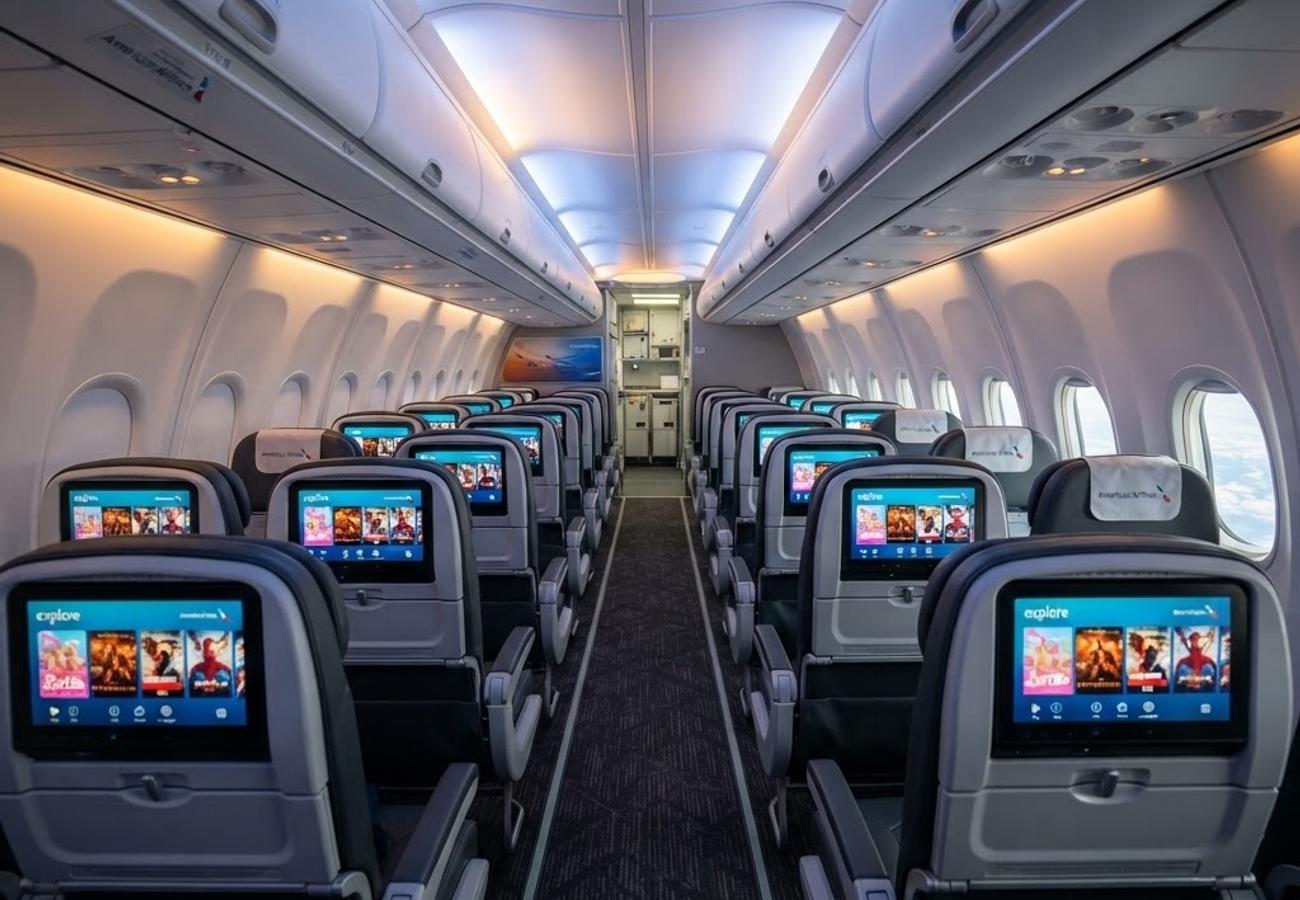
Image generated by AI
American Airlines is pivoting away from its "bring your own device" philosophy, committing to a massive hardware rollout of seatback screens to reclaim competitiveness in the U.S. domestic market.
For over a decade, American Airlines championed a lean approach to in-flight entertainment (IFE), stripping embedded screens from its narrowbody aircraft and urging passengers to stream content to their own tablets and smartphones. This cost-saving strategy is now being reversed as the carrier moves toward a Request for Proposal (RFP) to bring dedicated displays back to a significant portion of its fleet.
The shift highlights a growing realization in the aviation industry: while passengers own smartphones, they prefer not to rely on them for entertainment during flights. The need to manage battery life, juggle devices while eating, and maintain connectivity in cramped quarters has made the fixed seatback screen a highly desired amenity once again.
Strategic Pivot in Passenger Experience
The decision to reintroduce screens is a direct response to declining customer satisfaction scores and a widening product gap between American and its primary rivals, Delta Air Lines and United Airlines. Both competitors have doubled down on integrated IFE, positioning large screens and curated libraries as a hallmark of a premium travel experience.
American's new initiative focuses on modern, high-resolution touch interfaces. Unlike the legacy systems of the past, these new displays are designed for higher reliability and seamless integration with the aircraft's connectivity infrastructure.
Fleet Integration and Rollout Logistics
The upgrade program will target the backbone of American's operations—the narrowbody fleet. This includes the Boeing 737 and Airbus A321 families, which handle the majority of the airline's domestic and short-haul international traffic.
The deployment will follow a two-pronged approach:
- New Deliveries: Systems will be factory-fitted on aircraft arriving from manufacturers.
- Retrofits: Existing aircraft will be upgraded during scheduled heavy maintenance checks to minimize revenue loss from grounded planes.
Because this is a phased rollout, passengers will likely experience a "mixed fleet" environment for several years. Some flights on the same route may feature the new screens, while others will remain limited to personal-device streaming.
Convergence of Connectivity and Hardware
The return of the screen is not an isolated move; it is part of a broader push toward satellite-based, high-speed Wi-Fi. By combining hardware with better connectivity, American is moving toward a hybrid entertainment model.
New-generation platforms are expected to offer:
- Live TV and Real-Time Data: Integration with satellite feeds for current events and flight tracking.
- Bluetooth Pairing: Allowing passengers to use their own wireless headphones without requiring adapters.
- Cross-Device Continuity: The potential to start a movie on a seatback screen and finish it on a personal device.
From a business perspective, these screens transform from cost centers into revenue generators. The displays provide a direct channel for targeted advertising, paid upgrades, and partnerships with third-party streaming services.
Competitive Pressures and Market Positioning
In the current U.S. aviation climate, the "basic" experience is no longer sufficient for frequent flyers. American's previous reliance on dense cabin layouts and streaming-only entertainment led to perceptions that the airline was less technologically advanced than its peers.
By accepting the added weight and maintenance costs associated with embedded screens, American is signaling a shift toward a "full-service" narrative. This aligns with a broader trend where major carriers are prioritizing premium amenities—including upgraded seating and enhanced catering—to attract high-value business travelers.
What to Expect During the Transition
Passengers should not expect a fleet-wide change overnight. The availability of screens will depend on the specific aircraft assigned to a route, and equipment swaps are common.
As the rollout progresses, the airline is expected to provide more transparency regarding aircraft amenities during the booking process and at boarding gates. The ultimate success of the program will likely hinge on the responsiveness of the touchscreens and the breadth of the content library provided.
The era of the "pocket screen" as the sole entertainment source is ending as American Airlines bets on the return of the built-in display.
Narrowbody Fleet Impact Summary
| Aircraft Family | Implementation Method | Primary Focus | Expected Impact |
|---|---|---|---|
| Boeing 737 | Factory-fit & Retrofit | Domestic/Short-haul | Millions of annual passengers |
| Airbus A321 | Factory-fit & Retrofit | Domestic/Near-International | High-density, long-domestic routes |
Key Takeaways
- Strategy Reversal: American Airlines is moving away from personal-device streaming back to embedded seatback screens.
- Target Fleet: The rollout centers on Boeing 737 and Airbus A321 narrowbody aircraft.
- Competitive Driver: The move is designed to close the amenity gap with Delta and United.
- Tech Integration: New screens will feature touch interfaces and pair with upgraded satellite Wi-Fi and Bluetooth audio.
- Phased Rollout: Upgrades will occur via new deliveries and during heavy maintenance checks.
FAQ
Which planes will get the new screens? The rollout focuses on narrowbody aircraft, specifically the Boeing 737 and Airbus A321 families.
Will I still be able to use my own device? Yes, the airline is moving toward a hybrid model that supports both seatback screens and personal-device streaming via Wi-Fi.
When will this be available on all flights? The rollout is gradual and will take several years to complete across the entire narrowbody fleet.
Related Travel Guides
Disclaimer
This article is for informational and educational purposes only. It does not constitute legal, financial, or professional advice. While we strive to provide accurate and up-to-date information, travel policies, regulations, and conditions change rapidly. Always verify information with official sources before making travel decisions. Nomad Lawyer makes no representations about the accuracy, reliability, completeness, or suitability of the information provided. Readers should consult qualified professionals for advice specific to their circumstances. The views expressed in this article are those of the author and do not necessarily reflect the views of Nomad Lawyer.
Kunal K Choudhary
Co-Founder & Contributor
A passionate traveller and tech enthusiast. Kunal contributes to the vision and growth of Nomad Lawyer, bringing fresh perspectives and driving the community forward.
Learn more about our team →