
Bypassing Travel Chaos: American Airlines Activates Mandatory FAA Cockpit Security Barriers, Redefining Flight Deck Protection: Airline News
As airlines battle severe travel chaos, American Airlines executes a massive FAA 2025 mandate, rolling out Installed Physical Secondary Barriers on new aircraft.

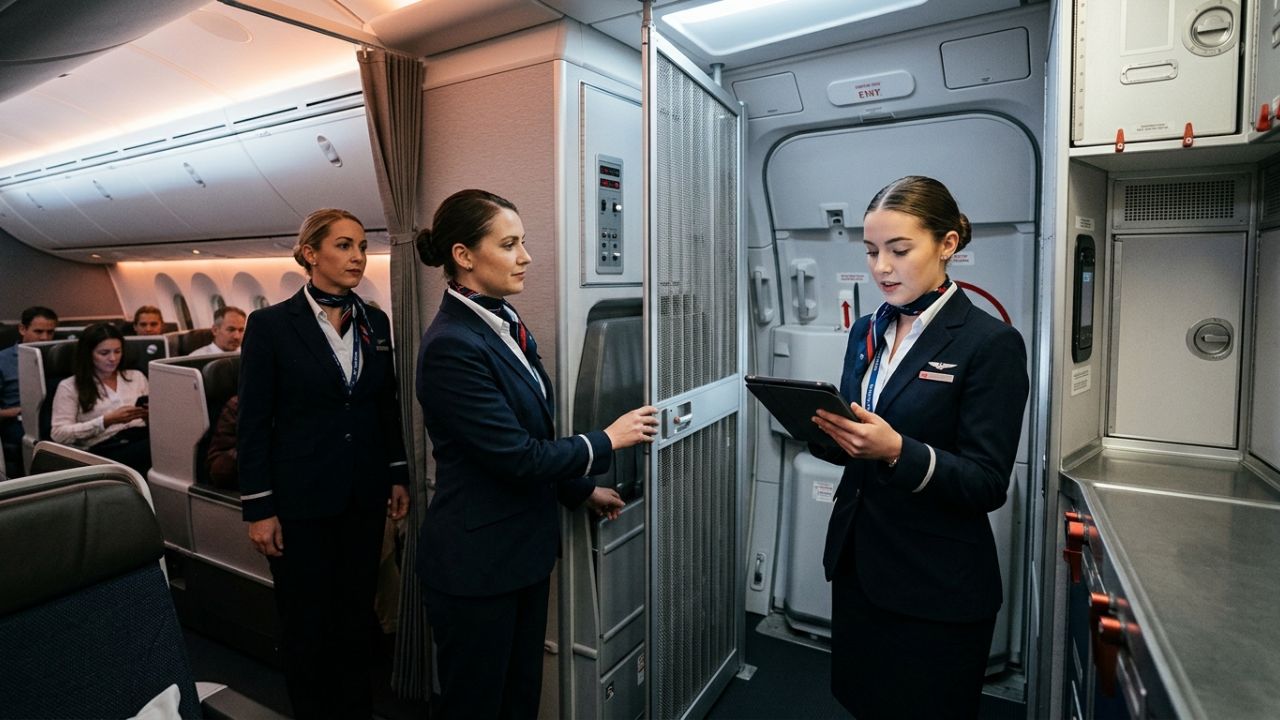
Image generated by AI
In a massive structural shift designed to lock down flight deck security amidst an era of unprecedented travel chaos, American Airlines has officially activated a powerful new layer of aviation protection. Reported out of New York on June 20, 2026, as exhausted passengers frantically monitor the latest airline news to avoid rolling flight cancellations, the world’s largest carrier has begun deploying Installed Physical Secondary Barrier (IPSB) systems across select newly delivered aircraft. Driven directly by the strict FAA 2025 cockpit security mandate, this rollout—which officially commenced on June 18—is forcing airlines to operate highly complex dual-security systems across their vast fleets. Because the physical defense of the flight deck fundamentally dictates operational safety, this technological upgrade provides vital "survival intelligence" for travelers attempting to navigate ongoing global airport disruptions, cementing this security shift as today's most crucial headline in breaking aviation updates.
By introducing direct passenger coordination and dynamic scheduling backups, the regional aviation hubs target growing passenger demand across vital commerce sectors. The choice to coordinate flight departures in phases helps to manage gate capacity, supporting the country's broader regional transportation network.
Context: Closing the Mid-Flight Security Gap
For the highly interconnected United States aviation grid, securing the cockpit against rapid, unauthorized access is the ultimate tactical defense against catastrophic operational failure.
While post-9/11 security protocols successfully mandated heavily reinforced flight deck doors across the globe, aviation regulators eventually identified a terrifying remaining vulnerability: the "gap risk." This refers to the brief, highly sensitive exposure window that occurs whenever the reinforced cockpit door must be opened mid-flight for pilots to access the lavatory or receive crew service. To eradicate this vulnerability, the Federal Aviation Administration (FAA) issued a sweeping 2025 mandate requiring all newly built commercial aircraft to be equipped with secondary physical barriers. Instead of a full, sealed door replacement, the IPSB acts as a retractable protective gate. When the primary cockpit door opens, this secondary barrier automatically locks into place, restricting movement toward the flight deck entry zone. This massive operational shift guarantees that the flight deck remains protected, eliminating the terrifying necessity of using temporary makeshift barriers like heavy beverage service carts.
To view live flight schedules, verify the active departure status of your specific American Airlines itinerary, or to track potential route restorations prior to heading to the airport, travelers must consult official aviation directories. For direct updates regarding how new crew security protocols might trigger sudden flight cancellations out of major US hubs, travelers should aggressively utilize the official digital portals of their respective airlines. To explore live flight tracking and monitor the exact severity of the cascading bottlenecks paralyzing the broader North American airspace, passengers can consult the official FlightAware tracking service.
Section-Wise Breakdown: The American Airlines Rollout
The Tri-Layered Implementation: Training Before Action
From June 18, American Airlines has officially begun activating IPSB systems exclusively on newly delivered aircraft. To avoid generating internal travel chaos, the airline structured its approach into three distinct layers. First, the pre-installation phase ensures the IPSB units are hardwired into the airframe during initial manufacturing. Second, the massive training phase ensures that thousands of American Airlines pilots and cabin crew are thoroughly drilled in the controlled usage of the gate. Finally, the activation phase ensures the systems are hot and live on all new aircraft entering service after the June 18 deadline.
The Industry Divide: Southwest Takes the Lead
While American Airlines heavily prioritized structured crew training before activating the systems, Southwest Airlines aggressively led early adoption, initiating operational use of IPSB systems on its new aircraft deliveries well before the June 18 mark. This divergence highlights a fractured US aviation ecosystem: early movers like Southwest are already utilizing the tech, structured adopters like American are just now going live, while slower legacy carriers continue to lag behind, struggling to align their certification and fleet integration timelines.
The Generational Fleet Transition
Crucially, the FAA's IPSB rollout applies only to new aircraft delivered after the strict regulatory cut-off date. This means that thousands of older, mid-life aircraft currently operating in the American Airlines fleet will not be retrofitted under current rules. Consequently, full integration across the global fleet will take several years, entirely dependent upon long-term aircraft replacement cycles.
Technical Roster: Official Airline Security Integration Matrix
To ensure absolute factual accuracy regarding the exact regulatory thresholds, the specific carrier implementation timelines, and the operational functionality defining this security shift, the following matrix details the strictly verified data:
Official FAA Secondary Barrier Rollout Matrix (June 2026)
| Security Metric / Airline Action | Verified Operational Data |
|---|---|
| Governing Authority | Federal Aviation Administration (FAA) |
| Primary Regulatory Standard | FAA 2025 Mandate (Cockpit Security) |
| Security Technology | Installed Physical Secondary Barrier (IPSB) |
| Operational Function | Retractable gate delaying access to open cockpit doors |
| American Airlines Activation | Officially commenced on June 18, 2026 |
| Fleet Applicability | Exclusively applies to newly delivered aircraft |
| Southwest Airlines Status | Early Adopter (Already activated prior to June 18) |
| Retrofit Requirement | Not currently required for existing mid-life fleet |
| Strategic Security Goal | Transition to "time-based" delay and defense mechanics |
Data accurately reflects the verified FAA regulations and the specific carrier integration timelines tracking the US aviation security overhaul as of June 2026.
Operational Impact: The Burden of Dual Systems
For the thousands of pilots and flight attendants managing the American Airlines network, this rollout instantly creates severe operational complexity.
Because older fleets do not require retrofitting, crews must now operate within a massive mixed-safety environment. A flight attendant might fly a brand-new Airbus A321neo in the morning utilizing the high-tech IPSB, and then switch to a legacy Boeing 737 in the afternoon where they must still deploy beverage carts to guard the flight deck door. If crews are not perfectly trained to seamlessly switch between these vastly different operational environments, the resulting confusion can easily trigger ground delays and massive airport disruptions. For passengers, this introduces a silent layer of protection; the IPSB operates without any visible change in the passenger cabin experience, yet it fundamentally alters how the crew moves and operates during the flight.
Industry Analysis: The Shift to Time-Based Security
Aviation analysts monitoring the IPSB rollout note that the FAA mandate represents a profound transformation in how global regulators define threat mitigation.
Anup Kumar Keshan, Founder and Editor-in-Chief of Travel And Tour World, observed that this development signals a massive doctrinal shift. “What we are witnessing is not just a cockpit security upgrade, but a structural redesign of how aviation defines risk,” Keshan stated. “The IPSB system represents a shift from prevention-only thinking to controlled-delay security logic. Airlines that delay adoption risk falling behind regulatory and operational expectations.” Aviation operators emphasize that in modern security architecture, seconds matter more than absolute barriers. By forcing an intruder to spend precious seconds breaching a secondary gate, the IPSB provides the flight crew the exact amount of time required to permanently lock the primary reinforced door, securing the aircraft.
Actionable Advice for Navigating New Cabin Protocols
While the IPSB is designed to operate seamlessly behind the scenes, passengers must execute this strategic checklist to avoid accidentally triggering a security response during mid-flight operations:
- Respect the Forward Galley: If you are seated in the first-class cabin or near the forward lavatories, do not loiter in the galley area. If a flight attendant asks you to remain in your seat or step back into the aisle, comply instantly. They are preparing to open the cockpit door and deploy the IPSB.
- Observe the Restrictive Gate: If you see a retractable metal or wire gate deployed across the forward aisle, do not attempt to bypass it, touch it, or hand items over it. Breaching an active IPSB is a severe federal offense that will result in immediate arrest upon landing.
- Anticipate Service Pauses: Understand that when the flight crew transitions to the lavatory, the deployment of the IPSB effectively freezes movement in the forward cabin. Beverage services and passenger lavatory access will be completely paused during these brief, highly controlled exposure windows.
FAQ: Installed Physical Secondary Barriers (IPSB)
What is the FAA 2025 cockpit security rule?
The FAA 2025 mandate requires all newly built commercial aircraft to be equipped with a secondary physical barrier to protect the flight deck when the primary door is opened mid-flight.
When did American Airlines activate the IPSB system?
American Airlines officially began activating the Installed Physical Secondary Barrier (IPSB) on its newly delivered aircraft starting June 18, 2026.
Will older aircraft be fitted with the new security gates?
No. Currently, the FAA mandate only applies to newly manufactured aircraft delivered after the regulatory threshold, meaning older mid-life fleets will not be retrofitted.
The Reality of Modern Aviation Defense
The activation of the IPSB system by American Airlines proves definitively that aviation security is evolving from static protection into highly dynamic, time-sensitive defense layers. By effectively deploying retractable gates to secure the cockpit exposure gap, the airline has successfully guaranteed that the flight deck remains impenetrable. Yet, as relieved travelers board these newly delivered aircraft, they must accept a critical new reality: security is entirely invisible until it is tested. Surviving this era of rapid regulatory expansion demands extreme situational awareness, a complete refusal to ignore crew commands in the forward galley, and the tactical discipline to respect the invisible barriers that keep the global transit network safely in the sky.
Key Takeaways
- Massive Security Rollout: American Airlines activated IPSB systems on newly delivered aircraft starting June 18.
- FAA Mandate: The rollout is driven by the strict FAA 2025 cockpit security rules targeting the "gap risk."
- Southwest Leads: Southwest Airlines was an early adopter, activating systems prior to the American Airlines rollout.
- Dual Fleet Reality: Older aircraft are exempt from retrofitting, creating a generational transition that will take years.
- Survival Strategy: Passengers are strongly urged to never loiter near the forward galley or approach a deployed secondary barrier.
Related Travel Guides
Massive Travel Chaos Paralyzes Chicago O'Hare with 1,425 Disruptions
Disclaimer
This article is for informational and educational purposes only. It does not constitute legal, financial, or professional advice. While we strive to provide accurate and up-to-date information, travel policies, regulations, and conditions change rapidly. Always verify information with official sources before making travel decisions. Nomad Lawyer makes no representations about the accuracy, reliability, completeness, or suitability of the information provided. Readers should consult qualified professionals for advice specific to their circumstances. The views expressed in this article are those of the author and do not necessarily reflect the views of Nomad Lawyer.
Kunal K Choudhary
Co-Founder & Contributor
A passionate traveller and tech enthusiast. Kunal contributes to the vision and growth of Nomad Lawyer, bringing fresh perspectives and driving the community forward.
Learn more about our team →