
Alaska Airlines Flight Disrupted: Customs Constraints and Communication Challenges on Costa Rica-US Route
Alaska Airlines flight AS617 from Liberia, Costa Rica to Los Angeles was canceled after pushback due to customs processing constraints and communication gaps, highlighting operational and crew communication challenges in international aviation.

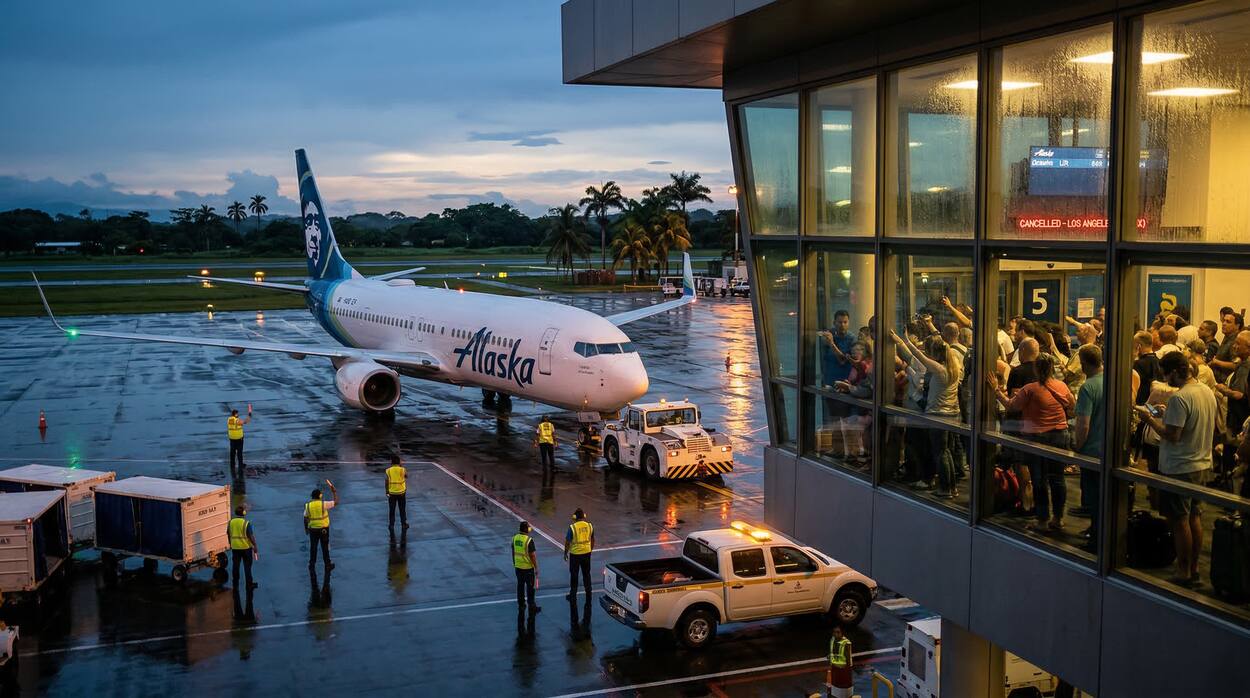
Image generated by AI
Quick Summary
- Alaska Airlines flight AS617 from Liberia Guanacaste Airport (Costa Rica) to Los Angeles International Airport was canceled on March 21, 2026, after passengers had boarded and the aircraft pushed back from the gate.
- The cancellation was attributed to customs processing time constraints at LAX — the scheduled arrival time fell outside designated international processing windows.
- Pilot communication during the disruption was perceived as unclear and speculative, amplifying passenger anxiety rather than providing clarity.
- The incident underscores the operational challenge of tight scheduling on international routes and the critical importance of structured communication during irregular operations.
Alaska Airlines Flight AS617: An Unexpected Cancellation After Pushback
A routine international journey between Costa Rica and the United States took an unexpected turn when Alaska Airlines flight AS617 was canceled following an unexpected return to the gate. The Boeing 737-900ER, operating from Liberia Guanacaste Airport (LIR) in Costa Rica to Los Angeles International Airport (LAX) in the United States, had already completed boarding procedures and begun taxiing when operations were halted.
The disruption occurred on March 21, 2026, affecting passengers who had settled into their seats expecting a standard international departure. Rather than proceeding toward a two-hour plus transpacific journey, the aircraft was directed back to the gate, and the flight was subsequently canceled entirely. While operational disruptions are not uncommon in global aviation networks, the timing, circumstances, and manner in which information was communicated contributed significantly to passenger confusion and frustration.
For travelers already invested in the journey — mentally and logistically — the sudden halt represented more than just an inconvenience. It underscored the delicate balance airlines must maintain between operational planning, safety protocols, and passenger communication.
Key Facts at a Glance
| Detail | Information |
|---|---|
| Flight Number | Alaska Airlines AS617 |
| Route | Liberia Guanacaste (LIR) → Los Angeles (LAX) |
| Aircraft Type | Boeing 737-900ER |
| Date of Disruption | March 21, 2026 |
| Incident Stage | Post-boarding, after pushback from gate |
| Primary Cause | Customs processing hour constraints at LAX |
| Outcome | Full flight cancellation |
| Communication Issue | Unclear, speculative captain announcement |
The Operational Challenge: Customs Processing Windows and Tight Scheduling
The cancellation of Alaska Airlines flight AS617 was directly attributed to operational constraints related to customs processing hours at Los Angeles International Airport. International arrivals at major U.S. hubs operate within designated processing windows — flights arriving after these windows close cannot be accommodated until the next business day.
The scheduled arrival time for flight AS617, if operations had proceeded on schedule, would have fallen perilously close to the customs cutoff time. With minimal buffer room for any delays — whether from taxiing, ground hold patterns, or en route weather — the aircraft risked arriving after customs operations had ceased.
This operational reality left Alaska Airlines management with a difficult choice: proceed with a flight that would likely arrive outside the processing window, or cancel and rebook passengers on later flights. The airline elected cancellation, deeming it the more practical solution to an impossible schedule.
The Broader Scheduling Dilemma
Airlines operating international routes between Central America and North America often design schedules to maximize aircraft utilization. While this approach is efficient in theory, it frequently leaves little margin for the inevitable delays and uncertainties inherent in aviation operations.
The Liberia-to-Los Angeles route exemplifies this challenge:
- Limited buffer time before customs processing deadlines
- Narrow windows for ground operations and taxiing
- Minimal resilience if any component of the flight experiences delays
- Increased likelihood that minor disruptions cascade into major cancellations
This operational vulnerability has long been a concern in the aviation industry, particularly on international routes connecting popular tourism destinations like Costa Rica with major U.S. hubs.
Pilot Communication and Passenger Uncertainty
During the unfolding disruption, the captain delivered an extended announcement intended to explain the situation to passengers. However, instead of providing a structured, clear explanation, the communication was perceived as fragmented and speculative.
The announcement reportedly included:
- References to unclear internal communications and operational ambiguities
- Uncertain language rather than definitive statements
- Incomplete explanations of the decision-making process
- Lack of reassurance or confidence in the information being shared
Why Communication Matters in Aviation
Cockpit announcements serve as the primary real-time communication channel between the flight crew and passengers. During irregular operations — disruptions, delays, cancellations — these announcements are critically important. Passengers are often anxious and seeking clarity. A well-structured announcement should:
- Explain the situation clearly — What is happening and why
- Provide confirmed information — Facts, not speculation
- Offer reassurance — Confidence that the situation is being managed
- Outline next steps — What passengers can expect and what they should do
In the case of Alaska Airlines flight AS617, the announcement fell short on several fronts. The inclusion of speculative elements and incomplete details, rather than clarifying the situation, heightened anxiety among passengers who were already disappointed by the disruption.
The Impact on Passenger Experience
For travelers already disappointed by a canceled international flight, unclear communication transforms operational frustration into emotional distress. Passengers wonder:
- Is there more to the story?
- Are we being told everything?
- Should we be concerned about something else?
These anxieties propagate quickly in confined environments like aircraft cabins, amplifying the negative impact of the disruption itself.
Scheduling Pressures vs. Operational Resilience
The cancellation of flight AS617 highlights a fundamental tension in modern airline operations: the pressure to minimize costs through efficient scheduling versus the need to maintain operational resilience in the face of inevitable disruptions.
The Efficiency Argument
Airlines want to:
- Maximize aircraft utilization (more flights per day = higher revenue)
- Minimize idle time and ground assignments
- Optimize crew scheduling and crew rest requirements
- Compete on prices that depend on operational efficiency
The Resilience Argument
However, resilience requires:
- Buffer time to accommodate minor delays
- Flexibility to absorb schedule disruptions without cascading cancellations
- Operational margins that preserve the ability to complete flights even if things don't go exactly as planned
- Reduced dependency on external constraints (like customs hours)
The Alaska Airlines incident demonstrates that when scheduling margins are too thin, operational constraints — whether customs deadlines, airport curfews, or crew fatigue regulations — become trip-killers rather than manageable challenges.
Broader Industry Implications
The disruption of flight AS617 serves as a case study in how multiple factors can converge to create significant passenger impact:
Operational Planning: Schedules that ignore or minimize external constraints leave airlines vulnerable.
Communication Protocols: Crew training in passenger communication is essential, especially during irregular operations.
Route Development: Popular international routes often operate at the margins of feasibility without additional scheduling flexibility.
Passenger Experience: Airlines are increasingly evaluated not just on safety and on-time performance, but on how well they manage disruptions.
For passengers traveling between Costa Rica and the United States — a popular route for both tourism and business — incidents like the AS617 cancellation underscore the importance of choosing airlines with strong operational track records and clear communication standards.
Lessons for the Aviation Industry
The incident has reinforced several important principles:
-
Scheduling Should Incorporate Buffer Time — Particularly on international routes with hard external constraints like customs processing windows.
-
Communication Clarity is Non-Negotiable — During disruptions, passengers need clear, confident, structured information to remain calm and trust airline management.
-
Transparency Must Be Balanced with Competence — While honesty is essential, sharing incomplete information can undermine passenger confidence more than brief, accurate wait-and-see updates.
-
Operational Resilience Matters — Airlines that build flexibility into schedules are better positioned to handle disruptions without cascading cancellations.
-
International Route Planning Requires Special Attention — Routes spanning time zones and international borders have additional operational complexity that must be reflected in scheduling.
What Passengers Should Know
If you're traveling on international routes between Costa Rica and the United States, particularly on routes with tight arrival windows at major U.S. hubs:
- Understand customs processing windows — Know that international arrivals have time constraints that can impact scheduling
- Choose airlines with buffer time — Prefer carriers that build operational margins into their scheduling
- Expect clear communication — During disruptions, request regular updates and don't accept vague explanations
- Know your rights — Under U.S. and international regulations, you may be entitled to compensation or rebooking on alternative carriers
- Monitor departure boards — Arrive early and watch for last-minute schedule changes on international flights
Looking Forward
The Alaska Airlines disruption of flight AS617 has drawn attention to the intersection of operational efficiency, international regulatory constraints, and customer service in modern aviation. As global travel continues to grow, particularly on routes connecting popular tourism destinations like Costa Rica with major U.S. hubs, the industry will face increasing pressure to balance efficiency with reliability.
The incident serves as a valuable reminder that the smallest operational margins can amplify into significant disruptions. Airlines that invest in scheduling flexibility, crew training, and clear communication protocols will build stronger relationships with passengers and weathered operational challenges more successfully.
Related News & Resources
- Major Airlines Reroute Flights Across Europe, Middle East & US Amid Price Surge
- Gulf Air Cancels 100 Flights at Bahrain Hub: Major Routes Disrupted
- Cape Town's Airport Just Changed Everything for African Travel
FAQ
Why was flight AS617 canceled if it had already boarded? The scheduled arrival time at Los Angeles International Airport fell outside the designated customs processing window for international arrivals. With no time buffer, the flight risked arriving after customs operations ceased, making completion of the flight operationally impractical.
What does customs processing window mean? International arrivals in the United States must be processed by U.S. Customs and Border Protection within designated hours. Flights arriving outside these windows cannot land (or must be diverted), making those arrivals infeasible.
Was the pilot communication inadequate? The captain's announcement was perceived as unclear and speculative rather than structured and definitive. During disruptions, passengers benefit from clear, confident communication that explains the situation without unnecessary uncertainty.
Could Alaska Airlines have prevented this disruption? Yes. Building additional buffer time into the schedule would have provided margin to absorb minor delays without triggering a cancellation. Airlines operating routes with tight external constraints should incorporate scheduling flexibility.
What are passenger rights when a flight is cancelled? Under U.S. and international regulations, passengers may be entitled to rebooking on the next available flight, meal vouchers, hotel accommodation (if applicable), and potentially compensation depending on the cause and circumstances.
Is this a common issue on Costa Rica-United States routes? Tight scheduling near customs processing deadlines is not uncommon on popular international routes. Airlines balance efficiency against the risk of disruptions, and not all maintain adequate buffer time.
Disclaimer: Information accurate as of March 24, 2026. Specific details regarding compensation and regulatory outcomes are subject to change as Alaska Airlines completes its internal review.
Disclaimer
This article is for informational and educational purposes only. It does not constitute legal, financial, or professional advice. While we strive to provide accurate and up-to-date information, travel policies, regulations, and conditions change rapidly. Always verify information with official sources before making travel decisions. Nomad Lawyer makes no representations about the accuracy, reliability, completeness, or suitability of the information provided. Readers should consult qualified professionals for advice specific to their circumstances. The views expressed in this article are those of the author and do not necessarily reflect the views of Nomad Lawyer.
Raushan Kumar
Founder & Lead Developer
Full-stack developer with 11+ years of experience and a passionate traveller. Raushan built Nomad Lawyer from the ground up with a vision to create the best travel and law experience on the web.
Learn more about our team →