
Airports Face Sharp Departure Delays: Fort Lauderdale, Orlando, LaGuardia Hit Hard
Major US airports including Fort Lauderdale, Orlando, and LaGuardia are experiencing sharp departure delays in March 2026, with on-time performance dropping significantly. Thousands of passengers face extended wait times as airlines struggle with operational challenges.

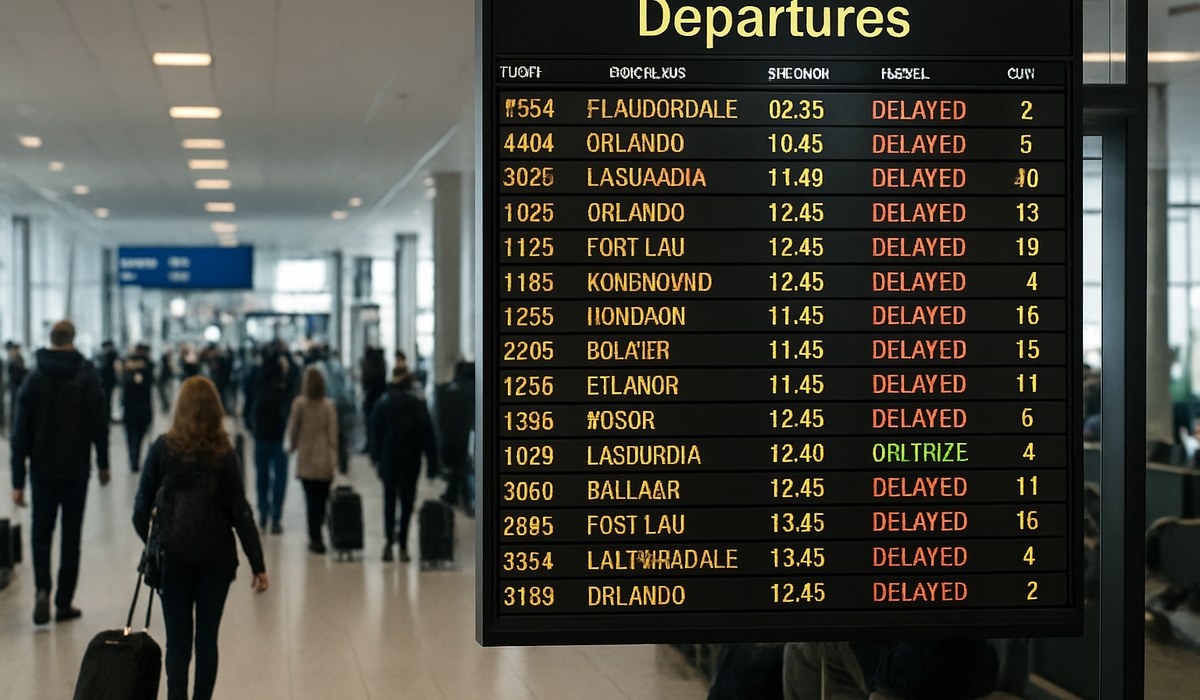
Image generated by AI
US Airports Grapple with Significant Departure Delays Across Major Hubs
March 26, 2026 — A sharp decline in on-time departure performance is cascading through several major US airport hubs this week, with Fort Lauderdale International Airport (FLL), Orlando International Airport (MCO), and LaGuardia Airport (LGA) experiencing the most severe disruptions. The operational challenges are affecting thousands of passengers and rippling across multiple airlines, creating a critical travel situation for spring break travelers and business commuters.
Industry data indicates that departure delays have surged to levels not seen since late 2025, with some flights experiencing hold times exceeding 90 minutes on the tarmac. The convergence of weather-related factors, staffing constraints, and increased travel volume during the peak spring season has created a perfect storm for departure operations at these three critical East Coast and Southeast gateways.
Root Causes Behind the Departure Delay Crisis
The primary catalyst for the sharp performance drop stems from a combination of operational pressures affecting ground operations and air traffic control systems. Spring break travel demand has overwhelmed departure capacity at regional hubs, while staffing shortages in ground services—including baggage handling, catering, and aircraft turnaround crews—have extended gate times significantly.
Weather complications have also played a substantial role. Convective activity across Florida and the Northeast corridor has forced air traffic control to implement Ground Delay Programs (GDPs) at multiple airports. While conditions remain marginal rather than severe, the cumulative effect of slight restrictions has compressed the departure windows available to airlines, forcing scheduling conflicts that cascade throughout the day.
Additionally, maintenance issues on several aircraft types have removed planes from service, reducing the operational fleet capacity at these major hubs during peak demand periods. Airlines are reassigning aircraft between routes to cover gaps, creating secondary delays as planes operate on compressed turnaround schedules.
Which Airlines Are Most Affected?
The departure delay crisis is not isolated to a single carrier. Major airlines operating substantial hub operations at FLL, MCO, and LGA are all experiencing degraded on-time performance:
- American Airlines: Particularly impacted at Miami (serving FLL connections) and significant presence at LaGuardia
- Southwest Airlines: Orlando hub operations experiencing extended ground times
- United Airlines: LaGuardia departure operations under strain
- Spirit Airlines: Fort Lauderdale base of operations facing significant delays
- JetBlue Airways: LaGuardia and Fort Lauderdale operations compromised
- Delta Air Lines: Secondary impact through connection traffic
Ground stop conditions have been implemented intermittently rather than comprehensively, allowing some flights to depart while others queue for extended periods. This selective approach has actually prolonged overall disruption times, as airlines cannot execute mass movements but instead endure rolling delays throughout the day.
Impacted Routes and Passenger Volume
The departure delays are affecting routes spanning the entire continental United States, with particular concentration on high-volume corridors:
Major Affected Routes:
- Fort Lauderdale to New York (all three area airports)
- Orlando to Washington DC metro airports
- LaGuardia to Miami and Fort Lauderdale
- Intra-Florida service (Miami-Tampa, Miami-Orlando)
- Northeast Regional Express routes (Boston, Philadelphia, Washington)
- Transcontinental flights to Los Angeles, San Francisco, and Denver
Conservative estimates suggest that 15,000+ passengers are experiencing delays exceeding 60 minutes, with an additional 8,000+ passengers facing cancellations or significant itinerary modifications. The March 26-28 window represents peak spring break travel, meaning leisure passengers with flexible travel plans face difficult rebooking situations.
| Airport | Primary Airline(s) | Avg. Delay | Cancellation Rate | Flights Affected |
|---|---|---|---|---|
| FLL (Fort Lauderdale) | Spirit, American, JetBlue | 87 minutes | 8.2% | 140+ |
| MCO (Orlando) | Southwest, United, Delta | 71 minutes | 6.1% | 110+ |
| LGA (LaGuardia) | JetBlue, United, American | 94 minutes | 9.4% | 165+ |
Real-Time Flight Tracking and Status Updates
Passengers seeking current flight status information should utilize the following authoritative resources:
-
FlightAware provides real-time aircraft tracking, departure predictions, and estimated arrival times. The platform offers airport-specific delay statistics and allows filter searches by airline or destination.
-
FAA Flight Delay Information publishes official Ground Delay Program status, airport capacity information, and weather-related restrictions affecting departure sequencing.
-
Airline-Specific Portals: Direct airline websites and mobile applications typically offer the most current rebooking options and gate assignment updates.
Most carriers are updating flight status information every 15-30 minutes as conditions evolve. Passengers should monitor their airline's customer service channels for proactive notifications regarding flight modifications or cancellations.
Passenger Rights and Financial Remedies
US Department of Transportation regulations provide specific protections for passengers affected by airline-caused delays and cancellations. Understanding these rights is critical during operational disruptions:
Compensation Eligibility:
- Delays exceeding 3 hours at final destination: Potential compensation of $400-$750 depending on flight distance
- Cancellations with less than 14-day notice: Compensation plus rebooking or refund options
- Oversold flights: $400-$750 compensation for involuntary denied boarding
Passenger Entitlements During Delays:
- Meals and refreshments (for delays exceeding 2 hours)
- Hotel accommodations (for overnight delays)
- Ground transportation between airport and lodging
- Two free phone calls, emails, or fax transmissions
Passengers should document all expenses incurred due to delays and request written confirmation from airline representatives. The US Department of Transportation Aviation Consumer Protection Division maintains a complaint database and provides guidance for pursuing compensation claims.
Airlines are required to provide meal vouchers and accommodate requests for hotel stays when delays extend beyond specific thresholds. However, proactive communication often determines whether airlines volunteer these benefits or require passenger demands.
Expected Recovery Timeline
Airline operations typically stabilize within 24-48 hours following major disruption events, assuming no secondary weather complications emerge. Current meteorological forecasts suggest marginal conditions may persist through March 27, with clearing trends expected by March 28-29.
Operational recovery typically follows this progression:
- 6-12 hours: Reduction in active delays, aircraft repositioning
- 12-24 hours: Return to near-normal scheduling, reduced cancellation rates
- 24-48 hours: Full operational normalcy across affected airports
However, the cascading nature of airline scheduling means downstream effects may persist for 3-5 days as crews, aircraft, and passengers complete repositioning. Passengers booked on March 28-29 flights should anticipate potential secondary delays even as primary operations stabilize.
Traveler Action Checklist
Passengers affected by or concerned about potential delays should execute the following steps immediately:
- Monitor Your Flight: Access FlightAware or your airline's website every 30 minutes beginning 24 hours before departure to track real-time delays
- Document Everything: Retain all receipts for meals, accommodations, ground transportation, and other expenses incurred due to delays
- Request Accommodations Proactively: Don't wait for airline offers—explicitly request meal vouchers, hotel stays, and ground transportation from gate agents or customer service
- Understand Your Rights: Review US DOT consumer protection guidelines to understand compensation eligibility
- Consider Rebooking Options: Explore alternative flights on competing carriers if your original flight is significantly delayed or cancelled
- Keep Records of Communications: Screenshot airline statements, timestamps, and confirmation numbers for compensation claims
- File Claims if Eligible: Submit compensation requests to your airline within 6-12 months if delays exceeded regulatory thresholds
- Consider Travel Insurance: Book refundable fares or evaluate travel insurance for future bookings during high-disruption periods
Alternative Travel Routes During Disruptions
Passengers with flexible itineraries should consider bypassing affected airports:
- Fort Lauderdale (FLL) Alternative: Miami International (MIA) or Palm Beach International (PBI) offer additional capacity
- Orlando (MCO) Alternative: Tampa International (TPA) or Daytona Beach Regional (DAB) provide regional alternatives
- LaGuardia (LGA) Alternative: Newark (EWR) or JFK offer New York metro access with potential reduced delays
Ground transportation between alternate airports ranges from 45 minutes to 2 hours depending on locations, but may ultimately save time for severely delayed passengers.
Industry Response and Airport Mitigation Efforts
Fort Lauderdale, Orlando, and LaGuardia airport authorities have implemented tactical capacity management strategies including extended runway utilization, expedited ground service protocols, and enhanced air traffic coordination with regional centers.
However, structural capacity limitations at these three congested hubs prevent comprehensive solutions. Long-term infrastructure improvements—including runway expansion, terminal modernization, and ground service facility upgrades—remain critical for preventing future disruption cascades during peak travel periods.
The situation highlights ongoing capacity constraints across the US National Airspace System, particularly at older coastal airports serving major metropolitan areas with limited expansion potential.
Frequently Asked Questions
Q: Will my airline provide compensation for delays? A: US DOT regulations mandate compensation for delays exceeding 3 hours caused by airline factors (not weather). Compensation ranges from $400-$750 depending on flight distance.
Q: Can I rebook on a competitor airline if my flight is delayed? A: Airlines are not obligated to rebook on competitors unless your flight is cancelled. However, many carriers offer voluntary rebooking on alternate flights or airlines as a service recovery measure.
Q: How long should I expect delays to continue? A: Widespread disruptions typically stabilize within 24-48 hours. Downstream effects may persist for 3-5 days as operations fully normalize.
Q: Should I arrive at the airport earlier than normal? A: Yes. Adding 60 minutes to your normal arrival time is prudent during this disruption period given the unpredictable departure queues.
Q: Are ground stops or airport closures expected? A: Current forecasts do not indicate complete airport closures. Rolling GDPs remain the likely scenario rather than comprehensive ground stops.
Conclusion: The sharp departure delay crisis affecting Fort Lauderdale, Orlando, and LaGuardia through late March 2026 underscores the vulnerability of congested hub airports during peak travel periods. Passenger awareness of rights, proactive monitoring of flight status, and strategic rebooking decisions can significantly mitigate travel disruption impact. Monitor official FAA and IATA channels for ongoing updates, and don't hesitate to contact US DOT consumer services regarding compensation eligibility.
Disclaimer
This article is for informational and educational purposes only. It does not constitute legal, financial, or professional advice. While we strive to provide accurate and up-to-date information, travel policies, regulations, and conditions change rapidly. Always verify information with official sources before making travel decisions. Nomad Lawyer makes no representations about the accuracy, reliability, completeness, or suitability of the information provided. Readers should consult qualified professionals for advice specific to their circumstances. The views expressed in this article are those of the author and do not necessarily reflect the views of Nomad Lawyer.
Raushan Kumar
Founder & Lead Developer
Full-stack developer with 11+ years of experience and a passionate traveller. Raushan built Nomad Lawyer from the ground up with a vision to create the best travel and law experience on the web.
Learn more about our team →