
Airlines Chase Profits With Premium Cabins, Deepening Fare Class Divide in 2026
Major US airlines are aggressively pursuing premium cabin profits in 2026, widening the wealth gap between first-class luxury travelers and economy passengers facing surging fares and mounting fees.

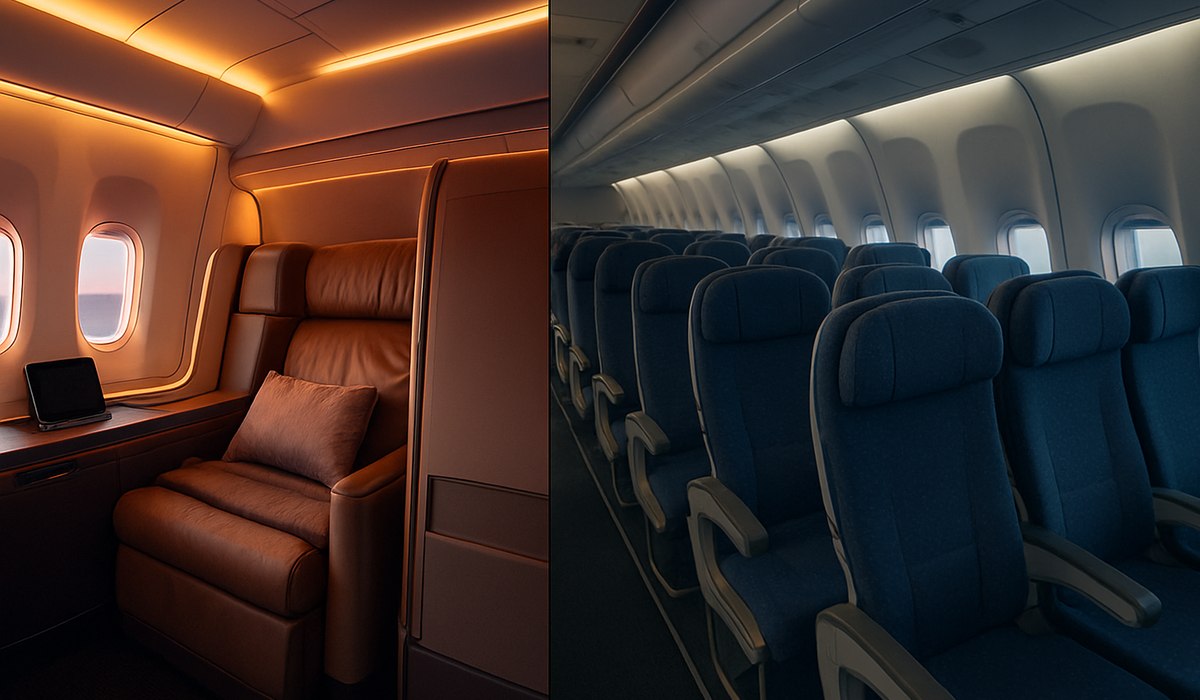
Image generated by AI
US Airlines Chase Profits Through Premium Cabin Expansion
Major US carriers are intensifying their focus on premium cabin experiences, reshaping aircraft configurations and aggressively monetizing first-class and business-class services. This strategy reflects a fundamental shift in airline revenue models, where carriers prioritize high-margin premium products while economy passengers absorb rising base fares and ancillary charges. The trend accelerated throughout 2026 as airlines reported robust demand from affluent business travelers and international passengers willing to pay substantial premiums for enhanced comfort, priority boarding, and dedicated cabin service.
The divide between premium and economy experiences has never been starker. While first-class passengers enjoy suites with direct-aisle access, premium cuisine, and concierge services, economy travelers increasingly face basic seating, restrictive baggage policies, and persistent surcharges for seat selection and carry-on luggage. Airlines justify this divergence through yield management strategies that segment passenger demand by willingness to pay.
The Premium Cabin Gold Rush
Airlines are reconfiguring narrow-body and wide-body fleets with expanded premium sections. United Airlines, American Airlines, and Delta Air Lines have each announced multi-billion dollar investments in premium cabin retrofits, removing economy seats to create additional first-class and business-class configurations. These aircraft redesigns typically reduce overall capacity by 5-15% while increasing revenue per available seat mile.
The economic rationale is compelling: premium passengers generate 3-5 times the revenue of economy travelers on identical routes. A first-class seat on a transcontinental flight generates $800-1,200 in margin, compared to $120-180 for economy. This mathematical reality drives airlines to chase profits through cabin redesigns that maximize premium inventory.
Manufacturers like Boeing and Airbus are responding with premium cabin products designed specifically for long-haul routes. Enhanced galley systems, lie-flat beds, and shower spas in first-class cabins represent the new competitive baseline for international carriers. Airlines marketing premium cabins as hospitality experiences rather than transportation services signals this shift in positioning.
Economy Passengers Bear the Deepening Cost
While premium cabins expand, economy passengers face a squeeze on multiple fronts. Base fares for economy seats have increased 8-12% across major carriers since early 2026. Simultaneously, ancillary fees proliferate: seat selection costs now routinely reach $15-25 per flight, carry-on bag fees range $20-35, and checked baggage charges remain at $30-40 for first bags.
Airlines are also narrowing seatpitch in economy cabins from 31-32 inches to 29-30 inches, reducing comfort while maintaining capacity. This compression allows carriers to reallocate premium square footage without sacrificing absolute passenger counts. The result: more economy passengers in tighter spaces subsidizing lavish premium experiences.
Budget carriers and legacy airlines show divergent approaches. Southwest and Alaska Airlines maintain competitive economy fares, while American, United, and Delta increasingly rely on premium revenue concentration. This strategic fork in the industry creates observable market segmentation, with business travelers and international passengers clustering on premium-heavy carriers, while leisure travelers gravitate toward value-focused alternatives.
Aircraft Reconfiguration and Revenue Strategy
The mechanical transformation of aircraft reflects boardroom priorities. A typical wide-body reconfiguration removes 20-30 economy seats while adding 8-12 premium suites. On a 350-seat Boeing 787, this means reducing economy from 250 to 225 seats while expanding first-class from 8 to 20 seats. The trade-off in absolute passenger capacity is offset by 40-60% revenue increases on profitable routes.
Major carriers are executing these reconfigurations systematically. United's Polaris cabin program, American's new Flagship Suite design, and Delta's Premium Delta One configurations represent billions in capital allocation. These aren't incremental improvements—they're fleet-wide transformations affecting hundreds of aircraft.
Route deployment strategies have shifted accordingly. Airlines prioritize premium-heavy aircraft on high-yield business corridors (New York-London, San Francisco-Tokyo, Chicago-Frankfurt) while deploying standard configurations on price-sensitive leisure routes (Orlando-Denver, Las Vegas-Phoenix). This deliberate fleet allocation deepens the service divide geographically.
What This Means for Budget-Conscious Travelers
Travelers seeking affordable flights face a narrowing middle class in aviation. The traditional economy experience—decent legroom, included baggage, reasonable service—is vanishing. Budget travelers must now choose between legacy carriers with compressed economy cabins and fees, or ultra-low-cost carriers offering transparent pricing but minimal amenities.
Route flexibility becomes essential. Flying off-peak hours, choosing secondary airports, and booking indirect routings can reduce costs by 20-35%. Loyalty program optimization matters more than ever, as elite status often waives baggage fees and provides economy-plus seating. Airlines are deliberately rewarding frequent travelers with benefits that casual flyers don't access.
International travel economics have shifted notably. A transatlantic economy fare on American, United, or Delta often reaches $600-900, making premium budget carriers and Middle Eastern carriers (Turkish Airlines, Qatar) increasingly competitive. Currency fluctuations and fuel costs also influence optimal routing strategies.
Live Flight Tracking and Reservation Monitoring
Monitoring aircraft configurations before booking provides critical intelligence. FlightAware's aircraft database allows travelers to view specific plane types assigned to scheduled flights. Checking seat maps on airline websites reveals exact premium cabin percentages. Tools like FlightAware enable real-time visibility into aircraft operations and scheduling decisions.
Fare tracking services identify pricing anomalies and optimal booking windows. Airlines employ sophisticated revenue management algorithms that adjust prices dynamically based on demand, competition, and inventory mix. Understanding these patterns helps travelers identify genuinely discounted fares versus compressed pricing from reduced capacity.
Regulatory and Consumer Rights Landscape
The US Department of Transportation actively monitors airline practices affecting consumer welfare. Recent DOT rulings have restricted some hidden fees while allowing others. The US DOT maintains extensive complaint databases showing fee-related grievances have increased 31% since 2024.
The FAA oversees safety and operational standards without direct authority over pricing. However, increasing consumer advocacy focused on airline revenue practices suggests regulatory scrutiny may intensify. Transparency in airline pricing and fee structures remains a contentious policy area.
Denied boarding compensation rules remain in effect, as do customer service requirements around baggage handling and flight disruptions. These protections apply equally across cabin classes, though premium passengers access priority resolution channels.
Traveler Action Checklist
-
Monitor aircraft configurations before booking by checking FlightAware and airline seat maps to identify cabin density and layout.
-
Compare total costs across carriers including base fares, mandatory fees, and baggage charges using multi-airline search tools rather than single-carrier websites.
-
Book flights during off-peak windows (Tuesday-Thursday, early morning departures, red-eye schedules) when airlines deploy standard-configuration aircraft.
-
Enroll in airline loyalty programs targeting your preferred carrier to access waived baggage fees, seat upgrades, and priority support.
-
Consider positioning flights on budget carriers to hub airports, then booking legacy carrier long-haul flights from premium-light configurations.
-
Negotiate baggage allowances by calling airline customer service directly—waiving fees for frequent travelers remains negotiable on many carriers.
-
Review premium cabin pricing on transcontinental routes, where premium fares sometimes undercut economy plus ancillary fee combinations.
-
Use airline alerts to monitor fare drops and schedule changes that might shift aircraft assignments and cabin configurations.
Key Industry Data Table
| Metric | 2024 Value | 2026 Value | Change |
|---|---|---|---|
| Average First-Class Revenue per Seat | $850 | $1, |
Disclaimer
This article is for informational and educational purposes only. It does not constitute legal, financial, or professional advice. While we strive to provide accurate and up-to-date information, travel policies, regulations, and conditions change rapidly. Always verify information with official sources before making travel decisions. Nomad Lawyer makes no representations about the accuracy, reliability, completeness, or suitability of the information provided. Readers should consult qualified professionals for advice specific to their circumstances. The views expressed in this article are those of the author and do not necessarily reflect the views of Nomad Lawyer.
Kunal K Choudhary
Co-Founder & Contributor
A passionate traveller and tech enthusiast. Kunal contributes to the vision and growth of Nomad Lawyer, bringing fresh perspectives and driving the community forward.
Learn more about our team →