
Aircraft Carriers China: Three-Carrier Operation Signals Naval Ambitions, Not Readiness
China operated three aircraft carriers simultaneously for the first time in April 2026, marking a symbolic naval milestone. However, experts question whether the nation can sustain this capability amid logistical and operational challenges.

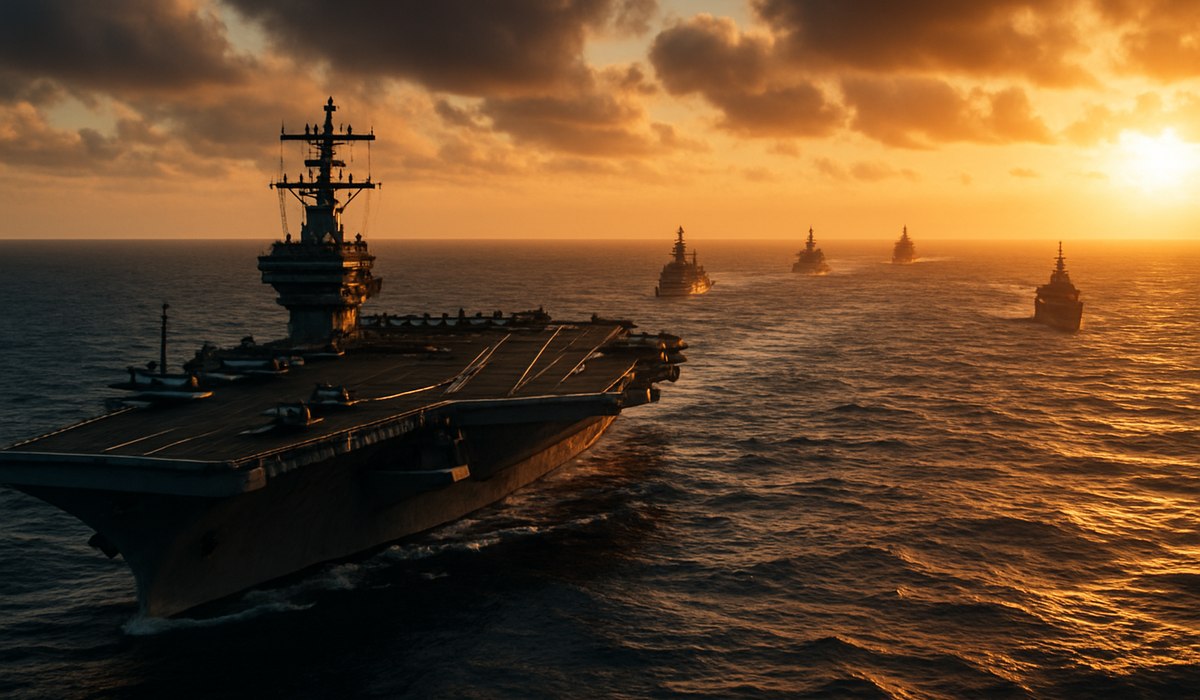
Image generated by AI
Lede
China's People's Liberation Army Navy (PLAN) achieved a historic operational milestone in early April 2026 by simultaneously deploying three aircraft carriers at sea for the first time. The coordinated operation of the Liaoning, Shandong, and Fujian represents a significant step toward China's aspiration to become a true global naval power. Yet analysts caution that executing a one-time demonstration differs fundamentally from sustaining continuous multi-carrier operations—a capability the United States has maintained for decades.
China's Historic Three-Carrier Operation
The simultaneous deployment of three aircraft carriers marks a watershed moment for Chinese naval ambitions. For years, defense analysts predicted when China would achieve this capability. The successful coordination demonstrates that the PLAN has progressed beyond single-carrier operations into early multi-carrier operational phases. This achievement signals China's transition from a regionally-focused naval force to one with genuine power-projection ambitions across the Indo-Pacific, Indian Ocean, and potentially toward the Middle East and African waters.
The significance extends beyond mere numbers. Operating multiple carriers requires integrated command structures, coordinated logistics, and trained personnel across expanded naval formations. The fact that China accomplished this coordination suggests years of internal preparation, exercise refinement, and organizational maturation. Defense officials from allied nations have closely monitored China's aircraft carriers and carrier development timelines to assess regional security implications.
The Gap Between Demonstration and Sustainability
The critical distinction between operating three aircraft carriers and sustaining three aircraft carriers cannot be overstated. Demonstration exercises differ substantially from maintaining persistent global presence. The United States operates 11 supercarriers as part of everyday operational routine, maintaining forward-deployed carrier strike groups continuously. China currently lacks this infrastructure.
Structural gaps remain apparent. China's PLAN operates without the global basing network the US Navy leverages across the Pacific, Atlantic, and Indian Oceans. Forward bases in allied nations, established logistics chains, and decades of combat-tested procedures give American carriers sustainability advantages. China's carrier air wings, while improving, require additional operational development. The J-15 fighter—the primary platform—remains constrained compared to American equivalents. These factors collectively mean that while China can surge three carriers to sea temporarily, maintaining this deployment indefinitely presents entirely different challenges. Sustaining multiple carrier operations demands redundancy in supply chains, personnel rotation schedules, and maintenance infrastructure that China continues developing.
Carriers Liaoning, Shandong, and Fujian Explained
Understanding each carrier reveals the trajectory of Chinese naval development. The Liaoning (Type 001) represents China's first carrier—a former Soviet vessel retrofitted with Chinese systems. This platform operates a ski-jump launch system and serves primarily for training and limited combat operations. The Liaoning remains operationally valuable but reflects earlier-generation design philosophy.
The Shandong (Type 002) marked China's transition to domestically-built carriers. Also employing ski-jump technology, the Shandong improved substantially over the Liaoning with increased air wing capacity and refined internal layout. This carrier demonstrated that China could manufacture sophisticated warships independently.
The Fujian (Type 003) represents the technological leap China aspires toward. Equipped with electromagnetic catapults—a capability only the United States operated previously—the Fujian enables launching heavier aircraft at higher operational tempos. This carrier reflects where Chinese naval ambitions genuinely lie and provides a platform comparable to American Nimitz-class carriers in certain respects.
The fighter complement, primarily the J-15 "Flying Shark," exhibits limitations relative to American F/A-18 Super Hornets but has demonstrated improvement potential. China has successfully tested the fifth-generation J-35 from Fujian's launch system, suggesting future carrier air wing enhancements.
Global Power Projection: From Regional to International
China's long-term naval strategy envisions a five-to-six-carrier fleet—approximately half the US Navy's carrier capacity. This expansion would fundamentally alter China's strategic posture from regional force to genuine global power-projection capability. The implications ripple across geopolitics.
An expanded carrier fleet allows China to maintain persistent presence across multiple ocean regions simultaneously. The Indo-Pacific becomes contested space where China projects comparable force to American capabilities. The Indian Ocean—critical to global energy transport—becomes subject to Chinese influence operations. Extended reach toward African and Middle Eastern waters amplifies Chinese Belt and Road strategic objectives through military dimension.
For the United States, an expanded Chinese carrier capability complicates regional force allocation decisions. Resources currently positioned elsewhere would require redeployment to maintain regional superiority. Crisis response capabilities become constrained. Allied nations from Japan to India to Australia face recalibrated strategic environments where American security guarantees face pressure from growing Chinese military reach.
The psychological and political dimensions of carriers amplify their military significance. Carriers project national power, symbolic presence, and political will more effectively than other naval platforms. China understands this calculus well—expanding carrier operations directly expand political influence without firing weapons.
Operational Maturity and Coordination
The successful three-carrier operation indicates growing coordination between Chinese naval commands. Distributed operations—where multiple carriers operate semi-independently but within coordinated tactical framework—require sophisticated communication systems, shared situational awareness, and trained commanders. China's military has invested substantially in modernizing these capabilities.
Layered defense becomes possible with multiple carriers. One carrier provides primary air defense while others operate strike missions. Greater sortie generation means more aircraft sorties per day, sustaining operations longer. Redundancy improves—losing one carrier no longer eliminates Chinese naval presence entirely.
The PLAN increasingly mirrors US Navy multi-carrier exercise patterns. Dual-carrier exercises have become regular occurrences. Multi-domain coordination exercises integrate air, surface, and subsurface forces. This systematic training approach suggests China learns deliberately from American naval operations and implements lessons methodically into organizational practices.
| Capability Factor | China (Current) | United States | Gap Assessment |
|---|---|---|---|
| Active Carriers | 3 | 11 | Quantitative disadvantage |
| Carrier Technology | Mixed (ski-jump + catapult) | Advanced catapult fleet | Technology parity emerging |
| Global Basing Network | Limited | Extensive | Significant structural gap |
| Sustained Deployments | Short-term surge capable | Persistent global presence | Sustainability gap critical |
| Combat Experience | Limited | Decades of operations | Experience advantage decisive |
| Logistics Infrastructure | Developing | Mature and redundant | Infrastructure development ongoing |
| Air Wing Development | J-15 with J-35 testing | F/A-18 Super Hornet fleet | Capability narrowing gradually |
| Personnel Training | Improving systematically | Institutionalized excellence | Training quality improving |
What This Means for Travelers
Geopolitical developments affect travel patterns through multiple mechanisms. Understanding implications helps travelers make informed decisions about Asian and Indo-Pacific travel.
1. Regional stability matters for aviation infrastructure. Expanded military presence in contested waters doesn't create immediate civilian aviation disruption, but geopolitical tension can eventually affect airline scheduling and route adjustments across Asia-Pacific regions.
2. Monitor regional news sources. Travelers planning trips to Southeast Asia, India, Japan, or Philippines should maintain awareness of military exercise announcements. While civilian aircraft avoid military operations, unexpected rerouting occasionally occurs during intensive exercises.
3. Insurance becomes more valuable. Travel insurance protecting against geopolitical disruptions offers peace of mind for extended Asia-Pacific journeys. Coverage for airline schedule changes due to military activities provides financial security.
4. Plan flexible itineraries. Maintaining flexibility for alternate routes or extended stays reduces complications if military activity affects specific regional travel corridors temporarily.
5. Consult official travel advisories regularly. The US State Department, UK Foreign Office, and other government agencies update travel advisories reflecting regional security developments. Check advisories before booking and periodically while traveling.
FAQ
**Q: How does China's three-carrier operation affect commercial
Disclaimer
This article is for informational and educational purposes only. It does not constitute legal, financial, or professional advice. While we strive to provide accurate and up-to-date information, travel policies, regulations, and conditions change rapidly. Always verify information with official sources before making travel decisions. Nomad Lawyer makes no representations about the accuracy, reliability, completeness, or suitability of the information provided. Readers should consult qualified professionals for advice specific to their circumstances. The views expressed in this article are those of the author and do not necessarily reflect the views of Nomad Lawyer.
Raushan Kumar
Founder & Lead Developer
Full-stack developer with 11+ years of experience and a passionate traveller. Raushan built Nomad Lawyer from the ground up with a vision to create the best travel and law experience on the web.
Learn more about our team →