
Air New Zealand Skynest Redefines Long-Haul Travel With Lie-Flat Sleep Pods for Economy Passengers Flying to New Zealand in 2026
Air New Zealand's world-first Skynest pods give Economy and Premium Economy passengers full lie-flat sleeping berths on 17-hour ultra-long-haul flights, launching November 2026 from NZD $495 per four-hour session on Boeing 787-9 aircraft.

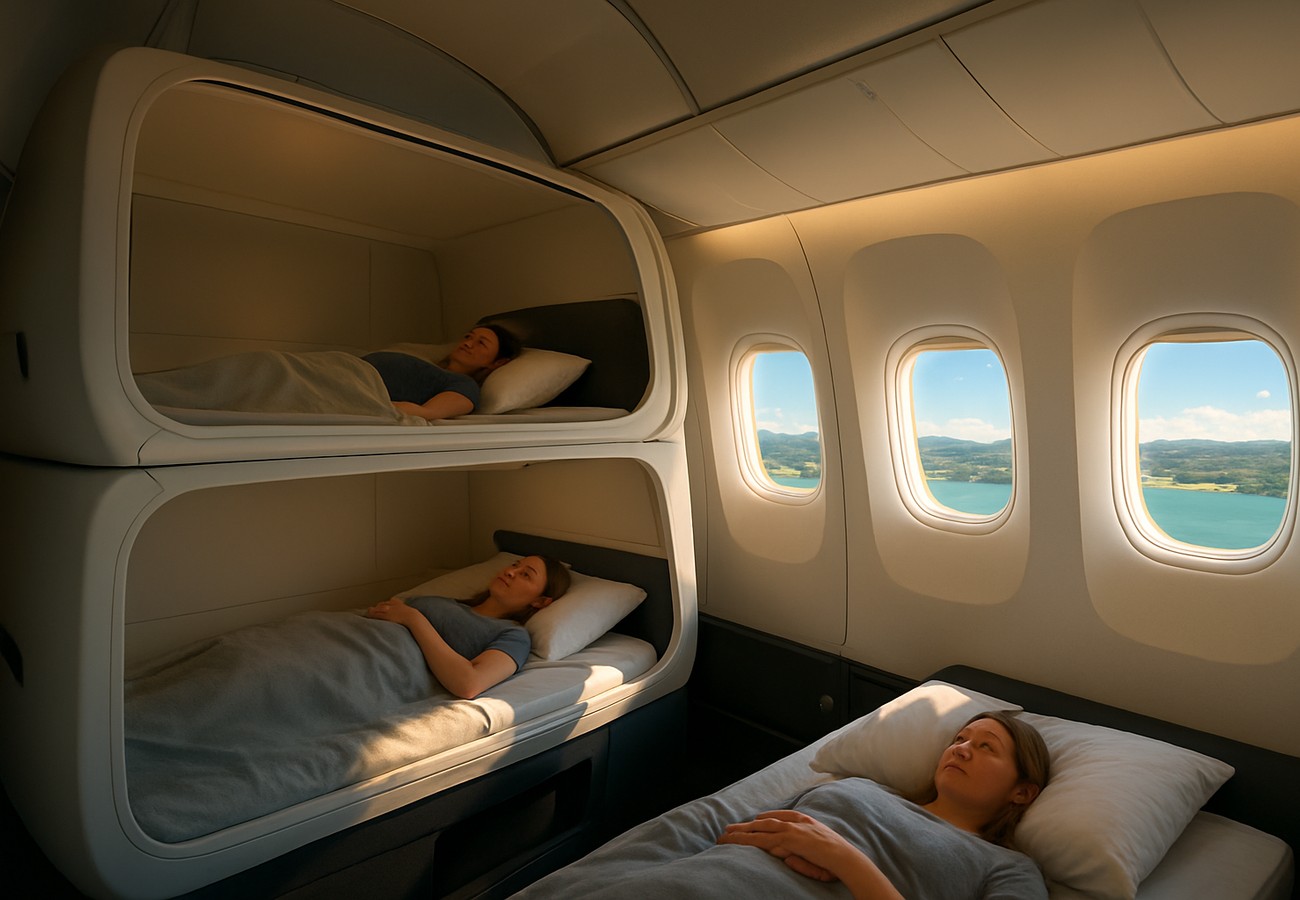
Image generated by AI
Air New Zealand has upended the economics of long-haul comfort with the unveiling of Skynest — a world-first lie-flat sleeping pod product available to Economy and Premium Economy passengers — setting a new benchmark for ultra-long-haul aviation at a time when New Zealand's $46 billion tourism industry is staking its global growth on making the journey itself part of the appeal.
Air New Zealand Launches a World First: Lie-Flat Pods Outside Business Class
For decades, the lie-flat bed has been the exclusive preserve of Business and First Class passengers, a luxury gated behind ticket prices that can run four to six times the cost of an economy seat. Air New Zealand has dismantled that barrier.
Skynest places six fully lie-flat sleeping pods in a bunk-style configuration between the Economy and Premium Economy cabins aboard the airline's Boeing 787-9 Dreamliner fleet. Each pod is a self-contained rest environment, fitted with a full-length mattress, pillow, sheets, blanket, privacy curtain, ambient lighting tuned to sleep and wake cycles, personal ventilation, a reading light, USB-A and USB-C charging ports, and a curated "Nestcessities" kit — an eye mask, earplugs, socks, and skincare items.
The service opens for booking on May 18, 2026, with commercial operations beginning in November 2026. A four-hour session — the core unit, sized around natural sleep cycles — is priced from NZD $495, booked as an add-on to an existing Economy or Premium Economy fare.
Why This Matters: New Zealand's Geography Is Both Its Greatest Asset and Its Biggest Barrier
New Zealand's extraordinary natural landscapes — fjords, geothermal fields, indigenous Maori culture, world-class wine regions — generate extraordinary demand. Tourism contributes $46 billion to the country's economy annually. But the country's very remoteness is the industry's most stubborn structural challenge.
Flights from major long-haul origins routinely clock 17 hours or more. London to Auckland covers roughly 18,820 kilometres. Los Angeles to Auckland still exceeds 10,800 kilometres. These are not flights passengers can simply endure with a neck pillow and a window seat; they arrive physically depleted, and that depleted arrival experience colors the start of every trip.
Air New Zealand CEO Nikhil Ravishankar has been direct about the stakes: the flying experience is not a prelude to the New Zealand holiday — for most international visitors, it is the first significant memory of it. According to Air New Zealand, Skynest was developed specifically to address this reality, giving travelers who cannot or will not pay for Business Class a medically-informed, structured rest option mid-flight.
What Passengers Actually Get: The Skynest Experience in Detail
Two four-hour Skynest sessions are available per flight, meaning up to 12 passengers per departure can book a pod slot. The sessions are timed around natural circadian rhythms rather than arbitrary time blocks — designed so that a passenger can board the pod in a drowsy state, fall asleep efficiently, and be gently brought out of sleep before the session ends.
Key features at a glance:
- Full lie-flat mattress — not a reclined seat, not a partial flat, a genuine horizontal sleeping surface
- Privacy curtain on each pod for acoustic and visual separation from the cabin
- Ambient lighting system that transitions through dusk and dawn spectrums to prompt sleep and waking
- Nestcessities Kit — eye mask, earplugs, socks, and skincare included per session
- USB-A and USB-C charging so devices are ready at destination
- Personal ventilation to maintain a comfortable pod microclimate
Passengers retain their original Economy or Premium Economy seat for the remainder of the flight. The pod is not a replacement seat — it is a dedicated rest zone. This distinction matters commercially: Air New Zealand is monetizing previously unused cabin volume without displacing existing seat revenue.
A Strategic Successor to Skycouch
Skynest does not emerge from nowhere. Air New Zealand pioneered the Skycouch concept years earlier — a triple-seat Economy configuration where the footrests raise to create a flat surface for couples or families, allowing a horizontal rest without booking a premium cabin. Skycouch proved both that the demand existed and that the engineering was solvable in the economy cabin footprint.
Skynest is the next logical step: a purpose-built, dedicated sleeping environment rather than an adapted seat. The progression reflects a mature strategic thesis — that the airline can capture incremental revenue from sleep as a commodity on ultra-long routes, while simultaneously differentiating itself from competitors who have not solved the rest problem for non-premium passengers.
What This Means for Travelers: Actionable Advice
For anyone planning long-haul travel to New Zealand in late 2026 or 2027, here is what the Skynest launch means practically:
- Book Skynest sessions early. With only six pods and two sessions per flight, there are a maximum of 12 available berths per departure. High-demand routes will sell out pod slots well ahead of departure.
- Skynest bookings open May 18, 2026 — set a reminder if New Zealand is on your itinerary for the northern winter or early 2027.
- Budget the add-on cost: NZD $495 converts to approximately USD $295–310 at current rates. For a 17-hour flight, this represents strong value relative to the price gap between Economy and Business Class fares.
- Skynest operates on Boeing 787-9 aircraft only — confirm your aircraft type at booking to ensure eligibility.
- Pair with the right Economy seat: Choosing an aisle seat adjacent to the Skynest zone could ease the transition in and out of your pod session.
FAQ: Air New Zealand Skynest 2026
Q: Who is eligible to book a Skynest session? Skynest is available as an add-on for passengers already holding Economy or Premium Economy tickets on qualifying Air New Zealand Boeing 787-9 long-haul flights. Business Class passengers are not the target — they already have lie-flat seats.
Q: How much does a Skynest session cost and when can I book? Sessions start from NZD $495 (approximately USD $295–310) for a four-hour pod slot. Bookings open May 18, 2026, with service beginning November 2026.
Q: Is Skynest available on all Air New Zealand long-haul routes? At launch, Skynest is confirmed for select Boeing 787-9 services. Passengers should verify aircraft type and Skynest availability on their specific flight at booking.
The Bigger Picture: Aviation's Next Comfort Frontier
Skynest arrives as the global aviation industry grapples with surging long-haul demand and persistent passenger dissatisfaction with Economy Class comfort on flights exceeding 12 hours. According to IATA passenger experience data, sleep quality and arrival condition are consistently among the top-ranked dissatisfiers for long-haul Economy travelers — above in-flight entertainment and even meal quality.
Air New Zealand has identified this gap and is commercializing it directly. If Skynest performs at load factor targets in its first operational season, industry analysts expect rival carriers on competing ultra-long-haul routes — particularly those serving Australia, South America, and Southern Africa — to evaluate similar configurations. The pod-in-economy concept, long discussed in aviation design circles, now has a live commercial proof of concept.
The implications extend beyond Air New Zealand. Airlines operating routes of 14 hours or more from Southeast Asia, the Middle East, and Europe will be watching Skynest's occupancy and revenue-per-available-seat-kilometre (RASK) data closely. A successful model could trigger a new category of cabin product between Economy and Premium Economy — a structural shift in how long-haul cabins are configured.
Key Takeaways
- Air New Zealand Skynest launches commercially in November 2026 — the world's first lie-flat sleeping pods available to Economy and Premium Economy passengers
- Six pods in a bunk-style configuration between Economy and Premium Economy cabins on Boeing 787-9 aircraft
- Each pod includes a full mattress, privacy curtain, ambient lighting, ventilation, USB charging, and a Nestcessities kit
- Sessions priced from NZD $495 for four hours; bookings open May 18, 2026
- Two four-hour sessions available per flight — a maximum of 12 pod sessions per departure
- New Zealand's tourism sector contributes $46 billion annually; Skynest directly addresses the country's geographic isolation barrier
- Skynest follows Air New Zealand's earlier Skycouch innovation — a deliberate progression toward monetizing rest in the economy cabin
Related Travel Guides
Low-Cost Carriers Eye Gulf Shores Alabama Beaches as Summer 2026 Travel Demand Surges
Best Long-Haul Airlines for Economy Comfort: The Ultimate Passenger Guide for 2026
Zealand. Session booking opens May 18, 2026 — confirm all details directly at airnewzealand.com before making travel plans. Currency conversions from NZD are approximate and fluctuate with exchange rates.
Disclaimer
This article is for informational and educational purposes only. It does not constitute legal, financial, or professional advice. While we strive to provide accurate and up-to-date information, travel policies, regulations, and conditions change rapidly. Always verify information with official sources before making travel decisions. Nomad Lawyer makes no representations about the accuracy, reliability, completeness, or suitability of the information provided. Readers should consult qualified professionals for advice specific to their circumstances. The views expressed in this article are those of the author and do not necessarily reflect the views of Nomad Lawyer.
Kunal K Choudhary
Co-Founder & Contributor
A passionate traveller and tech enthusiast. Kunal contributes to the vision and growth of Nomad Lawyer, bringing fresh perspectives and driving the community forward.
Learn more about our team →