
Air New Zealand Secures Third in Asia-Pacific Punctuality: Pre-Staging Boarding and 90.3% Regional Reliability Dissected
Air New Zealand achieved an 87.3% on-time arrival rate in September 2026, cutting flight cancellations to 1.4% and codifying pre-staging boarding ahead of summer.

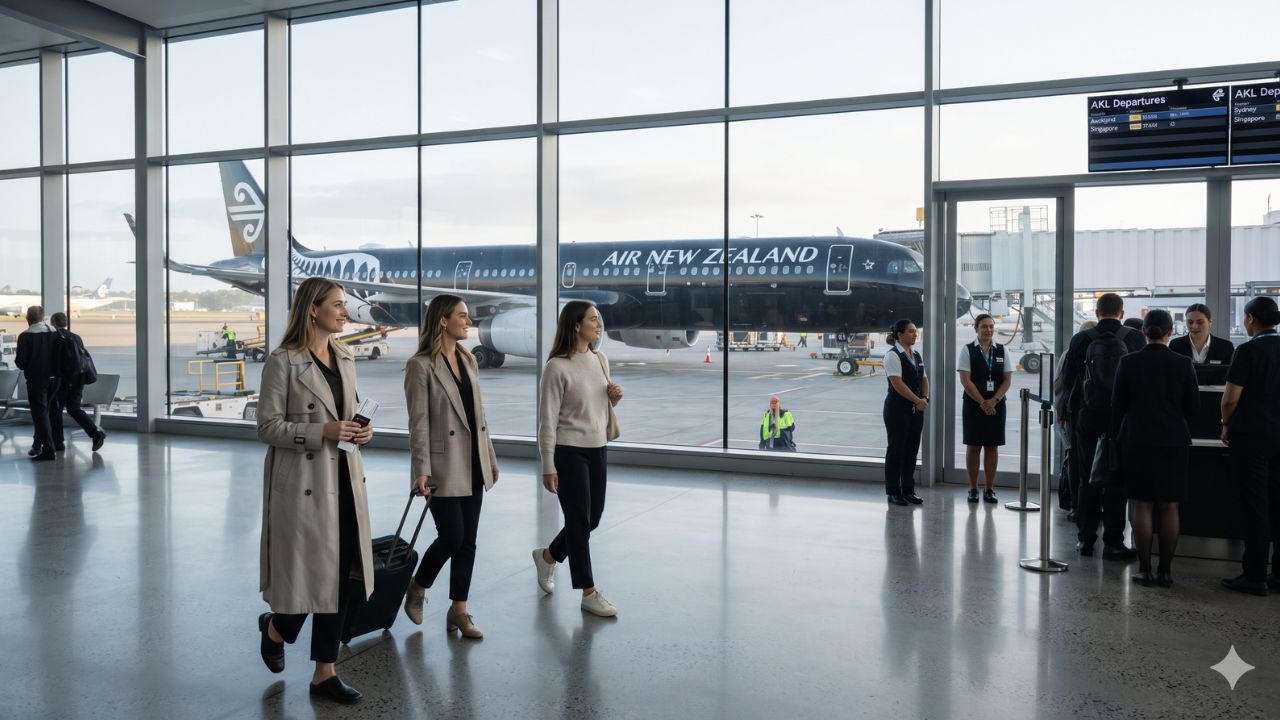
Registering an 87.3 percent on-time arrival rate across 13,072 scheduled operations and driving regional network punctuality to 90.3 percent, Air New Zealand secured third place in Cirium’s Asia-Pacific airline operational rankings for September 2026. Outperforming the international industry benchmark of 77.7 percent by 9.6 percentage points, the flag carrier achieved an 11.8 percentage point year-over-year recovery compared to its 75.5 percent rating in September 2025. Concurrently, systemwide cancellations plummeted from 2.5 percent in August to 1.4 percent in September, demonstrating how gate-side process innovation can protect schedule integrity before peak Southern Hemisphere summer travel commences.
Tracked independently by aviation analytics leader Cirium and coordinated across domestic terminals alongside Air New Zealand, the performance rebound reflects structural adjustments to ground operations rather than schedule padding. By targeting gate-side passenger congestion, optimizing aircraft turnaround intervals, and synchronizing ramp coordination across primary trunk hubs, the airline has insulated its schedule against cascading downline delays. For long-haul passengers transiting into domestic itineraries across the North and South Islands, this operational stability provides vital connection certainty.
Process Engineering at the Gate: The Rollout of Pre-Staging General Boarding
The primary driver behind Air New Zealand’s operational recovery is the implementation of a workflow protocol designated as "pre-staging general boarding." Traditional boarding protocols often generate severe cabin door delays because passenger documentation, carry-on luggage allowances, and digital boarding passes are verified right at the jet-bridge threshold. When passengers enter the narrow aisles of twin-engine aircraft and struggle to locate overhead bin space for oversized luggage, the entire passenger queue halts, leaving departure gates blocked and missing allocated air traffic control pushback slots.
To address these chronic delays, Air New Zealand launched rigorous operational trials across international services departing Auckland Airport as well as heavy-frequency domestic trunk routes connecting Auckland, Wellington, and Christchurch. Under the pre-staging framework, gate staff scan boarding passes and verify passenger credentials into an isolated, secure boarding holding area while inbound cabin grooming and safety checks conclude. The moment cabin flight attendants confirm cabin readiness, passenger boarding initiates at maximum velocity, eliminating podium chokepoints and ensuring overhead bin loading occurs continuously.
Following extensive testing that significantly cut departure delays and turnaround times, the airline formally integrated pre-staging general boarding as standard operating procedure network-wide on 1 October 2026. This operational refinement demonstrates that disciplined procedural adjustments can unlock significant punctuality gains without demanding expensive airport physical modifications.
Operational Performance Benchmarks and Regional Fleet Reliability
The airline’s operational success in September 2026 was largely anchored by its domestic and regional network. Regional feeder flights—frequently operating between secondary provincial airports and major metropolitan hubs—often bear the brunt of mechanical delays, weather buffers, and air traffic control restrictions. However, across 13,072 scheduled operations, regional flights achieved a 90.3 percent on-time arrival rate, surpassing the main trunkline average.
Simultaneously, the carrier lowered its flight cancellation frequency. Sashing cancellations from 2.5 percent in August to 1.4 percent in September represents a 44 percent month-over-month decline in aborted flights. This reduction indicates that line maintenance scheduling, aircraft availability, and crew staging have achieved greater operational equilibrium across the fleet.
The following data table compares Air New Zealand's September 2026 performance metrics against preceding operational periods and international aviation benchmarks:
| Operational Performance Metric | September 2026 Result | August 2026 (Prior Month) | September 2025 (Year-Ago) | Global Aviation Average | Operational Variance & Impact |
|---|---|---|---|---|---|
| Systemwide On-Time Arrival Rate | 87.3% | 85.3% | 75.5% | 77.7% (Worldwide Benchmark) | +11.8 percentage points YoY; beats global average by 9.6 points |
| Cirium Asia-Pacific Ranking | 3rd Place | Top 5 Standing | Unranked in Top Tier | N/A (Regional Metric) | Secures podium finish among Asia-Pacific legacy carriers |
| Regional Sector Punctuality | 90.3% | 87.1% | 78.2% | ~80.0% (Regional Benchmark) | Surpasses systemwide average; anchors domestic connectivity |
| Flight Cancellation Frequency | 1.4% | 2.5% | 3.1% | 2.2% (Industry Average) | 44% month-over-month reduction in cancellations |
| Total Monthly Operations | 13,072 Flights | 13,210 Flights | 12,890 Flights | N/A (Carrier-Specific) | Sustained high-frequency operational volume across all fleets |
| Standard Boarding Protocol | Pre-Staging Boarding | Trial Phase (Select Hubs) | Conventional Gate Boarding | Conventional Gate Boarding | Formally mandated as standard procedure from 1 October 2026 |
These performance improvements are particularly critical for domestic tourism corridors. Secondary destinations such as Queenstown, Napier, Nelson, and Rotorua depend heavily on punctually operated regional aircraft to feed passengers into departing transpacific and long-haul Asian international flights from Auckland.
Expert Analysis: Slot Protection, Downline Cascading Delay Prevention, and Transpacific Connection Security
The strategic importance of Air New Zealand’s operational rebound centers on fleet utilization economics and airport slot preservation ahead of the Southern Hemisphere summer high season.
For travelers booking this route, the direct consequence of an 87.3 percent arrival punctuality rate and an ultra-low 1.4 percent cancellation rate is the practical safeguarding of flight connections. International visitors landing in Auckland after 12-to-14-hour transpacific flights from Los Angeles, San Francisco, or Houston can book domestic onward connections with standard 90-minute buffers without fearing that gate-side ground delays will strand them overnight.
The pricing pressure this creates forces competing trans-Tasman carriers, including Qantas and Jetstar, to tighten their own ground-turnaround performance. In competitive regional markets, corporate flyers and high-yield international travelers prioritize operational reliability over small fare differentials, as business missed-connection costs far outweigh marginal seat savings.
From an aviation engineering standpoint, ground turnaround compression is the most cost-effective lever an airline can pull. By trimming five to seven minutes off standard passenger boarding through pre-staging, the carrier protects its aircraft against missing assigned pushback windows. In high-density air traffic corridors like Auckland and Wellington, missing an assigned slot by three minutes can result in a 25-minute runway queue hold, generating cascading delays that degrade an aircraft’s subsequent five scheduled flight sectors across the day.
Looking ahead to the peak December-through-February holiday surge, Air New Zealand’s operational challenge will be sustaining these metrics under intense passenger volumes and volatile weather patterns. Spring and early summer winds across Cook Strait routinely test approach patterns into Wellington International Airport, while summer convection can restrict runway capacity. However, by formalizing disciplined gate boarding and reducing cancellations to 1.4 percent entering the high season, the airline has built an essential operational buffer to absorb peak-season strains.
Key Takeaways
- Podium Punctuality Finish: Air New Zealand secured third place in Cirium’s Asia-Pacific rankings for September 2026 with an 87.3% on-time arrival rate.
- Significant Year-Over-Year Surge: The carrier achieved an 11.8 percentage point increase compared to September 2025 (75.5%), comfortably exceeding the global average of 77.7%.
- Regional Network Leadership: Regional flights achieved a 90.3% punctuality rating across 13,072 scheduled operations during the month.
- Plummeting Cancellations: Systemwide flight cancellations dropped from 2.5% in August to 1.4% in September, a 44% month-over-month decrease.
- Network-Wide Pre-Staging Boarding: Following successful trials in Auckland, Wellington, and Christchurch, the faster pre-staging boarding protocol was officially enacted across all flights on 1 October 2026.
FAQ: Air New Zealand Operational Performance 2026
What was Air New Zealand's on-time arrival rate in September 2026?
Air New Zealand recorded an 87.3% on-time arrival rate in September 2026, ranking third among all Asia-Pacific airlines according to independent aviation analytics firm Cirium.
What is the new pre-staging boarding procedure introduced by Air New Zealand?
Pre-staging boarding processes passengers and scans their travel documents into a secure forward lounge before the aircraft cabin is cleared, accelerating boarding once the doors open.
How did Air New Zealand's regional flights perform compared to its main routes?
Regional flights performed exceptionally well, achieving a 90.3% on-time arrival rate across 13,072 total monthly operations, outperforming the carrier’s overall network average.
Did Air New Zealand reduce its flight cancellation rate?
Yes. The airline reduced its cancellation rate from 2.5% in August 2026 to 1.4% in September 2026, marking a 44% month-over-month reduction in canceled flights.
By transforming mundane gate procedures into a finely calibrated operational discipline, Air New Zealand proves that punctuality is won or lost on the airport tarmac long before an aircraft ever takes flight.
Related Travel Guides
Disclaimer
This article is for informational and educational purposes only. It does not constitute legal, financial, or professional advice. While we strive to provide accurate and up-to-date information, travel policies, regulations, and conditions change rapidly. Always verify information with official sources before making travel decisions. Nomad Lawyer makes no representations about the accuracy, reliability, completeness, or suitability of the information provided. Readers should consult qualified professionals for advice specific to their circumstances. The views expressed in this article are those of the author and do not necessarily reflect the views of Nomad Lawyer.
Raushan Kumar
Founder & Lead Developer
Full-stack developer with 11+ years of experience and a passionate traveller. Raushan built Nomad Lawyer from the ground up with a vision to create the best travel and law experience on the web.
Learn more about our team →