
Air China and China Southern Raise the Stakes as China Flight Overbooking Rules Bring Tougher Protections
Air China and China Southern Raise the Stakes as China Flight Overbooking Rules Bring Tougher Protections. Latest travel news, updates, and expert analysis.

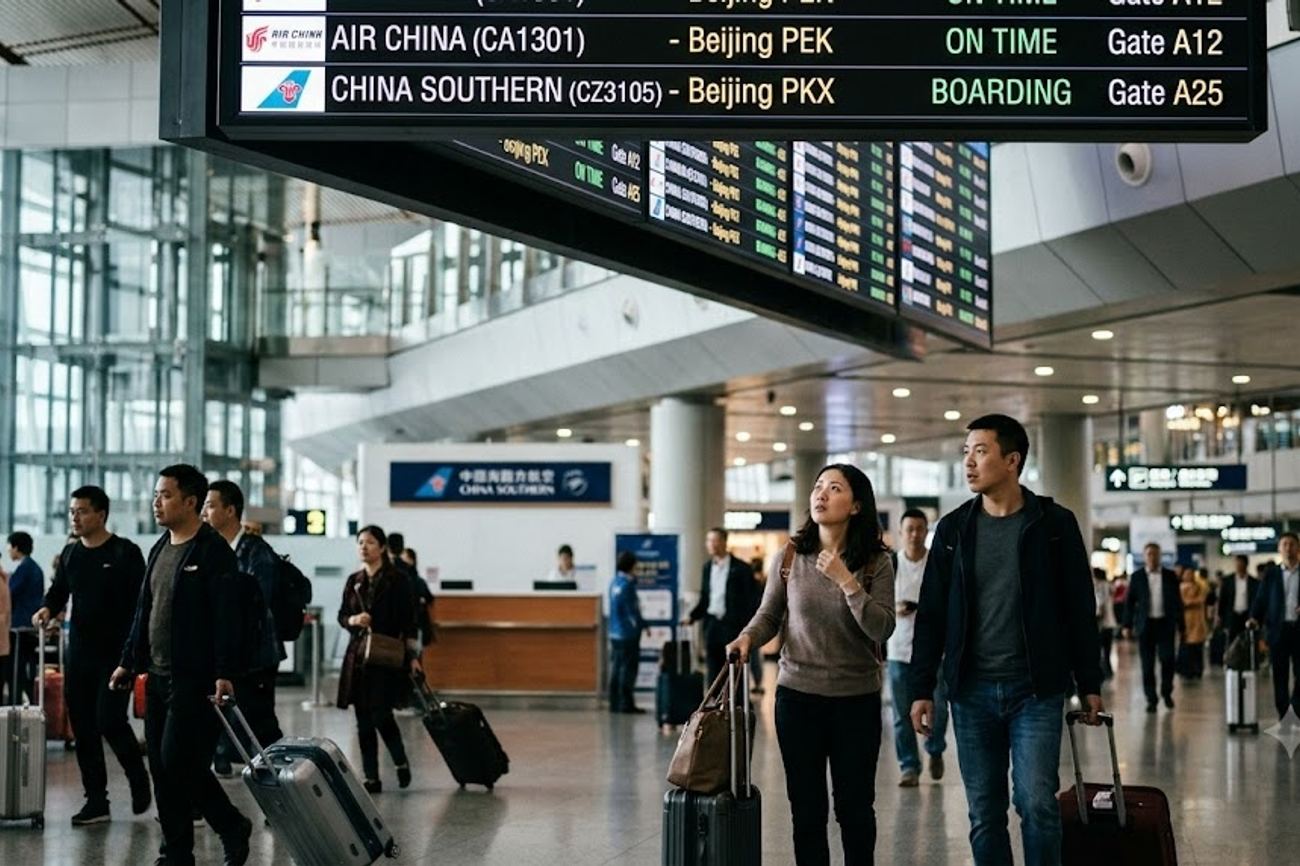
Image generated by AI
While commercial aviation across China handled a record 770.15 million passenger journeys in 2025 alongside a 20% surge in international travelers, an era of murky denied-boarding disputes has quietly come to an abrupt close. Following joint consumer protection accords confirmed on 8 September across Beijing, Tianjin, and Hebei, 10 dominant airlines and five primary digital booking platforms finalized sweeping passenger rights upgrades on 31 August. Instead of fine-print ambiguities buried beneath booking screens, travelers taking off from mega-hubs like Beijing Capital, Shanghai Pudong, or Guangzhou Baiyun now operate under transparent seat disclosures, strictly documented gate handling, and mandatory protections against arbitrary bumping.
Air China and China Southern Lead a Unified Overbooking Standard
The rapid post-pandemic acceleration of Chinese air travel created pressing logistical challenges across the nation's 5,488 scheduled domestic and international air routes. In 2025, commercial airports across China registered 1.529 billion passenger movements, an increase of 4.8%, while total cargo and mail throughput climbed 9.0% to 21.86 million tonnes across 12.45 million aircraft movements. Supported by a commercial fleet of 4,574 aircraft operated by 65 certified airlines connecting 261 mainland cities and reaching 147 foreign destinations in 65 countries, the system operated at historic capacity. Under such density, even a fractional percentage of overbooked flights triggered severe friction for travelers connecting across distant provinces.
To eliminate regional inconsistencies, regulatory bodies across the Beijing-Tianjin-Hebei cluster unified the standard across 10 major carriers: Air China, China Southern Airlines, China Eastern Airlines, Hainan Airlines, Xiamen Airlines, Tianjin Airlines, Sichuan Airlines, Juneyao Airlines, Spring Airlines, and Hebei Airlines. Parallel mandates were placed upon China's five leading travel portals: Trip.com Group, Fliggy, Qunar, Tongcheng, and Meituan. Backed by China's revised Civil Aviation Law, which entered into legal force on 1 July 2026, the updated framework compels carriers to treat denied boarding as a formalized operational event rather than an ad-hoc customer service argument.
The practical impact begins directly on booking screens. Civil Aviation Administration of China guidelines now dictate that seat availability risks cannot hide inside multi-page terms of service. On Trip.com, prospective flyers encounter mandatory confirmation pop-up windows outlining seat management policies before payment processing. Qunar has introduced interactive explainers breaking down yield management models, while China Eastern and Sichuan Airlines feature dedicated top-tier sections explaining passenger guarantees. By converting passive booking clicks into informed agreements, the rules establish clear passenger expectations before tickets are issued.
What Makes Flying Across Mainland China a Singular Experience
Navigating China by air reveals extraordinary geographic scale and architectural ambition. Travelers departing Beijing no longer simply pass through utilitarian terminals; they step beneath the flowing starfish canopy of Zaha Hadid's Daxing International Airport (PKX) or navigate the vast corridors of Terminal 3 at Capital Airport (PEK). In western China, flying into Chengdu Tianfu (TFU) places visitors within striking distance of the bamboo reserves and ancient irrigation marvels of Dujiangyan, a treasured UNESCO World Heritage Centre site.
Domestic flying in China also carries distinct regional identity across individual carriers. Boarding Sichuan Airlines often feels like a culinary preview of Chengdu, where flight attendants serve warm spiced potatoes and generous spoonfuls of fragrant chili paste alongside hot meals. Flying Xiamen Airlines introduces passengers to refined Minnan tea service rituals, reflecting the maritime culture of Fujian Province. Meanwhile, northern journeys aboard Air China carry the formal efficiency of Beijing's diplomatic corridors, and southern routes aboard China Southern Airlines reflect the kinetic commercial pace of the Pearl River Delta.
The sensory transition between airports and ancient destinations is equally striking. In less than three hours, an Airbus A350 or domestic COMAC C919 can lift travelers from the hyper-modern financial skyline of Shanghai Hongqiao and deposit them amidst the terracotta relics of Xi'an or the karst peaks of Guilin. With air travel deeply interwoven with everyday mobility, knowing your rights during high-season periods like the Mid-Autumn Festival or Spring Festival Golden Week is essential for maintaining peace of mind.
How Revised Airport Gate Procedures Protect Passenger Journeys
When oversold flights encounter zero no-shows at the boarding gate, the updated regulations enforce a strict, uniform protocol that frontline airline staff cannot bypass. Gate agents must exhaust every avenue to recruit voluntary surrenders before anyone is involuntarily denied boarding. To incentivize voluntary rebooking, carriers like Xiamen Airlines instruct staff to present direct cash reimbursement options first, while Spring Airlines has written standardized meal vouchers, hotel lodging, and ground transit assistance directly into its internal gate handling manuals.
If voluntary requests prove insufficient, involuntary denied boarding must follow a protected hierarchy. Frontline gate teams are legally required to safeguard vulnerable categories of travelers, giving absolute boarding priority to unaccompanied children, elderly travelers, passengers with physical disabilities, pregnant women, and flyers holding confirmed international or domestic connecting connections. Platforms like Meituan have integrated specialized accessibility fields that pass medical and mobility data directly into airline check-in backends, preventing special assistance records from being lost during ticket transmission.
Operational accountability has been reinforced at every touchpoint. Juneyao Airlines has widened frontline discretion so airport managers can resolve disputes immediately with upgraded vouchers, while Hebei Airlines and Tianjin Airlines mandate full end-to-end incident logging for every passenger affected. Under the supervision of the China National Tourist Office, airlines cannot charge change fees, cancellation penalties, or fare differences when rebooking bumped flyers onto the next available flight. China Southern has upgraded its predictive route forecasting models, utilizing machine learning to suppress seat over-allocation during peak holiday rushes before check-in counters open.
Visitor Insider Tips: Navigating Chinese Air Terminals and Ground Connections
- Airport Pairs and Transit Choices: Major Chinese hubs feature dual airport systems. In Beijing, choosing Daxing (PKX) over Capital (PEK) offers newer facilities and rapid 20-minute express rail connections to Beijing West Railway Station. In Shanghai, select Hongqiao (SHA) for seamless, same-station transfers to high-speed rail lines heading toward Hangzhou and Suzhou; reserve Pudong (PVG) primarily for long-haul international flights and experience the 430 km/h Maglev train into Pudong's financial district.
- Power Bank Regulations at Security: Airport security screening throughout China strictly enforces battery rules. Every lithium-ion power bank must have its rated capacity clearly visible on the casing and must remain under 100 watt-hours (or up to 160 watt-hours with advance airline approval). Power banks lacking factory capacity markings or exceeding limits are confiscated immediately at security checkpoints and can never be packed inside checked luggage.
- Written Proof of Denied Boarding: If your flight is overbooked and you are denied boarding, always ask the ground agent for an official written certificate of denied boarding (jv deng zheng ming). Under the consumer protection agreement, this formal paperwork guarantees immediate fee waivers, supports travel insurance claims, and establishes priority on alternative flights.
- High-Speed Rail as a Built-In Backup: China's China Railway High-speed (CRH) network is an exceptional travel partner to aviation. On dense corridors like Beijing–Shanghai (4.5 hours on the Fuxing bullet train) or Guangzhou–Changsha (2.5 hours), high-speed rail frequently outpaces air travel once check-in times and runway taxi delays are factored in. Keep the official 12306 railway app installed on your smartphone as a real-time contingency plan.
Cultural and Environmental Context: Sustainable Skies Alongside High-Speed Rail
China's civil aviation expansion operates within an integrated multimodal transportation network unmatched anywhere in the world. Rather than competing destructively against high-speed rail lines, the aviation sector increasingly channels flyers into secondary and tertiary regional destinations where rail construction across rugged mountain terrain remains difficult. Cities across the Tibetan Plateau, the Taklamakan Desert, and the mountains of Yunnan depend on reliable air bridges to sustain eco-tourism, local handicrafts, and heritage hospitality.
Simultaneously, major hubs are aggressively adapting to national carbon neutrality goals. Beijing Daxing and Chengdu Tianfu integrate geothermal heating systems, rainwater recycling, and expansive solar canopies across support buildings. Electric ground service vehicles, single-engine taxi protocols, and optimized airspace routing contribute to curbing per-passenger emissions across China's 12.45 million annual aircraft movements. For international travelers, understanding this balance between high-speed infrastructure and ecological preservation provides a deeper appreciation of how modern China moves its people across immense distances.
FAQ: Flying in China 2026
What happens if my domestic flight in China is overbooked? Airlines must first call for volunteers and offer cash or flight alternatives without change fees. If involuntary bumping occurs, vulnerable travelers and connecting flyers are protected, and the airline must provide free rebooking, food, and accommodation.
How do I prove I was bumped from my flight? Request a written denied-boarding certificate (jv deng zheng ming) directly from the airline gate supervisor. This official document is required by consumer protection rules to validate compensation and insurance claims.
Can I switch to a high-speed train if my flight is disrupted? Yes. Chinese airports in cities like Shanghai Hongqiao, Beijing Daxing, and Chengdu East offer direct high-speed rail links. You can cancel your disrupted flight penalty-free and purchase bullet train seats via the official 12306 app.
What power bank capacity is permitted on domestic flights? Power banks must have factory-printed labels showing 100 watt-hours (Wh) or less. They must be carried in your cabin baggage only; batteries without visible capacity ratings or exceeding 160Wh are strictly prohibited.
When mainland skies move over two million passengers every single day, knowing your consumer rights turns potential airport turbulence into a smooth, confident journey.
Related Travel Guides
- Thai Airways Nagoya Bangkok Flights Return in 2027 As Overnight Service Boosts Japan Thailand Travel Connectivity
- Turkish Airlines Flight Turnback Signals Heightened Wildlife Safety Protocols at Istanbul Airport
- Copenhagen Airport Passenger Traffic Soars as Summer Transit Demands Reshape Scandinavian Aviation
Disclaimer
This article is for informational and educational purposes only. It does not constitute legal, financial, or professional advice. While we strive to provide accurate and up-to-date information, travel policies, regulations, and conditions change rapidly. Always verify information with official sources before making travel decisions. Nomad Lawyer makes no representations about the accuracy, reliability, completeness, or suitability of the information provided. Readers should consult qualified professionals for advice specific to their circumstances. The views expressed in this article are those of the author and do not necessarily reflect the views of Nomad Lawyer.
Raushan Kumar
Founder & Lead Developer
Full-stack developer with 11+ years of experience and a passionate traveller. Raushan built Nomad Lawyer from the ground up with a vision to create the best travel and law experience on the web.
Learn more about our team →