
Aeroméxico and European Carriers Launch Transatlantic Routes for 2027: Milan, Paris, and the 75% Domestic Consolidation of Grupo Más Vuelos

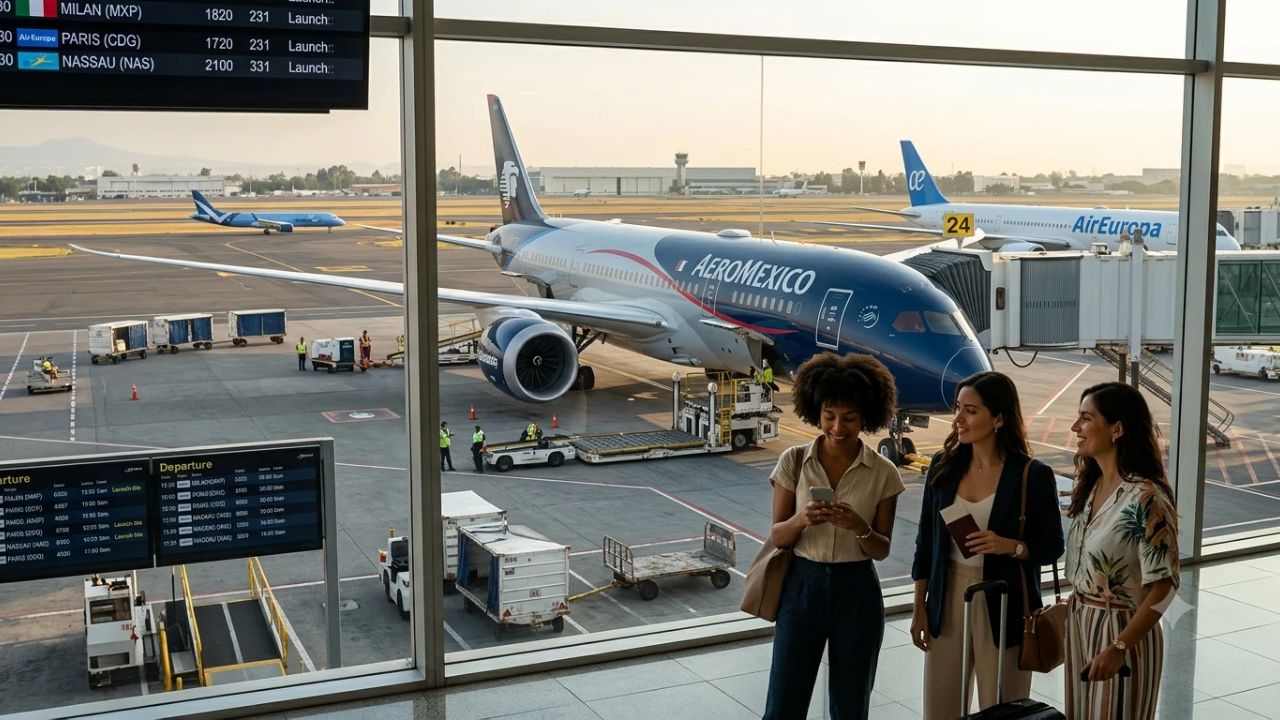
Controlling roughly 75% of Mexico's internal aviation market following antitrust clearance from competition authorities, domestic carriers Volaris and Viva Aerobus have finalized terms to unite under the holding conglomerate Grupo Más Vuelos by the end of 2026, triggering an unprecedented restructuring of Mexican airspace. At the same time, national flag carrier Aeroméxico has announced a sweeping international offensive for Spring 2027, deploying its long-range Boeing 787 Dreamliner fleet to open scheduled corridors to Milan and Paris, alongside non-stop Caribbean routes to Nassau and Montego Bay.
The simultaneous realignment across domestic and long-haul sectors reflects a structural transition following the multi-billion-dollar infrastructure test of the 2026 FIFA World Cup. Having demonstrated that regional secondary airports can absorb high-density traffic, Mexican civil aviation authorities are implementing permanent international authorizations. Under the oversight of the Federal Civil Aviation Agency of Mexico (AFAC), airlines are shifting away from short-term leisure experiments toward durable corporate routes connecting Mexico's manufacturing corridors with Europe and North America.
Post-World Cup Structural Transition and Mexican Aviation Growth
The evolution of Mexican commercial aviation over recent years has transformed the country from a regional destination into a major Latin American transit crossroads. For decades, international connectivity remained heavily centralized within the traditional United States and Canadian transborder corridors, governed by cross-border trade under the United States-Mexico-Canada Agreement (USMCA). Long-haul routes to Europe and Asia were limited to a handful of legacy airlines operating constrained frequencies out of Mexico City International Airport (MEX).
However, the infrastructural demands of the 2026 FIFA World Cup served as an operational stress test for the nation's aviation sector. Domestic and regional carriers aggressively expanded point-to-point routes to transport millions of international spectators between host cities in Mexico City, Guadalajara, and Monterrey.
MEXICAN COMMERCIAL AVIATION EXPANSION MATRIX: 2027 ARCHITECTURE
| Strategic Pillar | Operating Carriers Involved | Structural Milestone | Long-Term Market Impact |
|---|---|---|---|
| Transatlantic | Aeroméxico | Non-stop MEX to Milan (MXP) | Direct industrial link to |
| Expansion | (SkyTeam Alliance Flag) | & GDL to Paris (CDG) | northern Italy & France |
| Caribbean Capital | Aeroméxico | Direct non-stops to Nassau | First-ever scheduled MEX |
| Connections | (Boeing 737-8 Fleet) | (NAS) & Montego Bay (MBJ) | to Bahamas capital link |
| Domestic Mega- | Volaris & Viva Aerobus | Merger into holding company | Control ~75% of domestic |
| Consolidation | (COFECE Antitrust Cleared) | branded Grupo Más Vuelos | market; optimize fleet |
| European Regional | Air Europa | Direct Madrid (MAD) to | Direct executive access |
| Industrial Route | (Bilateral Negotiations) | Bajío / Guanajuato (BJX) | to automotive cluster |
| Transborder Point- | Breeze Airways | Non-stop leisure flights | Affordable bypass of |
| to-Point Travel | (Airbus A220 Fleet) | from secondary US cities | congested legacy hubs |
As the industry moves into 2027, Mexican airlines are not contracting capacity; instead, they are converting temporary event routes into permanent commercial networks. Federal transport authorities are deliberately decentralizing international air traffic away from the congested airspace of Mexico City Benito Juárez Airport, empowering secondary industrial hubs in Jalisco, Nuevo León, and Guanajuato.
Aeroméxico Transatlantic Widebody Offensive: Milan and Paris
At the center of the 2027 international expansion is Aeroméxico's widebody deployment plan. Armed with newly delivered Boeing 787-8 and 787-9 Dreamliners, the SkyTeam member is opening two direct European corridors designed to capture high-yield corporate travelers and premium tourists.
AEROMÉXICO TRANSATLANTIC ROUTE MAP 2027:
[Mexico City (MEX)] =======[4x Weekly Boeing 787]=======> [Milan Malpensa (MXP), Italy]
*(Launches March 28, 2027: Second Italian gateway alongside established Rome service)*

[Guadalajara (GDL)] =======[3x Weekly Boeing 787-9]=====> [Paris Charles de Gaulle (CDG), France]
*(Launches April 13, 2027: Western Mexico export corridor; raises Paris total to 13x weekly)*
1. Mexico City (MEX) to Milan Malpensa (MXP)
Launching on March 28, 2027, Aeroméxico will begin non-stop flights between Mexico City International Airport (MEX) and Milan Malpensa Airport (MXP) in northern Italy. Operating four times weekly, the route represents Aeroméxico’s second direct destination in Italy, complementing its existing daily service to Rome Fiumicino (FCO).
- Fleet Deployment: The service utilizes the long-range Boeing 787 Dreamliner, featuring Aeroméxico's signature Clase Premier cabin with lie-flat seats in a 1-2-1 layout, AM Plus extra-legroom seating, and standard Economy seating with personal entertainment touchscreens.
- Economic Alignment: Milan is the commercial, financial, and manufacturing center of Italy. The direct flight establishes an unhindered commercial corridor between Lombardy’s industrial machinery, pharmaceutical, automotive, and luxury fashion exporters and their manufacturing subsidiaries operating across Mexico.
- Transit Elimination: Previously, business executives commuting between Milan and Mexico City were forced to route through European hubs like Madrid, Paris, or Frankfurt, adding between three and six hours of transit time. The non-stop flight completes the transatlantic crossing in roughly 11 hours and 30 minutes.
2. Guadalajara (GDL) to Paris Charles de Gaulle (CDG)
In a decisive move to decentralize long-haul operations away from Mexico City, Aeroméxico confirmed the launch of direct flights between Guadalajara International Airport (GDL) and Paris Charles de Gaulle Airport (CDG) starting April 13, 2027.
- Operating Frequency and Fleet: The route will operate three times weekly utilizing high-capacity Boeing 787-9 Dreamliner aircraft, equipped with 36 Clase Premier business suites and 252 economy seats.
- Strategic Significance for Western Mexico: Combined with existing departures from Mexico City, this route elevates Aeroméxico’s weekly operations to Paris to 13 flights per week. Guadalajara serves as the economic capital of Jalisco and the central technology hub of Mexico. The direct connection links Jalisco’s thriving electronics, software development, medical device manufacturing, and agro-industrial tequila sectors straight into continental Europe.
- SkyTeam Synergy at Paris CDG: Arriving at Paris Charles de Gaulle Terminal 2E, passengers gain immediate single-ticket connections onto European and African flights operated by SkyTeam joint-venture partner Air France.
Caribbean Capital Expansions: Nassau and Montego Bay
Beyond transatlantic routes, Aeroméxico is expanding its presence in the Caribbean basin. Utilizing 166-seat Boeing 737-8 narrowbody aircraft, the airline is introducing two direct regional services in March 2027:
AEROMÉXICO CARIBBEAN EXPANSION SPECIFICATIONS 2027
| Operating Route | Inaugural Launch Date | Weekly Flight Schedule | Operating Aircraft Type |
|---|---|---|---|
| Mexico City (MEX) | March 19, 2027 | 3 Flights Weekly | Boeing 737-8 Narrowbody |
| to Nassau (NAS) | (Inaugural Flight) | (Tue, Thu, Sun) | (166 Seats: 16J / 150Y) |
| Mexico City (MEX) | Late March 2027 | 3 Flights Weekly | Boeing 737-8 Narrowbody |
| to Montego Bay | (Spring Schedule) | (Wed, Fri, Sun) | (166 Seats: 16J / 150Y) |
Direct Non-Stop Service to Nassau, Bahamas (NAS)
Commencing on March 19, 2027, Aeroméxico will operate three weekly flights between Mexico City International Airport and Lynden Pindling International Airport (NAS) in Nassau. This route marks the first-ever scheduled direct commercial air service connecting the capitals of Mexico and the Commonwealth of the Bahamas.
The service serves both high-end luxury resort tourism and growing regional diplomatic and financial services trade. Mexican travelers gain direct access to Bahamian marine tourism and family resorts, while Bahamian business travelers gain convenient access to Mexico’s commercial markets without requiring transit visas through Miami or Fort Lauderdale.
Expanded Tropical Connectivity to Montego Bay, Jamaica (MBJ)
Concurrently launching in late March 2027, Aeroméxico will begin three-times-weekly service from Mexico City to Sangster International Airport (MBJ) in Montego Bay. This route establishes direct commercial connectivity between Mexico and Jamaica's primary leisure coastline, offering cultural, musical, and resort travel options for Latin American holidaymakers.
European Secondary Corridors: Air Europa and the Bajío Manufacturing Hub
European airlines are also looking beyond traditional capital hubs to access Mexico's industrial heartland directly. Bilateral negotiations between Spanish carrier Air Europa, state authorities in Guanajuato, and the Federal Civil Aviation Agency (AFAC) have entered advanced stages regarding a proposed non-stop service connecting Madrid-Barajas Airport (MAD) with Bajío International Airport (BJX).
THE BAJÍO EUROPEAN AIR BRIDGE (IN NEGOTIATION):
Madrid-Barajas (MAD) =======[Scheduled Widebody Flight]=======> Bajío / León (BJX)
                                                                       |
               +-------------------------------------------------------+----------------------------------+
               |                                                                                          |
               v                                                                                          v
   [Automotive & Aerospace Plants]                                                            [Colonial UNESCO Heritage]
 Silao, Irapuato, Celaya, Querétaro                                                          Guanajuato City & San Miguel de Allende
 (BMW, GM, VW, Toyota, Pirelli Facilities)                                                   (Historic Cultural Tourism Corridors)
Bajío International Airport, located in Silao, serves the metropolitan agglomerations of León, Guanajuato City, Irapuato, and Celaya. The Bajío basin is one of Latin America’s most concentrated manufacturing clusters, hosting extensive assembly plants and component fabrication facilities operated by global automotive giants including BMW, General Motors, Volkswagen, Toyota, Mazda, and Pirelli.
Establishing a direct Madrid-to-Bajío flight delivers clear commercial advantages:
- Supply Chain Time Savings: European engineers, procurement specialists, and executive managers can travel directly between Spain and Guanajuato without the friction of transferring through Mexico City Benito Juárez Airport or transiting through Houston Bush Intercontinental (IAH).
- Cultural and Heritage Tourism: Guanajuato City and nearby San Miguel de Allende are celebrated UNESCO World Heritage sites known for Spanish colonial architecture, cultural festivals, and boutique hotels. Direct flights from Madrid allow European travelers to explore central Mexico’s colonial heartland without tedious highway journeys from the capital.
Transborder Low-Cost Injections: Breeze Airways Point-to-Point Strategy
While legacy carriers focus on widebody long-haul links, low-cost carriers are innovating across transborder markets. On October 13, 2026, American hybrid airline Breeze Airways formally announced a substantial network expansion scheduled for Spring and Summer 2027, introducing new point-to-point flights connecting secondary US airports with Mexican coastal leisure destinations.
BREEZE AIRWAYS TRANSBORDER LEISURE EXPANSION 2027
| Operating Airline | Core Fleet Deployed | US Departure Base | Target Mexican Hub | Commercial Strategy |
|---|---|---|---|---|
| Breeze Airways | Airbus A220-300 | Underserved Secondary | Cancun (CUN) & | Bypass legacy hubs |
| (Hybrid Low-Cost) | Pratt & Whitney GTF | US Regional Cities | Puerto Vallarta | with point-to-point |
| Regulatory Oversight | Bilateral Accord | US DOT & Mexican | Slot allocations at | Strict safety and |
| Compliance | US-Mexico Air Svc | AFAC Authorization | resort airfields | consumer compliance |
Breeze Airways operates an expanding fleet of fuel-efficient Airbus A220-300 aircraft configured with premium seating (Breeze Ascent) and spacious economy cabins. By linking secondary US metropolitan markets—cities that lack direct international flights—straight to Mexican resort airports, Breeze circumvents congested legacy connecting hubs like Dallas/Fort Worth, Atlanta, and Charlotte.
This point-to-point approach reduces airfares, shortens overall travel durations for leisure travelers, and stimulates tourist arrivals in Mexican coastal communities.
Domestic Market Consolidation: Grupo Más Vuelos Controls 75% Share
While international routes are expanding, Mexico’s domestic aviation sector is undergoing a major structural transformation. Domestic low-cost operators Volaris and Viva Aerobus have completed regulatory requirements to combine their operations under a single parent holding group, officially named Grupo Más Vuelos, effective by year-end 2026.
DOMESTIC MARKET CONSOLIDATION IN MEXICO:
+---------------------------------------------------------------------------------------------------------+
|                                    GRUPO MÁS VUELOS (HOLDING ENTITY)                                    |
|                       Controls Approximately 75% of Total Domestic Passenger Capacity                   |
+---------------------------------------------------+-----------------------------------------------------+
|                  VOLARIS FLEET                    |                  VIVA AEROBUS FLEET                 |
|             Airbus A320neo / A321neo              |               Airbus A320neo / A321neo              |
|          Focus: Transborder Trunk Lines           |         Focus: High-Density Domestic Feeder         |
+---------------------------------------------------+-----------------------------------------------------+
Antitrust Conditions Set by COFECE
The merger received formal regulatory clearance from the Federal Economic Competition Commission (COFECE) under strict behavioral mandates to prevent anti-competitive abuses:
- Preventing Monopolistic Pricing: COFECE established fare surveillance mechanisms across domestic trunk routes where the merged entity holds dominant market share (such as Mexico City to Monterrey, Guadalajara, and Tijuana).
- Slot Allocation Protections: Grupo Más Vuelos must surrender select takeoff and landing slots at capacity-constrained airports to facilitate entry by independent competitors and regional operators.
- Consumer Protection and Refund Guarantees: Both operating subsidiaries must maintain separate consumer ticketing channels and respect statutory passenger refund rules for flight disruptions.
Network Rationalization and Fleet Redeployment
To eliminate route duplication, Grupo Más Vuelos has begun pruning underperforming domestic leisure lines. As an initial adjustment, Volaris announced the termination of its non-stop service between Guadalajara (GDL) and Tulum (TQO), effective January 7, 2027.
The narrowbody Airbus A320neo aircraft freed from this domestic service will be redeployed onto high-demand transborder commercial corridors connecting Mexican manufacturing hubs with the United States, optimizing aircraft utilization and improving overall operating margins.
Macroeconomic Impact, Trade Corridors, and Foreign Investment
The expansion of Mexico's international air network carries substantial economic benefits across Latin America. Commercial aviation acts as an economic multiplier, driving international trade, foreign direct investment (FDI), and hospitality employment.
MACROECONOMIC BENEFITS OF 2027 MEXICAN AVIATION EXPANSION
| Entity / Route | Metrics | Operational Status |
|---|---|---|
| Economic Dimension | Operational Mechanism | Tangible Economic Output |
| Foreign Direct Investment | Direct widebody flights to Milan | Accelerated capital commitments in |
| (FDI) & Industrial Trade | and Paris for corporate executives | automotive, tech, and pharma plants |
| Air Cargo Export Capacity | Lower-deck belly capacity on | Rapid export of perishable berries, |
| (Widebody Cargo Logistics) | Boeing 787-9 Dreamliners to Europe | avocados, aerospace parts, and pharma |
| Tourism Revenue Dispersion | Decentralizing long-haul routes | Greater hospitality spending captured |
| directly to Guadalajara & Bajío | by western and central Mexican states | |
| Aviation Sector Employment | Ground handling, maintenance, and | Significant job creation across |
| in-flight catering expansion | secondary international airports |
Data from the International Air Transport Association (IATA) and Mexican economic development councils demonstrates that every new long-haul international widebody flight creates hundreds of direct airport jobs and thousands of indirect hospitality positions.
In addition, lower-deck cargo capacity on Aeroméxico's Boeing 787 flights to Milan and Paris provides valuable transport for Mexican high-value exports—including fresh berries from Jalisco, automotive electronic sensors, and aerospace components—reaching European markets within 24 hours of harvest or production.
Traveler Practical Playbook: Booking Windows and Cabin Amenities
Travelers planning journeys on the new 2027 routes can take advantage of practical booking strategies:
PRACTICAL TRAVEL PLAYBOOK FOR 2027 EXPANSION ROUTES
| Entity / Facility | Delays | Cancellations | Details |
|---|---|---|---|
| Target Route | Best Booking Advance Window | Cabin Options Recommended | Loyalty Program Strategy |
| Mexico City (MEX) | 4 to 6 months prior to | Clase Premier (1-2-1 Flat) | Redeem Aeroméxico Rewards |
| to Milan (MXP) | Spring 2027 departure | or AM Plus extra legroom | or Delta SkyMiles points |
| Guadalajara (GDL) | Book early for inaugural | Boeing 787-9 Clase Premier | Connect seamlessly via |
| to Paris (CDG) | April 2027 season | for long-haul overnight | Air France Flying Blue |
| Mexico City (MEX) | 60 to 90 days in advance | Economy standard on | Combine with resort hotel |
| to Nassau (NAS) | for Caribbean vacations | Boeing 737-8 aircraft | packages in the Bahamas |
In-Flight Product Standards on Aeroméxico Dreamliners
Passengers traveling on Aeroméxico’s long-haul European routes experience modern widebody amenities:
- Clase Premier Business Class: Features 180-degree lie-flat beds in a 1-2-1 reverse herringbone configuration, offering every passenger direct aisle access, personal storage compartments, noise-canceling headphones, and multi-course dining curated by acclaimed Mexican chefs.
- AM Plus and Economy Class: Economy seating provides an ergonomic pitch, personal touchscreens loaded with international films and television series, complimentary in-flight messaging via Wi-Fi, and complimentary hot meals and beverages, including Mexican beers and wines.
- Baggage Allowances: Standard transatlantic tickets include one personal item and one carry-on bag (up to 10 kilograms combined), alongside generous checked luggage allowances (up to 23 kilograms in Economy and two bags up to 32 kilograms each in Clase Premier).
Frequently Asked Questions
When do Aeroméxico's new flights to Milan and Paris begin operations?
Direct flights between Mexico City (MEX) and Milan Malpensa (MXP) commence on March 28, 2027, operating four times weekly. Flights from Guadalajara (GDL) to Paris Charles de Gaulle (CDG) launch on April 13, 2027, operating three times weekly.
What is Grupo Más Vuelos and what percentage of the market does it hold?
Grupo Más Vuelos is the joint holding conglomerate uniting Mexican low-cost carriers Volaris and Viva Aerobus following COFECE antitrust approval, collectively controlling approximately 75% of Mexico's domestic aviation capacity.
What Caribbean routes is Aeroméxico launching in March 2027?
Aeroméxico will launch three-times-weekly non-stop flights from Mexico City to Nassau, Bahamas (NAS) on March 19, 2027, alongside three-times-weekly service from Mexico City to Montego Bay, Jamaica (MBJ).
Which aircraft will operate the new European and Caribbean routes?
The transatlantic routes to Milan and Paris will be operated by widebody Boeing 787 Dreamliners with lie-flat business class, while the Caribbean routes to Nassau and Montego Bay will use 166-seat Boeing 737-8 aircraft.
Related Travel Guides
- Taiwan Deploys NT$10 Million Tourism Subsidies with EVA Air and Klook: Decentralising Foreign Footfall to Southern Scenic Zones
- SriLankan Airlines Named Leading International Carrier at SATA 2026: Colombo's South Asian Hub Strategy and Fleet Dynamics Explored
- American Airlines Axes Doha, Tijuana, and Santa Maria Routes: Geopolitical Risk and Yield Pressures Reshape 2026 Network
Disclaimer
This article is for informational and educational purposes only. It does not constitute legal, financial, or professional advice. While we strive to provide accurate and up-to-date information, travel policies, regulations, and conditions change rapidly. Always verify information with official sources before making travel decisions. Nomad Lawyer makes no representations about the accuracy, reliability, completeness, or suitability of the information provided. Readers should consult qualified professionals for advice specific to their circumstances. The views expressed in this article are those of the author and do not necessarily reflect the views of Nomad Lawyer.
Naina Thakur
Contributor & Travel Specialist
Travel enthusiast and legal writer covering visa regulations, responsible tourism, and cultural journeys across global destinations.
Learn more about our team →