
277 Flights Delayed, 3 Canceled at Houston Bush International as United, American, Delta, KLM Disrupt U.S., Caribbean, Europe Routes June 2026
Major operational crisis at Houston Bush International Airport leaves 277 flights delayed and 3 canceled, affecting eight carriers and disrupting travel across North America, Europe, Caribbean, and Latin America on June 6, 2026.

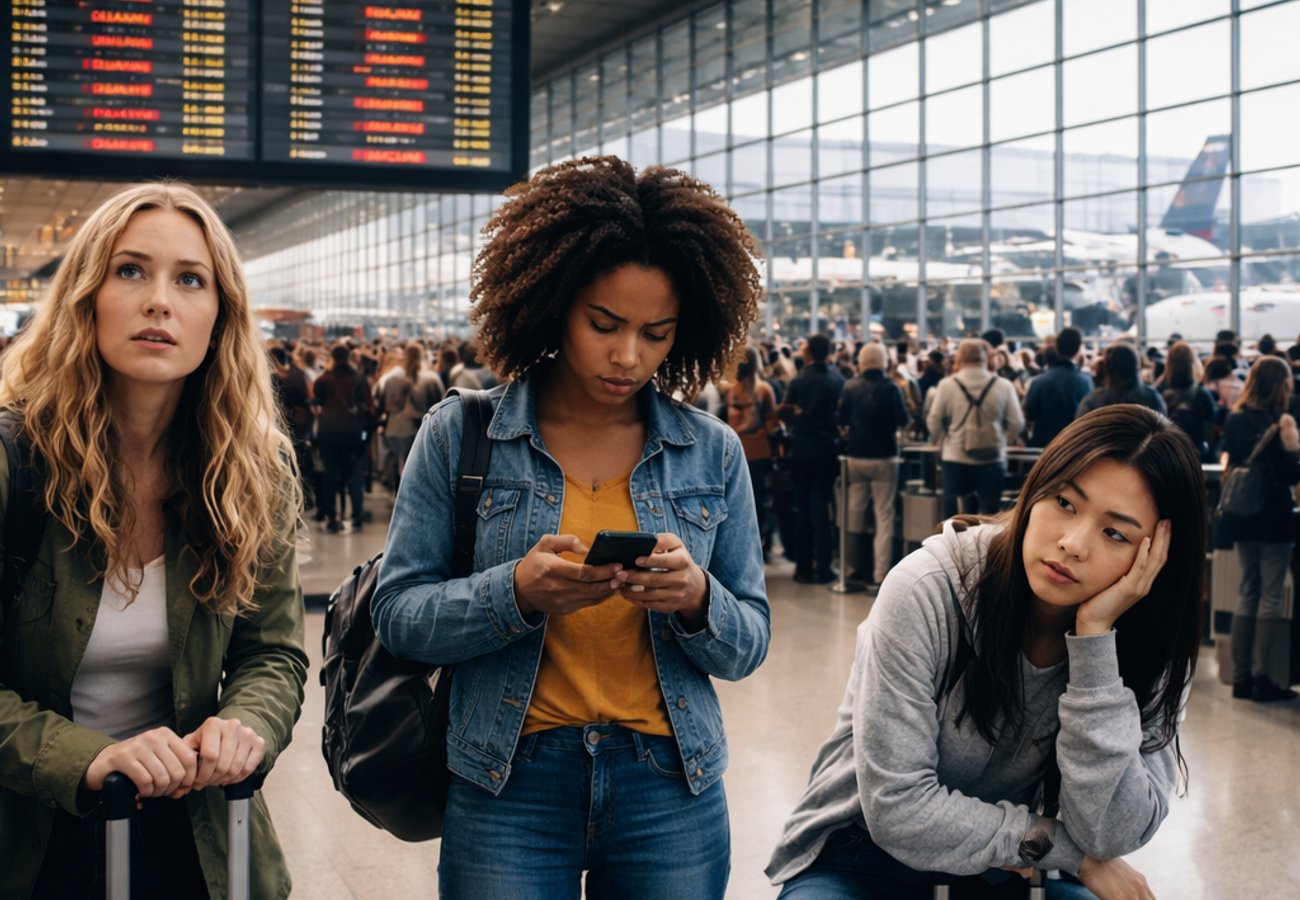
Image generated by AI
The Crisis Unfolds at Houston Bush International
Houston Bush Intercontinental Airport (IAH) is in chaos today. What started as routine morning operations has spiraled into one of the busiest travel disruption days of 2026, with 277 flights delayed and 3 flights canceled across eight major carriers. For the thousands of passengers caught in the crossfire, it's a day of uncertainty, missed connections, and frustrated phone calls to customer service departments already overwhelmed by inquiries.
United Airlines is bearing the heaviest burden, with 122 delayed flights representing 19% of its Houston operations. Its regional partner CommuteAir compounds the crisis with 49 additional delays (31% of its schedule). American Airlines reports 12 delays (22%), while Delta Air Lines shows 5 delays (9%). Beyond the major carriers, international operators including KLM, Air Canada, British Airways, Emirates, ITA Airways, JetBlue, WestJet, SkyWest, Envoy Air, and PSA Airlines are all reporting scattered delays between one and three flights each.
Reddit: "Just got notified my United flight from Houston is delayed 3 hours. Already on the plane. This is going to be a long day." — r/travel
Why Houston? The Operational Perfect Storm
The disruptions stem from a toxic combination of factors: operational congestion, high traffic volumes, gate and runway limitations, and coordination challenges spanning both domestic and international routes. Houston's position as a major U.S. hub means that delays cascade through the entire network like dominoes in slow motion.
Major domestic origin airports are driving inbound congestion. Austin-Bergstrom (AUS) reports 6 delays at 50% of flights, while Dallas-Fort Worth (DFW) shows 4 delays affecting 22% of operations. Chicago O'Hare (ORD) contributes 3 delays (15%), and Reagan National (DCA) reports 4 delays at 40% — a staggering figure that reveals how tightly coordinated these networks have become.
Regional airports are feeling the ripple effect too. San Francisco (SFO) reports 5 delays (50%), Baton Rouge (BTR) shows 4 delays (50%), and Charlotte-Douglas (CLT) logs 4 delays (44%) of its flights. Even smaller airports like Jackson-Medgar Wiley Evers (JAN) with 3 delays at 60% demonstrate that Houston's operational crisis is spreading across the continental network.
International Routes Taking the Hardest Hit
The international damage is even more severe, particularly for Caribbean and Latin American destinations.
European gateways are experiencing moderate disruption. Amsterdam Schiphol (AMS) reports 2 delays (66%), London Heathrow (LHR) shows 2 delays (50%), and Charles de Gaulle (CDG) — one of the world's busiest airports — reports 1 delay (100%). Frankfurt (FRA) and Rome Fiumicino (FCO) each report single-digit delays, but in international operations, even one delayed wide-body aircraft creates cascading problems.
The Caribbean is suffering disproportionately. Cancún (CUN) — one of North America's busiest leisure destinations — is reporting 5 delays at 62%, indicating that family vacations and beach getaways are being disrupted at scale. Cozumel (CZM) and Montego Bay (MBJ) each report 100% delay rates on their Houston-bound and Houston-departing flights. Belize City (BZE) shows 2 delays at 100%.
Central America and Mexico are similarly affected. Cancún (CUN) tops the region with 5 delays (62%), Guadalajara (GDL) reports 3 delays (60%), Guanajuato (BJX) shows 3 delays (75%), and Guatemala City (GUA) logs 2 delays (66%). Managua (MGA), San Salvador (SAL), and San Pedro Sula (SAP) are all experiencing meaningful disruptions.
Canadian operations are notably impacted on the international side. Montreal-Trudeau (YUL) has 1 cancellation (100%), while Toronto Pearson (YYZ) reports 1 delay (25%) — relatively modest numbers that still represent high-impact disruptions to Canada's two largest airports.
What Passengers Need to Know Right Now
If you're flying from, to, or through Houston Bush International today, action is required immediately.
Check real-time flight status through airline apps or the official IAH website — don't rely on outdated information from booking confirmation emails. Arrive at the airport 30 minutes earlier than normal to account for longer check-in and security processing times. Gate congestion means ground handling is slower, and security lines will be longer than typical.
Contact your airline proactively before your scheduled departure. Don't wait for a delay notification. Call the airline's customer service line or use their mobile app to explore rebooking options, standby flights, or alternate routing before you arrive at the airport. The first passengers to call have the most options; those who wait until they're at the gate will face far fewer alternatives.
Monitor your connecting flights with obsessive attention if you're traveling through Houston. If you're booked on United, American, or Delta — the three most severely impacted carriers — assume your first leg will be delayed and check connections accordingly. According to FlightAware, delays in hub operations typically cascade for 6-8 hours after initial disruptions.
Use airport resources aggressively. Customer service desks, airline information booths, and airport staff can provide updated gate assignments, real-time delay information, and access to services like meal vouchers or hotel accommodations if overnight delays are imminent.
The Domino Effect Nobody Wants to See
What makes today particularly dangerous is the network effect. A single delayed wide-body aircraft on a Houston-to-London flight doesn't just strand 350 passengers in Houston — it strands a crew in London who can't operate their next scheduled flight, delays that flight's passengers, and potentially disrupts operations for the next 24 hours across multiple continents.
United Airlines' 122 delays mean that 122 aircraft are in the wrong place at the wrong time. CommuteAir's 49 delays compound this because regional carriers operate on tissue-thin schedules with minimal buffer time between flights. A regional aircraft delayed by two hours doesn't just miss one subsequent flight — it typically misses two or three.
The 3 cancellations — while numerically small — represent complete evacuation of a flight's schedule. Those passengers must be rebooked on alternative flights, and those alternatives must accommodate not just the original passenger count but also the cascading effects of other delays.
Why This Matters for the Airline Industry
Days like June 6, 2026 at Houston Bush International expose the fragility of modern airline operations. Despite decades of optimization, a single day of congestion can paralyze hundreds of flights across eight different carriers and multiple continents. The industry operates on margins so thin that there's almost no buffer for operational disruption.
The fact that 277 delays occurred but only 3 flights were canceled actually demonstrates airline operational excellence — they kept the vast majority of flights moving despite severe constraints. However, it also reveals the human cost: thousands of passengers experiencing delays measured in hours, missed connections, and disrupted travel plans.
What Happens Next
Airport authorities and airlines are working to resolve the congestion through expedited gate turnarounds, prioritized taxiing, and adjusted ground handling procedures. However, the backlog won't clear until late evening at earliest. Passengers scheduled for evening departures should assume their flights will be delayed and plan accordingly.
The weather forecast for Houston shows clear conditions for the remainder of June 6, so additional weather delays are unlikely. The crisis is purely operational — a capacity and coordination problem, not a weather problem. This is actually somewhat positive news: once the backlog clears, operations should normalize relatively quickly.
Passengers with refundable tickets should seriously consider rebooking for June 7 if their travel is flexible. The cost of a hotel night and a new airline ticket is often less than the cost of missed meetings, ruined vacations, or the stress of 10+ hour travel delays.
Stay vigilant, check that flight status obsessively, and call your airline before you call the airport.
Related Travel Guides
- Christchurch Airport Summer 2026 Sets Record with 3.1M Passengers
- Breaking Airline News: Middle East Airports Forge Massive AI Security Grid to Aggressively Bypass Terrifying Travel Chaos
- Air Serbia Forges Historic Caucasus Link: New Belgrade to Baku Nonstop Flights Launched to Bypass European Travel Chaos and Hub Disruptions
Disclaimer
This article is for informational and educational purposes only. It does not constitute legal, financial, or professional advice. While we strive to provide accurate and up-to-date information, travel policies, regulations, and conditions change rapidly. Always verify information with official sources before making travel decisions. Nomad Lawyer makes no representations about the accuracy, reliability, completeness, or suitability of the information provided. Readers should consult qualified professionals for advice specific to their circumstances. The views expressed in this article are those of the author and do not necessarily reflect the views of Nomad Lawyer.
Raushan Kumar
Founder & Lead Developer
Full-stack developer with 11+ years of experience and a passionate traveller. Raushan built Nomad Lawyer from the ground up with a vision to create the best travel and law experience on the web.
Learn more about our team →