
Zannier Bãi San Hô Expands Marine Coral Restoration Mission Along Vietnam’s Central Coast
Zannier Bãi San Hô in Vietnam has expanded its marine partnership with SASA, restoring 200 sq m of coral reef and removing 180 kg of ghost nets.

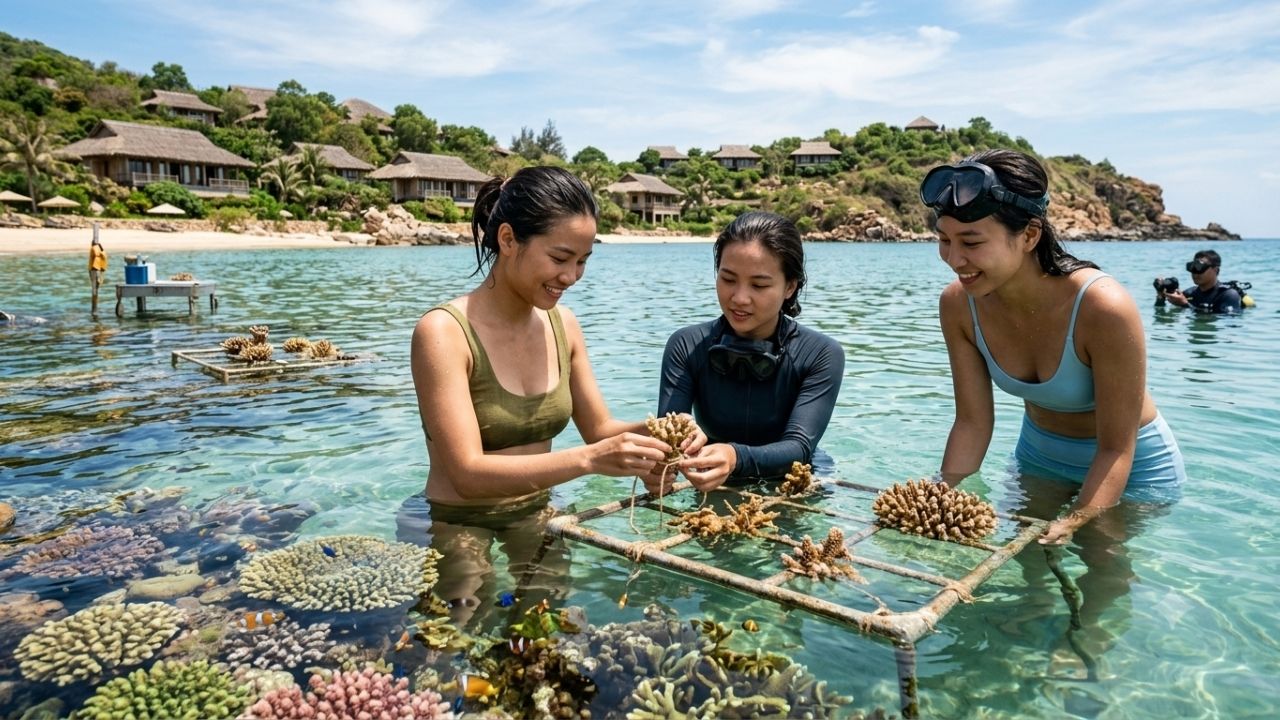
Image generated by AI
Luxury eco-resort Zannier Bãi San Hô has expanded its coral reef conservation mission along Vietnam’s central coast in partnership with marine biologists.
[PHÚ YÊN, Vietnam] — Conservation and hospitality disclosures confirm that luxury resort Zannier Bãi San Hô has extended its marine restoration partnership with SASA Marine Animals Rescue Center. Operating along Vietnam’s central coast since September 2024, the collaboration has completed marine cleanup and coral planting missions. During a June 2026 expedition, marine divers cleared 180 kilograms of ghost nets and marine debris, removed coral predators, and planted 200 square meters of rescued coral fragments.
June 2026 Marine Expedition: Debris Clearance and Predator Control
During the June 2026 conservation mission, marine rescue divers performed targeted ecosystem management across the resort’s offshore reef:
- Debris Removal: Cleared 180 kilograms of abandoned ghost nets and plastic pollution, alongside 250 kilograms of submerged wood debris.
- Invasive Predator Removal: Removed 11 Crown-of-Thorns Starfish (Acanthaster planci) and approximately 1,000 coral-eating Drupella snails to protect vulnerable hard coral colonies.
- Mooring Safeguards: Deployed protective mooring buoys to prevent anchor damage from passing fishing vessels and dive boats.
June 2026 SASA Expedition Metrics:
├── Debris Cleared: 180 kg ghost nets & plastic waste | 250 kg sunken wood
├── Predator Control: 11 Crown-of-Thorns Starfish & ~1,000 Drupella snails removed
├── Coral Planted: 200 square meters of rescued hard coral fragments
└── Infrastructure: 100 sq meter coral garden established with 5 structural zones
| Restoration & Ecological Category | Survey / Mission Parameter | Conservation Outcome |
|---|---|---|
| Resort Name | Zannier Bãi San Hô | Central coast luxury eco-resort |
| Marine Conservation Partner | SASA Marine Animals Rescue Center | Specialized marine animal & reef rescue |
| Initial Partnership Date | September 2024 | Program launch & baseline reef mapping |
| Green Globe Certification | Held since February 2023 | Verified sustainable hotel operations |
| Latest Mission Date | June 2026 | Debris removal & coral fragment planting |
| Total Reef Area Surveyed | 26,000 Square Meters | Baseline survey footprint |
| Baseline Coral Cover | 60% Total Coverage | 99% soft coral vs 1% hard reef-building coral |
| Species Diversity Count | 40+ hard coral & 20+ soft coral species | Recorded species baseline |
| Rescued Coral Area | 200 Square Meters Planted | Acropora, Pocillopora, Turbinaria, Montipora |
Micro-Fragmentation Coral Nursery: 100-Square-Meter Garden
Restoration efforts focus on building hard coral resilience using micro-fragmentation and macro-fragmentation propagation techniques.
Divers planted 200 square meters of rescued hard coral fragments, targeting fast-growing and resilient species including Acropora, Pocillopora, Turbinaria, and Montipora.
To support long-term growth, the team established a 100-square-meter coral nursery garden divided into five structural zones designed to accelerate fragment attachment and fish habitat formation.
Coral Nursery & Propagation Blueprint:
├── Micro-Fragmentation Method: Micro & macro-fragmentation of resilient hard corals
├── Primary Species Planted: Acropora, Pocillopora, Turbinaria & Montipora
├── Nursery Structure: 100 sq meter coral garden organized into 5 structural zones
└── Anchor Protection: Mooring buoys deployed to eliminate boat anchor impact
Baseline Ecological Data: 26,000-Square-Meter Reef Assessment
Initial environmental surveys conducted in September 2024 established a clear scientific baseline across 26,000 square meters of coastal reef:
- Initial Coverage: Coral covered 60% of the surveyed seabed.
- Species Imbalance: Soft coral accounted for 99% of total coral cover, while essential reef-building hard coral represented only 1%.
- Species Richness: Scientists identified more than 40 species of reef-building hard corals and 20 species of soft corals, highlighting high potential for ecological recovery.
September 2024 Baseline Reef Findings:
├── Total Survey Area: 26,000 square meters of coastal reef bed
├── Overall Coral Cover: 60% coverage across surveyed seabed
├── Composition Breakdown: 99% soft coral species vs 1% hard reef-building coral
└── Biological Diversity: 40+ hard coral species & 20+ soft coral species recorded
Travel Trade Alignment: Green Globe Certification and Eco-Tourism
Zannier Bãi San Hô has held Green Globe certification since February 2023, reflecting sustainable energy, water, and waste management practices.
Integrating active reef restoration into hotel operations provides travel agents and eco-conscious guests with verified environmental credentials.
Resort management plans to introduce guest-inclusive marine monitoring tours and local community education programs to expand marine stewardship across Vietnam’s central coast.
Sustainability Certification & Future Roadmap:
├── Eco Certification: Green Globe Certified since February 2023
├── Guest Programs: Guided marine monitoring & coral propagation workshops
└── Community Outreach: Coastal education initiatives for local fishing communities
Frequently Asked Questions (FAQ)
Q1: How much coral was planted during the June 2026 mission at Zannier Bãi San Hô?
A: Marine divers planted 200 square meters of rescued hard coral fragments and established a 100-square-meter coral garden.
Q2: What baseline reef conditions were recorded in September 2024?
A: The baseline survey of 26,000 square meters showed 60% coral cover, composed of 99% soft coral and 1% reef-building hard coral.
Q3: Which eco-certification does Zannier Bãi San Hô hold?
A: Zannier Bãi San Hô has held Green Globe certification since February 2023.
Why This Matters for Eco-Tourists, Marine Biologists, and Resort Operators
Analyzing Zannier Bãi San Hô's coral restoration mission highlights key sustainable travel trends:
- For Eco-Conscious Travelers: Verifiable marine restoration programs ensure travel spending directly supports coastal biodiversity.
- For Marine Biologists: Micro-fragmentation of hard corals on a 99% soft-coral reef provides a practical model for accelerating hard coral recovery.
- For Sustainable Resort Operators: Combining Green Globe certification with hands-on marine conservation sets a benchmark for eco-luxury hospitality.
Related Travel Guides
Disclaimer
This article is for informational and educational purposes only. It does not constitute legal, financial, or professional advice. While we strive to provide accurate and up-to-date information, travel policies, regulations, and conditions change rapidly. Always verify information with official sources before making travel decisions. Nomad Lawyer makes no representations about the accuracy, reliability, completeness, or suitability of the information provided. Readers should consult qualified professionals for advice specific to their circumstances. The views expressed in this article are those of the author and do not necessarily reflect the views of Nomad Lawyer.
Raushan Kumar
Founder & Lead Developer
Full-stack developer with 11+ years of experience and a passionate traveller. Raushan built Nomad Lawyer from the ground up with a vision to create the best travel and law experience on the web.
Learn more about our team →