
US Air Force's $30 Million Autonomous Wingman Drone Signals Major Shift in Military Aviation Strategy
Breaking airline news and aviation industry updates for 2026.

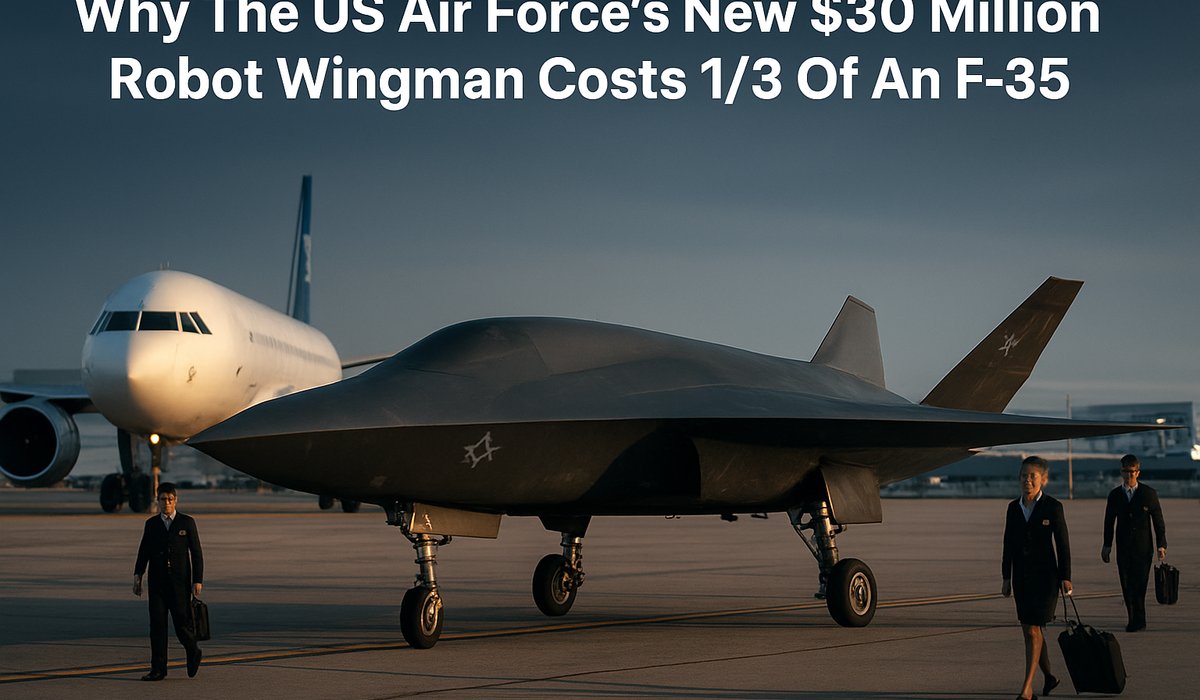
Image generated by AI
US Air Force's $30 Million Autonomous Wingman Drone Signals Major Shift in Military Aviation Strategy
Pentagon embraces unmanned swarms to reduce costs and modernize fighter squadrons
Revolutionary Approach to Air Superiority
The United States Air Force is fundamentally reshaping its combat aviation strategy, moving away from traditional manned-aircraft-heavy fleets toward an integrated ecosystem of crewed stealth fighters paired with autonomous drone wingmen. The latest technological breakthrough—a new robotic companion aircraft priced at approximately $30 million—represents just one-third the acquisition cost of a single F-35 fighter jet, signaling a dramatic pivot in how the military will achieve air dominance in future conflicts.
This strategic recalibration reflects broader shifts within global defense procurement, where advanced technology no longer demands premium pricing proportional to capability. The autonomous wingman concept allows the Air Force to multiply its operational capacity without proportionally escalating defense budgets.
The Economics of Unmanned Combat Systems
The cost differential is striking: while a fifth-generation F-35 fighter jet costs approximately $90 million per unit, the new robotic wingman platform delivers significant combat multipliers at just one-third that price. This economic advantage enables the Pentagon to field substantially larger combat formations without exponentially increasing acquisition spending—a critical consideration as defense budgets face mounting political scrutiny worldwide.
Defense analysts suggest this pricing structure reflects the drone's specialized design. Unlike full-fledged fighters, autonomous wingmen prioritize supporting functions: enhanced surveillance, electronic warfare, precision strike support, and defensive countermeasures. They operate under advanced artificial intelligence protocols alongside piloted command aircraft, creating a networked combat system greater than any individual component.
System-of-Systems Combat Architecture
Rather than investing exclusively in expensive crewed aircraft, the USAF envisions a layered force structure where manned stealth fighters and bombers serve as command hubs within larger tactical networks. Unmanned swarms—potentially dozens of autonomous units coordinated through a single aircraft—would handle reconnaissance, target acquisition, and sustained engagement operations.
This "system of systems" approach mirrors evolving defense strategies employed by advanced militaries globally. By distributing combat functions across multiple platforms, the Air Force reduces vulnerability to single-point failures while maximizing operational flexibility. A damaged manned aircraft can direct drone operations; autonomous units can operate independently when communications are degraded.
Implications for Military Aviation and Beyond
The strategy carries significant implications for aircraft manufacturing, pilot training, and force readiness doctrine. Traditional defense contractors face pressure to develop competitive unmanned platforms, while emerging aerospace firms specializing in autonomous systems gain strategic importance.
Military observers note this transition parallels civilian aviation industry trends, where automation increasingly augments human operators. The convergence of military and commercial aerospace technology suggests broader implications for the future of flight itself.
FAQ: Military Aviation, Autonomous Warfare, and Pentagon Strategy
1. How much does the US Air Force's new autonomous wingman drone cost compared to an F-35 fighter jet? The new robotic wingman costs approximately $30 million—roughly one-third the acquisition cost of an F-35 fighter, which exceeds $90 million per unit.
2. What is the "system of systems" strategy the Air Force is adopting? This approach integrates crewed stealth fighters and bombers as command platforms supported by swarms of autonomous drones, enabling distributed combat operations and enhanced tactical flexibility.
3. Why is the US military shifting toward unmanned drone wingman aircraft? The shift addresses cost constraints, increases force multiplier capabilities, reduces pilot risk, and enables larger tactical formations without proportionally escalating defense budgets.
4. How do autonomous wingman drones operate alongside piloted fighters? Robotic wingmen use advanced artificial intelligence to coordinate with manned command aircraft, performing reconnaissance, electronic warfare, target support, and strike operations while maintaining network connectivity.
5. What does this mean for the future of military aviation procurement? Defense contractors must develop competitive unmanned platforms, while traditional aircraft manufacturers face pressure to justify expensive crewed systems through enhanced capabilities and specialized roles.
Related Travel Guides
External Resources
Disclaimer
This article is for informational and educational purposes only. It does not constitute legal, financial, or professional advice. While we strive to provide accurate and up-to-date information, travel policies, regulations, and conditions change rapidly. Always verify information with official sources before making travel decisions. Nomad Lawyer makes no representations about the accuracy, reliability, completeness, or suitability of the information provided. Readers should consult qualified professionals for advice specific to their circumstances. The views expressed in this article are those of the author and do not necessarily reflect the views of Nomad Lawyer.
Preeti Gunjan
Contributor & Community Manager
A passionate traveller and community builder. Preeti helps grow the Nomad Lawyer community, fostering engagement and bringing the reader experience to life.
Learn more about our team →