
Airbus A350's Competitive Edge: Why Its Uncommonly Low Landing Speed Reshapes Modern Aviation Economics
Breaking airline news and aviation industry updates for 2026.

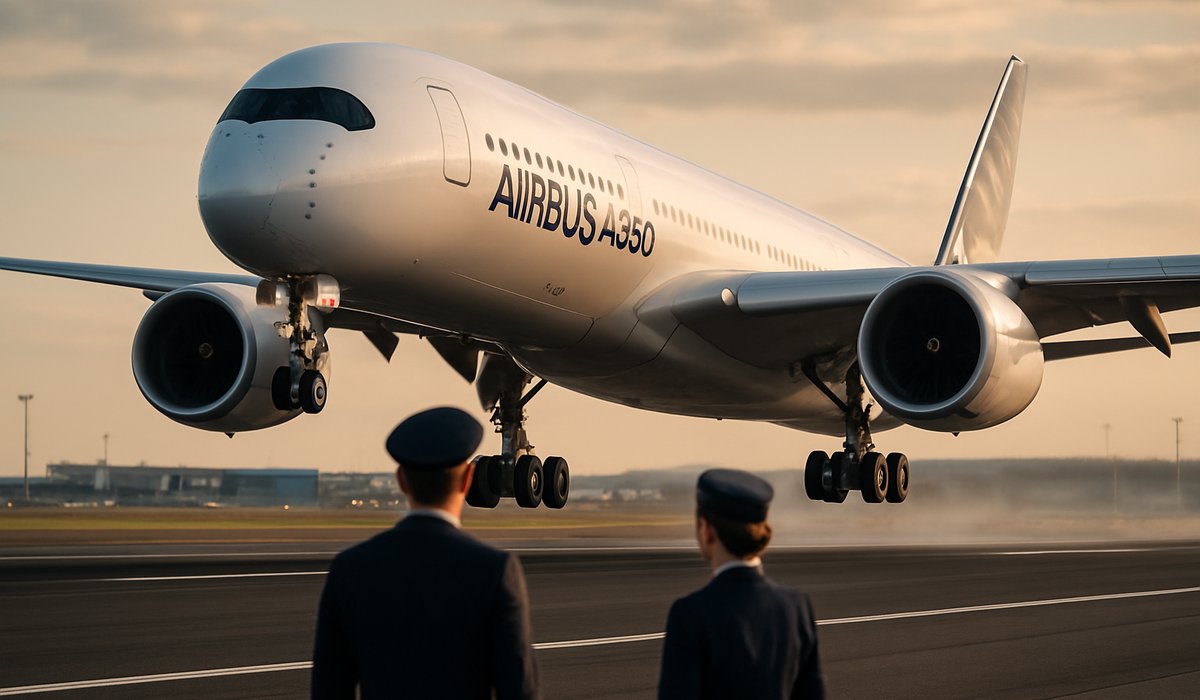
Image generated by AI
Airbus A350's Competitive Edge: Why Its Uncommonly Low Landing Speed Reshapes Modern Aviation Economics
The widebody jet's distinctive approach capabilities are transforming operational flexibility and profitability across global carriers
Engineering Innovation Driving Operational Advantage
The Airbus A350 has emerged as a game-changer in modern commercial aviation, distinguished by a remarkable ability to approach and touch down at significantly lower speeds than competing aircraft. This technical capability, celebrated by operators including Cathay Pacific and pilot communities worldwide, represents a fundamental shift in how airlines can optimize their fleet economics and network strategies.
The aircraft's unusually slow landing velocity—combined with a comparatively short ground roll distance—translates into tangible operational benefits that are reshaping how carriers approach route planning, airport selection, and cargo capacity deployment.
Operational and Commercial Implications
For airlines navigating an increasingly competitive landscape shaped by volatile jet fuel prices and evolving travel demand patterns, the A350's performance characteristics offer substantial advantages. The ability to decelerate smoothly while maintaining control opens access to regional airports with shorter runways that would typically accommodate only narrowbody aircraft. This expanded runway flexibility enables carriers to serve secondary markets and reduce dependency on congested major hubs.
Equally significant is the payload-range optimization this capability enables. Lower landing speeds allow operators to load additional cargo weight or carry maximum passenger configurations on routes previously constrained by runway length limitations. For international carriers competing on long-haul routes where fuel surcharges and baggage fees have become standard revenue drivers, this operational flexibility directly improves unit economics.
Safety and Pilot Performance Benefits
Beyond commercial considerations, aviation safety specialists note that the A350's approach characteristics reduce landing-phase stress on airframes and engines. Pilots, according to Cathay Pacific's operational assessments, report enhanced control authority during final descent phases, particularly in challenging weather conditions or at congested airports where approach stability is critical.
The reduced ground roll distance also decreases brake wear and associated maintenance costs—an often-overlooked factor in total cost of operations that compounds across thousands of flight cycles annually.
Competitive Positioning in Fleet Planning
As airlines worldwide reassess fleet compositions following pandemic-driven disruptions and shifting demand patterns, the A350's distinctive landing performance has become a decisive factor in procurement decisions. The aircraft's ability to access secondary tier airports while maintaining cargo-carrying capacity addresses a fundamental industry challenge: how to expand network reach while maximizing revenue per flight hour in an era of elevated operational costs.
For Airbus, this technical differentiation against Boeing's competing widebody offerings underscores how engineering choices can drive commercial success beyond raw passenger capacity metrics.
FAQ: Airbus A350 Landing Speed and Aviation Operations
Why does the Airbus A350 land slower than other widebody aircraft? The A350's aerodynamic design, advanced wing geometry, and sophisticated flight control systems enable it to generate lift efficiently at lower speeds, reducing approach velocities compared to aircraft like the Boeing 777 or 787.
How does slow landing speed benefit airline operations? Lower landing speeds allow operations at airports with shorter runways, increase allowable cargo loads on weight-restricted routes, and reduce wear on landing gear and brakes, lowering maintenance costs.
What airports benefit most from the A350's runway flexibility? Secondary and regional airports with runways between 8,000-10,000 feet see the greatest operational benefit, enabling direct long-haul service that would previously require narrowbody aircraft or hub connections.
Does the A350's landing performance affect passenger safety? Yes—slower approach speeds reduce landing-phase structural stress, improve pilot control authority, and decrease accident risk during difficult weather conditions or challenging approach scenarios.
How does this compare to Boeing's widebody landing capabilities? The A350's landing speed advantage positions it competitively against Boeing's 777 and 787 models, making it increasingly attractive to carriers prioritizing operational flexibility and secondary market access.
Related Travel Guides
- Aviation Expansion: Fly Jinnah Launches Karachi-Riyadh Route
- Breaking Airline News: FlyArystan Forges Massive Kazakhstan-China Network Expansion to Aggressively Bypass Terrifying Travel Chaos
- Preventing Travel Chaos: How Cathay Pacific is Slashing Fuel Surcharges to Combat Massive Flight Cancellations Across the Asia-Pacific
Disclaimer
This article is for informational and educational purposes only. It does not constitute legal, financial, or professional advice. While we strive to provide accurate and up-to-date information, travel policies, regulations, and conditions change rapidly. Always verify information with official sources before making travel decisions. Nomad Lawyer makes no representations about the accuracy, reliability, completeness, or suitability of the information provided. Readers should consult qualified professionals for advice specific to their circumstances. The views expressed in this article are those of the author and do not necessarily reflect the views of Nomad Lawyer.
Kunal K Choudhary
Co-Founder & Contributor
A passionate traveller and tech enthusiast. Kunal contributes to the vision and growth of Nomad Lawyer, bringing fresh perspectives and driving the community forward.
Learn more about our team →