
Boeing's Alleged Next-Generation Fighter Jet Spotted Near Area 51: Design Marks Dramatic Departure From F-22 Legacy
Breaking airline news and aviation industry updates for 2026.

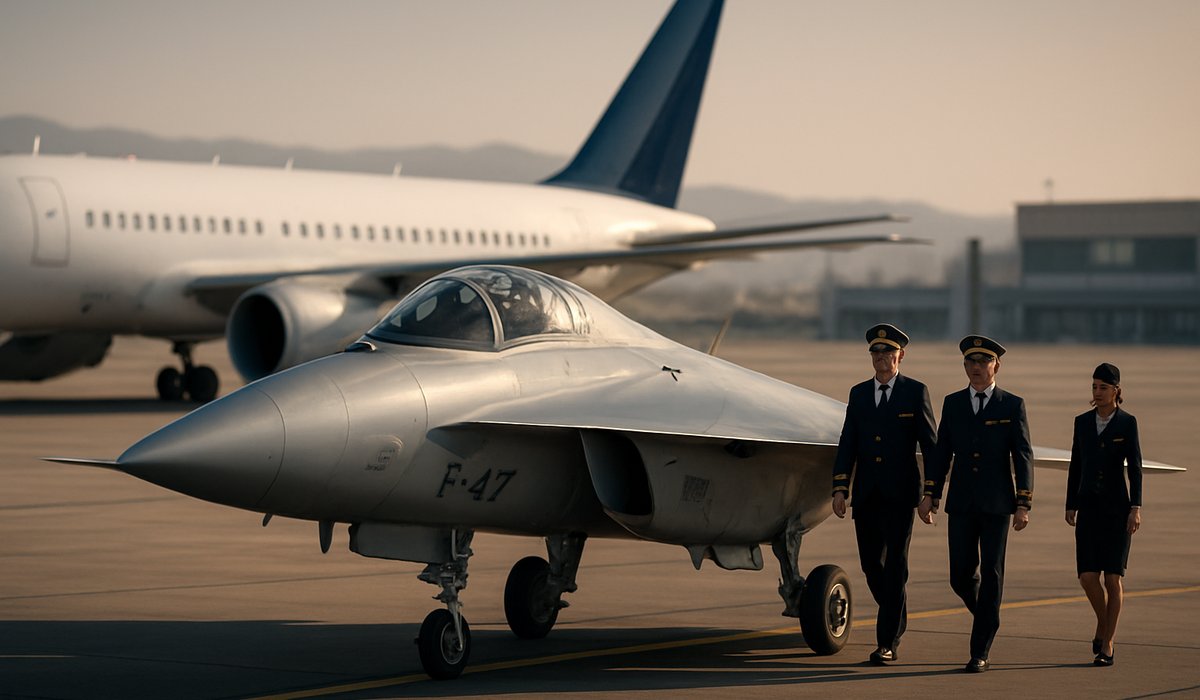
Image generated by AI
Boeing's Alleged Next-Generation Fighter Jet Spotted Near Area 51: Design Marks Dramatic Departure From F-22 Legacy
Unconfirmed imagery suggests radical redesign featuring canard configuration for sixth-generation air superiority platform
Advanced Stealth Fighter Emerges in Secretive Testing Program
What may be the first photographic evidence of Boeing's next-generation combat aircraft has surfaced online, captured via thermal imaging near Groom Lake, the classified U.S. Air Force testing facility in Nevada commonly known as Area 51. The unverified silhouette appears consistent with prior concept designs for the Boeing F-47, signaling a significant technological leap in America's pursuit of sixth-generation fighter dominance amid intensifying international military competition.
The thermal imagery reveals a dramatically reimagined airframe that departs fundamentally from the proven F-22 Raptor architecture that has dominated U.S. air superiority for over two decades. Most notably, the detected platform incorporates a canard configuration—small forewing surfaces positioned ahead of the main wings—a design feature notably absent from its predecessor.
Design Philosophy Signals New Strategic Direction
The structural modifications evident in the imagery underscore Boeing's commitment to addressing evolving threats in modern aerial combat. The canard design enhances maneuverability and control authority, potentially enabling superior dogfighting capabilities compared to conventional delta-wing configurations. This architectural shift reflects lessons learned from operational theaters and advanced computational aerodynamics developed over the past decade.
The silhouette's proportions align closely with previously circulated artist renderings and industry analyses of what sixth-generation fighters might resemble. These conceptual designs have emphasized reduced radar cross-section, hypersonic-capable engines, and advanced sensor integration—technological benchmarks shaping contemporary fighter development across allied nations.
Global Competition Accelerates Advanced Fighter Development
The apparent emergence of this platform underscores the intensifying technological race among global superpowers to achieve decisive air superiority. Russia and China have simultaneously accelerated their own sixth-generation fighter programs, creating unprecedented pressure on U.S. defense contractors to field revolutionary capabilities within compressed timelines.
Boeing and competing defense firms operate under strict compartmentalization protocols, making official confirmation of any sighting highly unlikely. The Air Force has historically maintained absolute operational security surrounding classified aircraft programs, particularly those tested at Groom Lake's restricted airspace.
The detection of thermal imagery near the Nevada testing range—despite advanced security measures—highlights both the growing sophistication of reconnaissance capabilities and the inevitable challenges in maintaining secrecy around large-scale aviation programs in the digital age.
FAQ
What is the Boeing F-47 fighter jet? The F-47 is an alleged next-generation combat aircraft under development by Boeing as part of the U.S. military's sixth-generation fighter initiative, designed to succeed the F-22 Raptor.
What are canards on a fighter jet? Canards are small winglets positioned forward of the main wings that enhance aircraft maneuverability, control response, and overall aerodynamic efficiency in advanced fighter designs.
Why would the U.S. military develop a sixth-generation fighter? Sixth-generation platforms address emerging threats from advanced adversary air defenses, hypersonic weapons systems, and the need for sustained air dominance through 2050 and beyond.
How do thermal imaging discoveries affect classified aerospace programs? Such detections demonstrate vulnerabilities in operational security and underscore the challenges defense contractors face maintaining secrecy in reconnaissance-saturated environments.
Which other nations are developing sixth-generation fighters? Russia and China have announced their own advanced fighter programs, intensifying global competition for next-generation air superiority capabilities.
Related Travel Guides
External Resources
Disclaimer
This article is for informational and educational purposes only. It does not constitute legal, financial, or professional advice. While we strive to provide accurate and up-to-date information, travel policies, regulations, and conditions change rapidly. Always verify information with official sources before making travel decisions. Nomad Lawyer makes no representations about the accuracy, reliability, completeness, or suitability of the information provided. Readers should consult qualified professionals for advice specific to their circumstances. The views expressed in this article are those of the author and do not necessarily reflect the views of Nomad Lawyer.
Raushan Kumar
Founder & Lead Developer
Full-stack developer with 11+ years of experience and a passionate traveller. Raushan built Nomad Lawyer from the ground up with a vision to create the best travel and law experience on the web.
Learn more about our team →