
Boeing 777X Emerges as Game-Changer in Ultra-Long-Haul Aviation, Challenging Airbus A380's Dominance
Breaking airline news and aviation industry updates for 2026.

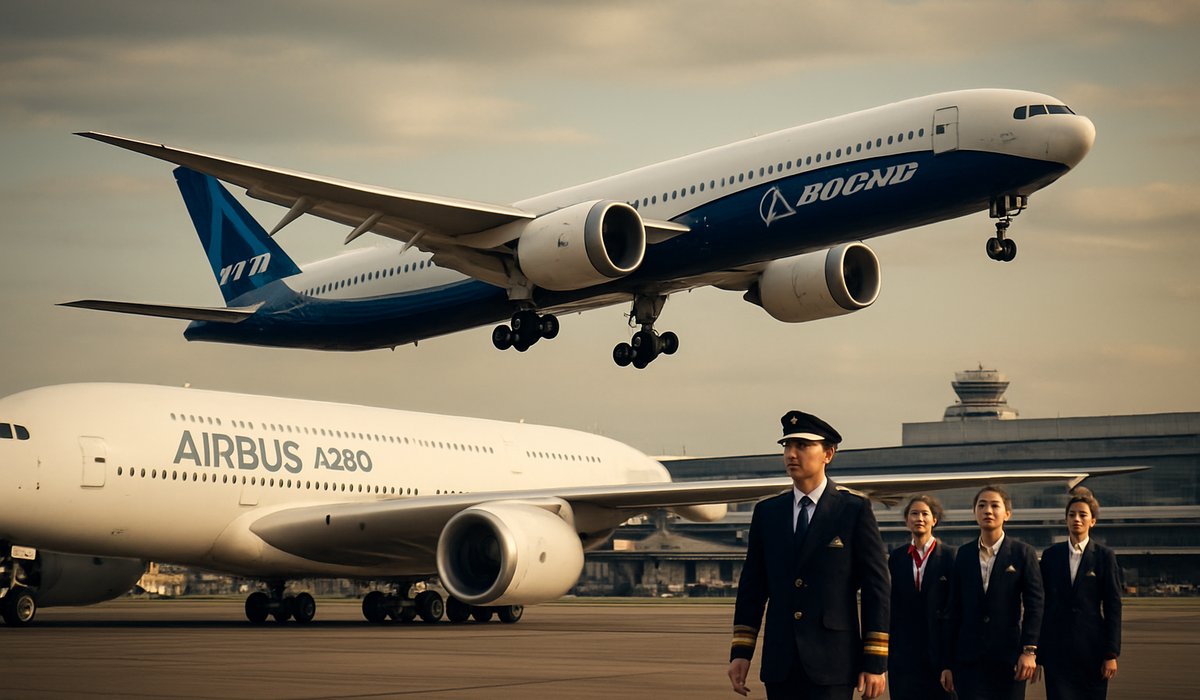
Image generated by AI
Boeing 777X Emerges as Game-Changer in Ultra-Long-Haul Aviation, Challenging Airbus A380's Dominance
Next-generation twin-engine aircraft promises lower operating costs and efficiency gains as airlines reassess fleet strategies
The Future of Long-Haul Flight Takes Shape
The commercial aviation industry faces a pivotal choice as carriers worldwide evaluate competing visions for tomorrow's intercontinental routes. On one side stands the Airbus A380, the double-deck superjumbo that has defined ultra-long-haul capacity since 2007. On the other emerges Boeing's 777X, a technologically advanced twin-engine aircraft designed to challenge the established paradigm—forcing major carriers like Emirates to fundamentally reconsider their fleet investments.
This competitive tension reflects a broader shift in aviation economics, where fuel efficiency and operational simplicity increasingly trump raw passenger capacity in determining profitability on extended routes.
Capacity Versus Efficiency: Competing Philosophies
The specifications reveal starkly different engineering philosophies. The Airbus A380 accommodates over 500 passengers in a standard three-class configuration, leveraging its iconic four-engine design to move maximum volume across oceanic distances. Conversely, Boeing's 777-9 variant targets approximately 426 seats while fundamentally restructuring the economics of long-range operations.
The 777X achieves this competitive positioning through revolutionary technologies, particularly its General Electric GE9X turbofans—currently the world's most powerful commercial engines—paired with an advanced composite wing structure that dramatically reduces structural weight. These innovations translate directly into measurable fuel consumption advantages that reshape airline profitability calculations.
Operational Complexity and Cost Implications
Industry analysis consistently highlights a critical distinction: the 777X delivers near-A380 capacity while circumventing the operational complexity inherent to four-engine aircraft. This matters significantly for airline economics, as twin-engine operations require fewer spare parts, streamlined maintenance protocols, and reduced crew training complexity.
For carriers navigating volatile jet fuel markets and post-pandemic capacity challenges, the 777X's superior fuel efficiency represents genuine strategic value. Airlines operating ultra-long-haul routes—particularly those connecting Asian, Middle Eastern, and European hubs—can optimize load factors across multiple daily services using 777X aircraft rather than depending on periodic A380 deployments.
Industry Implications and Market Dynamics
The emergence of this choice reflects broader aviation industry trends. High fuel prices, environmental regulations, and climate-conscious consumer demand increasingly reward efficiency over capacity. Additionally, the limited secondary market for A380s has created buyer's remorse among some operators, strengthening the business case for newer, more flexible platforms.
Emirates, historically a stalwart A380 operator with over 100 aircraft on order or in service, now confronts genuine trade-offs between legacy investments and next-generation efficiency. Similar calculations confront Singapore Airlines, Lufthansa, and other premium carriers.
The 777X represents not merely an incremental improvement but a fundamental reimagining of long-haul aircraft design—one that prioritizes operational flexibility and financial sustainability over absolute capacity metrics.
Frequently Asked Questions
What are the main fuel efficiency advantages of the Boeing 777X over the Airbus A380? The 777X utilizes advanced GE9X engines and composite wing technology that reduce fuel consumption per seat-mile compared to the A380's four conventional turbofans, directly improving airline operating margins on fuel-intensive ultra-long-haul routes.
How many passengers can each aircraft carry on long-haul routes? The Airbus A380 accommodates 500+ passengers in three-class layouts, while the Boeing 777-9 seats approximately 426 passengers—a meaningful capacity difference offset by superior fuel economics.
Why are airlines reconsidering A380 purchases in favor of the 777X? Airlines increasingly value operational simplicity, lower maintenance costs, and fuel efficiency over maximum capacity. Twin-engine aircraft like the 777X offer greater scheduling flexibility and profitability per flight.
Which airlines are prioritizing Boeing 777X orders for long-haul routes? Major carriers including Emirates, Singapore Airlines, and Lufthansa have placed substantial 777X orders as they modernize fleets and optimize efficiency across extended routes.
Does the 777X eliminate the need for large-capacity aircraft on high-demand routes? Not entirely. However, the 777X's combination of substantial capacity and superior efficiency allows airlines to deploy more frequent services rather than relying on periodic superjumbo operations, improving network profitability.
Related Travel Guides
Flight Delay Compensation Guide 2026
Understanding Airline Route Changes
Airport Security Process Updated (2026)
External Resources
Disclaimer
This article is for informational and educational purposes only. It does not constitute legal, financial, or professional advice. While we strive to provide accurate and up-to-date information, travel policies, regulations, and conditions change rapidly. Always verify information with official sources before making travel decisions. Nomad Lawyer makes no representations about the accuracy, reliability, completeness, or suitability of the information provided. Readers should consult qualified professionals for advice specific to their circumstances. The views expressed in this article are those of the author and do not necessarily reflect the views of Nomad Lawyer.
Raushan Kumar
Founder & Lead Developer
Full-stack developer with 11+ years of experience and a passionate traveller. Raushan built Nomad Lawyer from the ground up with a vision to create the best travel and law experience on the web.
Learn more about our team →