
Aviation Updates: Vietnam Airlines A350 Diverted for Urgent Venezuela Earthquake Relief Amid South American Travel Chaos
As devastating earthquakes trigger massive travel chaos across South America, Vietnam Airlines deploys Flight VN66, rushing 124 rescue personnel and 25 tonnes of supplies to Caracas.

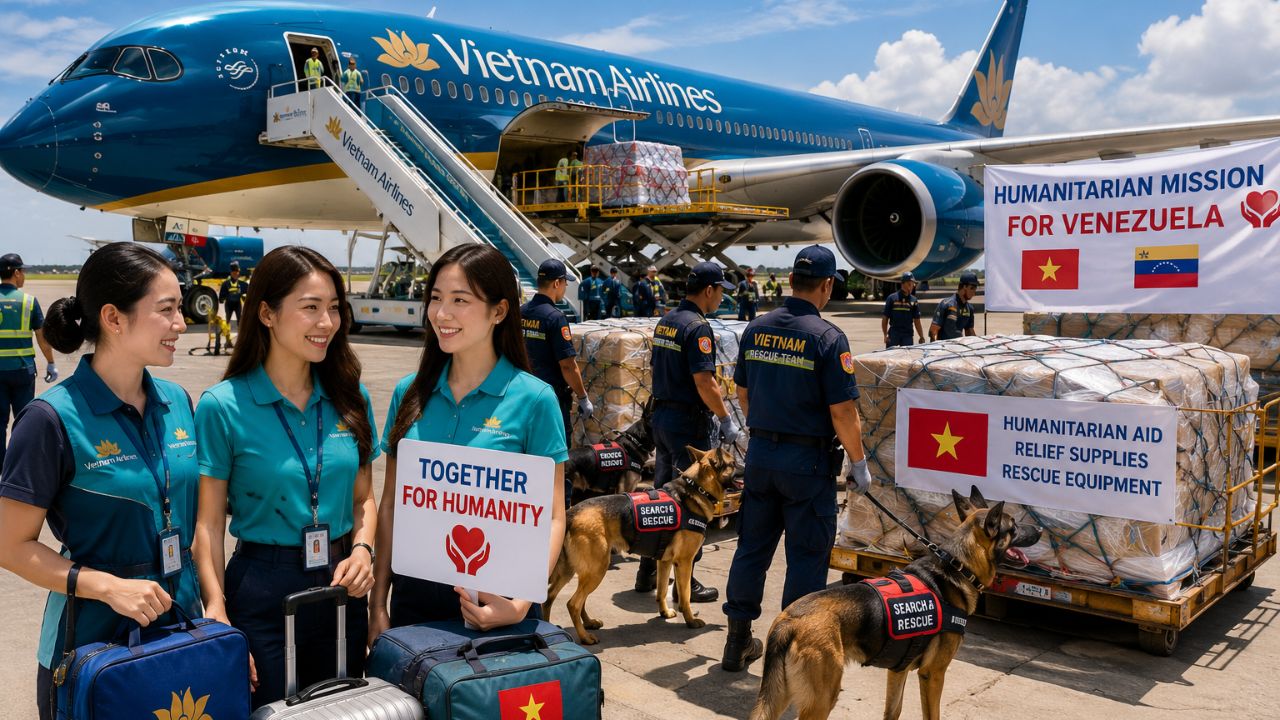
Image generated by AI
Aviation Updates: Vietnam Airlines A350 Diverted for Urgent Venezuela Earthquake Relief Amid South American Travel Chaos
As catastrophic tectonic events paralyze South American infrastructure and trigger massive regional travel chaos, Vietnam Airlines has executed an unprecedented emergency deployment, launching an ultra-long-haul humanitarian mission directly into the disaster zone.
Image generated by AI
As high-impact airline news platforms and critical aviation updates continuously document the severe structural collapse across South America, Vietnam Airlines has forcefully transitioned from commercial operations into absolute disaster response. Operating under emergency diplomatic clearance, the national carrier has launched a dedicated humanitarian flight to Venezuela, aggressively mobilizing massive resources to support communities devastated by the recent earthquakes. This incredibly complex, ultra-long-haul mission perfectly underscores the absolute strategic necessity of heavy-lift aviation during global crises. While natural disasters instantly trigger severe airport disruptions and paralyzing flight cancellations across affected regions, international airlines are actively stepping into the void, utilizing their massive logistical architecture to deliver survival. Departing Hanoi in the early hours of June 29, this incredibly rapid deployment forces the airline to dynamically reroute commercial assets, potentially causing localized travel chaos on standard passenger networks, yet proving that commercial widebodies are the ultimate lifeline when global emergencies strike.
Expanded Overview: The Strategic Asset Deployment
When analyzing the massive macroeconomic and humanitarian forces dictating modern aviation, the ability to launch an ultra-long-haul rescue mission on virtually zero notice represents absolute operational supremacy.
Unlike heavily scheduled, highly predictable commercial passenger operations, emergency humanitarian flights require brutal, hyper-accelerated logistical planning. Vietnam Airlines had to instantly secure expedited regulatory approvals, complex diplomatic flight clearances, international airspace permissions, and emergency airport slot management across multiple continents. By completely mobilizing its highly advanced Airbus A350 fleet, the carrier successfully compressed weeks of standard operational planning into mere hours. This specific deployment explicitly showcases how government-led humanitarian initiatives are entirely dependent on the physical infrastructure and sheer heavy-lift capability of their national commercial carriers.
Section-Wise Breakdown: The Ultra-Long-Haul Intercontinental Route
The absolute core of this massive intervention is the complex routing required to transport heavy relief payloads from Southeast Asia to the South American continent.
Operating under the specific identifier Flight VN66, the incredibly massive operation commenced on June 29. The specially configured Airbus A350 departed heavily laden from Noi Bai International Airport in Hanoi at exactly 12:45 a.m. local time. Given the extreme geographic distance and the massive payload onboard, the aircraft required a mandatory technical stop at Paris Charles de Gaulle Airport in France. After flawlessly executing rapid refueling and critical operational procedures in Paris, the widebody immediately continued its transatlantic crossing. The aircraft was officially scheduled to arrive at Simon Bolivar International Airport in Caracas at exactly 12:10 p.m. local time on the very same day, minimizing transit time during the critical 72-hour survival window.
Section-Wise Breakdown: The Specialized Payload Matrix
Aviation engineers and cargo specialists highlight that reconfiguring a commercial passenger jet for a heavy-lift rescue operation requires extreme precision.
The Vietnam Airlines Airbus A350 is actively transporting a massive contingent of 124 highly trained emergency personnel directly representing Vietnam’s Ministry of National Defence and Ministry of Public Security. Operating alongside this human capital are ten professionally trained search-and-rescue dogs, absolutely vital for locating survivors trapped beneath collapsed concrete in highly inaccessible disaster zones. To physically support this massive ground operation, the aircraft’s cargo holds have been completely filled with approximately 25 tonnes of specialized humanitarian cargo, consisting of critical emergency relief supplies, heavy technical rescue gear, and mandatory field operations equipment. To physically execute the incredibly demanding flight profile, the airline assigned a massive, dedicated flight crew consisting of 23 members.
Aviation Details: Mission Overview Matrix
The exact operational telemetry outlining this highly critical rescue deployment, detailing the specific aircraft utilization and the complex routing architecture, has been consolidated into the mandatory matrix below.
Mission Overview Matrix (June 29, 2026)
| Mission Element | Verified Deployment Data |
|---|---|
| Airline Operator | Vietnam Airlines |
| Flight Identifier | VN66 |
| Aircraft Type | Airbus A350 |
| Departure Origin | Noi Bai International Airport, Hanoi |
| Strategic Transit | Paris Charles de Gaulle Airport, France |
| Final Destination | Simon Bolivar International Airport, Caracas |
| Mission Objective | Humanitarian and Search-and-Rescue Deployment |
| Execution Date | June 29 |
Passenger Impact: Absorbing the Commercial Disruption
For the standard international traveler booked on the Vietnam Airlines network, this massive humanitarian intervention carries direct commercial consequences.
The airline has officially acknowledged that rapidly assigning a high-capacity Airbus A350, alongside 23 dedicated crew members and massive ground support teams, to an emergency intercontinental mission will temporarily impact portions of its scheduled commercial network. Passengers booked on standard routes may experience sudden aircraft substitutions or revised departure times as the airline forcibly reallocates its active fleet to cover the missing widebody. While this sudden operational shift creates the potential for temporary transit friction or localized travel chaos, the carrier has guaranteed that all passenger rights will be rigorously honored, deploying customer support teams to mitigate missed connections and prevent cascading terminal disruptions.
Industry Analysis: The Future of Rapid Disaster Response
Aviation economists explicitly highlight that this specific mission profile proves that national carriers are operating as critical extensions of state emergency architecture.
The deployment of Flight VN66 to Venezuela perfectly demonstrates the incredibly growing collaboration between sovereign governments and their national airlines in responding to massive humanitarian emergencies. By leveraging ultra-long-range aircraft like the Airbus A350 and highly experienced operational teams, airlines can violently compress response times during the most critical rescue windows following a tectonic event. This structural capability reinforces aviation’s broader contribution to global resilience, proving that while airlines must fiercely protect their commercial profitability, their ultimate value often lies in their ability to physically project survival across the globe.
Conclusion: Bridging Continents in Crisis
Ultimately, the successful execution of Vietnam Airlines Flight VN66 is a monumental victory for global humanitarian logistics. By aggressively deploying an Airbus A350 loaded with 124 rescue specialists, ten trained search dogs, and 25 tonnes of heavy relief cargo, the carrier has directly combated the catastrophic devastation tearing through Venezuela. While the sudden extraction of this widebody aircraft from the standard commercial network may force temporary scheduling adjustments and minor travel chaos for standard passengers, the immediate delivery of survival resources far outweighs the commercial disruption. As recovery efforts intensely escalate across South America, Vietnam Airlines has definitively proven that modern commercial aviation is the absolute backbone of international disaster response.
Key Takeaways
- Massive Rescue Deployment: On June 29, Vietnam Airlines executed Flight VN66, a dedicated emergency humanitarian mission from Hanoi to earthquake-devastated Caracas, Venezuela.
- Complex Route Architecture: The Airbus A350 departed Noi Bai International Airport at 12:45 a.m., executing a critical technical stop at Paris Charles de Gaulle before arriving in Caracas at 12:10 p.m. local time.
- Heavy Payload: The aircraft successfully transported 124 rescue personnel from the Ministry of National Defence and Ministry of Public Security, 23 flight crew, 10 search dogs, and 25 tonnes of emergency cargo.
- Commercial Network Impact: Vietnam Airlines acknowledged that pulling the A350 for emergency operations may cause temporary schedule revisions and aircraft substitutions across its passenger network.
- Strategic National Asset: The incredibly rapid mobilization highlights the absolute necessity of using national commercial carriers for ultra-long-haul disaster response.
FAQ: Vietnam Airlines Flight VN66 Earthquake Relief
Why did Vietnam Airlines deploy a special flight to Venezuela? Vietnam Airlines operated Flight VN66 as a dedicated humanitarian mission to rapidly transport search-and-rescue personnel, trained dogs, and emergency supplies to support recovery efforts following devastating earthquakes in South America.
What specific route did the emergency flight take? The Airbus A350 departed from Noi Bai International Airport in Hanoi at 12:45 a.m., executed a technical refueling stop at Paris Charles de Gaulle Airport in France, and arrived at Simon Bolivar International Airport in Caracas at 12:10 p.m. local time.
Who and what was onboard the aircraft? The massive payload included 124 government rescue personnel, a 23-member flight crew, 10 professionally trained search-and-rescue dogs, and approximately 25 tonnes of heavy humanitarian aid and technical rescue gear.
Will this emergency mission disrupt regular Vietnam Airlines passenger flights? Yes, the airline officially confirmed that pulling an Airbus A350 and operational resources for this mission may trigger temporary schedule adjustments or aircraft substitutions on regular commercial routes, though passenger protections will be fully enforced.
Related Travel Guides
Etihad Cargo AI Excellence Hub Logistics Travel Chaos 2026
China Boeing 777-8 Freighter Deal Travel Chaos 2026
South America Regional Flight Disruption Survival Guide 2026
Disclaimer: This article is strictly for informational and aviation crisis response analysis purposes. The specific flight telemetry (VN66, Airbus A350 routing via Paris to Caracas), payload data (124 personnel, 10 dogs, 25 tonnes of cargo), and operational timings (12:45 a.m. departure, 12:10 p.m. arrival) are based on emergency deployment statements issued by Vietnam Airlines available at the time of publication. Humanitarian aviation operations and associated airspace clearances are highly dynamic and incredibly complex; flight schedules, exact cargo tonnages, and potential impacts on commercial passenger networks are subject to immediate, unannounced modification by the operating carrier or international regulatory bodies. Passengers traveling on commercial Vietnam Airlines routes should explicitly monitor official airline communications for potential schedule adjustments resulting from this fleet reallocation.
Disclaimer
This article is for informational and educational purposes only. It does not constitute legal, financial, or professional advice. While we strive to provide accurate and up-to-date information, travel policies, regulations, and conditions change rapidly. Always verify information with official sources before making travel decisions. Nomad Lawyer makes no representations about the accuracy, reliability, completeness, or suitability of the information provided. Readers should consult qualified professionals for advice specific to their circumstances. The views expressed in this article are those of the author and do not necessarily reflect the views of Nomad Lawyer.
Kunal K Choudhary
Co-Founder & Contributor
A passionate traveller and tech enthusiast. Kunal contributes to the vision and growth of Nomad Lawyer, bringing fresh perspectives and driving the community forward.
Learn more about our team →