
VietJet Reveals South Asia Expansion Strategy Combining Ho Chi Minh City–Colombo Route Launch with GMR Airports and Bird Group India Partnerships — How the Airline Is Building Asia's Next Great Low-Cost Aviation Network
VietJet's South Asia expansion strategy combines the August 2026 Ho Chi Minh City–Colombo direct launch with operational GMR Airports Limited and Bird Group partnerships in India, creating a Vietnam-anchored low-cost aviation corridor connecting South Asia and Southeast Asia.

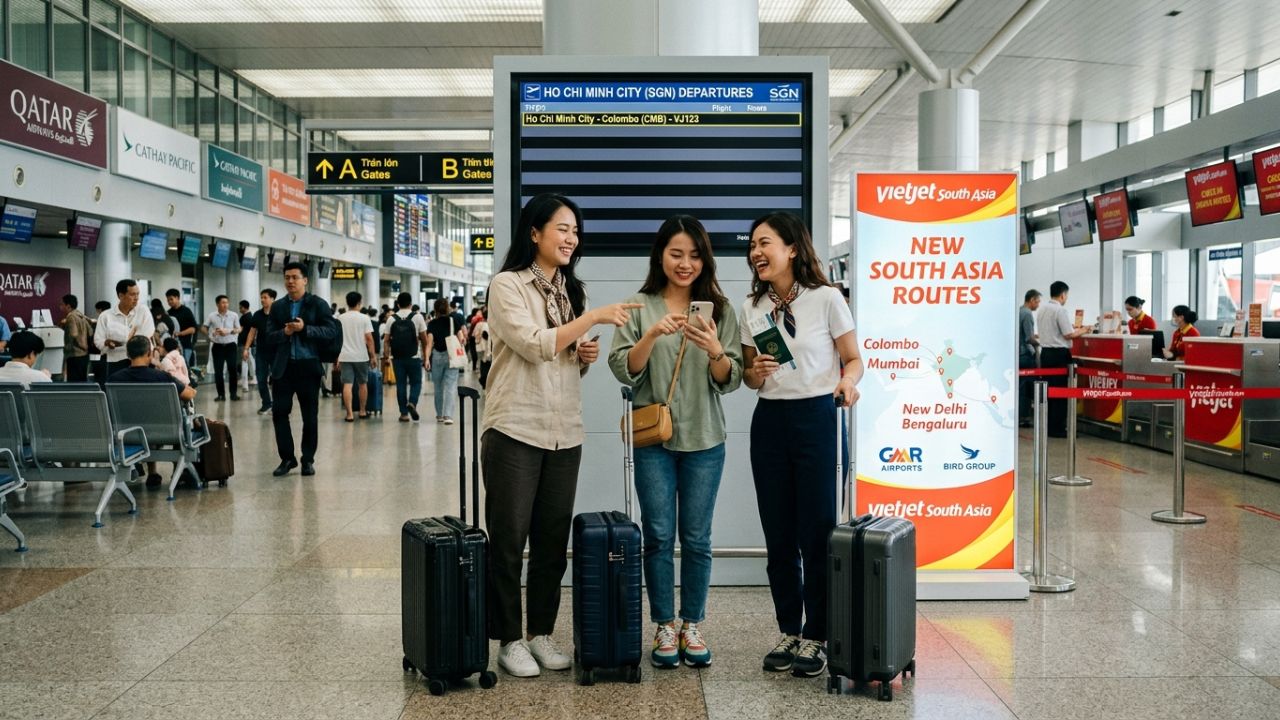
Image generated by AI
VietJet Unveils Coordinated South Asia Expansion Strategy Combining Ho Chi Minh City to Colombo Direct Flights with GMR Airports and Bird Group India Partnerships — Building the Low-Cost Aviation Bridge Between South Asia and Southeast Asia
Published on May 13, 2026
VietJet Air is not just launching a new flight route. The Vietnamese low-cost carrier has unveiled a coordinated South Asia expansion strategy — announced across multiple simultaneous moves in May 2026 — that combines the launch of direct Ho Chi Minh City–Colombo flights from August 2026 with the signing of strategic aviation partnership agreements with GMR Airports Limited and the Bird Group in India, creating the infrastructure architecture of a Vietnam-anchored low-cost aviation corridor that is designed to transform how South Asia and Southeast Asia connect in the air. This is a strategy of genuine regional ambition. Colombo's Bandaranaike International Airport becomes VietJet's operational beachhead in the Indian Ocean — a direct connection serving four travel segments simultaneously: cultural tourism, beach holidays, business travel, and Buddhist religious travel. Through Colombo, Sri Lankan travelers gain access to VietJet's extraordinary onward network across Japan, South Korea, China, Thailand, Singapore, Malaysia, Indonesia, and Australia without requiring a connection through the traditional Gulf, Singapore, or Bangkok hub complex. And through GMR Airports Limited and the Bird Group partnerships in Mumbai, VietJet strengthens the operational infrastructure in India — already served at Delhi, Mumbai, Ahmedabad, Hyderabad, and Bengaluru — that supports the airline's ambition to dominate the most underserved aviation market in Asia: the India–Southeast Asia middle-class leisure corridor.
Quick Summary:
- VietJet launches Ho Chi Minh City (SGN) → Colombo (CMB) direct, 4x weekly from August 2026 — the first scheduled nonstop Vietnam–Sri Lanka air service, opening a new South Asia–Southeast Asia aviation corridor.
- VietJet signed a cooperation agreement with GMR Airports Limited (operator of Delhi Indira Gandhi and Hyderabad Rajiv Gandhi International Airports) — covering airport operations, logistics support, infrastructure development, and aviation technology solutions.
- VietJet signed a separate cooperation agreement with Bird Group — one of India's largest diversified conglomerates — covering passenger services, airport handling, travel technology, and tourism support operations.
- Both India agreements were signed in Mumbai as part of VietJet's coordinated South Asia engagement, reflecting India's status as a priority aviation market for Southeast Asian carriers in 2026.
- VietJet's India network already serves Delhi (DEL), Mumbai (BOM), Ahmedabad (AMD), Hyderabad (HYD), and Bengaluru (BLR) — five of India's most commercially significant aviation markets.
- Through Colombo, Sri Lankan passengers gain access to VietJet's wider Asia-Pacific network spanning Japan, South Korea, China, Thailand, Singapore, Malaysia, Indonesia, and Australia — without Gulf, Singapore, or Bangkok hub connections.
- The Ho Chi Minh City–Colombo route also opens a cargo dimension for Vietnam's extraordinary export economy — creating direct air freight capacity for Vietnam–Sri Lanka trade in electronics, textiles, seafood, and manufactured goods.
The Three-Part South Asia Strategy: Understanding What VietJet Is Building
Most airline announcements describe a new route. VietJet's May 2026 South Asia package describes a network architecture — and understanding the three components as a coordinated system rather than separate announcements reveals the strategic depth of what the airline has designed.
Component 1: The Ho Chi Minh City–Colombo Route is the demand-facing element — the new service that creates the actual air connection between Vietnam and Sri Lanka where none currently exists as a scheduled nonstop operation. Four weekly departures in each direction provide enough frequency to serve both leisure and business segments without oversupplying a route whose demand must first be cultivated.
Component 2: The GMR Airports Limited Partnership is the infrastructure element — a cooperation agreement with one of India's most powerful aviation infrastructure operators that gives VietJet access to GMR's airport operations expertise, technology ecosystem, logistics frameworks, and institutional relationships at the airports VietJet already uses in Delhi and Hyderabad, and potentially at GMR's other airport assets as VietJet's India network expands.
Component 3: The Bird Group Partnership is the commercial operations element — a cooperation agreement with an India conglomerate whose travel services, airport handling, hospitality, and tourism businesses provide VietJet with the ground-side commercial infrastructure that an expanding international carrier requires across India's diverse and geographically sprawling aviation market.
Together, the three components construct the operating system of a South Asia aviation strategy — not just a new route.
The GMR Airports Partnership: Infrastructure Intelligence at Delhi and Hyderabad Scale
GMR Airports Limited's significance as a VietJet partnership target is immediately apparent from the airports it operates: Indira Gandhi International Airport in New Delhi (DEL) — India's busiest airport and the 10th busiest in the world by passenger volume — and Rajiv Gandhi International Airport in Hyderabad (HYD) — one of India's most efficiently operated and technology-forward airports.
The partnership between VietJet and GMR Airports Limited is not merely a commercial relationship between an airline and an airport operator. It is a knowledge and infrastructure transfer agreement — covering airport operations expertise, logistics technology, infrastructure development methodology, and the aviation-specific technology solutions that GMR has developed across its portfolio of airport assets in India and internationally (GMR also has airport development interests in the Philippines and Greece).
For VietJet's India operations, the GMR partnership provides several specific operational advantages: slot optimization intelligence at Delhi International (one of the world's most congested slot environments), technology integration for check-in, baggage handling, and passenger flow management that GMR has implemented at scale, and logistics development that could support VietJet's expanding cargo business between India, Vietnam, and the broader Southeast Asia corridor.
The cargo dimension of VietJet's India–Southeast Asia operations is an underappreciated element of the GMR partnership's significance. As Vietnam's manufacturing and export economy continues growing — the country is now one of the world's largest exporters of electronics (Samsung, Intel, Apple supply chain), seafood, furniture, and textiles — the belly cargo capacity of VietJet's India–Vietnam routes represents a meaningful logistics contribution to bilateral trade flows that GMR's logistics expertise can help optimize.
The Bird Group Partnership: Ground-Side Commercial Infrastructure Across India
Bird Group — one of India's oldest and largest diversified conglomerates with interests spanning aviation ground handling, travel services, luxury hospitality, retail, and technology — provides VietJet with precisely the type of ground-side commercial ecosystem that an expanding international low-cost carrier requires to operate efficiently across India's extraordinarily diverse aviation market.
The specific areas of the VietJet–Bird Group cooperation agreement include:
Passenger services — Bird Group's ground handling and passenger service operations provide the airport-side customer experience infrastructure that VietJet requires at Indian stations where the airline does not have its own ground operations. This includes check-in counter management, boarding gate operations, special assistance services, and disruption management support.
Airport handling operations — Bird Group's aviation handling division provides aircraft handling, ramp services, fueling coordination, and aircraft turnaround support that is essential for VietJet's tight schedule connectivity across Indian airports.
Travel technology — Bird Group's technology businesses cover booking platform integrations, distribution system connections, and passenger service technology that VietJet can leverage to improve its commercial performance in the Indian market without building each capability from scratch.
Tourism support activities — Bird Group's significant presence in luxury hospitality and tourism (including its Oberoi Hotels connections and luxury travel subsidiary) creates potential for VietJet to develop packaged tourism products for the India–Vietnam leisure travel segment that has grown so rapidly in recent years.
VietJet's India Network: Five Cities and a Strategy for Dominance
VietJet's India footprint — already encompassing five of India's most commercially significant cities — is the foundation on which the GMR and Bird Group partnerships build. Understanding the geographic and demographic logic of the five current India stations explains why these partnerships matter for the airline's growth objectives.
Delhi (DEL) — India's capital and North India's dominant aviation market, serving 100+ million passengers annually and connecting India's largest population catchment to VietJet's Vietnam and Southeast Asia network. Delhi–Ho Chi Minh City carries both leisure travelers (Vietnamese heritage tourism, beach holidays in Da Nang and Phu Quoc) and the significant business travel flow between India and Vietnam's FDI-intensive manufacturing economy.
Mumbai (BOM) — India's financial capital and the anchor market for India's affluent and high-frequency international traveler segment. Mumbai's outbound leisure travel market — among Asia's most valuable per-traveler-spending demographics — is where VietJet's premium ancillary strategy (upgrading from base fare to seat selection, premium cabin, and hotel packaging) has the most development potential.
Ahmedabad (AMD) — Gujarat's commercial capital and the gateway to India's most entrepreneurially active business community. Ahmedabad is also the primary city for India's Jain community — whose interest in Buddhist heritage travel across Vietnam, Sri Lanka, and Southeast Asia creates a specific religious and cultural tourism segment that VietJet's South Asia network is ideally positioned to serve.
Hyderabad (HYD) — South India's technology capital, home to the extraordinary concentration of Indian IT services, pharmaceutical, and biotech companies whose business travel to Vietnam and Southeast Asia's tech manufacturing ecosystem is growing rapidly. The GMR-operated Rajiv Gandhi Airport is VietJet's Hyderabad base — making the GMR partnership particularly operationally relevant here.
Bengaluru (BLR) — India's Silicon Valley, whose extraordinary technology startup ecosystem and international business community generates the highest per-capita international travel frequency of any Indian city. Bengaluru–Ho Chi Minh City serves both tech business travelers and the large Vietnamese community studying and working in India's technology sector.
Colombo as VietJet's Gateway to the Indian Ocean — and Beyond
The Ho Chi Minh City–Colombo route's strategic significance extends beyond the bilateral Vietnam–Sri Lanka travel market. Colombo's Bandaranaike International Airport is positioned at the center of the Indian Ocean's aviation geography — equidistant from the Gulf, South Asia, and Southeast Asia — and VietJet's entry into Colombo gives the airline a node in the Indian Ocean's commercial aviation network that it has not previously occupied.
Sri Lankan passengers who book VietJet's Colombo–Ho Chi Minh City service gain access — through VietJet's extensive Vietnam-anchored network — to destinations that currently require multi-carrier connections through Singapore, Bangkok, or Kuala Lumpur. Japan (Osaka, Tokyo, Fukuoka), South Korea (Seoul, Busan), China (multiple VietJet-served destinations), Thailand (Bangkok), Singapore, Malaysia (Kuala Lumpur), and Australia (Sydney, Melbourne) all become accessible via Ho Chi Minh City with a single VietJet connection — eliminating the Gulf or traditional Southeast Asian hub from the Sri Lankan traveler's routing requirement.
The cargo potential of the Colombo route also deserves specific attention. Sri Lanka's export economy — tea, apparel, gems, rubber, and spices — and Vietnam's import demand for specific Sri Lankan products create bilateral freight flows that VietJet's belly cargo capacity can serve more efficiently than the current routing via Colombo–Singapore–Vietnam cargo chains.
Guide for Travelers:
- Book the Ho Chi Minh City–Colombo route at vietjetair.com from approximately June 2026 when the August booking window is expected to open. New route introductory fares are typically VietJet's most competitive price point — monitoring the booking launch date with a price alert is the optimal booking strategy.
- Sri Lanka via VietJet's India network: Indian travelers at Delhi, Mumbai, Ahmedabad, Hyderabad, or Bengaluru can access Sri Lanka via a VietJet India–Ho Chi Minh City + VietJet Ho Chi Minh City–Colombo two-leg itinerary — potentially competitively priced against direct India–Sri Lanka options while adding Vietnam as a multi-city stop.
- Colombo onward connections for Sri Lankan travelers: Use VietJet's Ho Chi Minh City hub to connect to Osaka (KIX), Tokyo (NRT/HND), Seoul (ICN), Bangkok (BKK), Kuala Lumpur (KUL) — all accessible as VietJet connecting itineraries without requiring a Gulf or Singapore hub transit.
- Buddhist heritage circuit via VietJet: Colombo (Temple of Tooth Relic connecting flight from Colombo to Kandy) → Ho Chi Minh City → Hanoi (Hoa Lu ancient temples + Bai Dinh Pagoda) is now commercially viable as a single-airline Buddhist heritage circuit without a non-VietJet connection required.
- VietJet ancillary planning: Base fares on VietJet's international routes are extremely competitive — but checked baggage, seat selection, and inflight meals are separately priced. Budget US$40–70 in ancillaries for a comfortable experience, or consider VietJet's bundled fare options (available at booking) which include baggage allowance.
- GMR airports (Delhi and Hyderabad) VietJet check-in: The GMR partnership should improve passenger processing at Delhi and Hyderabad for VietJet flights — check vietjetair.com's India operations page for any updated check-in location or process information as the partnership is operationalized.
- India–Vietnam travel demand: Travel periods from India to Vietnam peak during Indian school holidays (May–June, October–November) and during Diwali (October–November). Book India–Vietnam VietJet routes at least 4–6 weeks in advance during these periods for the most competitive fare availability.
Related Travel Guides
- VietJet Launches Ho Chi Minh City to Colombo at Historic Ceremony with Vietnam's President To Lam and Sri Lanka's PM Harini Amarasuriya
- VietJet's Direct Ho Chi Minh City–Colombo Route Analysis — What It Means for South Asia Aviation
- Singapore Airlines Expands to Hangzhou, Riyadh, Madrid, and Western Sydney in 2026
VietJet's South Asia expansion is the most comprehensive single-airline regional strategy announcement in Southeast Asian aviation in 2026 — and the deliberate simultaneity of its three components (Colombo launch + GMR partnership + Bird Group partnership) signals that this is not opportunistic route addition but designed network architecture. The Ho Chi Minh City–Colombo route opens the Indian Ocean. The GMR Airports partnership deepens the operational foundation in Delhi and Hyderabad. The Bird Group partnership expands the commercial infrastructure across five Indian cities. Together, they construct the connective tissue of a South Asia–Southeast Asia low-cost aviation corridor whose commercial logic — India's extraordinary outbound demand, Sri Lanka's extraordinary inbound tourism recovery, Vietnam's extraordinary transit hub positioning — is among the most compelling in all of Asian aviation. The flights begin in August 2026. The strategy begins now.
Disclaimer
This article is for informational and educational purposes only. It does not constitute legal, financial, or professional advice. While we strive to provide accurate and up-to-date information, travel policies, regulations, and conditions change rapidly. Always verify information with official sources before making travel decisions. Nomad Lawyer makes no representations about the accuracy, reliability, completeness, or suitability of the information provided. Readers should consult qualified professionals for advice specific to their circumstances. The views expressed in this article are those of the author and do not necessarily reflect the views of Nomad Lawyer.
Kunal K Choudhary
Co-Founder & Contributor
A passionate traveller and tech enthusiast. Kunal contributes to the vision and growth of Nomad Lawyer, bringing fresh perspectives and driving the community forward.
Learn more about our team →