
The Ultimate Stand Against Overtourism: Valencia Freezes Tourist Flat Licenses to Save Its Housing Grid
Mathematically aligning with Barcelona and Paris, Valencia has officially executed a brutal crackdown on short-term tourist flats to combat massive urban inequality and soaring 'touristflation'.

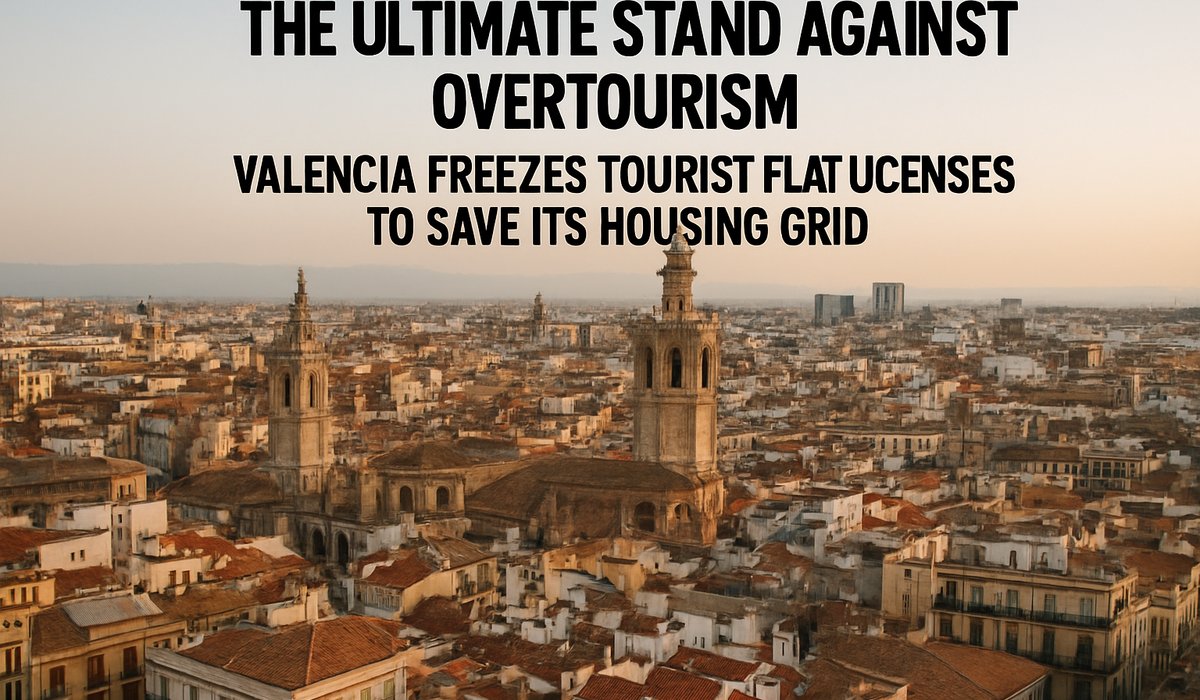
Image generated by AI
The Boiling Point of the European Housing Grid
Executing a highly necessary, entirely structural reset in its urban tourism policy, Valencia has aggressively joined a powerful coalition of European mega-hubs—including Barcelona, Amsterdam, Paris, and Berlin—in heavily cracking down on the catastrophic expansion of short-term tourist flats. For the past five years, the massive allure of the Spanish coast has caused the Valencian real estate market to mathematically warp. Property investors and massive corporate syndicates systematically purchased deeply historic local apartments and violently converted them into highly lucrative Airbnbs. The result is a brutal phenomenon known locally as "touristflation," where the massive influx of wealthy global tourists mathematically displaces the localized workforce, completely eradicating affordable urban housing.
To combat this absolute existential threat to the city’s core identity, Valencia authorities have explicitly enacted a massive municipal freeze on all new tourist flat licenses. Furthermore, they are drastically expanding their highly aggressive legal enforcement architecture, utilizing dedicated investigation units to mathematically locate, heavily penalize, and shut down illegal rental operations. This is not simply an anti-tourist sentiment; it is a desperate, highly coordinated effort to return the city to a state of absolute equilibrium, ensuring that teachers, nurses, and local artisans can financially survive within the city limits.
The Continental Shift in Hospitality
Valencia is not operating in isolation; its actions indicate an absolute, systemic shift in how Europe will handle tourism in the late 2020s.
Massive hubs like Florence have entirely banned the creation of new tourist units in their historic core, while Amsterdam severely limits the mathematical amount of nights an owner can rent their property. The ultimate goal across the continent is a return to highly regulated, structured hospitality. Cities are deliberately attempting to push incoming tourists heavily back into established, highly taxed commercial hotels, completely removing the extreme residential strain caused by unregulated short-term rentals.
The European Anti-Overtourism Matrix (2026 Shift)
| City | The Legislative Anti-Tourism Tactic | The Core Desired Outcome |
|---|---|---|
| Valencia | Absolute freeze on new licenses + heavy legal sweeps | Stabilizing localized long-term rent prices against "touristflation." |
| Barcelona | Total eradication of short-term rentals by 2028 | Forcefully returning 10,000+ units back to the citizen housing grid. |
| Amsterdam | Severe maximum night caps and zone prohibitions | Decriminalizing the red-light district aesthetics and dispersing tourist density. |
What Guests Get
- Redefining the 'Airbnb' aesthetic — realizing that renting a highly historic apartment in a Spanish city frequently means you are mathematically contributing to the eviction of a multi-generational local family.
- The return of the Hotel — grasping that because short-term rentals are heavily banned or heavily taxed, luxury boutique hotels are mathematically becoming the most socially responsible, efficient way to travel Europe.
- Micro-economic stabilization — understanding that by forcing tourists into specific, commercially zoned infrastructure, local civic services (like trash collection and public transit) are not completely crushed.
What This Means for Travelers
If you are planning an itinerary to a major Spanish or European hub in 2026: You must deeply audit your accommodation structure. Do not blindly book a cheap, highly centralized short-term rental flat in Valencia or Barcelona without meticulously demanding verified proof of their municipal tourism license. The aggressive legal crackdowns mean that illegal, unlicensed flats are routinely raided and shut down by civic authorities with zero notice. Tourists have been physically evicted mid-vacation by local police because their host was operating entirely outside the new municipal legal frameworks.
Embracing the Push to the Periphery: Because central accommodations are being highly restricted, travelers must actively embrace the strategy of massive dispersion. The absolute smartest, most luxurious way to visit Valencia is to secure heavily regulated, highly premium agriturismo (farm stay) lodging or coastal villas situated miles completely outside the city core. You execute short, highly strategic day-trips into the dense urban zones using regional rail, entirely avoiding the massive friction and extreme civic hostility directed at tourists residing inside the strained residential neighborhoods.
FAQ: Navigating Europe's Tourism Bans
What exactly is "Touristflation"? It is a highly concentrated, localized inflation matrix where massive tourism demand violently drives up the basic cost of urban housing, groceries, and local transport, rendering the city financially unlivable for the actual citizens.
Is it illegal for me to rent an Airbnb in Valencia? Renting a short-term property is not explicitly illegal for the tourist; it is the owner's mathematical responsibility to possess official civic licensing. The severe risk is that booking an unlicensed unit makes you vulnerable to sudden governmental cancellation.
Will this heavily reduce the amount of tourists in Spain? That is the explicit mathematical intention. The Spanish government is no longer targeting "Mass Volume." They are aggressively pivoting to "Quality Over Quantity," intentionally reducing the sheer number of arrivals while increasing the required financial yield per visitor.
External Resources
Related Travel Guides
Disclaimer
This article is for informational and educational purposes only. It does not constitute legal, financial, or professional advice. While we strive to provide accurate and up-to-date information, travel policies, regulations, and conditions change rapidly. Always verify information with official sources before making travel decisions. Nomad Lawyer makes no representations about the accuracy, reliability, completeness, or suitability of the information provided. Readers should consult qualified professionals for advice specific to their circumstances. The views expressed in this article are those of the author and do not necessarily reflect the views of Nomad Lawyer.
Raushan Kumar
Founder & Lead Developer
Full-stack developer with 11+ years of experience and a passionate traveller. Raushan built Nomad Lawyer from the ground up with a vision to create the best travel and law experience on the web.
Learn more about our team →