
US Flight Chaos Erupts as United, Delta, Southwest, and Alaska Airlines Cancel 44 Flights and Delay Over 1,400 More Across Chicago, New York, Los Angeles, and Anchorage
A sweeping wave of weather and operational disruptions grounds 44 US flights and delays 1,426 more across major carriers including United, Delta, Southwest, and Alaska Airlines on May 12, 2026.

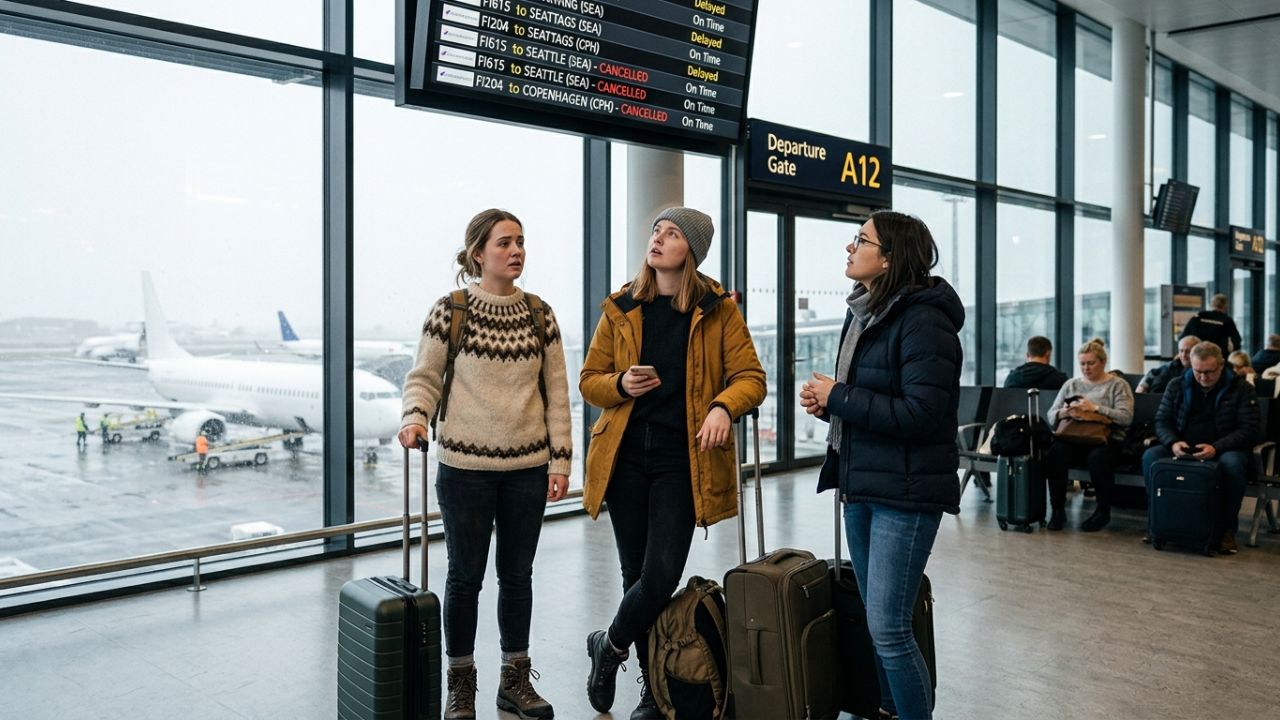
Image generated by AI
US Flight Chaos Erupts as United, Delta, Southwest, and Alaska Airlines Cancel 44 Flights and Delay Over 1,400 More Across Chicago, New York, Los Angeles, and Anchorage
Published on May 13, 2026
America's air travel system buckled under severe pressure on May 12, 2026, as a convergence of adverse weather and cascading operational failures triggered one of the most wide-reaching domestic disruption events of the year. A total of 44 flights cancelled and 1,426 flights delayed across the United States — affecting hundreds of thousands of travelers at airports stretching from the Caribbean warmth of San Juan, Puerto Rico to the Arctic reaches of Anchorage, Alaska. The country's biggest carriers — United Airlines, Delta Air Lines, Southwest Airlines, and Alaska Airlines — were all caught in the storm, with Southwest alone recording a staggering 229 delays in a single operational day. From the congested tarmacs of Chicago O'Hare to the fog-bound runways of San Francisco International, travelers across America faced crushing uncertainty. Here is the complete, airport-by-airport breakdown — and everything you need to do right now if your flight is affected.
Quick Summary:
- 44 total flight cancellations and 1,426 delays recorded across US airports on May 12, 2026, driven by low visibility, weather, and operational constraints.
- Airlines hardest hit: Southwest Airlines (229 delays, 2 cancellations), United Airlines (106 delays, 9 cancellations), Delta Air Lines (115 delays, 2 cancellations), Alaska Airlines (19 delays, 9 cancellations).
- Worst-affected airports: Luis Muñoz Marín International (SJU) with 14 cancellations; Princess Juliana International (SXM) with 10; Anchorage International (ANC) with 8.
- Ground delays active at: San Francisco International (SFO) — average 58-minute delay due to low ceilings; Teterboro (TEB) — average 118-minute delay from operational volume management.
- Major hub disruptions: Los Angeles (LAX), Chicago O'Hare (ORD), JFK, Washington Dulles (IAD), and Newark (EWR) all recording significant delay volumes.
- Primary causes: Low ceiling/visibility conditions at SFO; volume management and metering procedures at TEB; weather-related cascading effects across the network.
- Travelers advised to check airline apps immediately, know DOT compensation rights, and arrive at airports with extended buffer time.
The Scale of It: Why 1,426 Delays in One Day Is an Aviation Crisis
One cancellation is an inconvenience. One hundred delays is a bad day. Fourteen hundred and twenty-six delays in a single operational day across the United States is a systemic failure — the kind that ripples outward from a handful of weather-affected airports and cascades across an entire interconnected national aviation network.
When fog descends on San Francisco International, aircraft don't just sit on the ground in California. They don't make their scheduled arrivals in Denver, Seattle, or Houston. Connecting passengers miss onward flights in cities they haven't even reached yet. Crews time out. Gates back up. The ripple becomes a wave.
That's precisely what happened on May 12, 2026. A cluster of weather and visibility events at key operational hubs triggered a chain reaction that ultimately touched 1,470 total disrupted services across America's busiest airlines — turning an ordinary Tuesday into a day that tested every traveler's patience, every airline's operational resilience, and every airport's passenger management capacity.
Airport-by-Airport Breakdown: Where the Crisis Was Worst
Complete Cancellations and Delays by Airport
| Airport | Code | Total Cancellations | Total Delays |
|---|---|---|---|
| Luis Muñoz Marín Intl, Puerto Rico | SJU | 14 | 21 |
| Princess Juliana Intl, St. Maarten | SXM | 10 | 5 |
| Anchorage Intl, Alaska | ANC | 8 | 21 |
| Los Angeles Intl | LAX | 3 | 33 |
| John F. Kennedy Intl, New York | JFK | 2 | 20 |
| Chicago O'Hare Intl | ORD | 2 | 63 |
| Washington Dulles Intl | IAD | 2 | 23 |
| Newark Liberty Intl | EWR | 2 | 12 |
Luis Muñoz Marín International in San Juan recorded the single highest cancellation count of any US airport on the day — 14 cancellations alongside 21 delays, creating massive disruption for travelers moving between Puerto Rico and the US mainland. Caribbean vacation itineraries, family visits, and business trips were all caught in the crossfire.
Princess Juliana International in St. Maarten — one of the world's most photographically dramatic airports, famous for planes passing just metres above the beach — saw 10 cancellations cut deeply into its limited daily schedule, severing essential Caribbean island connectivity for hundreds of passengers.
Anchorage International recorded 8 cancellations and 21 delays — a disruption that carries particular weight in Alaska, where air travel is not a convenience but a critical infrastructure lifeline connecting remote communities with no road access to the outside world.
San Francisco's Low-Ceiling Crisis: The Fog That Grounded the West Coast
San Francisco International Airport (SFO) became one of the day's most significant operational flashpoints when persistent low ceiling conditions triggered a formal Ground Delay Program that backed up the airport's entire departure schedule.
Average ground delays reached 58 minutes — a figure that sounds modest until you understand the mathematics of cascading aviation delays. A 58-minute delay on a morning departure means the aircraft arrives late at its destination, turns around late, and arrives back in San Francisco late for its next departure. By the end of the operating day, that initial 58-minute delay has potentially multiplied across four or five flight cycles.
For travelers at SFO specifically — and for the tens of thousands of passengers waiting at connecting airports for SFO-departing aircraft — the low ceiling conditions created disruption that extended well beyond the Bay Area.
Teterboro's Two-Hour Ordeal: The New Jersey Hub Under Maximum Pressure
Teterboro Airport (TEB) — the primary general aviation and business jet gateway serving the New York metropolitan area — recorded one of the day's most severe individual ground delays: an average of 118 minutes attributable to a combination of volume management, traffic metering procedures, and airport congestion.
Departure delays at TEB ran at an additional average of 30 minutes — although these were gradually decreasing as operational teams worked to restore normal flow.
For business aviation passengers expecting the expedited, low-friction airport experience that Teterboro is designed to provide, a two-hour-plus ground delay represents exactly the kind of disruption that corporate travelers pay premium prices specifically to avoid.
The Airline-by-Airline Picture: Who Was Hit Hardest?
Complete Airline Disruption Summary
| Airline | Cancellations | Delays |
|---|---|---|
| Southwest Airlines | 2 | 229 |
| United Airlines | 9 | 106 |
| Delta Air Lines | 2 | 115 |
| Alaska Airlines | 9 | 19 |
Southwest Airlines recorded the most alarming delay volume of the day — 229 individual flight delays representing a near-total disruption of the carrier's tight, point-to-point scheduling model. Southwest operates without hub-and-spoke architecture, meaning every delay on one segment directly affects the aircraft and crew for the next departure. In a network of 229 simultaneous delays, the operational recovery challenge is immense.
United Airlines combined a significant cancellation count of 9 with 106 delays — consistent with a carrier managing major hub exposure at both Chicago O'Hare (ORD) and Newark (EWR), two of the day's most congested airports.
Delta Air Lines recorded 115 delays alongside 2 cancellations — reflecting Delta's typically strong operational recovery capability limiting outright cancellations while still absorbing significant schedule disruption from weather-adjacent cascades.
Alaska Airlines saw 9 cancellations — heavily weighted toward Anchorage operations, where weather conditions and the operational realities of Alaskan aviation create elevated disruption risk during periods of atmospheric instability.
Chicago O'Hare: America's Most Congested Hub Reaches Its Limit
Chicago O'Hare International Airport (ORD) recorded only 2 cancellations on the day — but 63 individual flight delays tell the real story of a hub stretched to its operational limits.
O'Hare handles more aircraft operations than virtually any other airport on earth. Even a modest weather or volume constraint at ORD doesn't create a local problem — it creates a national problem. Flights delayed into O'Hare mean connecting passengers miss their onward services to every corner of the United States and dozens of international destinations.
The 63 delays recorded at O'Hare on May 12 rippled outward across United and American Airlines' networks in ways that affected passengers who may never have come within 500 miles of Chicago.
Los Angeles International: Delays Pile Up on the West Coast
Los Angeles International Airport (LAX) recorded 3 cancellations and 33 delays — disruptions that carry particular weight for one of the world's busiest origin-and-destination markets.
Unlike hub airports like ORD or EWR, where most passengers are connecting through rather than originating or terminating, LAX serves an enormous number of travelers beginning and ending journeys in the Los Angeles metropolitan area. Its 33 delays represent 33 instances of real people — tourists, business travelers, families, international visitors — sitting in terminals and on tarmacs when they should be in the air.
Guide for Travelers:
- Check your flight status NOW via your airline's app — FlightAware and FlightRadar24 also provide real-time delay and cancellation data that often updates faster than airport boards.
- United passengers: United's mobile app offers same-day rebooking for cancelled flights without fee. Call 1-800-864-8331 for complex rebooking needs.
- Southwest passengers: Southwest's unique open-seating model means rebooking to the next available flight is generally faster than other carriers. Call 1-800-435-9792 or use the Southwest app.
- Delta passengers: Delta's Fly Delta app allows instant rebooking on cancellations and offers real-time delay notifications. Call 1-800-221-1212 for assistance.
- Alaska passengers: Alaska's app and website allow flight changes for affected passengers. Call 1-800-252-7522 for rebooking support at Anchorage or other disrupted hubs.
- Know your DOT rights: US Department of Transportation rules require airlines to refund passengers for cancelled flights regardless of reason. For delays, check your airline's published delay compensation policy — meal vouchers and hotel accommodations may be available for lengthy delays.
- SFO travelers: Ground delays due to fog typically clear by mid-morning as marine layer burns off. If your departure is afternoon or later, your flight may operate normally despite morning disruption.
- Anchorage travelers: If your Anchorage flight is cancelled, contact Alaska Airlines immediately — alternative routing through Seattle or Fairbanks may be available on a same-day basis.
- Allow extra airport buffer: Across all affected airports, expect customer service desk congestion. Digital rebooking via apps is significantly faster than queuing at airport counters.
Related Travel Guides
- Europe's Jet Fuel Crisis Threatens Summer Travel as EU Issues Emergency Aviation Guidance
- IndiGo and SpiceJet Cancel a Dozen Flights Across Delhi, Bengaluru, Kolkata, and Kochi
- Thailand Flight Cancellations: Bangkok Airways and Thai Airways Disrupt Travel Across Suvarnabhumi and Chiang Mai
America's airports absorbed a brutal operational day on May 12, 2026 — and for the hundreds of thousands of travelers caught in the chaos at Chicago O'Hare, Los Angeles International, JFK, San Juan, Anchorage, and beyond, the frustration is real, immediate, and deeply inconvenient. But disruption, however severe, is temporary. The weather clears. Ground delays lift. Aircraft reposition. Schedules stabilize. And the journeys that matter most — the family reunions, the business milestones, the long-anticipated vacations — find a way to happen. Stay informed, know your rights, use your airline's digital tools, and hold onto the destination waiting at the other end. Chicago's extraordinary architecture, Los Angeles' golden coastline, New York's electric energy, and Alaska's incomparable wilderness are all still there — and absolutely worth every moment of the wait.
Disclaimer
This article is for informational and educational purposes only. It does not constitute legal, financial, or professional advice. While we strive to provide accurate and up-to-date information, travel policies, regulations, and conditions change rapidly. Always verify information with official sources before making travel decisions. Nomad Lawyer makes no representations about the accuracy, reliability, completeness, or suitability of the information provided. Readers should consult qualified professionals for advice specific to their circumstances. The views expressed in this article are those of the author and do not necessarily reflect the views of Nomad Lawyer.
Kunal K Choudhary
Co-Founder & Contributor
A passionate traveller and tech enthusiast. Kunal contributes to the vision and growth of Nomad Lawyer, bringing fresh perspectives and driving the community forward.
Learn more about our team →