
Severe Thunderstorms and Independence Day Airspace Restrictions Trigger 322 Flight Cancellations and 2,521 Delays Across Major United States Aviation Hubs
Severe weather and airspace restrictions caused 322 cancellations and 2,521 delays across the U.S. aviation network during the July 4 holiday weekend.

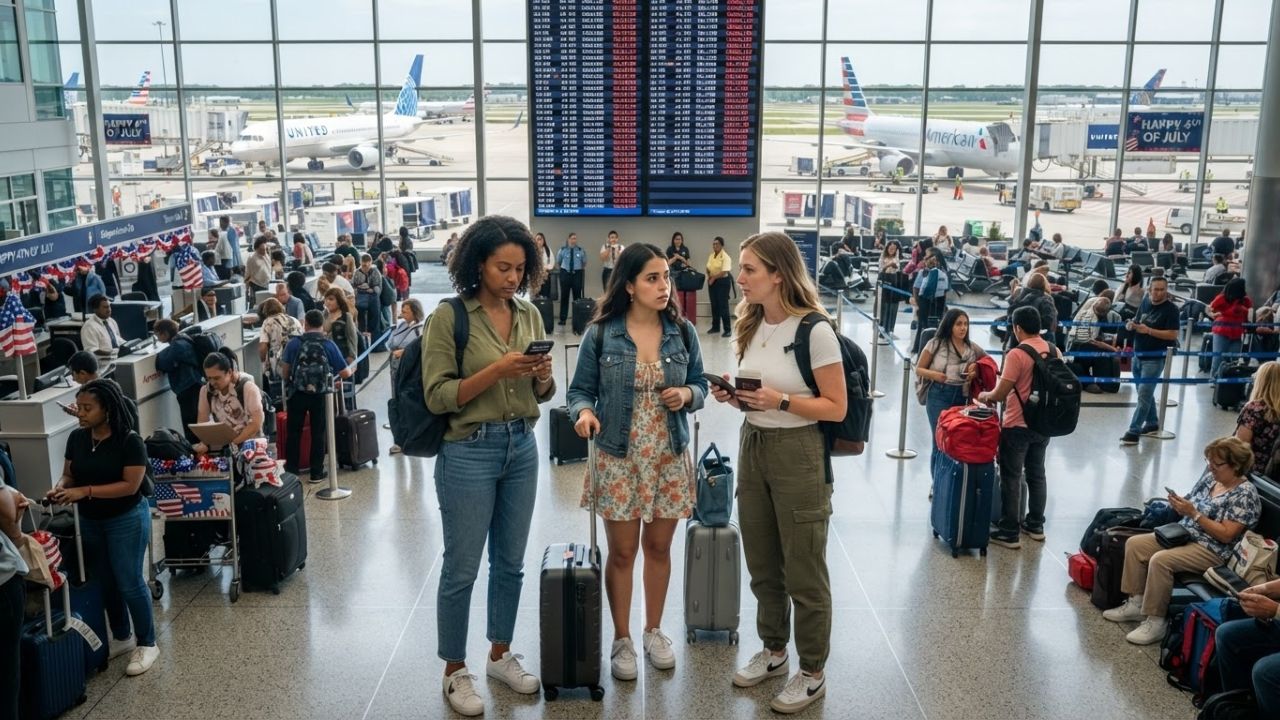
Image generated by AI
Independence Day holiday flights across the United States faced severe delays due to weather and security shutdowns. Chicago O'Hare Airport recorded the highest cancellations, while Ronald Reagan Washington National Airport closed its airspace for national celebrations.
Severe Weather Triggers Ground Stops at Chicago O'Hare Airport
According to reports, flight cancellations across the country reached 322, with another 2,521 flights delayed on July 4 and July 5, 2026.
Official weather bulletins published by the National Weather Service (NWS) indicate that severe thunderstorm lines moved through the Midwest.
Ground stop advisories issued by the Federal Aviation Administration (FAA) show that Chicago O'Hare was the most affected hub.
O'Hare recorded 127 flight cancellations and 339 delayed movements as storm cells blocked arrival and departure corridors.
Airlines were forced to divert dozens of inbound flights to alternate fields, displacing aircraft and crews.
The tables below display the airport-by-airport disruption figures and the carrier delay statistics.
Most Affected U.S. Airports and Disruption Levels
| Airport Hub Gateway | Location State | Total Delayed Flights | Total Cancelled Flights | Primary Disruption Drivers |
|---|---|---|---|---|
| Chicago O'Hare (ORD) | Illinois | 339 delays | 127 cancellations | Severe thunderstorms, FAA stops |
| John F. Kennedy (JFK) | New York | 373 delays | 33 cancellations | High holiday passenger volume |
| LaGuardia (LGA) | New York | 170 delays | 16 cancellations | Runway flow limits, congestion |
| Newark Liberty (EWR) | New Jersey | 162 delays | 21 cancellations | Regional airspace saturation |
| Dallas/Fort Worth (DFW) | Texas | 116 delays | 2 cancellations | Summer convective wind shifts |
| Boston Logan (BOS) | Massachusetts | 115 delays | 5 cancellations | Northeast traffic restrictions |
| Houston Bush (IAH) | Texas | 54 delays | 6 cancellations | Thunderstorm cell activity |
| St. Louis Lambert (STL) | Missouri | 22 delays | 8 cancellations | High local cancellation rate |
| Nashville (BNA) | Tennessee | 40 delays | 7 cancellations | Regional feeder delays |
| Austin-Bergstrom (AUS) | Texas | 27 delays | 1 cancellation | Local departure slot limits |
Air Carrier Cancellations and Delays Breakdown
| Operating Air Carrier | Main Service Category | Number of Flight Delays | Number of Cancellations | Network Reach Impact |
|---|---|---|---|---|
| SkyWest | Regional Feeder Partner | 219 delays | 73 cancellations | Busiest regional carrier affected |
| United Airlines | Mainline Carrier | 286 delays | 62 cancellations | Heavy impact at Chicago & Newark |
| Southwest Airlines | Mainline Low-Cost | 274 delays | 31 cancellations | Nationwide point-to-point routes |
| Tradewind | Regional Private Charter | 0 delays | 31 cancellations | High cancellation proportion |
| Republic Airways | Regional Feeder Partner | 133 delays | 27 cancellations | East Coast network restrictions |
| Delta Air Lines | Mainline Carrier | 264 delays | 20 cancellations | Hub flow management in Atlanta |
| American Airlines | Mainline Carrier | 257 delays | 16 cancellations | Delays at DFW, Charlotte, Chicago |
| Endeavor Air | Delta Connection Partner | 131 delays | 21 cancellations | Northeast regional disruptions |
| PSA Airlines | American Eagle Partner | 47 delays | 9 cancellations | Mid-Atlantic feeder corridors |
| Envoy Air | American Eagle Partner | 44 delays | 8 cancellations | Texas and Midwest regional loops |
New York and Texas Aviation Hubs Experience High Holiday Delays
New York's John F. Kennedy Airport reported 373 delays, the highest of any U.S. airport, along with 33 cancellations.
Nearby LaGuardia and Newark Liberty airports combined for over 330 delays and 37 cancellations.
In Texas, Dallas/Fort Worth and Houston Bush airports registered moderate delays as airlines adjusted scheduling slots.
These delays were caused by a combination of high holiday travel volumes and convective weather along the East Coast.
Holiday traffic peaks mean that airports are operating at near-capacity, leaving no room to absorb delays.
Regional and Mainline Air Carriers Register Extensive Flight Cancellations
Regional operators, which handle feeder services for major airlines, recorded the highest number of flight cancellations.
SkyWest led all carriers with 73 cancellations and 219 delays, affecting United Express, Delta Connection, and American Eagle.
Among mainline airlines, United Airlines reported 62 cancellations, while Southwest and Delta also registered multiple delays.
Republic Airways and Endeavor Air experienced significant disruptions across their regional networks.
Regional flight cancellations can leave travelers stranded in smaller cities that have fewer daily flights.
Airspace Restrictions Halt Flight Operations at Reagan National Airport
Ronald Reagan Washington National Airport (DCA) suspended all flight arrivals and departures from 12:00 PM to midnight on July 4.
The temporary closure was ordered to accommodate airspace restrictions for the United States' 250th anniversary celebrations.
Normal flight operations at the airport resumed on July 5, although residual delays persisted throughout the morning.
Airlines proactively adjusted their flight schedules to bypass the Washington D.C. area during the closure.
This planned suspension contributed to the high volume of traffic diverted to nearby Baltimore and Dulles airports.
Why This Matters
Our analysis of the flight data indicates that weather delays at primary transit hubs like Chicago O'Hare have a domino effect on regional air travel. When ORD is grounded, the aircraft and flight crews scheduled to operate return legs become displaced.
This displacement causes secondary delays at airports that are experiencing clear weather.
Additionally, regional partner airlines like SkyWest and Republic play a critical role in maintaining network connectivity.
When regional feeders experience high cancellation rates, it cuts off connectivity for smaller communities.
For travelers, holiday weekends represent the highest risk for flight delays due to the lack of empty seats on alternative flights.
Industry Outlook
Market trends suggest that U.S. airlines will invest in predictive dispatch tools to manage severe weather disruptions more effectively. Carriers will continue to increase the size of their standby crews during holiday weekends.
Expect flight schedules to normalize once the holiday travel period ends and convective weather systems clear. The domestic aviation network is projected to see stable capacity management.
Key Takeaways
- Nationwide Delays: The U.S. aviation network recorded 322 cancellations and 2,521 delays during the holiday weekend.
- O'Hare Hardest Hit: Chicago O'Hare reported the most cancellations (127) due to severe thunderstorms and FAA ground stops.
- Regional Disruption: SkyWest experienced the highest number of cancellations (73) among all carriers.
- Capital Shutdown: Reagan National Airport suspended all flight operations for 12 hours on July 4 for national celebrations.
- New York Congestion: JFK Airport registered the highest delay volume with 373 flights delayed.
FAQ
Why were flights delayed across the United States today?
Flights were delayed due to severe thunderstorms in the Midwest, high holiday travel volumes, and airspace closures in Washington D.C.
Which airport recorded the most flight cancellations?
Chicago O'Hare International Airport (ORD) recorded the highest volume with 127 cancellations.
Why did Reagan National Airport suspend flight operations on July 4?
The airport closed its airspace from 12:00 PM to midnight to accommodate temporary restrictions for the U.S. 250th anniversary celebrations.
What should passengers do if their flight is cancelled?
Passengers should check airline mobile apps for rebooking options, contact customer service early, and monitor local weather updates.
Disclaimer
This article is for informational and educational purposes only. It does not constitute legal, financial, or professional advice. While we strive to provide accurate and up-to-date information, travel policies, regulations, and conditions change rapidly. Always verify information with official sources before making travel decisions. Nomad Lawyer makes no representations about the accuracy, reliability, completeness, or suitability of the information provided. Readers should consult qualified professionals for advice specific to their circumstances. The views expressed in this article are those of the author and do not necessarily reflect the views of Nomad Lawyer.
Kunal K Choudhary
Co-Founder & Contributor
A passionate traveller and tech enthusiast. Kunal contributes to the vision and growth of Nomad Lawyer, bringing fresh perspectives and driving the community forward.
Learn more about our team →