
Aviation Updates: Delta, United, and American Maintain Record High Fares Despite Fuel Relief and Widespread Travel Chaos
As catastrophic logistical bottlenecks and rolling flight cancellations severely paralyze domestic transit grids, major US carriers are keeping airfares historically high to protect profit margins.

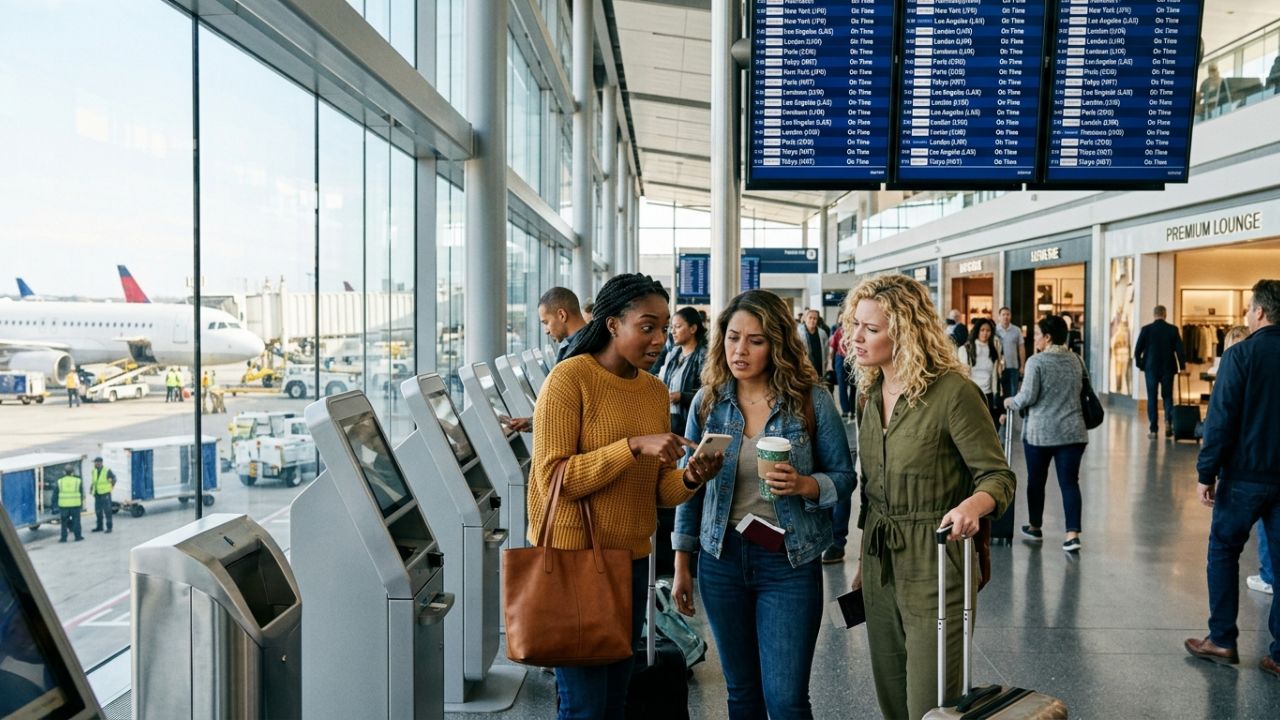
Image generated by AI
Aviation Updates: Delta, United, and American Maintain Record High Fares Despite Fuel Relief and Widespread Travel Chaos
As extreme operational friction and suddenly compounding infrastructure bottlenecks continue to terrorize standard travel itineraries, major American carriers are actively prioritizing corporate yields over consumer relief, keeping ticket prices at record highs.
Image generated by AI
As high-impact airline news platforms rapidly issue continuous, grim aviation updates regarding the intense fragility of the North American transit grid, American travelers are facing an incredibly expensive reality. Despite millions of passengers desperately navigating terrifying travel chaos and severe rolling airport disruptions, American Airlines is moving aggressively in step with Delta Air Lines, United Airlines, and other major US carriers to maintain mountain-high domestic and international airfares. While global jet fuel prices have officially eased following earlier market panic, these mega-carriers are strictly retaining current fare levels to drastically strengthen corporate profitability rather than passing any savings onto weary travelers. An unprecedented combination of strong travel demand, inflating fuel costs from earlier quarters, premium flight service demand, war-torn airspace closures, severe labor shortages, and widespread flight cancellations are officially reshaping the brutal economics of air travel in 2026.
Expanded Overview: Prioritizing Yield Over Relief
To fully comprehend the sheer scale of this fiscal strategy, economic analysts must closely examine the latest, highly comprehensive federal data exposing airline pricing power.
The latest definitive data published by the US Department of Transportation’s Bureau of Transportation Statistics (BTS) reveals that the average domestic airfare reached a staggering US$428 during the first quarter of 2026. This massive unadjusted figure officially exceeds the previous quarterly record of US$405 recorded during the fourth quarter of 2025, making Q1 2026 the highest first-quarter average fare since the BTS began maintaining these records. On an inflation-adjusted basis, this represents a brutal 4.7% increase compared with the previous quarter and an aggressive 7.7% rise year-on-year.
Airlines forcefully argue that these elevated fares remain absolutely necessary to recover rising operating costs triggered by geopolitical airspace restrictions, severely limited aircraft deliveries, and pilot shortages. Rather than heavily discounting seats to fill capacity during times of travel chaos, carriers are meticulously balancing capacity with demand, effectively forcing consumers to absorb the financial burden of industry-wide operational friction.
Section-Wise Breakdown: How the Major US Carriers Are Reacting
America’s largest airlines are strictly continuing to charge incredibly high fares across domestic and international networks, though their specific strategies diverge.
American Airlines: American continues to aggressively benefit from resilient demand across its massive domestic network while maintaining incredibly firm pricing on long-haul international routes serving Europe, Latin America, and Asia. Fare increases and ancillary revenues are actively offsetting the sharp rise in fuel costs experienced earlier in 2026.
Delta Air Lines: Delta has successfully maintained one of the industry’s absolute strongest pricing strategies by focusing incredibly heavily on premium cabins, highly loyal members, and high-value business travelers willing to pay a premium to avoid terminal chaos.
United Airlines: Benefiting from one of the massive largest international route networks among US carriers, United expects its aggressive pricing strategy to recover virtually all additional fuel costs by the end of 2026.
Southwest and Alaska: Southwest Airlines is adapting its traditionally competitive pricing strategy to reflect higher operating costs in the domestic market, while Alaska Airlines is heavily building pricing momentum following network expansion and its integration of Hawaiian Airlines.
Flight Details: Verified Fare and Airline Strategy Matrices
To ensure international travelers and commercial economic analysts can accurately track the incredibly precise financial telemetry driving this pricing strategy, all verified data has been consolidated into the four mandatory matrices below.
Matrix 1: Airline Pricing Strategies (2026)
| Airline | Domestic Network | International Network | Pricing Trend in 2026 |
|---|---|---|---|
| American Airlines | Extensive | Extensive | Higher fares driven by fuel costs and demand |
| Delta Air Lines | Extensive | Extensive | Yield-focused pricing with premium demand |
| United Airlines | Extensive | Extensive | Strong international pricing |
| Southwest Airlines | Largest domestic carrier | Limited international | Domestic fare increases amid capacity constraints |
| Alaska Airlines | West Coast focus | Growing | Benefiting from pricing strength |
| JetBlue Airways | East Coast | Caribbean & Europe | Mixed pricing depending on competition (OAG) |
| Frontier Airlines | Domestic leisure | Limited | Competitive fares on selected routes (OAG) |
Matrix 2: Cost Factor Impact Analysis
| Factor | Domestic Impact | International Impact |
|---|---|---|
| Jet fuel price surge | High impact | Very high impact |
| Strong passenger demand | High | High |
| Limited aircraft deliveries | Medium | High |
| Airspace restrictions | Medium | High |
| Higher operating costs | High | High |
| Labour shortages | Medium | Medium |
| Premium leisure demand | Medium | High |
| Ancillary revenue strategies | High | High |
Matrix 3: International Passenger and Route Trends (Q1 2026)
| Metric | Latest Trend | Details | Source |
|---|---|---|---|
| International passenger demand | ▲ 5.9% YoY | January 2026 vs January 2025 | IATA |
| Capacity | ▲ 5.8% YoY | Airlines added international seats | IATA |
| Load factor | 82.5% | Near-record utilisation | IATA |
| Long-haul fares | Rising | Driven by fuel prices and limited aircraft availability | IATA |
| Europe routes | Higher fares on many routes | Capacity constraints supported pricing | OAG |
| JFK–London Heathrow | ▲ 6% | Economy fares increased year over year | OAG |
| Paris CDG–JFK | ▲ 7% | Reduced competition supported fare increases | OAG |
| London–Miami | ▼ 20% | Increased competition lowered fares | OAG |
| Overall international pricing | Mixed | Some markets rose while competitive leisure routes became cheaper | OAG |
Matrix 4: BTS Q1 2026 Airfare Telemetry
| Metric | Latest Figure | Trend | Source/Reason |
|---|---|---|---|
| Average domestic airfare (Q1 2026) | US$428 | ▲ 4.7% vs Q4 2025 (inflation-adjusted) | BTS/DOT |
| Average airfare (unadjusted) | US$428 | ▲ 5.7% vs Q4 2025 | BTS |
| Year-over-year change | ▲ 7.7% | Compared with Q1 2025 | Reuters/BTS |
| Average one-way fare | US$305 | Represents 45% of tickets | BTS |
| Average round-trip fare | US$522 | Represents 55% of tickets | BTS |
| Highest airport group average fare | US$444 | Airports with 2+ million originating passengers | BTS |
| Lowest airport group average fare | US$409 | Airports with 1.0–1.49 million passengers | BTS |
| Main drivers | Higher jet fuel costs, strong travel demand, constrained capacity, airline pricing power | Upward pressure on fares | Reuters, IATA |
Industry Analysis: The OD40 Data Revolution
This terrifying pricing reality is supported by a massive federal data overhaul. The first-quarter report is one of the earliest to fully utilize the Department of Transportation’s expanded Origin-Destination Survey of Airline Passengers, known officially as the OD40 programme.
Beginning on July 1, 2025, the government successfully increased ticket sampling from approximately 10% to around 40% of all scheduled passenger tickets sold by US airlines. This highly expanded database offers a far more comprehensive, transparent picture of airfare trends across the country, providing undeniable statistical confidence that airlines are prioritizing record profitability. Furthermore, the data reveals a massive behavioral shift: nearly 45% of all sampled tickets were purchased strictly as one-way journeys, averaging US$305, proving consumers are desperately piecing together bespoke itineraries to avoid widespread airport disruptions.
Conclusion: A Highly Resilient, Highly Expensive Future
Ultimately, while the unadjusted domestic average fare of US$428 is a historic Q1 record, adjusting for inflation proves today’s average fare remains approximately 35.1% below the all-time inflation-adjusted peak of US$660 recorded in Q1 1999. However, the current financial burden on consumers is undeniable. Passenger fares generated 71.8% of the industry’s massive US$45.9 billion in operating revenue, with the remainder heavily padded by exorbitant baggage fees and premium seating upcharges.
Anup Kumar Keshan, Travel Industry Tycoon and Founder of Travel And Tour World, succinctly stated: “The latest pricing trends demonstrate the remarkable resilience of the US aviation industry rather than signalling weakness. Airlines have successfully balanced rising operating costs with sustained passenger demand while continuing to invest in better aircraft... The industry’s disciplined approach to capacity management is creating a healthier commercial environment.” While the corporate environment remains healthy, travelers must adapt by booking aggressively early and remaining hyper-flexible to survive the expensive reality of 2026.
Key Takeaways
- Record Ticket Prices: The Q1 2026 unadjusted average domestic airfare hit a record US$428, representing a 5.7% increase from Q4 2025.
- Airlines Maintain High Fares: American, Delta, United, and others are explicitly refusing to lower fares despite recent drops in global jet fuel prices.
- OD40 Program Activation: The DOT's new OD40 program provides far greater transparency by analyzing a massive 40% of all US airline tickets sold.
- One-Way Surge: An incredible 45% of tickets are now purchased as one-way fares (averaging US$305) as passengers seek itinerary flexibility.
- Busiest Airports Are Most Expensive: Massive mega-hubs handling over 2 million passengers charge the highest average fares at US$444.
FAQ: 2026 Airline Pricing Trends
What is the current average domestic airfare in the US? According to the latest Q1 2026 data from the Bureau of Transportation Statistics, the average unadjusted domestic airfare is US$428.
Why aren't airlines lowering prices if jet fuel costs have dropped? Airlines are actively prioritizing profit recovery to offset massive fuel spikes earlier in the year, utilizing strong passenger demand and constrained capacity to keep prices firm.
What is the OD40 program? The OD40 program is an expanded federal data initiative that increased government ticket sampling from 10% to 40% of all US passenger tickets sold, providing highly accurate pricing telemetry.
Is it cheaper to fly round-trip or one-way? Currently, one-way tickets average US$305, while round-trip itineraries average US$522. One-way bookings account for 45% of the market as travelers demand flexibility.
Related Travel Guides
Toronto Pearson 141 Disruptions Air Canada WestJet Travel Chaos 2026
UK Airports Massive Delays EES easyJet Travel Chaos 2026
North America Regional Tourism and Transit Survival Guide 2026
Disclaimer: This article is strictly for informational and economic planning purposes. The specific airfare telemetry (US$428 average fare, 45% one-way splits, 5.9% international demand increase), affected airlines (Delta, United, American), and OD40 data are based on verified statistics from the Bureau of Transportation Statistics (BTS), the DOT, IATA, OAG, and Reuters available at the time of publication. National taxation policies, specific airline pricing algorithms, and global jet fuel surcharges are highly dynamic and subject to immediate modification by the operating carriers. Passengers planning domestic or international travel should explicitly verify their total ticket costs, strictly monitor their airlines for sudden flight cancellations, and secure comprehensive travel insurance prior to departure.
Disclaimer
This article is for informational and educational purposes only. It does not constitute legal, financial, or professional advice. While we strive to provide accurate and up-to-date information, travel policies, regulations, and conditions change rapidly. Always verify information with official sources before making travel decisions. Nomad Lawyer makes no representations about the accuracy, reliability, completeness, or suitability of the information provided. Readers should consult qualified professionals for advice specific to their circumstances. The views expressed in this article are those of the author and do not necessarily reflect the views of Nomad Lawyer.
Preeti Gunjan
Contributor & Community Manager
A passionate traveller and community builder. Preeti helps grow the Nomad Lawyer community, fostering engagement and bringing the reader experience to life.
Learn more about our team →