
U.S. Airlines Expand Premium Cabins and Luxury Airport Services as Premium Travel Demand Surges
Delta, United, and American Airlines are expanding premium seating, airport lounges, and VIP services to capture high-margin luxury travelers.

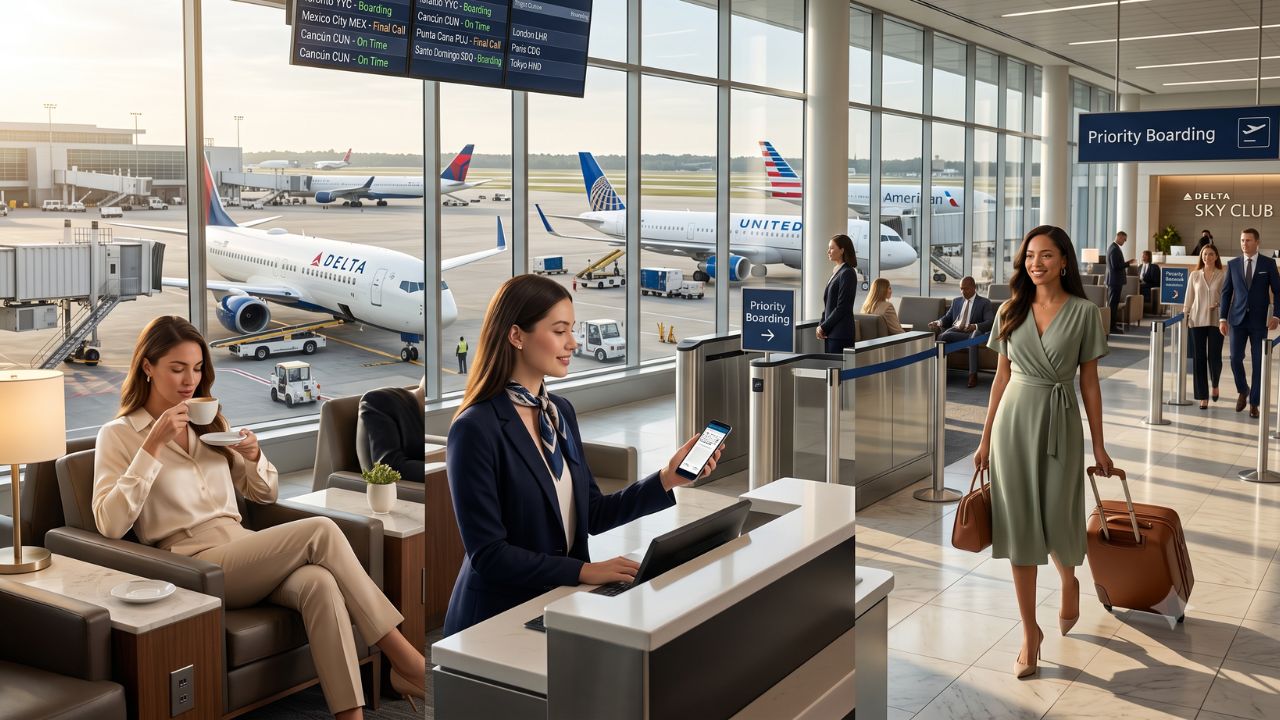
Image generated by AI
[New York, July 8, 2026] — A fundamental shift is transforming the North American aviation market as legacy carriers expand their premium travel services. Airlines are investing heavily in larger business and premium economy cabins, VIP lounges, and fast-track security access. The trend is reshaping the travel experience across the United States, Canada, Mexico, and the Dominican Republic.
Industry observers note that carriers are prioritizing high-value customers who purchase premium fares and premium credit cards. This focus on luxury services represents a major shift in how airlines generate profits. Instead of relying solely on high-density economy seating, carriers are finding stronger returns in the premium travel segment.
For passengers, this means that future aircraft cabins will look different, with more floor space allocated to premium seats. Budget travelers may face fewer included benefits as carriers establish a clear distinction between basic economy fares and premium services.
Commercial Strategy Drives Premium Airline Seat Expansion
Market trends suggest that the growth of premium leisure travel is driving this structural change. Vacationers are increasingly willing to pay extra for comfort on flights to Caribbean destinations like Punta Cana, Dominican Republic. As a result, carriers are adjusting their network schedules to deploy premium-configured aircraft on leisure routes.
Airlines have discovered that premium travelers contribute disproportionately to total flight profitability. A single business class ticket can generate equivalent revenue to multiple basic economy fares. This passenger segment also purchases lounge memberships, upgrades, and co-branded credit cards.
Consequently, airlines are moving away from fare price wars in the economy cabin. Instead, they are competing on the quality of their onboard catering, seat privacy, and airport terminal amenities.
Delta Air Lines Capitalizes on Loyalty and Corporate Demand
Our analysis of the flight data indicates that Delta Air Lines continues to lead the industry in premium revenue generation. Delta reported record revenue of $14.2 billion for the first quarter of 2026, marking a 9.4% increase year-on-year. The airline attributed this growth to premium cabin ticket sales and corporate travel demand.
Delta is expanding its network of premium lounges, introducing dedicated business class facilities at major hub airports. The carrier's premium push is designed to create a seamless journey from check-in to arrival.
By investing in high-end airport services, Delta aims to capture a larger share of the corporate travel budget. The carrier is also targeting high-income leisure travelers who value premium airport terminal lounges and expedited boarding.
United Airlines Premium Growth Outpaces Basic Economy
United Airlines is also recording strong revenue gains from its premium passenger segment. The airline reported that premium revenue rose 14% in the first quarter of 2026 compared with the same period in 2025. Loyalty program revenue also grew by 13% during the same timeframe.
In contrast, United's Basic Economy revenue rose by 7%, showing that premium classes are growing at double the rate of economy fares. The airline's premium strategy is particularly focused on long-haul international routes.
For international travelers, United is upgrading its long-haul business cabins and expanding its airport lounges. The carrier aims to build brand loyalty among frequent flyers who prioritize comfort and priority services on transoceanic flights.
American Airlines Retrofits Narrowbody Fleets for Premium Cabins
American Airlines is demonstrating its commitment to premium travel through an extensive fleet cabin retrofit program. The carrier is upgrading its domestic narrowbody fleet to increase the number of premium seats.
American plans to increase the premium cabin capacity on its Airbus A319 aircraft to 12 seats. The carrier's Airbus A320 aircraft will be retrofitted to feature 16 premium cabin seats. The upgrades will include privacy wings, larger overhead bins, and additional personal storage.
These retrofits ensure that premium passengers experience upgraded comfort on short-haul domestic and regional routes. This strategy allows American to offer consistent premium services across both its domestic and international networks.
North American and Caribbean Cross-Border Luxury Travel Flows
The shift toward premium aviation services is heavily impacting travel corridors connecting the United States with Canada, Mexico, and the Dominican Republic. Canada and Mexico represent the largest cross-border markets for U.S. carriers. Business and leisure travelers in these markets frequently connect through major U.S. hubs.
The Dominican Republic has emerged as a key destination for premium leisure travelers. Vacationers heading to resorts are increasingly upgrading to premium cabins. This has led airlines to deploy aircraft with larger premium sections on flights to the Caribbean.
Airlines are adjusting their loyalty programs to reward these high-spending passengers. Elite status qualifications are increasingly tied to total travel spending rather than miles flown.
U.S. Carrier Premium Strategies and Financial Indicators
| Airline | Verified Premium Strategy | What It Means for Travellers |
|---|---|---|
| Delta Air Lines | Record Q1 2026 revenue of $14.2 billion, led by premium, corporate and loyalty demand | More focus on premium cabins, lounge value and loyalty-led travel |
| United Airlines | Premium revenue up 14% and loyalty revenue up 13% in Q1 2026 | More attention on high-spending, brand-loyal travellers |
| American Airlines | A319 premium cabin rising to 12 seats and A320 premium cabin rising to 16 seats | More premium seats on shorter and domestic aircraft |
Key Takeaways
- Premium expansion: Delta, United, and American Airlines are expanding premium seating and airport services.
- Revenue growth: United reported a 14% increase in premium revenue, while Delta achieved record Q1 revenue.
- Narrowbody retrofits: American is retrofitting Airbus A319 and A320 aircraft to add more premium seats.
- Cross-border impact: The luxury travel trend affects key routes to Canada, Mexico, and the Dominican Republic.
- Loyalty shift: Airlines are aligning loyalty programs to reward high-spending premium passengers.
Why This Matters
Our analysis of the flight data indicates that the premium travel boom represents a structural change in airline economics. Legacy airlines are allocating more cabin space to premium economy and business class. This reduce the number of standard economy seats available, which can put upward pressure on basic economy fares.
Furthermore, narrowbody aircraft retrofits indicate that airlines want to offer a consistent premium experience on short regional flights. Passengers connecting from international business class expect similar comfort on domestic connecting segments. Increasing premium seats on Airbus A319 and A320 aircraft addresses this gap.
For leisure travelers, this trend changes the value of airline loyalty programs. Because elite status is increasingly tied to total travel spending, budget travelers may find it harder to earn upgrades. This shift encourages travelers to buy premium seats upfront rather than relying on loyalty upgrades.
Industry Outlook
Market trends suggest that airlines will continue to invest in premium lounge networks and private airport check-in areas. Expect carriers to develop more personalized onboard products, including high-speed internet and custom dining. In the short term, carriers will focus on completing narrowbody cabin retrofits to meet the high demand for premium seats.
FAQ
Why are U.S. airlines expanding their premium cabins? Airlines are focusing on premium cabins because high-spending travelers generate stronger revenue margins through premium fares, upgrades, and co-branded credit card spending.
How is American Airlines updating its domestic fleet? American Airlines is retrofitting its Airbus A319 and A320 aircraft to increase premium seating to 12 and 16 seats, respectively, while adding larger overhead bins and privacy features.
Will this premium shift affect economy class passengers? Yes. Economy class passengers may see fewer available seats and fewer included benefits, as airlines create a greater distinction between basic economy and premium experiences.
Are leisure routes to Mexico and the Caribbean included in this trend? Yes. Premium leisure demand is growing on routes to Mexico and the Dominican Republic, prompting carriers to deploy premium-configured aircraft on vacation routes.
Related Travel Guides
- JFK Airport Flight Cancellations: Airspace Reductions and Severe Weather Disrupt Transatlantic Summer Travel Coordinated by Delta and JetBlue
- Boston Logan International Airport Delays Mount as Airspace Volume and Air Traffic Control Initiatives Constrain New England Flights
- Miami International Airport Flight Cancellations: American, Delta, United, and Envoy Air Suspend Key Domestic and Caracas Routes
Disclaimer
This article is for informational and educational purposes only. It does not constitute legal, financial, or professional advice. While we strive to provide accurate and up-to-date information, travel policies, regulations, and conditions change rapidly. Always verify information with official sources before making travel decisions. Nomad Lawyer makes no representations about the accuracy, reliability, completeness, or suitability of the information provided. Readers should consult qualified professionals for advice specific to their circumstances. The views expressed in this article are those of the author and do not necessarily reflect the views of Nomad Lawyer.
Kunal K Choudhary
Co-Founder & Contributor
A passionate traveller and tech enthusiast. Kunal contributes to the vision and growth of Nomad Lawyer, bringing fresh perspectives and driving the community forward.
Learn more about our team →