
Aviation Updates: United Airlines Jet Barely Misses Rogue Drone Near Newark, FAA Investigates Impending Travel Chaos
A terrifying close-call drone encounter during final approach at Newark Airport sparks a massive FAA investigation as unauthorized airspace incursions threaten catastrophic airport disruptions.

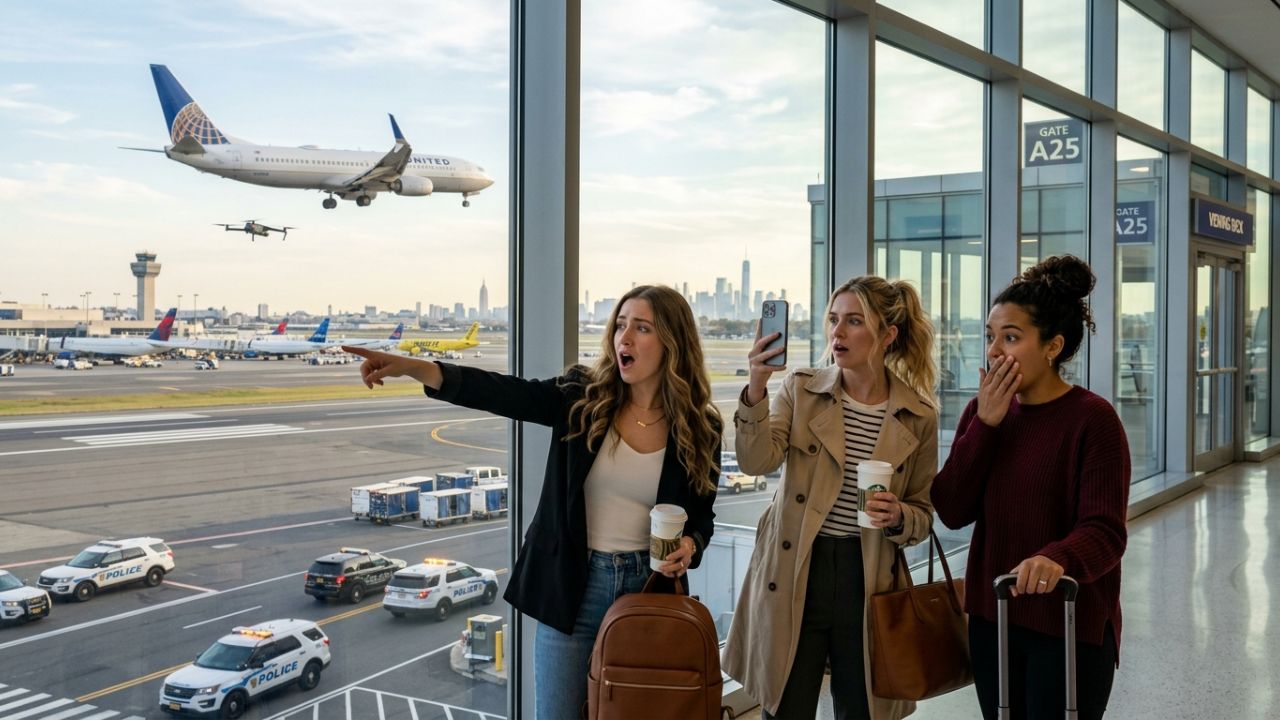
Image generated by AI
Aviation Updates: United Airlines Jet Barely Misses Rogue Drone Near Newark, FAA Investigates Impending Travel Chaos
In a terrifying incident that highlights the extreme vulnerability of heavily congested US airspace, a United Airlines Boeing 737 narrowly avoided a catastrophic mid-air collision with a rogue drone during its final descent into Newark, instantly triggering a massive federal safety investigation.
Image generated by AI
As urgent airline news portals and critical aviation updates relentlessly monitor the escalating threats facing domestic US airspace, a horrifying near-miss incident has just dramatically renewed scrutiny on unregulated aviation hazards. On Friday, June 26, United States travel safety was violently challenged when a United Airlines passenger jet reported a terrifyingly close drone encounter during its highly sensitive final approach into Newark Liberty International Airport. United Airlines Flight 1513, arriving from Key West, was executing a routine descent when the cockpit crew suddenly spotted a rogue, unauthorized drone operating dangerously close to the aircraft's flight path. While the Boeing 737—carrying 106 passengers and five crew members—successfully landed without physical impact, the incident acts as a massive, glaring warning. Aviation authorities explicitly warn that unauthorized drone incursions are no longer just a technical nuisance; they are a profound threat capable of triggering massive, cascading travel chaos, forcing emergency runway closures, severe airport disruptions, and massive waves of systemic flight cancellations across the entire Eastern Seaboard.
Expanded Overview: The Hidden Threat in the Approach Corridor
When analyzing the massive operational complexity of modern aviation, unauthorized drone activity represents the absolute highest unpredictable external threat to passenger safety.
During final approach, an aircraft is heavily committed to its descent profile. The aircraft is operating at critically low altitudes, heavily reduced speeds, and incredibly tight spacing margins between other commercial jets. At a massive mega-hub like Newark, this environment becomes exponentially more complex due to intensely dense surrounding urban infrastructure. When a rogue drone suddenly appears in this highly restricted zone, it creates terrifyingly limited reaction time for pilots. Even a small consumer drone can instantly become a catastrophic weapon if ingested by a massive commercial jet engine or if it shatters a cockpit windshield at high speed. A single confirmed strike would instantly paralyze the airport, trapping thousands of passengers in an agonizing web of massive systemic delays.
Section-Wise Breakdown: The Newark Airspace Incursion
The specific sequence of events on Friday highlights exactly how quickly an external threat can violate strictly controlled commercial airspace.
As Flight 1513 descended from Key West into the notoriously busy New Jersey airspace, the highly trained United Airlines crew suddenly identified a circular drone, estimated to be roughly three feet wide, hovering a terrifying 100 feet directly below their Boeing 737. This proximity is absolutely critical; at 100 feet, standard evasive maneuvers are incredibly dangerous due to the aircraft's low altitude and low speed on final approach. Disturbingly, reports also immediately surfaced noting a completely separate drone sighting from a different United Express flight crew operating near Newark, heavily suggesting a massive, coordinated breach or a horrifying lack of airspace discipline within the critical approach corridor.
Section-Wise Breakdown: Cockpit Professionalism Prevails
Despite the terrifying intrusion, the absolute professionalism of the flight crew ensured that panic never reached the passenger cabin.
Final approach requires intense, heavily coordinated calculations. Pilots are simultaneously managing complex descent rates, navigation arrays, radio communication, and precise runway alignment. The sudden appearance of a drone introduces a massive, unpredictable variable outside standard aviation planning. The United Airlines pilots flawlessly maintained absolute stability, executing a smooth, completely safe landing. The 106 passengers deplaned normally, entirely unaware of the high-stakes technical alert unfolding in real-time. Following the landing, the crew immediately filed mandatory incident reports, instantly prompting the Federal Aviation Administration (FAA) to launch a massive, high-priority safety investigation to hunt down the illegal operator.
Flight Details: United Airlines Flight 1513 Drone Incident Matrix
The exact operational telemetry outlining this highly dangerous near-miss, detailing the specific aircraft load and precise drone proximity, has been consolidated into the mandatory matrix below.
United Airlines Flight 1513 Incident Matrix
| Incident Parameter | Verified Aviation Data |
|---|---|
| Operating Carrier / Flight | United Airlines Flight 1513 |
| Aircraft Type | Boeing 737 (Narrow-body commercial jet) |
| Flight Route | Key West to Newark Liberty International Airport |
| Passenger & Crew Load | 106 passengers, 5 crew members |
| Encounter Location | Final approach corridor into Newark |
| Drone Description | Circular, approximately three feet wide |
| Proximity to Aircraft | Approximately 100 feet below the Boeing 737 |
| Official Outcome | Safe landing, no physical impact, FAA investigation launched |
Passenger Impact: The Threat of Immediate Gridlock
While the passengers onboard Flight 1513 survived a terrifying near-miss without even realizing it, the broader threat to the traveling public is massive.
Newark Liberty International Airport serves as a massive, absolutely critical pillar of the United States travel network. If air traffic controllers are forced to aggressively react to a confirmed drone threat, they must immediately suspend arrivals and heavily increase spacing between airborne flights. This rapid defensive action instantly creates massive downstream congestion. A single unreported drone can instantly paralyze airline rotation schedules, destroy crew duty timing, and force massive airborne holding patterns. For the business traveler, tourist, or transit passenger, this directly translates into missed connections, agonizing tarmac delays, and the horrifying reality of total airport gridlock.
Industry Analysis: Enforcing the Invisible Boundary
Aviation security experts explicitly warn that regulatory agencies must aggressively escalate enforcement against unauthorized drone operations.
The FAA already heavily enforces strict rules prohibiting unmanned aircraft systems near commercial airports. However, FAA data continues to show a terrifying frequency of drone sightings nationwide, particularly in highly vulnerable low-altitude departure and approach corridors. Authorities continually stress that unauthorized drones must absolutely remain clear of these highly restricted zones. As consumer drone technology becomes increasingly accessible and capable of higher altitudes, aviation authorities are being forced to aggressively deploy advanced terrestrial detection systems and enact massive legal penalties to protect airport workers, emergency services, and the flying public from catastrophic negligence.
Conclusion: Securing the Final Approach
Ultimately, the terrifying near-miss involving United Airlines Flight 1513 at Newark is a massive, highly critical warning for the entire global aviation sector. While the exceptional skill of the Boeing 737 crew flawlessly averted disaster, the incident powerfully demonstrates how quickly a rogue consumer drone can threaten the lives of 111 people onboard. As the FAA intensely investigates this massive breach of airspace discipline, the event stands as undeniable proof that preventing catastrophic travel chaos requires absolute, zero-tolerance enforcement of drone regulations. Passenger safety relies on an incredibly tightly controlled environment; any unauthorized object that pierces that invisible boundary is a profound threat to the entire United States aviation network.
Key Takeaways
- Terrifying Near-Miss: United Airlines Flight 1513 reported a highly dangerous drone encounter during its final approach into Newark on Friday, June 26.
- Extreme Proximity: Pilots visually identified a circular drone, roughly three feet wide, operating just 100 feet below the Boeing 737.
- Massive Potential Risk: The unauthorized drone severely threatened the safety of the 106 passengers and five crew members onboard.
- Multiple Incursions: A separate United Express crew also reported a highly concerning drone sighting near the Newark approach corridor.
- FAA Investigation Launched: The Federal Aviation Administration has aggressively opened a formal investigation to identify the illegal operator and secure the airspace.
FAQ: United Airlines Newark Drone Incident
How close was the drone to the United Airlines flight? According to the official flight crew reports, the unauthorized, three-foot-wide circular drone was spotted hovering a terrifyingly close 100 feet directly below the Boeing 737.
Were any passengers injured during the drone encounter? No. Thanks to the absolute professionalism of the flight crew, the aircraft successfully maintained its approach profile and landed safely, allowing all 106 passengers to deplane normally without injury.
What is the FAA doing about the drone sighting at Newark? The Federal Aviation Administration has aggressively launched a massive formal safety inquiry to investigate the airspace breach and identify the unauthorized drone operator.
Related Travel Guides
Cathay Pacific Melbourne Paris Baggage Delay Travel Chaos 2026
United Airlines Denver Turks and Caicos Flights Travel Chaos 2026
North America Regional Flight Disruption Survival Guide 2026
Disclaimer: This article is strictly for informational purposes. The aviation incident data, specific flight routing (United Airlines Flight 1513 from Key West to Newark), aircraft details (Boeing 737 with 106 passengers and 5 crew), the precise date (Friday, June 26), and the estimated proximity of the drone (100 feet below) are based on pilot reports and official FAA investigation disclosures available at the time of publication. Airspace safety regulations, formal drone operating restrictions, and specific federal enforcement actions are highly dynamic and subject to strict federal law. Passengers are strongly encouraged to immediately report any suspicious drone activity near major airports to local authorities to protect the safety of the commercial aviation network.
Disclaimer
This article is for informational and educational purposes only. It does not constitute legal, financial, or professional advice. While we strive to provide accurate and up-to-date information, travel policies, regulations, and conditions change rapidly. Always verify information with official sources before making travel decisions. Nomad Lawyer makes no representations about the accuracy, reliability, completeness, or suitability of the information provided. Readers should consult qualified professionals for advice specific to their circumstances. The views expressed in this article are those of the author and do not necessarily reflect the views of Nomad Lawyer.
Preeti Gunjan
Contributor & Community Manager
A passionate traveller and community builder. Preeti helps grow the Nomad Lawyer community, fostering engagement and bringing the reader experience to life.
Learn more about our team →