
United Airlines Flight UA2 Makes Emergency Landing at Singapore Changi
United Airlines Boeing 787-9 flight UA2 from Singapore to San Francisco was forced to make an emergency landing due to a severe electrical odor in the cabin.

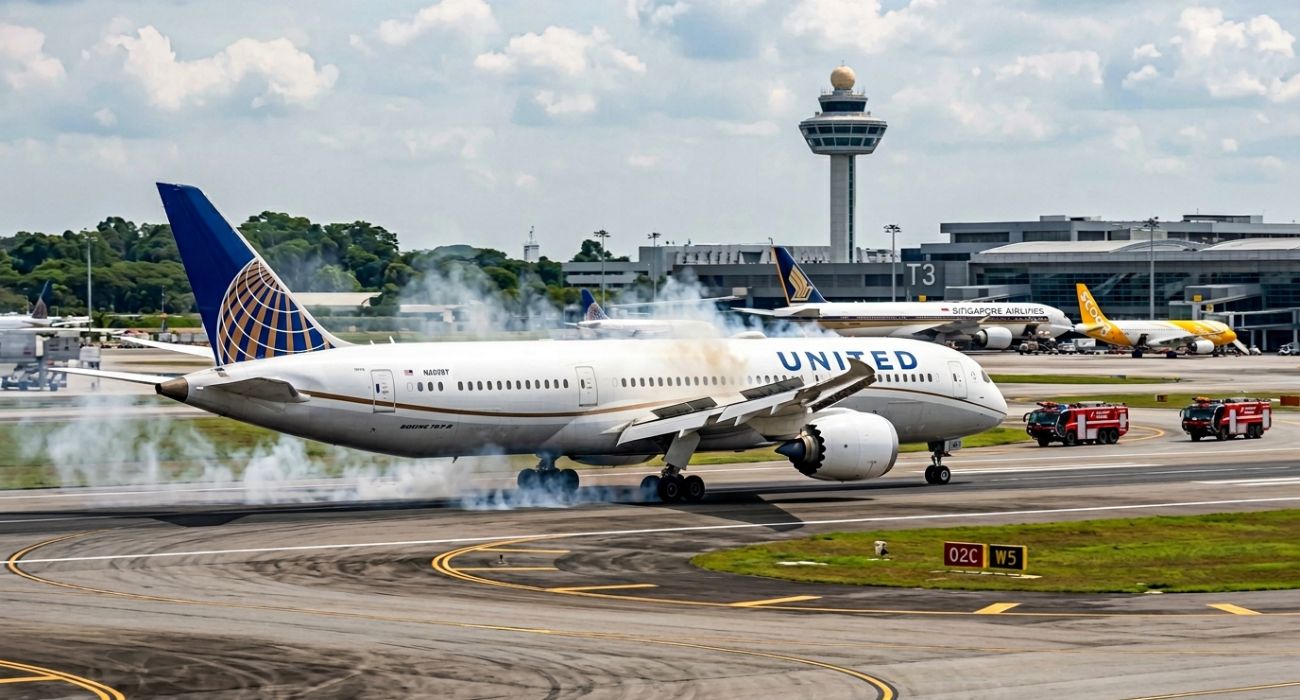
Image generated by AI
Breaking: United Airlines Boeing 787-9 Dreamliner Flight UA2 Makes Dramatic Emergency Landing at Singapore Changi After Electrical Odor Sparks Mid-Air Crisis
A severe electrical odor forces an immediate mid-air diversion, triggering fuel dumping procedures over the South China Sea to ensure the safety of 212 passengers on a long-haul flight bound for San Francisco.
A highly concerning mid-air emergency unfolded on the morning of April 24, 2026, when United Airlines flight UA2 was forced to abort its long-haul journey and make an emergency landing at Singapore Changi Airport. The Boeing 787-9 Dreamliner, which was fully loaded and bound for San Francisco International Airport (SFO), experienced a severe technical anomaly just 45 minutes after departure. A distinct, alarming odor—described by those on board as electrical or burning in nature—began filtering through the cabin air vents, prompting the flight crew to enact immediate, critical safety protocols to protect the 212 passengers and 15 crew members onboard.
This unexpected aviation crisis highlights the extreme precision and rigorous training required to safely operate widebody commercial aircraft over vast oceanic routes. The swift decision to prioritize passenger safety over operational continuity serves as a stark reminder of the unpredictable nature of global travel and the indispensable value of strictly enforced aviation safety standards.
EXPANDED OVERVIEW: The Mid-Air Anomaly
The incident began shortly after United Airlines flight UA2 lifted off from Singapore Changi Airport at approximately 9:30 a.m. local time. The aircraft, a state-of-the-art Boeing 787-9 Dreamliner, was scheduled to complete a grueling 15-hour transpacific crossing to San Francisco.
However, as the aircraft ascended into the early phases of its cruise altitude, the situation quickly deteriorated. Crew members and passengers detected a strong, unmistakable smell of burning electrical components emanating from the cabin's ventilation system. In commercial aviation, an unidentified burning odor is treated as a critical "red flag" event that requires immediate intervention, as it can indicate overheating wiring or impending electrical failure.
Acting with absolute precision, the pilots declared a formal in-flight emergency. Realizing that a 15-hour flight across the Pacific Ocean with a potential electrical fire hazard was entirely out of the question, the captain made the decisive call to abort the mission and safely route the massive Dreamliner back to its origin point.
SECTION-WISE BREAKDOWN: The Emergency Sequence
Departure from Singapore Changi
The morning departure appeared entirely routine as the Dreamliner pushed back from the gate at Singapore Changi Airport. Cleared for a heavy, fuel-laden takeoff suited for the long transpacific journey, the aircraft climbed out over the ocean. Within the first 45 minutes, the critical systems monitoring the cabin atmosphere relayed the first signs of trouble via the strong odor.
Fuel Dumping Over the South China Sea
Because the Boeing 787-9 had just taken off with enough fuel to reach California, it was significantly overweight for a safe landing. To prevent structural damage to the aircraft's landing gear upon touchdown, the pilots initiated a highly coordinated fuel dumping procedure. For approximately 10 minutes, the massive jet circled over the designated dumping zones of the South China Sea, carefully releasing thousands of gallons of aviation fuel to reach a safe maximum landing weight.
Safe Return and Ground Response
Following the successful fuel jettison, the aircraft re-approached Singapore Changi Airport. Aviation tracking platforms logged the aircraft's return to the tarmac at approximately 10:15 a.m. local time. Emergency response vehicles and ground crews were already staged and on full standby, flanking the runway to inspect the aircraft immediately upon touchdown. Fortunately, an emergency evacuation was not required, and all passengers remained safely in their seats while the jet was thoroughly secured.
FLIGHT DETAILS AND INCIDENT DATA
The precise details of the aborted flight have been logged and confirmed by aviation monitoring agencies:
- Flight Designation: UA2
- Operating Airline: United Airlines
- Aircraft Model: Boeing 787-9 Dreamliner
- Origin Hub: Singapore Changi Airport (SIN)
- Intended Destination: San Francisco International Airport (SFO)
Official Incident Snapshot
| Incident Metric | Factual Data |
|---|---|
| Airline | United Airlines |
| Flight Number | UA2 |
| Aircraft Type | Boeing 787-9 Dreamliner |
| Route | Singapore (SIN) to San Francisco (SFO) |
| Date of Incident | April 24, 2026 |
| Departure Time | Approx. 9:30 a.m. Local Time |
| Time of Return | Approx. 10:15 a.m. Local Time |
| Passengers Onboard | 212 |
| Crew Onboard | 15 |
| Primary Issue | Electrical/Burning Odor in Cabin Vents |
PASSENGER IMPACT: Travel Chaos and Rebooking
The immediate aftermath of the emergency landing triggered significant travel disruptions for the 212 passengers onboard. Following the safe arrival back at Changi Airport, the aircraft was immediately grounded and pulled out of service for extensive mechanical inspections. Consequently, United Airlines officially canceled flight UA2 for the day.
While the passengers avoided physical injury, the logistical nightmare of a canceled 15-hour long-haul flight immediately set in. Missed connecting flights in San Francisco caused massive ripple effects for those attempting to reach destinations across the United States. United Airlines mobilized its ground teams in Singapore to assist with the massive rebooking effort. Passengers were provided with alternative flight options, utilizing both later United Airlines services and partner carrier networks to resume their journeys. Standard compensation protocols, including overnight accommodations and meal vouchers, were likely triggered to assist the stranded travelers.
INDUSTRY ANALYSIS: The Risks of Electrical Anomalies
In modern aviation, an electrical odor is one of the most rigorously investigated anomalies. The Boeing 787-9 Dreamliner is heavily reliant on advanced, high-voltage electrical systems that power everything from cabin pressurization to anti-icing mechanisms, moving away from the traditional pneumatic bleed-air systems used in older jets.
Aviation experts emphasize that any smell of burning components could theoretically point to overheating lithium-ion batteries, short-circuiting wiring harnesses, or malfunctioning galley equipment. If an electrical fire were to ignite mid-flight over the Pacific Ocean—hours away from a diversion airport—the consequences could be catastrophic. Therefore, United Airlines' highly conservative decision to immediately return the aircraft to a major hub like Singapore Changi was the absolute correct operational choice, universally praised by industry safety analysts.
CONCLUSION: A Testament to Aviation Safety
While the cancellation of flight UA2 resulted in undeniable travel chaos for the passengers, the incident stands as a powerful testament to the effectiveness of modern aviation safety protocols. The seamless coordination between the United Airlines flight crew, the air traffic controllers, and the emergency ground response teams at Singapore Changi Airport ensured that a potentially dangerous situation was entirely defused without a single injury. As investigators work to identify the exact source of the electrical odor, the grounded Boeing 787-9 will remain out of service, ensuring the continued integrity of the global fleet.
KEY TAKEAWAYS
- Immediate Diversion: United Airlines flight UA2 was forced to return to Singapore Changi Airport just 45 minutes into its journey to San Francisco.
- Technical Trigger: A severe electrical and burning odor was detected emanating from the cabin air vents, prompting an official emergency declaration.
- Fuel Dumping: The pilots safely jettisoned fuel over the South China Sea for 10 minutes to reach a safe landing weight.
- Total Safety: All 212 passengers and 15 crew members landed safely at approximately 10:15 a.m. local time with zero reported injuries.
- Flight Cancellation: The Boeing 787-9 Dreamliner was taken completely out of service for mechanical inspection, resulting in massive rebooking efforts for affected travelers.
Disclaimer
This article is for informational and educational purposes only. It does not constitute legal, financial, or professional advice. While we strive to provide accurate and up-to-date information, travel policies, regulations, and conditions change rapidly. Always verify information with official sources before making travel decisions. Nomad Lawyer makes no representations about the accuracy, reliability, completeness, or suitability of the information provided. Readers should consult qualified professionals for advice specific to their circumstances. The views expressed in this article are those of the author and do not necessarily reflect the views of Nomad Lawyer.
Kunal K Choudhary
Co-Founder & Contributor
A passionate traveller and tech enthusiast. Kunal contributes to the vision and growth of Nomad Lawyer, bringing fresh perspectives and driving the community forward.
Learn more about our team →